TY @mackinprof for keeping it relevant and real when it comes to protein recommendations. Muscle gain is not the powder, pill or protein enhanced foods but more importantly high quality food choices in appropriate amounts paired with resistance.
Resistance training is resistance training—or is it?
There’s nothing easier than zoning out, listening to music, or otherwise distracting yourself while at the gym. But are there benefits to locking in and focusing on the exercise itself?
“We know that the latter has a better effect on how well your muscles are activated,” says Stu. “You can get much better at lifting the weight that’s built on neural pathways than you can if you’re just going through the motions.”
And Marty, of course, has a haiku.
Check out the rest of our episode about fitness tracking and EverMe, with special guest Gary LeBlanc, at the link below, or on Spotify, Apple Podcasts, or YouTube.
Learning ASL (American Sign Language): My Journey So Far 🤟🏾
⭐️ Taking a beginner ASL course online with a Deaf instructor has been an incredible experience! Beyond learning the basics and practicing fingerspelling out in the community, I’ve gained a deeper appreciation for ASL history, culture, and how we can make fitness and everyday spaces more inclusive and accessible for everyone.
📚 Still just getting started, and excited to keep learning!
#ASL #LearnASL #AmericanSignLanguage #DeafCommunity #Accessibility #InclusiveFitness #HealthEquity #Coach #Boston #CommunityBuilding #EMT #IDD #Autism #Neurodivergent #Diversity
“Functional training” has become an overused buzzword in the fitness industry, often associated with exercises that challenge balance, involve unstable surfaces, engage multiple joints, or mimic everyday movements. While these approaches make good for clickbait marketing hype, do they actually make an exercise more functional?
To help clarify this widely misunderstood concept, I collaborated with an international team of experts to develop a consensus definition of functional training using a modified Delphi approach (PMID: 40102701).
We settled on a few main themes:
1. Functional training is goal-dependent. An exercise is functional to the extent that it helps an individual achieve a desired outcome, whether in sports, daily activities, rehabilitation, or general fitness.
2. Specificity and individualization are key. The functionality of a training program depends on how well it aligns with an individual's goals, needs, and characteristics.
3. No exercise is inherently more functional than another. Squats, leg presses, machines, and free weights can all be functional depending on the intended purpose. The equipment or complexity of a movement does not determine its functionality.
4. The term itself may be redundant. Virtually every member of our expert panel raised concerns that “functional training” overlaps with the broader concept of training itself. Every well-designed training program should have a specific purpose, making the distinction between “functional” and “traditional” training largely unnecessary.
Bottom line: Rather than labeling exercises as “functional” or “nonfunctional,” it is more appropriate to view functionality along a continuum based on how well a training program aligns with an individual’s goals and needs. For most people in the general population, a basic resistance training program focused on building strength will likely be sufficient to improve their ability to perform everyday activities. There’s no need to overcomplicate things with elaborate exercises marketed as “functional.”
https://t.co/su9j3TyMIS
What’s a strong VO2 max for my age?
VO2 max is the maximum amount of oxygen your body can take in, transport, and use during intense exercise. Naturally, this number tends to decrease with age. But in the fourth episode from Exercise Science’s first season, @gibalam and @mackinprof went under the hood with science on VO2 max. What they found might surprise you.
“We can have people in their 80s who are well above the adult average,” Marty tells Stu.
What’s your VO2 max?
Check out the full VO2 max episode and the rest of season one at the link below, or wherever you get your podcasts. Stay tuned for season two coming soon.
https://t.co/nHaFb7EM1q The 1.6 g/kg/day figure rests on the same outcome and is defended as sufficiency, the intake above which no benefit has been shown, rather than as a measured ceiling. An intake of 1.6 g/kg/day appears sufficient, and the trials needed to show otherwise are described.
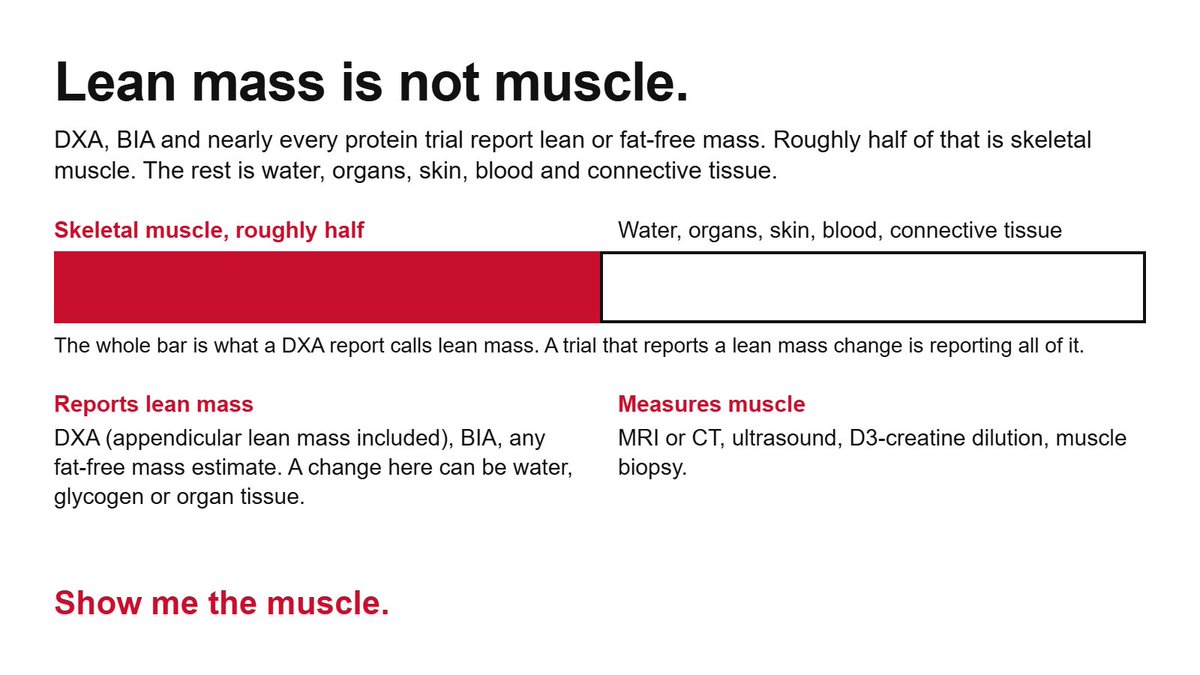
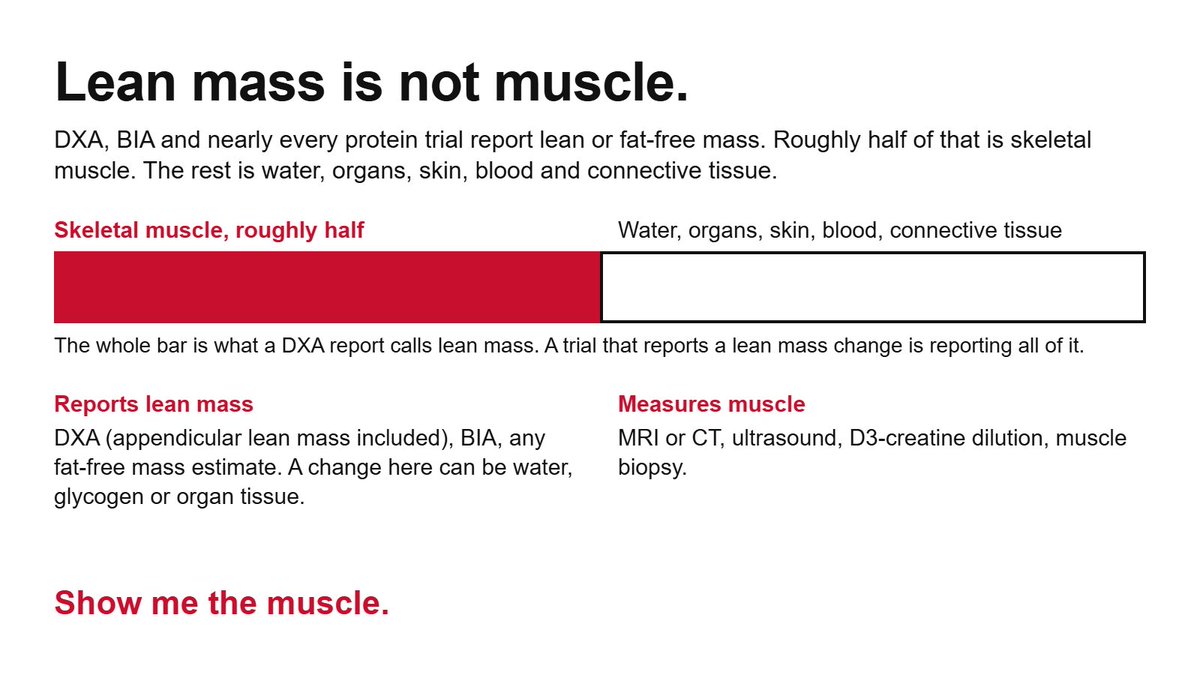
Agreed on both counts. Lean mass is not muscle. What DXA calls lean mass is muscle plus water, organs, skin and connective tissue, and a change in lean mass after a diet or a protein supplement tells you very little about how much actual muscle moved. See below.
1/ 1.6 g protein/kg/d (0.7 g/lb) still does it. The case for more rests on a measurement that's about half NOT muscle. New preprint. 10 points, the first at my own expense.
https://t.co/nHaFb7EM1q The 1.6 g/kg/day figure rests on the same outcome and is defended as sufficiency, the intake above which no benefit has been shown, rather than as a measured ceiling. An intake of 1.6 g/kg/day appears sufficient, and the trials needed to show otherwise are described.
Agreed on both counts. Lean mass is not muscle. What DXA calls lean mass is muscle plus water, organs, skin and connective tissue, and a change in lean mass after a diet or a protein supplement tells you very little about how much actual muscle moved. See below.
@mackinprof A visual separating lean mass from measured muscle would help readers interpret protein headlines. Keeping the population, measurement method and preprint status alongside quoted numbers could prevent a research estimate becoming a universal prescription.
Here's my prediction. Ten years from now, even with these guidelines in place, if every American hit 1.2 to 1.6 (and plenty already do), nobody would be much healthier. Protein is great. It is not a magic nutrient. https://t.co/ZLeAOC1zyP
You can’t fix a protein deficiency that doesn’t exist. The US protein target (1.2 to 1.6 g/kg/day) rests on 30 trials of dieting adults with obesity, applied to everyone, with no link to exercise. Ten years on, nobody will be much healthier. Protein is great. It is not magic.
More protein for muscle with no training is like delivering bricks to a site with no bricklayer. The Perspective touches on this. IMO, it deserves its own section.