One the saddest realizations for me when we were scaling the @midjourney server at @discord in ‘22 was seeing millions of US gen z kids struggle to prompt
They literally don’t have the words. Broken english. Pidgin lingo. Translating thought to language is insanely hard for them
„That 12 Americans could sit in judgment of the former and potentially future president is a remarkable display of the democratic principles that Americans prize at work.“ https://t.co/vc7vDQN0uA
This city is not in Italy, France, or Germany.
It's in China and it's less than ten years old.
This is Huawei's R&D Headquarters, where 25,000 people work, and it might just be the most interesting office building(s) in the world...
1/2 Das letzte Interview hat Wolfgang #Schäuble vor wenigen Tagen meinem Kollegen Jacques Schuster gegeben. Es ist in der Weihnachtsausgabe der @WELTAMSONNTAG erschienen. Ein typisches, ja klassisches Schäuble-Gespräch, insofern er tagespolitische ...
https://t.co/wY60xzCIPJ
Because the TikTok narrative is now so anti-Israel, the engagement flywheel encourages creators to support that narrative because it’s getting the most attention and creating anti-Israel content helps them increase their following.
Ich kann nur davor warnen, dass es eine Hoffnung gibt, dass eine Wagenknecht-Partei das rechte AfD-Lager schwächen würde, das Gegenteil ist der Fall.
#Thread
Durch die konsequente Politik einer zunehmenden Bildungsferne von Naturwissenschaft und dem gleichzeitigen Fördern
1/
@shop Hi there! I just discovered that the invoice-export feature isn’t working for me. It’s only generating a PDF with the date and no other text. I’ve tried looking for help but can’t find any. 😕 Could you please point me in the right direction/ offer some suggestions? Thanks!
A Brief Overview of Time Blocking
Since my Time Block Dad post went viral last weekend, I wanted to share a quick overview of how the principle works (at least for me).
Time blocking, time boxing, calendar blocking is a great way to make sure you're getting the right tasks done at the right time.
I first learned about time blocking from Cal Newport in his book Deep Work, but it's a widely used productivity principle that Founding Father Benjamin Franklin popularized hundreds of years ago.
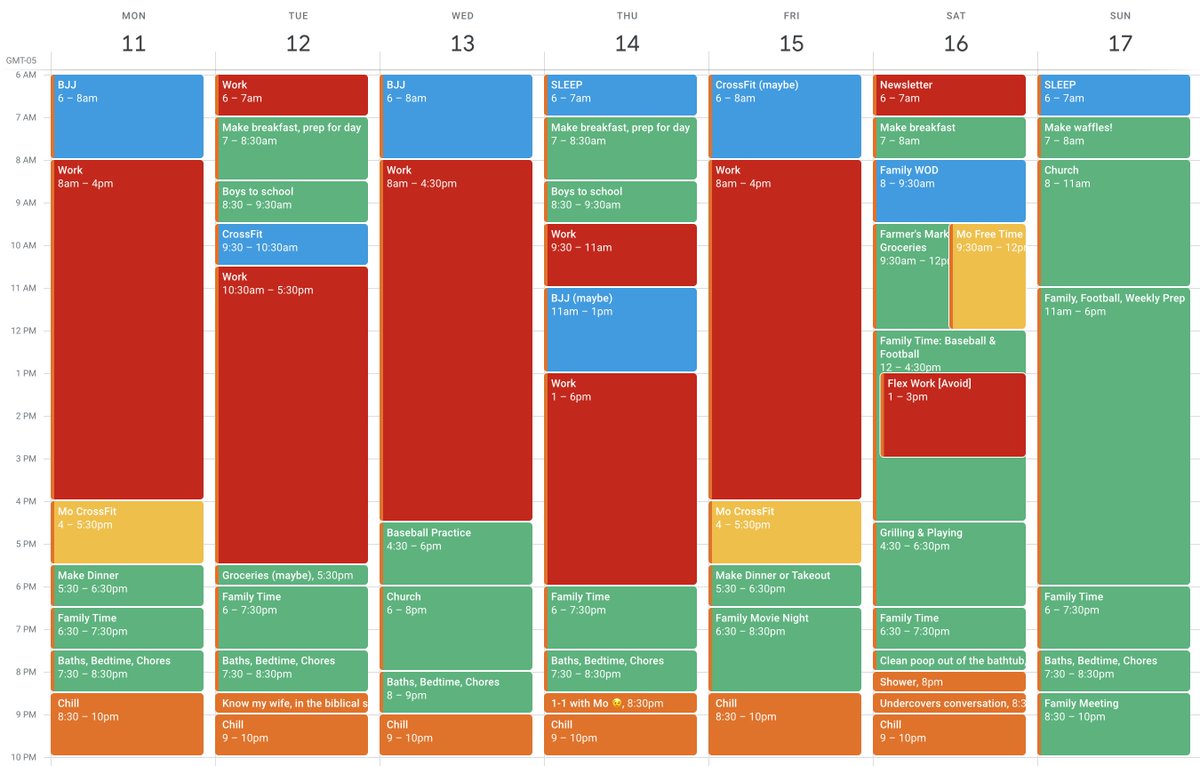
You can time block for an entire day or for a single block to focus on something important. Again, here's my schedule for reference:
So as you plan the upcoming week, try time blocking your days in two ways.
The first is to give each day a set of pre-planned blocks to help keep you on track.
I promise the first week is going to feel a little messy, because if you’ve never done this before it’s easy to under or overestimate the time it takes to do something. But you should have a pretty good idea of what needs to happen and what’s already scheduled into the week.
The second way I want you to time block is to look at your schedule and define at least one block of time that’s just for you and something you want.
It could be a project you’re working on, like I am with the podcast, a health goal, a hobby, time to read - whatever. Define your time for it and block it off.
You should be able to block off that time with a clear mind and confidence, because everything else is blocked off too!
I’d love to hear from you on the results of time blocking, and if you think it helps at all. Thanks for reading!
US Senator and war hero John McCain passed away five years ago on this day. He was one of the few who predicted exactly how Putin was planning to "rebuild the Soviet empire".
The video below is from an 2014 interview:
What the hell is an ampersand and why does it look like that?!
The first thing you need to know is that "&" used to be the 27th letter of the alphabet...
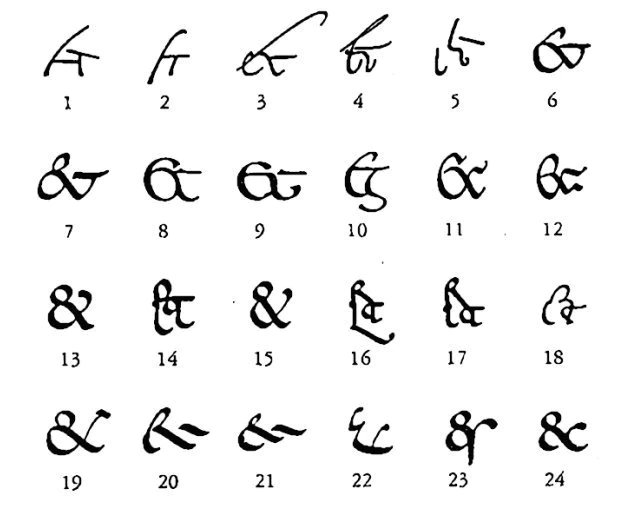
But there are three parts to this story. And the first begins over two thousand years ago in Ancient Rome with a single word: et. It's the Latin for "and". At some point Roman scribes started combining the two letters of et into a single symbol, which was the ancestor of our modern &.
The earliest example of the "et" symbol is actually from graffiti in Pompeii. In any case, it did not disappear with the fall of the Roman Empire.
Latin survived as the language of the Catholic Church and of scholarship in Medieval Europe. Scribes during the Dark Ages continued to use the & symbol. It evolved down the centuries, in places losing any semblance of the letters e and t whatsoever.
The second part of the story is that during the 18th and 19th centuries, as education and the teaching of literacy spread, & was added to the end of the alphabet as a sort of 27th letter.
On a related note, although "et cetera" is now usually just abbreviated as etc., for a long time it was instead abbreviated as "&c". The & was for et and the c for cetera.
The third and final part of the story is about how the alphabet was taught to children — and how it was read out loud.
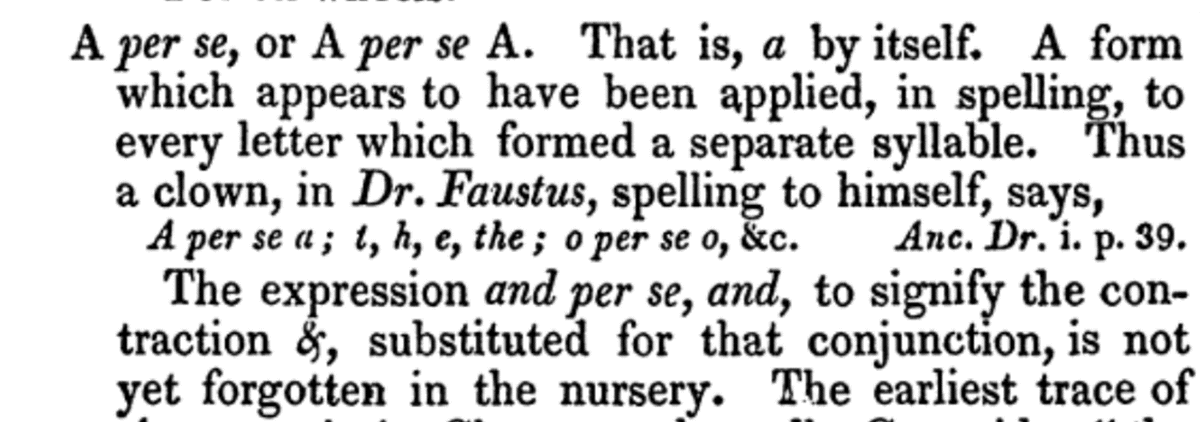
As this 1822 Glossary of Words and Phrases explains, it had been normal during the Renaissance, when speaking the alphabet, to add "per se" before any letter which could also be a word on its own — "per se" means "by itself" in Latin.
Take the letter A, which can also be a word of its own. When reading out the alphabet people would say "A, per se A, B, C, D, E, F, G, H, I, per se I..." and so on. O was also considered a word of its own.
Which means, when people got to the end of the alphabet, with & being the 27th letter, they would say: "S, T, U, V, W, X, Y, Z, and per se &."
When this old way of reading the alphabet was taught to children in the 18th century and they were reciting it aloud, they would garble "and per se " into what eventually became... ampersand.
A Dictionary of Slang and Colloquial English from 1905 relates some of the many other pronunciations school children apparently came up with:
"Ampersand. The sign &; ampersand. Variants: Ann Passy Ann; anpasty; andpassy; anparse; apersie; per-se; ampassy; am-passy-ana; ampene-and; ampus-and; ampsyand; ampazad; amsiam; ampus-end; apperse-and; empersiand; amperzed; and zumzy-zan."
Well, of all the many pronunciations that might have stuck, it was "ampersand" which came to be accepted and is now the official name for &... rather than zumzy-zan. So, from hurried Roman scribes to unruly school children, that's where "&" came from.
"The Lump of Labour fallacy is the misconception that there is a fixed amount of work to be done, and that if some work is taken by a machine then there will be less work for people." https://t.co/HztE0Tjx1Q via @matter
Day 485 of my 3 day war. Russia is invading Russia to free Russia from those who invaded Russia to free Russia from those who invaded Russia.
I remain a master strategist.