One thing I look for when identifying potential reversals is how volume is distributed within a candle.
At the lows, I want to see a red candle with the Value Area concentrated in the lower wick, while the body closes back above the VAH.
This tells me sellers pushed price lower, but couldn't get rewarded. That's the rejection I'm looking for.
I don't enter on that candle. I use it as an alert and wait for confirmation through orderflow and market structure.
The same logic applies at the highs, in reverse, when looking for a potential bearish reversal.
The goal isn't to catch the exact top or bottom. It's to identify rejection and early weakness then let the market confirm the shift.
How do we identify potential reversal zones during our trading session?
Start by identifying the direction in which price is trending. The Daily High and Daily Low are two key levels to watch. If either level is nearby during the NY session, I expect price to test it within the first hour.
If the level fails to break, I often start looking for a potential reversal setup.
Dire che Bitcoin non abbia un'utilità reale significa probabilmente non aver compreso il valore e il potenziale delle crypto. È normale che BTC attraversi fasi di correzione: non esiste un asset che salga continuamente. Bisogna capire che i mercati si muovono per cicli, con periodi di espansione e periodi di contrazione.
Lo stesso discorso vale per l'oro. È un asset che utilizzo per diversificare il rischio e proteggere il potere d'acquisto nel lungo periodo. Le correzioni fanno parte del mercato e non ne cancellano il valore. Continuo a diversificare con l'oro e continuerò a farlo, perché lo considero una delle riserve di valore più solide al mondo e un'alternativa alla FIAT currency. Se hai comprato oro a 5.000 sui massimi storici, il problema potrebbe essere il timing del tuo ingresso, non necessariamente l'asset. Bisogna distinguere tra la qualità di un investimento e il prezzo al quale si decide di acquistarlo.
Per quanto riguarda Bitcoin, rimango completamente bullish e continuo ad accumulare. Naturalmente, ho una percentuale del mio capitale allocata a questo investimento e un'esposizione al rischio che posso permettermi di sostenere. Non sto investendo alla cieca: ogni investimento è una questione di probabilità, gestione del rischio e risk/reward.
Ho una mia analisi e dei livelli di invalidazione ben precisi. Se lo scenario dovesse peggiorare e la mia tesi venisse meno, sono disposto a vendere anche ciò che sto accumulando attualmente. E non avrei alcun problema ad ammettere di essermi sbagliato.
Il punto è proprio questo: in Italia dobbiamo cambiare mentalità nei confronti del rischio. Non possiamo pretendere che ogni investimento sia lineare, che ogni acquisto sia immediatamente profittevole e che il mercato salga sempre. Investire significa accettare la volatilità, avere una strategia, gestire il rischio e soprattutto sapere quando la propria tesi non è più valida ( Solo nei mercati ad alto rischio).
One of the most common traps in day trading is trying to predict the next move when the market is simply rebalancing.
After a sharp move, the market tends to rebalance.
You get a pump supported by CVD, late longs jump in, liquidity gets absorbed, and those late buyers eventually get trapped. Then comes the retracement.
Inside that range, both longs and shorts can get trapped. This is where many day traders lose money: they keep trying to ANTICIPATE the next directional move instead of waiting for the market to show its hand.
My rule is simple: stay out and protect capital.
I want to see CVD start building a clear structure, followed by price confirming that direction with a proper breakout.
No CVD structure, no price confirmation, no trade.
Knowing when NOT to trade it is part of developing a real edge.
One pattern I particularly like during the NY session is a double bottom or double top with a liquidity sweep.
I never take the reversal without this confirmation. By combining volume and Big Trades, we can clearly spot liquidations sweep and identify trapped traders around the highs or lows.
Ho specificato chiaramente che non è possibile individuare con precisione assoluta bottom e top. Esistono però analisi che possono aiutarti a vendere e comprare in loro PROSSIMITÀ.
Questo approccio, nel mio caso, porta risultati. Preferisco prendere profitto a ogni ciclo di mercato, piuttosto che mantenere tutto in hold per poi ritrovarmi, magari dopo 8 anni, nuovamente al prezzo di partenza.
I take profit li reinvesto in asset con un profilo di rischio decisamente inferiore.
Per quanto riguarda il bottom, era sottinteso che, quando entriamo in bear market, la strategia sia fare DCA. Allo stesso modo, quando ci avviciniamo al top, l’analisi on-chain può fornire indicazioni preziose per individuare le zone in cui iniziare a prendere profitto.
Work hard, strive hard, and Europe will reward you by punishing you.
Who would even want to hold crypto in Europe?
Binance, the biggest exchange in the world, still hasn’t been fully operational here in Italy since this summer for some regulation rules.
And imagine, if the Netherlands unrealised gain tax will be adopt by all EU countries by 2028. You’re basically paying taxes on money you haven’t even made yet. How are you supposed to make any profit?
I’m totally fine with paying taxes. I’d happily pay 20-30% on profits I’ve actually realized, even though there are plenty of cheaper options around the world.
But taxing unrealized gains or messing with assets that people bought with their own money, took risks on and decided to hold is just crazy.
People are taking risks with their own money! The least you can do is let them enjoy the upside if things go well, instead of taxing them on paper profits, give a fear that they can seize your assets whenever they want without any reason.
Is VWAP really a reliable tool for day trading?
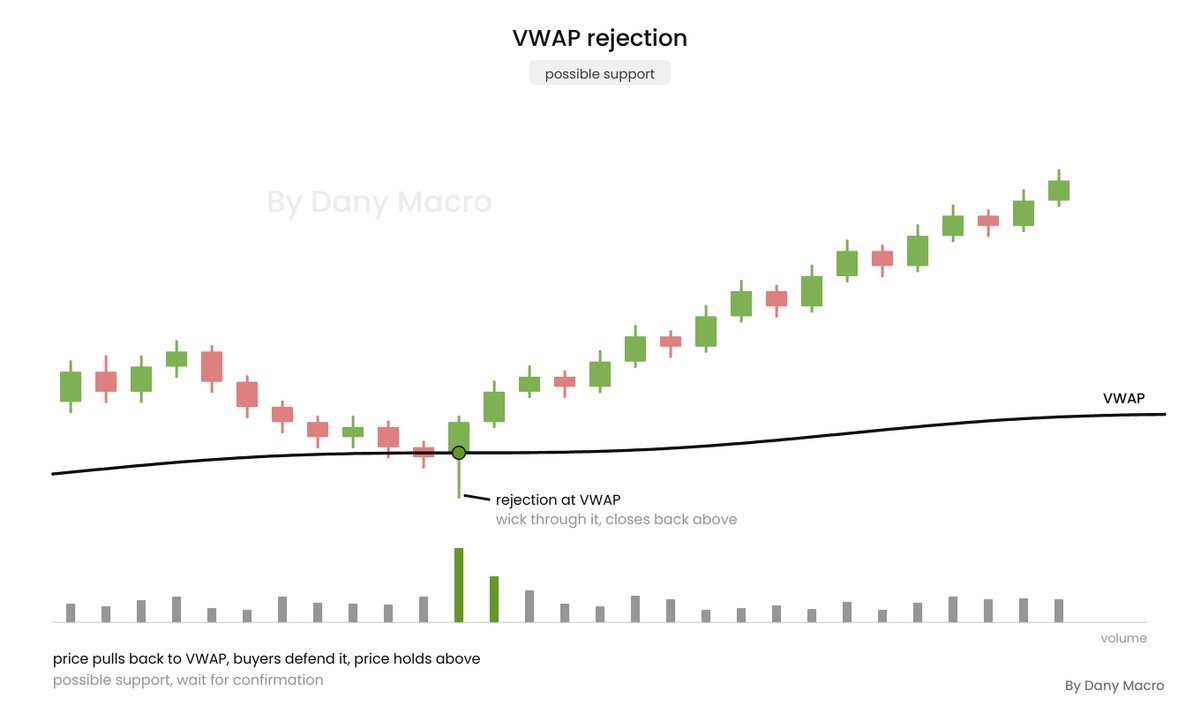
The VWAP (Volume Weighted Average Price) tells us where most of the volume has been transacted and gives us a reference for the market's average traded price.
When price is above the VWAP, it can act as support. When price is below it, it can act as resistance. Traders often look for rejections or retests of this level to enter in the direction of the trend.
However, there is one major limitation: market behaviour.
During strongly directional sessions, price can move aggressively without ever coming back to test the session VWAP. On the other hand, when price does interact with it, the number of quality setups can be very limited. This means that building an entire day trading strategy around session VWAP can leave you waiting for setups that simply never come.
For this reason, in my day trading model, I prefer not to use the Session VWAP as an entry reference.
Instead, I focus on the Weekly VWAP and Monthly VWAP.
The Weekly VWAP helps me understand the overall positioning of the market throughout the week. If price is trading below it, I consider it a potential resistance area.
Another important aspect is its use as a potential take-profit target. During intraday breakouts, the Weekly VWAP can become a natural target, especially when price is moving towards it with strong momentum.
The same concept applies to the Monthly VWAP, which provides a broader reference for potential resistance, support and reversal areas.
VWAP alone is not an edge.
I don't consider the session VWAP reliable enough to build my day trading strategy around, however, using the Weekly or Monthly VWAP as higher-timeframe reference zones can provide much more valuable context for identifying potential rejections, reversals and profit targets.
Real estate is a slow-moving asset. You can’t look at a 3–5 year period and conclude that the market is underperforming simply because prices haven’t appreciated significantly.
I’ve never been particularly attracted to real estate because of its relatively slow nature. In many cases, you’re putting in a lot of work just to have your tenants cover the mortgage, maintenance, taxes and other expenses.
If my primary goal is to preserve capital and protect it against inflation, I’d rather consider low-risk mutual funds or government bonds. They’re require far less management.
And homeownership will always remain a priority for people in the long run. Demand for housing isn’t going away, and property values should continue to appreciate over time but not in 3-5 years.
I’ve recently been monitoring the Dubai real estate market, however, with government bonds currently offering around 6% yields, and Dubai real estate offering rental yields in the 5–6% range, the risk-reward isn’t attractive.
For real estate to make sense, I want more than just rental income. I want to see the potential for both rental growth and capital appreciation.
@cmsinvests Been doing DCA since October.
I think there is nothing like DCA, it literally removes the emotions , sometimes keeping the strategy simple works best.
If the market goes lower, we keep buying. In the long run, we’re building our position at better average price.
Not all trading sessions are created equal. And if you're a day trader, the session you choose to trade can make a massive difference to your edge.
One pattern I’ve noticed repeatedly, and one of the main reasons why I avoid trading the London session, is the difference in how price behaves compared to New York.
When a move starts during London, it often comes with a relatively deep, slow retracement. Price tends to bleed gradually while continuing in the same direction, sometimes all the way until midday. This type of price action doesn't really suit my trading style.
New York, on the other hand, is completely different. One thing I particularly like about the NY session is how quickly it goes after liquidity. It's much more aggressive and volatile, with faster moves and sharper reactions. Given my day-trading style, I can often move my positions to breakeven much faster, which is something I value.
Asian, London and New York are three completely different environments. Even between Asian and London, I personally find late Asian much more attractive to trade.
If I had to rank these sessions based on where I would focus my time to develop and refine my edge, it would be:
1) New York Session
2) Late Asian Session
3) London Session
@michalmalewicz Never been to Poland, but the hype it’s crazy on X now.
Travelled almost the entire Europe but never feel the need to visit Poland, since we’ve been always taught that it’s on the “C tier “ list of countries in EU similar to Romania & Bulgaria.
Need to organize a trip!