***** Snippets from our Daily News..
-> U.S. Truflation measure, a real time measure, dropped below 2%.
-> Anthropic said frontier AI developers should establish a coordinated, verifiable way to slow down or temporarily pause development.
-> UK S&P Construction PMI dropped to 38.2 ..“Concerns about a prolonged decline in construction order books, alongside unfavourable near term UK economic prospects.
-> German carmakers lost ground to competitors at the start of the year.
https://t.co/kwAphptLpj
Bravo to them, taking the US back to Alexander Hamilton’s “American System” that shaped US policy in the 19th century and early 20th century.
Under a protective tariff of 20% - 25%, it aimed to boost domestic investment, with tariff revenues helping to pay for investments in canals and roads to develop the markets for increased domestic manufacturing.
It needed to do this to protect itself from cheaper British imports, much of which benefitted from monopoly powers, and to pay off government debt.
By creating a diversity of supply chains domestically, processing upstream resources into ever more processed downstream technologies, it created a productive society, including the creation of a middle class, which is something Scott Bessent has been calling for rather than the barbell economy the US presently has. In doing so, it shaped the economy to a productive natural hierarchy, driving the innovation and growth that made the U.S. the global power it became.
@terrybali The world is bananas about “tech” and has forgotten that you need a lot of minerals and energy to power things along…resources will outperform technology
Keir Starmer should rip up Ed Miliband’s “unnecessary” net zero agenda, Tony Blair tells #TimesRadio.
“It’s not that I'm a climate denier, but it's just coming to terms with this reality.”
@CalumAM
This @HedgieMarkets post illustrates where the infinity scalable asset-light technology model meets the physical realities of an asset-heavy business that faces an upward sloping supply curve.
We have long argued that AI compute is just another bit-atom commodity (like crypto) that uses a lot natural resources to create a valuable (unlike crypto) virtual asset.
On the bit side, Big Tech is a price-maker with fat margins. On the atom side, a price-taker.
Big Tech grew up in bits — search, social, e-commerce, office software: asset-light, infinitely scalable, natural monopolies. Build once, serve billions, watch costs fall every year. So they assume AI is the same game and will spend whatever it takes to own the market.
But inference is also atoms, i.e. land, critical minerals and electrons, which are mostly molecules. In the commodity world, competition drives price to marginal cost: P = MC, which is upward sloping as volume rises. The better the models get, the faster they compete their own margins down to the physical floor which rises with volume.
You can already see it. Microsoft just cancelled Claude Code because the cost to run it exceeded the value it returned — demand retreating the moment price met real cost. The irony: the customer pulling back was itself a hyperscaler. In April, Uber confirmed once again that AI compute demand is price elastic.
Bottom line: they assumed AI costs would keep falling like they always did on the bit side; however, on the atom side, there is a hard floor that likely rises in the short run.
I am not denying that the margins are still fat. But it’s not the same model. These guys are running towards obsolescing their own pricing power. Why did Rockefeller stop at the gas station and not vertically integrate into cars?
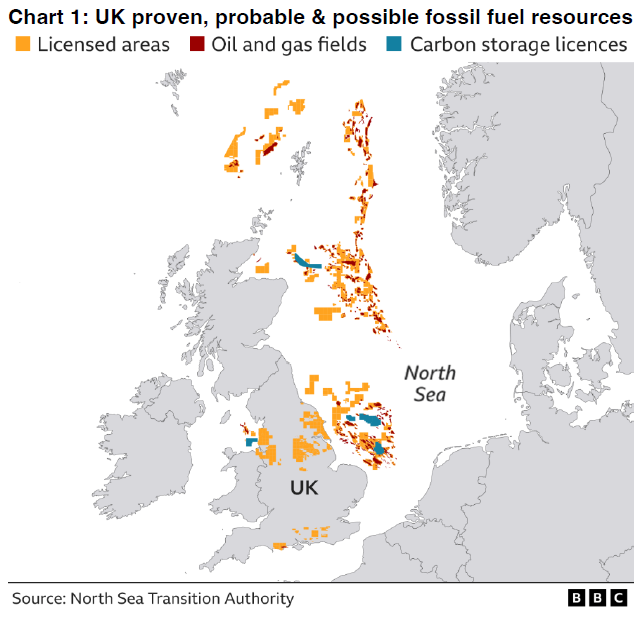
Scotland’s northern isles extend UK national waters north to cover a larger fossil fuel footprint than its close neighbor Norway (see Chart 1 below). Yet Norway’s sovereign wealth fund, the world’s largest, now exceeds $2trn and generated an additional
$247bn in oil proceeds last year from over 4mboepd of oil and gas production; during which time it also drilled 29 new exploration wells. That compares to the UK, which drilled not a single one exploratory well, is barely producing 1mboepd from a larger
area, declining at a rate of about -10% a year and is unlikely to have banked even $6bn in oil and gas tax revenue in 2025-26.
The ‘declining basin’ argument increasingly sounds like a political smokescreen to disguise the mismanagement of national assets on a truly epic scale.
This goes all the way back to the GFC, which once "bailouts" were pushed through the system, so to was a new way of thinking: -> That Government must provide the solution to everything (or Your Government will just bail you out).
And such, 20yrs later we have 'Big Ideological Government' that now chooses which policies will be “winners” and “losers”....and this has snuffed out productive growth in the economy. (More policy, More Regs, Higher Taxes)....
Politicians are so delusional with their insulated thinking of "we will provide the solutions" that they have no idea of the damage they are doing to society or the public’s opinion of their policies. Their Policies (Net Zero & Tax Hikes) have absolutely demolished the working class....the very section of society they "claim to help".
It is hard to imagine what we could be achieving as a society if our incomes were 2-4x higher (or our tax burden was half of what it currently is) and we were free to invest our surplus money unhindered by the state sector (taxes now the highest in the developed world alongside the highest electricity & energy costs), yet the drop in living standards is frightening.
It is the great sin of this 'Big Ideological Government' that we are still in the gutter, looking at the stars, rather than building a ladder towards them, and the incumbent political class still think it is the voters fault for not letting the "policies work effectively"....
After 18 months of “standing up to Putin” the Labour govt quietly issued a licence allowing imports of Russian oil refined in third countries.
Yesterday Labour MPs voted AGAINST UK oil and gas licences.
We are now importing from Russia instead of drilling in the North Sea.
Insane.
Scotland’s northern isles extend UK national waters north to cover a larger fossil fuel footprint than its close neighbor Norway (see Chart 1 below).
Yet Norway’s sovereign wealth fund, the world’s largest, now exceeds $2trn and generated an additional $247bn in oil proceeds last year from over 4mboepd of oil and gas production; during which time it also drilled 29 new exploration wells.
That compares to the UK, which drilled not a single one exploratory well, is barely producing 1mboepd from a larger area, declining at a rate of about -10% a year and is unlikely to have banked even $6bn in oil and gas tax revenue in 2025-26.
The ‘declining basin’ argument increasingly sounds like a political smokescreen to disguise the mismanagement of national assets on a truly epic scale.
Chancellor Reeves is right and saying ���Growth is the answer”, however that growth has been in the size of the government.
Big Ideological Government snuffs out productive growth by making policy choses based on their ideals.
It is hard to imagine what we could be achieving as a society if our incomes were 2-4x higher and we were free to invest our surplus money unhindered by the state sector (taxes now the highest in the developed world alongside the highest electricity & energy costs), yet the drop in living standards is frightening.
It is the great sin of this 'Big Ideological Government' that we are still in the gutter, looking at the stars, rather than building a ladder towards them, and the incumbent political class still think it is the voters fault for not letting the "policies work effectively"....
Smaller sized government, lower energy costs, less regulations! This will boost people's productivity.