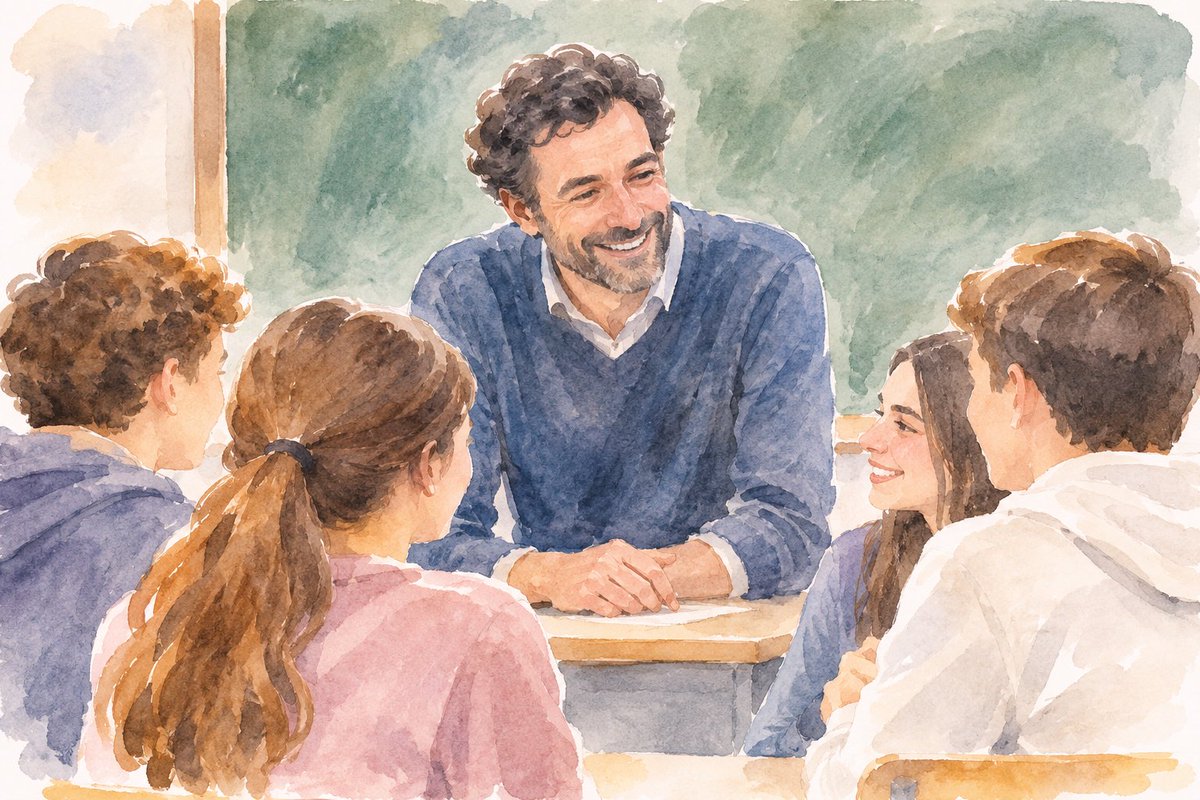
Decíamos ayer que ser profesor puede parecer un trabajo sencillo, pero ejercer de profesor es mucho más complicado: son decenas de adolescentes a los que atender y tratar de dar la mejor educación posible.
Muchas veces se nos dice que debemos entrar con el mazo en clase, sobre todo durante los primeros días de curso, para asentar de ese modo las bases de la futura relación con nuestros alumnos: que sepan quién manda, quién tiene poder. Pero yo nunca he podido hacer eso. No tengo dotes teatrales, y no me sale, como tampoco me ha salido nunca hablarles de usted o llamarlos por el apellido.
Después de más de una década en la educación secundaria, he observado que lo más provechoso es exactamente lo contrario: sonreírles desde el primer momento, aprender su nombre lo antes posible y tener así para ellos esa ascendencia sólida que es más que el simple poder y a la que llamamos autoridad.
La actual crisis de la familia, de esa institución que durante tantos años nos dio los mejores datos de salud mental a los países del sur de Europa, hace que los alumnos cada vez busquen más en nosotros, en sus profesores, la atención de la que carecen en sus casas. Por eso, aquello de que las familias educan y el sistema educativo forma ya no tiene sentido.
Cuando Isabel Celáa, malhadada ministra de Educación de Pedro Sánchez, dijo que "No podemos pensar de ninguna de las maneras que los hijos pertenecen a los padres", la entendimos mal: no estaba planteando una postura, sino lanzando una terrible profecía acorde al modelo de sociedad propuesto por el actual socialismo. Se busca una sociedad con lazos cada vez más débiles entre sus individuos y con individuos cada vez más aislados y dependientes del Estado. Y es este problema de salud mental colectivo el que hace necesario, más que nunca, el fortalecimiento de la educación y la extensión de su red de afectos.
People wonder why I'm so obsessed with donkeys. I've looked into it, and my only finding is that the rest of you are underdoing it.
The donkey was built for the ground where everything else gives up. It lives on thorn and scrub that a horse would starve beside, climbs rock on hooves like chisels, cools itself through those ears, and can lose nearly a third of its body weight in water, carry on eating, then drink 25 litres in three minutes and walk off as if nothing happened. We tamed it 7,000 years ago in the dry country of East Africa, and it has been the animal of the hard places ever since.
So it was the donkey, long before the horse, that carried civilisation on its back. One of Egypt's first pharaohs was buried at Abydos with ten donkeys laid in graves beside him, every spine worn from a lifetime under loads. The grain, the salt, the copper and the news of the ancient world moved at a donkey's pace, and wherever a hill is still too steep for a wheel, they still do.
The same animal fed our babies. Donkey milk is the closest milk on earth to a human mother's, Hippocrates prescribed it, and the foundling hospital in Paris kept a stable of jennies so the orphans could be put straight to the udder. A fair share of Europe's abandoned children owe their first month to a donkey, and most of those donkeys carry a dark cross down the back and across the shoulders, which the old story says was given to them on Good Friday.
It carried our wounded too. On the beach at Gallipoli a stretcher-bearer from South Shields found a stray donkey, and for 24 days the two of them walked up and down Shrapnel Gully under fire bringing broken men down to the boats, until a machine gun got the man. The donkey went back up with the next one. Of everything the Anzacs brought home from that campaign, the thing they chose to remember was a donkey.
Then there is the stubbornness, the one fact everybody is sure of, and it is the opposite of the truth. A horse meets danger by bolting, which is why horses die on cliff paths. A donkey stops, looks at the thing in front of it, and makes a decision, and it will refuse to step into water it cannot see the bottom of because it is right not to. For 7,000 years we have been calling a risk assessment an attitude.
Put one in a field of ewes and it appoints itself. A fox or a loose dog comes through the hedge and the donkey goes at it, head down, front feet first, and keeps going until the thing has gone. Nobody trains that in. It decided they were its sheep.
It remembers a face and a field after 25 years. It will stand over a dying companion for a day. It lives to 40 and outlasts half the people who ever owned it.
There are about 50 million of them alive, carrying water, firewood and children for the poorest people on earth, and close to 6 million a year are now killed for their hides, boiled down into a gelatine sold as a tonic. The animal that did the most work for the least thanks is being melted into a wellness product.
Seven thousand years of hauling us uphill, feeding our orphans and carrying our wounded, and the best we managed in return was to turn its name into an insult.
So no. Not nearly obsessed enough.
Sra. Colau,
Dice usted que gente como yo somos “pijos” a los que hay que freír a impuestos. La realidad es esta:
Trabajo solo como autónomo. 14 horas al día, fines de semana incluidos. No tengo loft, ni ministerio, ni collares ni casa en Galapagar.
Mantengo a mi padre con Alzheimer (86 años), a mi madre que lo cuida (84), a mi suegra en silla de ruedas con oxígeno las 24 horas (84) y a mi mujer, que no puede trabajar porque es su cuidadora principal.
Mientras tanto, Hacienda me abre inspección tras inspección, con saña, dándome 10 días para presentar facturas que ya tienen. Se llevan más del 50% de lo que gano. Y ni siquiera puedo usar la sanidad pública ni nada público porque todo está colapsado o sobre saturado.
Veo en su discurso que quiere usar el BOE como arma de resentimiento y envidia. Eso no castiga a los de arriba. Castiga a quienes madrugamos, cotizamos y sacamos adelante a nuestras familias mientras se subsidia a quienes nunca han aportado y no quieren trabajar.
Usted no nos representa. Nos desprecia. Y mientras siga pensando que el problema somos los que trabajamos y no los que viven de los demás, no hará más que agravar lo que ya está roto. No por falta de impuestos. Por falta de vergüenza.