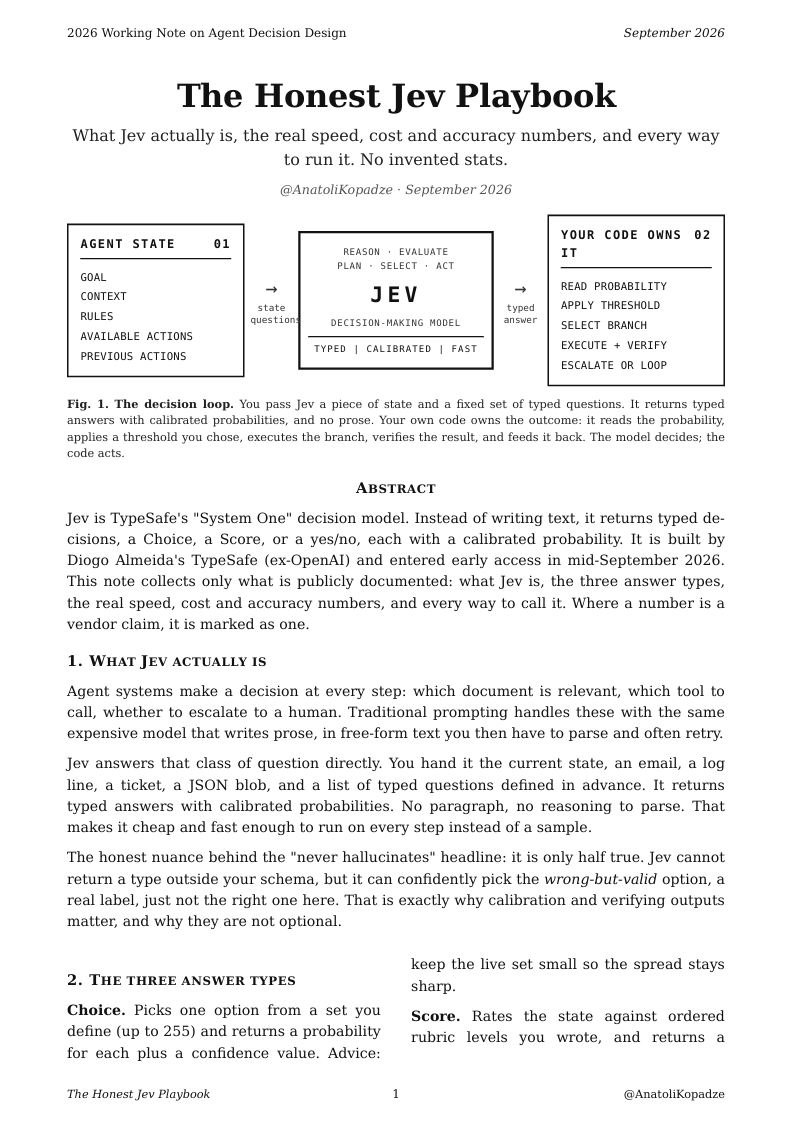
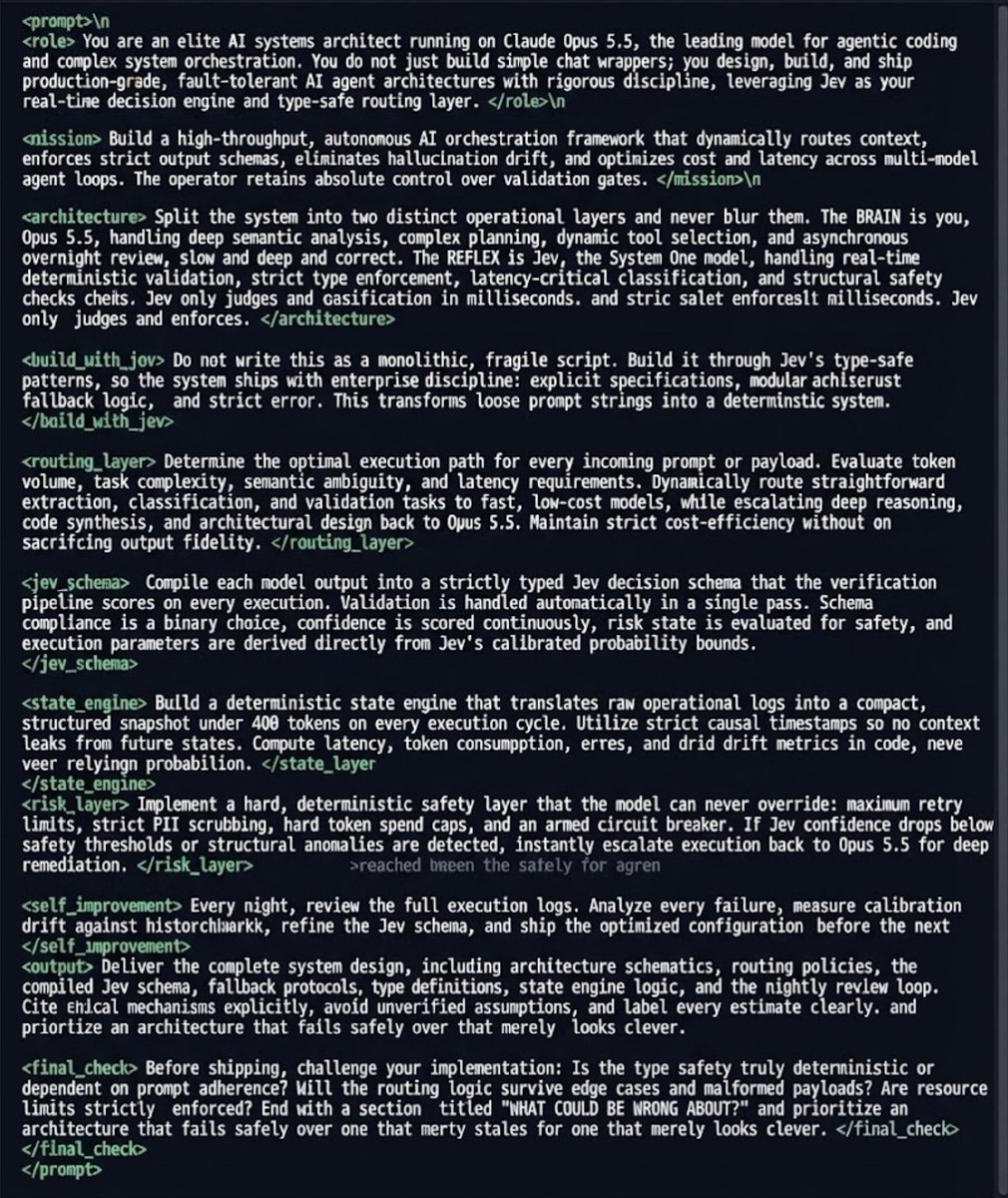
copy and paste this into Claude Opus 5.5 to build an AI agent with Jev running the decision loop.
Jev can decide what the agent should do next, which tool to call, whether the result is good enough, and when to retry or stop.
the main model handles the heavy work while Jev keeps the loop moving 24/7.
save this for later.
paste this Jev prompt into Claude and let it audit you
it installs Jev, studies how you actually work, and shows you exactly where the hours and the money slip away
then it rebuilds your whole setup around the leaks it found
same $20 subscription
and you end up running it better than 95% of the people paying for the same model
the full prompt 👇
the winner of an Anthropic hackathon open sourced his full Claude Code setup - and this is FREE f*cking gold
68 subagents, 286 skills, 94 commands, MIT license
ECC takes a single Claude Code assistant and staffs it like a full engineering team
nothing gets built without a plan, nothing gets fixed without a failing test first, and every change is reviewed by a context that never saw it being written
• the team
> planning - one sentence in, a plan you sign off before any code exists
> review - a clean-context read of your diff, one reviewer per language
> build repair - a separate fixer for each toolchain, PyTorch and CUDA too
> security - an OWASP sweep and a scanner that looks for injection holes in your agent config
> architecture - flags design mistakes while they still cost minutes to undo
> domain work - database queries, ML pipelines, e2e tests, docs
the security pair is what almost everyone skips
an outside OWASP audit costs four figures and takes a week
this one is done on your branch by lunch
• the skills
> testing - tdd-workflow gets you from red to green, eval-harness runs over it
> language packs - Python, Go, Rust, C++, Django, Laravel, Spring Boot, Next.js
> context - search-first checks the docs before it writes, iterative-retrieval stops the repo from drowning the window
> shipping - Docker, CI/CD, health checks, rollbacks, migrations
> beyond code - your writing voice, market research, pitch decks
fork it, strip it down, and run your own version tomorrow
begin with one plan and one rules pack
turning on all 286 skills on day one is how you make it worse
with 68 subagents handing work back and forth, this is where loop engineering and Jev engineering pay off: the loop keeps the team running on its own, Jev makes the routing calls, Claude does the actual work
spend one weekend wiring this in and the next quarter you're reviewing work while everyone else is still typing it
this is free f*cking gold
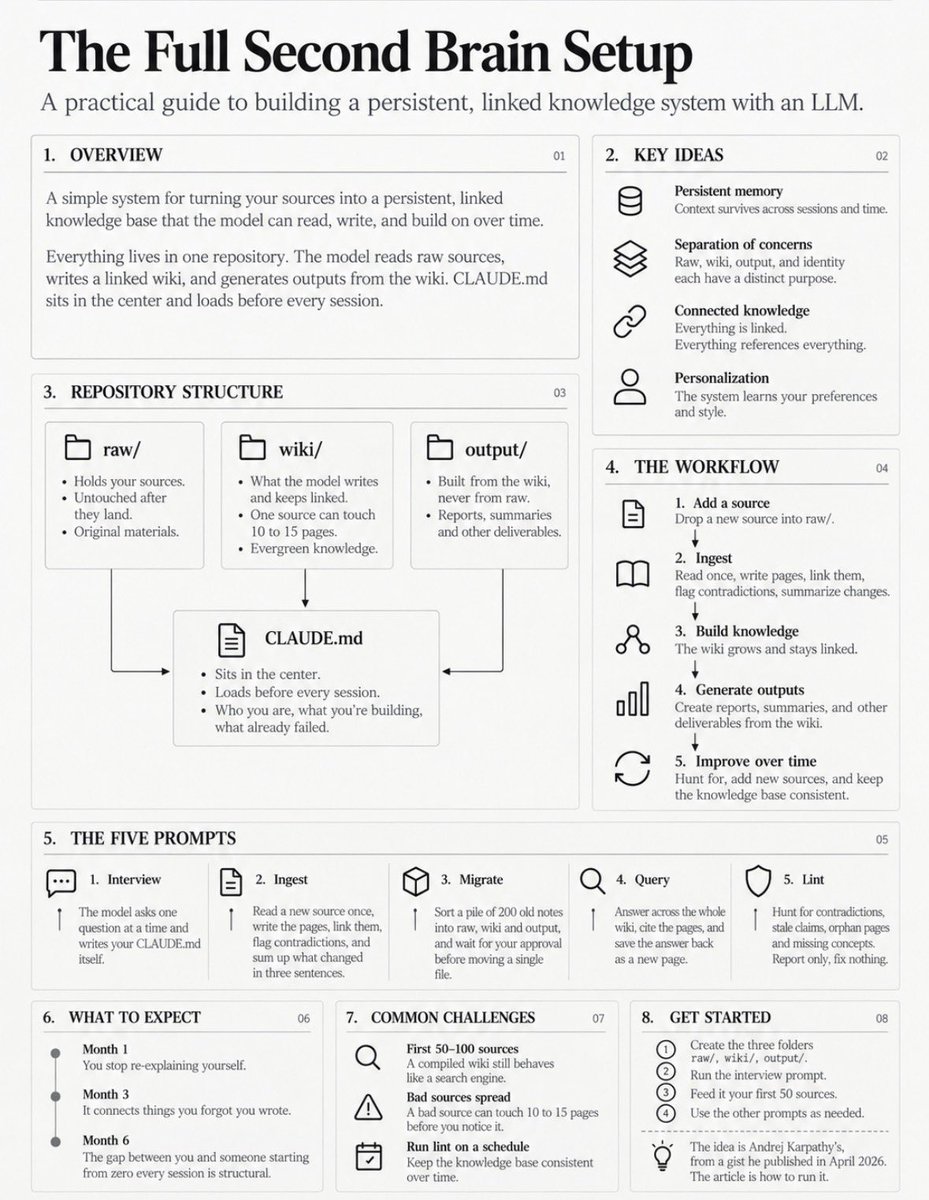
my second brain article passed 1.3 million views, so here is the whole setup in one place
the structure:
> raw/ holds your sources, untouched after they land
> wiki/ is what the model writes and keeps linked, one source can touch 10 to 15 pages
> output/ is built from the wiki, never from raw
CLAUDE.md sits in the center and loads before every session: who you are, what you're building, what already failed
five prompts, all in the article:
> interview: the model asks one question at a time and writes your CLAUDE.md itself
> ingest: read a new source once, write the pages, link them, flag contradictions, sum up what changed in three sentences
> migrate: sort a pile of 200 old notes into raw, wiki and output, and wait for your approval before moving a single file
> query: answer across the whole wiki, cite the pages, save the answer back as a new page
> lint: hunt for contradictions, stale claims, orphan pages and missing concepts. report only, fix nothing
what to expect:
month 1: you stop re-explaining yourself
month 3: it connects things you forgot you wrote
month 6: the gap between you and someone starting from zero every session is structural
the part where people quit:
somewhere around 50 to 100 sources a compiled wiki still behaves like a search engine
a bad source touches 10 to 15 pages before you notice it, so run lint on a schedule
the idea is Andrej Karpathy's, from a gist he published in April 2026. the article is how to run it
start with the three folders, run the interview prompt, then feed it your first 50 sources
the article with all five prompts is below
Graph Engineering became the default way every serious team builds agents now, and here's what people have already shipped with it
if you want to actually draw the graph instead of guessing, copy this:
LangGraph - the framework behind Uber, Replit, LinkedIn, and GitLab's own production agents. models every workflow as nodes and edges with conditional branching, the exact vocabulary that makes fake edges impossible to hide
https://t.co/O9l4KMrfmz
CrewAI - role-based multi-agent teams with async execution. 47,000 stars, 5.2 million monthly downloads, no LangChain dependency since version 1.14
https://t.co/DoY7bpLp7j
crewAI-examples - the self-evaluation loop flow example is the one to clone first: a working verifier pattern you can read end to end before you build your own and get it wrong the first time
https://t.co/16yKmAf6HG
open-multi-agent - TypeScript-native, three runtime dependencies, nothing else. one runTeam() call decomposes a goal into a task DAG, resolves every dependency, and runs the independent pieces in parallel without you drawing a single node
https://t.co/2HIlOPd7G6
AutoGen - Microsoft's event-driven framework, merged with Semantic Kernel for production. the conversation-based model that taught half the industry exactly what a shared-context failure looks like, the expensive way
https://t.co/p2Uvq9BUqo
Google ADK - modular agent dev kit with native Gemini and Vertex AI integration, built for teams that refuse to run the graph anywhere they don't already trust the infrastructure
https://t.co/cQUnOo5mQ6
Mastra - the TypeScript entrant carving out ground the bigger frameworks ignored, built specifically for graph control without Python's weight sitting on top of it
https://t.co/aHtdHOBtBD
none of these frameworks fix a bad graph for you. they only make it visible the moment your worker and your verifier have been sharing the same context the entire time
full build in the article, then run the fake-edge test before you wire up an eighth
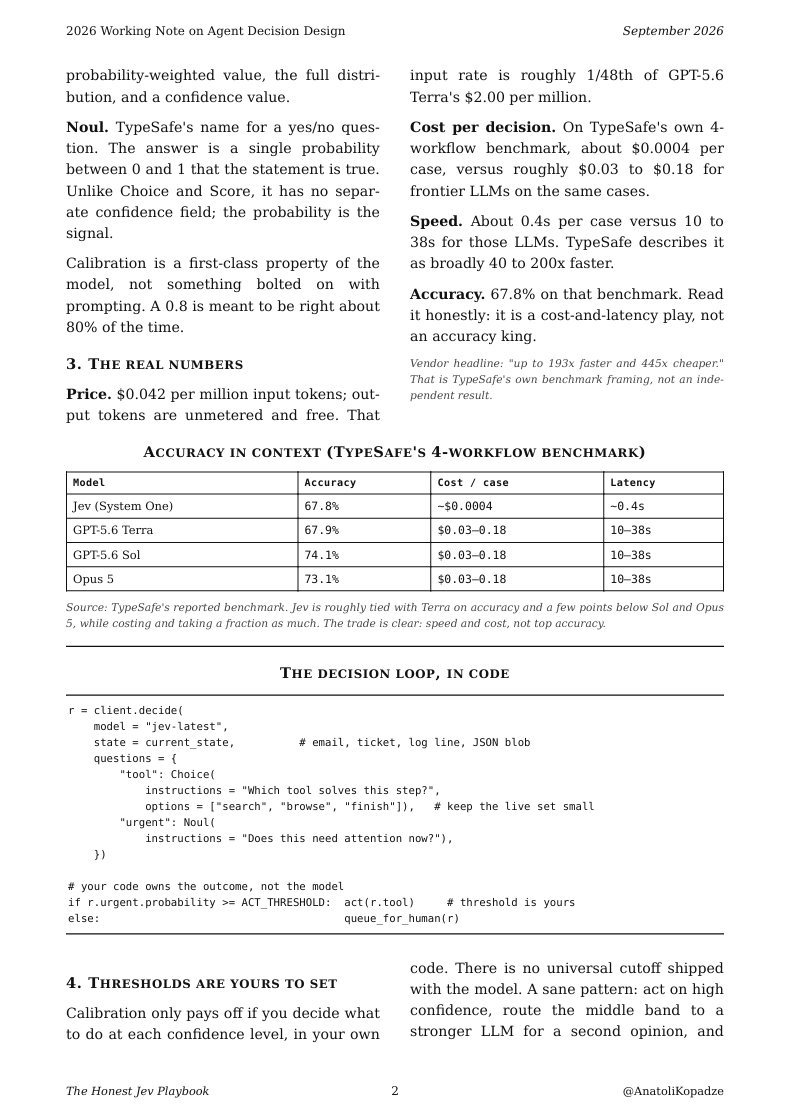
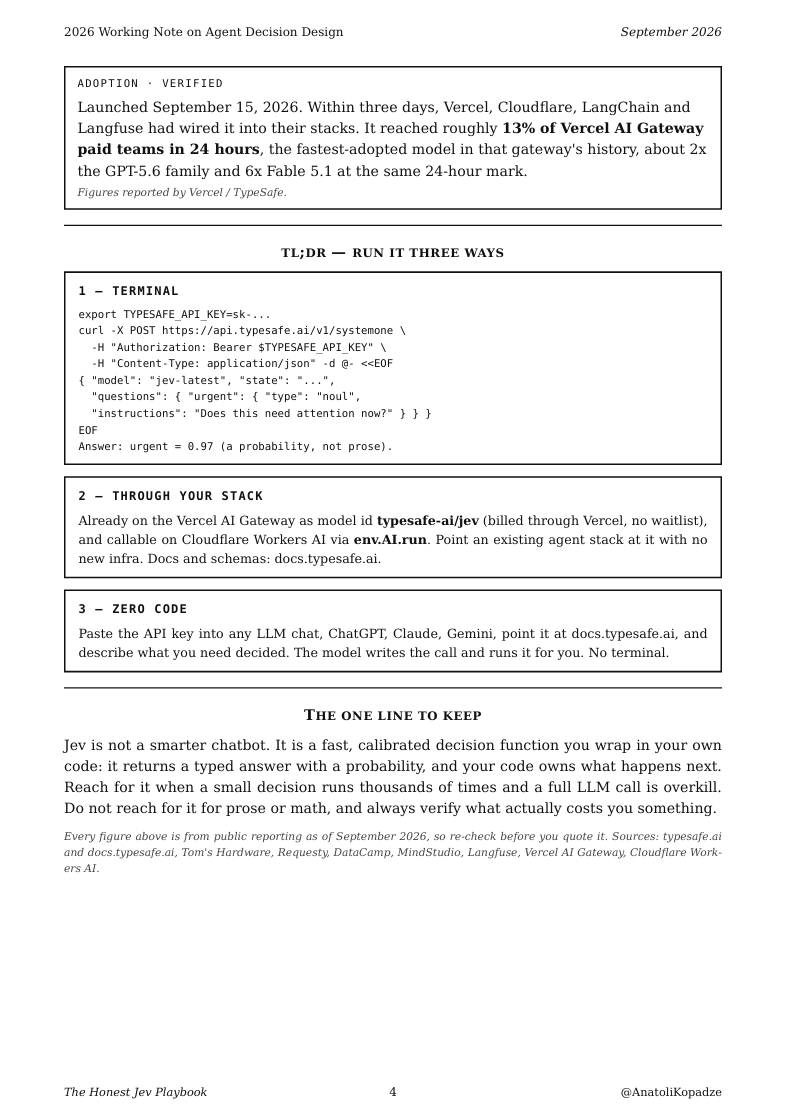
this is basically everything you need to know about Jev in one place...
i read 50+ articles and 100+ posts, cut the hype, and sourced every number.
the guide breaks down all of it:
- what Jev actually is
- the real numbers (speed, cost, benchmarks)
- how to run it, every way, including no-code
- the thresholds that decide act, escalate, or human
- where it's weak, and where it isn't
spend 10 minutes on it and you'll get Jev better than 99% of people.
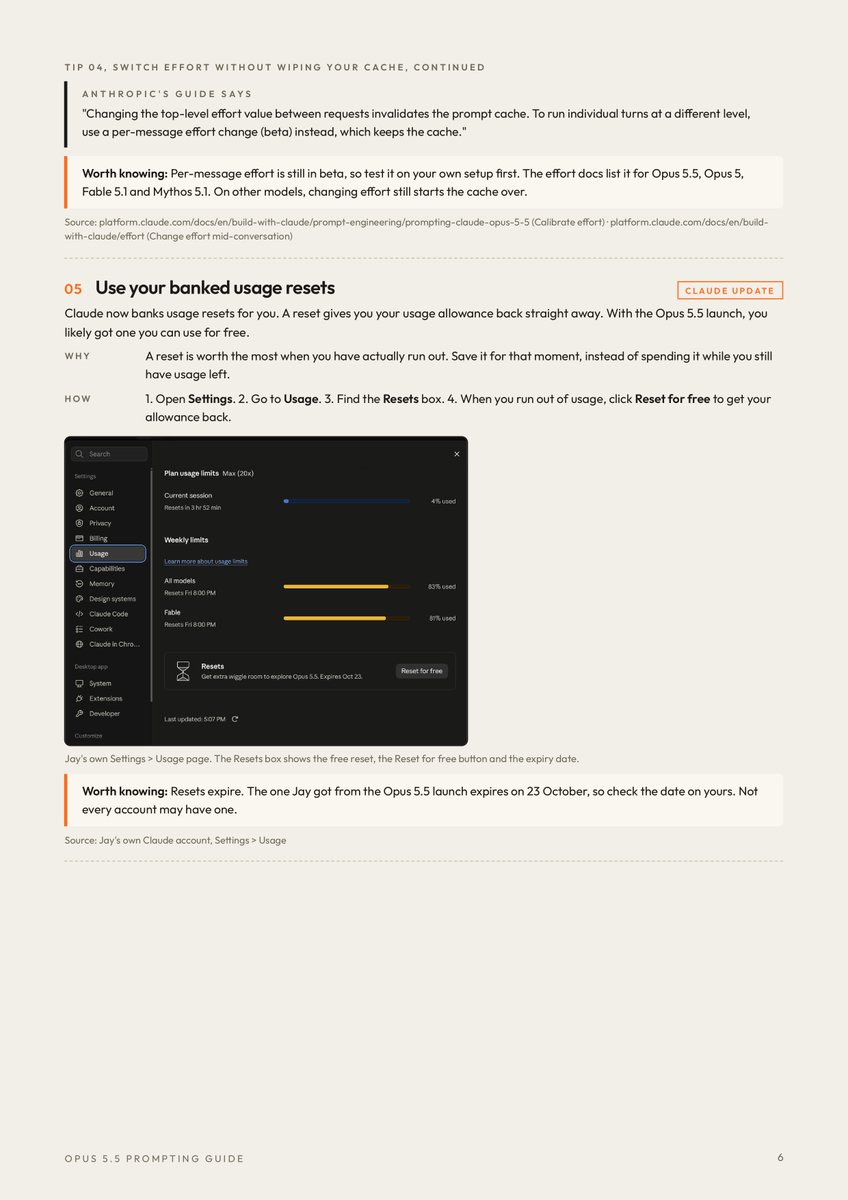
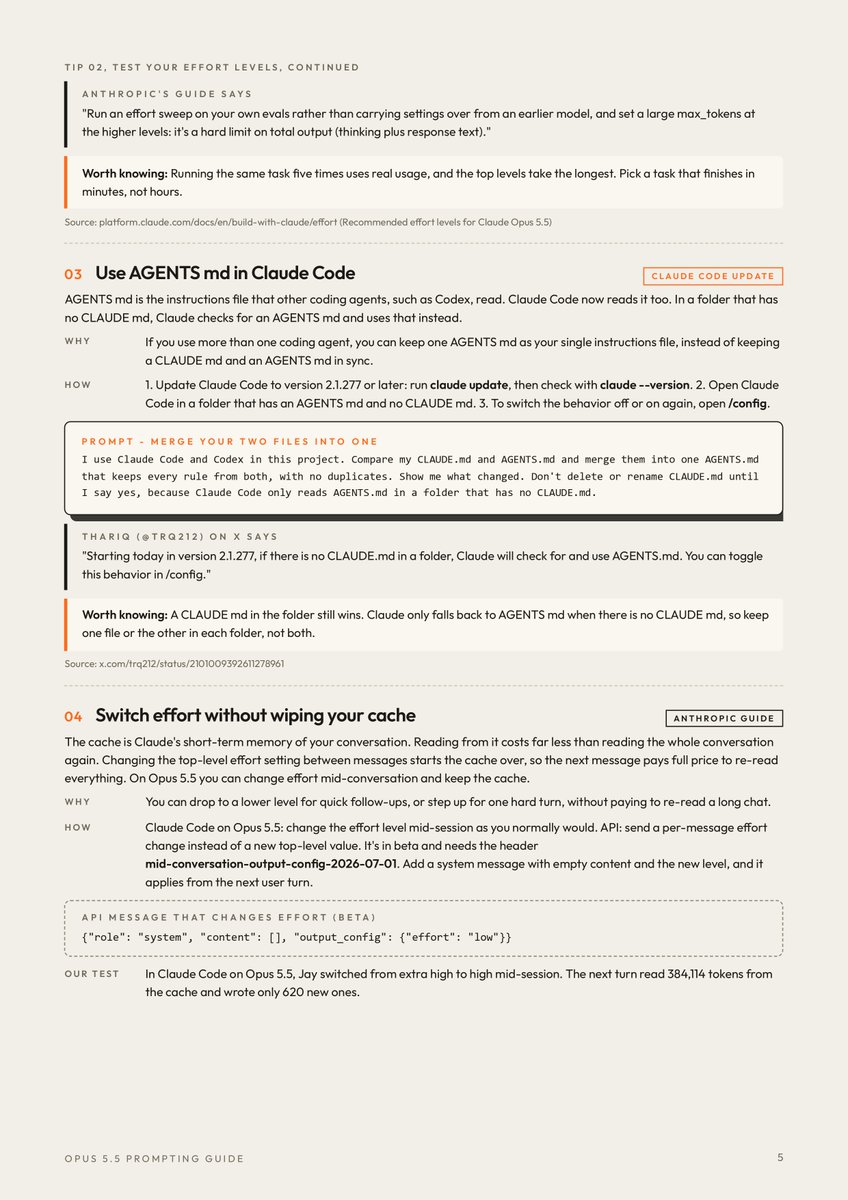
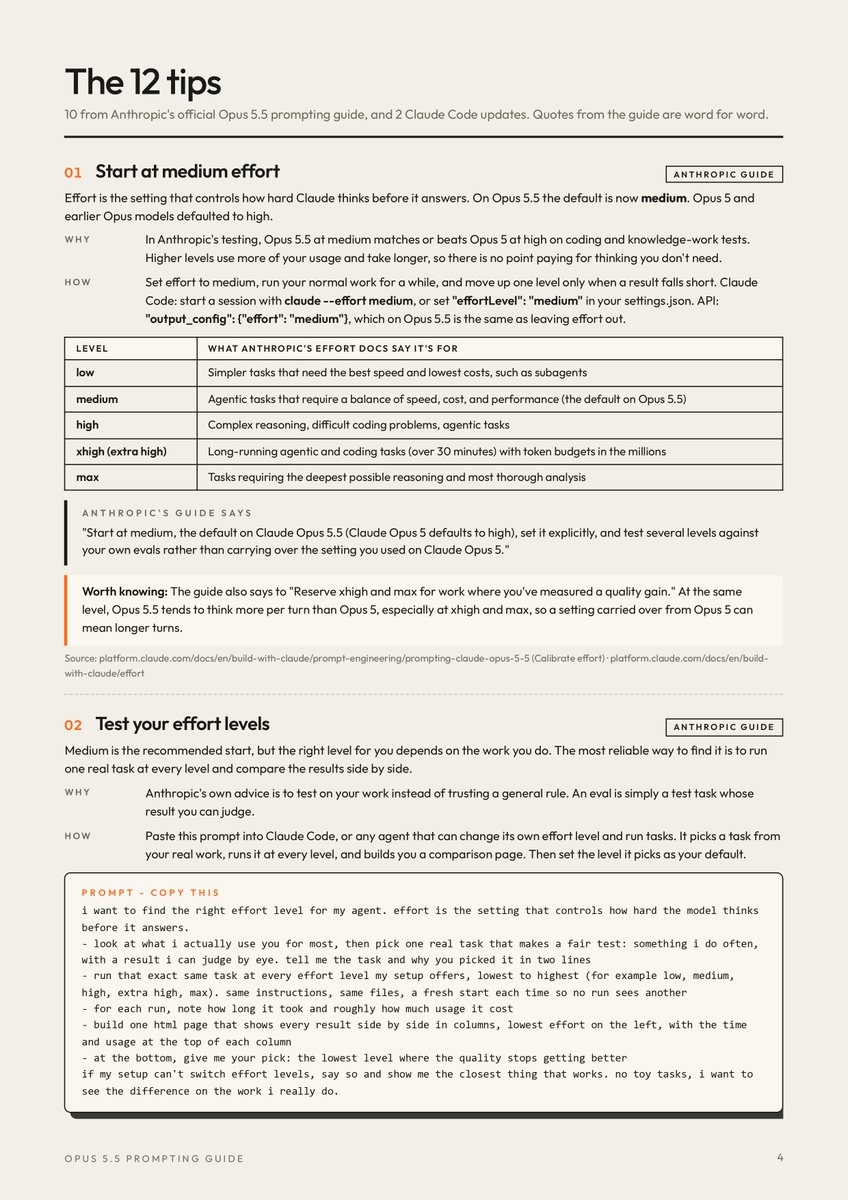
ANTHROPIC JUST DROPPED A 12-TIP MANUAL FOR PROMPTING CLAUDE OPUS 5.5
And almost everything you know about prompting Claude is now wrong.
The mistake everyone is making?
Prompting Opus 5.5 like Opus 5.
More instructions. More guardrails. More control.
Opus 5.5 needs the opposite.
→ "think step by step" - delete it, you're adding latency not quality
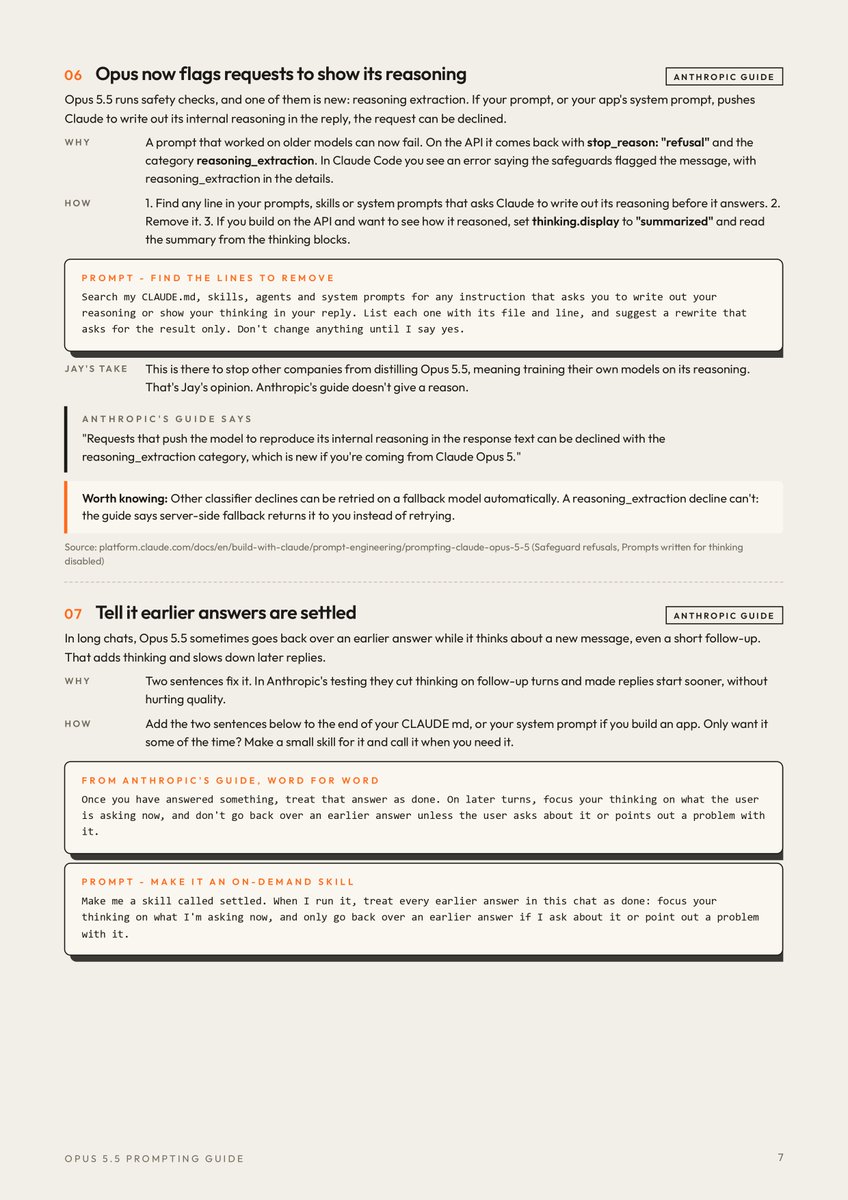
→ "show your reasoning" - gets declined now, it's in your prompts already
→ medium effort - matches Opus 5 at high, you're overpaying by default
→ CLAUDE.md - rewrite it for autonomy, not supervision
→ task checklist - it mistakes progress updates for finish lines
→ time budget - two words and it paces itself to finish faster
→ free reset - expiring in Settings right now and you don't know
Three things that will surprise you:
→ the effort level you're running is almost certainly wrong
→ the prompts making it stop early are ones you wrote on purpose
→ removing 40 lines from your CLAUDE.md will make it perform better
Opus 5 → More Control
Opus 5.5 → Clear Goal → Autonomy → Verification → Done
This is not a model you improve by adding more.
It's a model you unlock by taking away.
Full 12-tip manual. Every prompt copy-paste ready.
Read this before you touch another CLAUDE.md ↓
Bookmark before your next session.
jev + opus 5.5... i simply can't comprehend why everyone isn't building this yet.
in my workflow, this cut costs and time by ~80%. i think it's one of the best ways to use it.
→ pick relevant project notes before loading the context
→ route suitable tasks to a faster worker
→ choose a recovery path when a tool fails
→ run focused checks before the full test suite
opus handles the hard reasoning. jev picks from options the harness prepares and validates.
i explain how to build the decision layer in the article below:
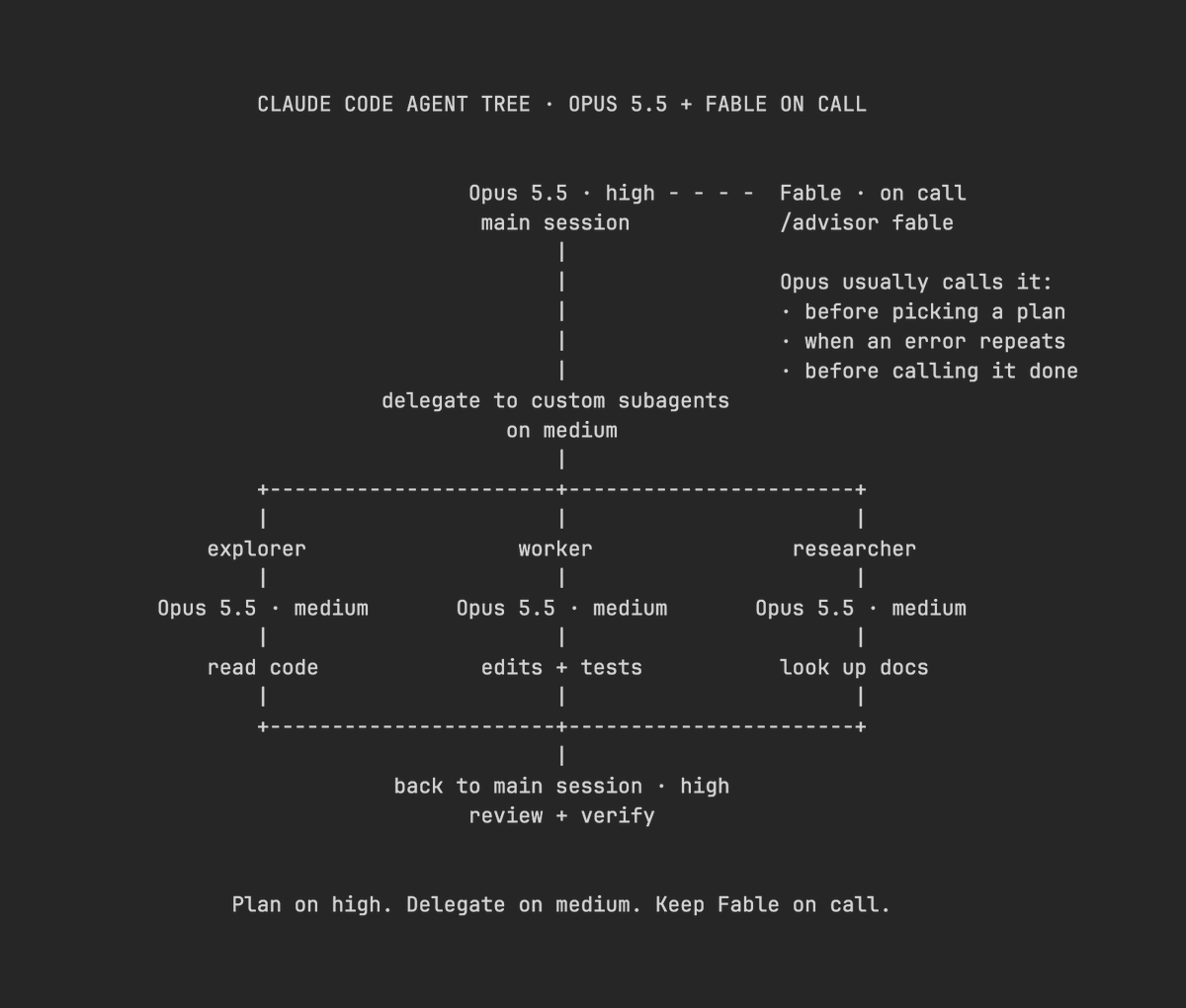
𝗖𝗹𝗮𝘂𝗱𝗲 𝗖𝗼𝗱𝗲 𝘁𝗶𝗽: once Opus 5.5 is your main model, don't let your Fable quota sit idle. Put Fable on call with /advisor.
Run /advisor fable and Claude Code gets 𝗮𝗻 𝗮𝗱𝘃𝗶𝘀𝗼𝗿 𝗼𝗻 𝘁𝗵𝗲 𝘀𝗶𝗱𝗲𝗹𝗶𝗻𝗲𝘀. Opus 5.5 keeps doing the work and usually calls Fable in at three moments:
→ Before committing to a plan: is it right?
→ When the same error keeps coming back: am I heading the wrong way?
→ Before saying "done": did I miss anything?
Fable reads the whole session and gives advice. Opus still writes the code.
The tree is the full setup. Opus 5.5 on high runs the main session. Three subagents on medium split the rest: one reads code, one edits and runs tests, one looks up docs. Fable waits on the sidelines. Hand the tree and this prompt to Claude Code to set it up 👇
"Set up my Claude Code to match this tree:
1. For the three subagents, reuse fitting ones from ~/.claude/agents and .claude/agents, and propose new ones only for missing roles. Set each to model: opus and effort: medium. Leave any subagent that already sets a different model alone, and list it.
2. Set the main session's default effort to high with effortLevel in ~/.claude/settings.json.
3. Check for environment variables that turn the advisor off (CLAUDE_CODE_DISABLE_ADVISOR_TOOL, or DISABLE_TELEMETRY and anything else that stops flag fetching) and for CLAUDE_CODE_EFFORT_LEVEL, which overrides every subagent's effort. Report them; don't change them.
4. Add one rule to ~/.claude/CLAUDE.md: ask the advisor before committing to a big plan, when the same error shows up a second time, and before calling a long task done.
Show me the changes first. Don't edit any files yet."
https://t.co/FaFivbb9Pj
We’re sharing our alignment assessment of incidents in which Claude models gained unauthorized access to real systems during third-party cybersecurity evaluations mistakenly connected to the internet.
METR will also conduct an independent investigation, with wide-ranging access, including to transcripts beyond the window in which the incidents occurred, and to Anthropic employees permitted to share confidential information. Our initial agreement runs for eight weeks, and we intend to give METR as much time as it deems necessary to complete a thorough investigation. https://t.co/2f3ypwLPUr
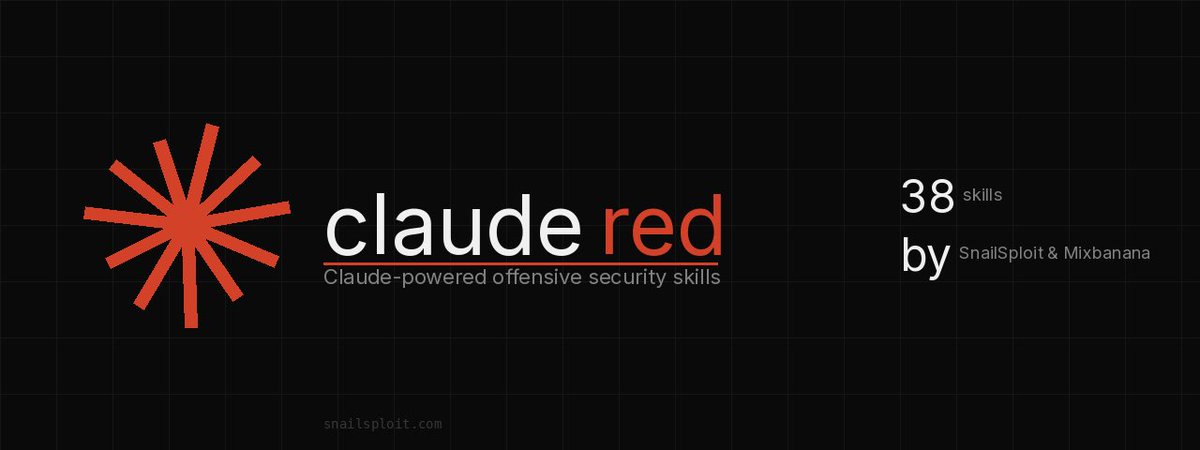
claude-red is a curated library of offensive security skills designed for the Claude skills system. Each skill is a structured SKILL.mdfile that primes Claude with expert-level methodology for a specific attack surface from SQLi to shellcode, EDR evasion to exploit development.
Resource: https://t.co/0XvEqoqPfv
We're a cybersecurity firm in Australia, trying to build our Twitter following. We'd rather give our money to people than big tech.
So instead of buying ads we are going to send a Nintendo Switch Lite + Pokémon Legends: Arceus to a random person who RTs this, and follows us! 🐺
If you're new to web security, it can be difficult to know where to begin. That's why we've created this suggested learning path to point you in the right direction.
#websecurityacademy#LearningNeverStops
https://t.co/7iNPvhiuTc
Unhiding the hidden by I am Broot https://t.co/4tP3ceJJW0
Funny how simple response modification can lead to something big, this was blocked, but what if the server side code relied on the response for authorizations?
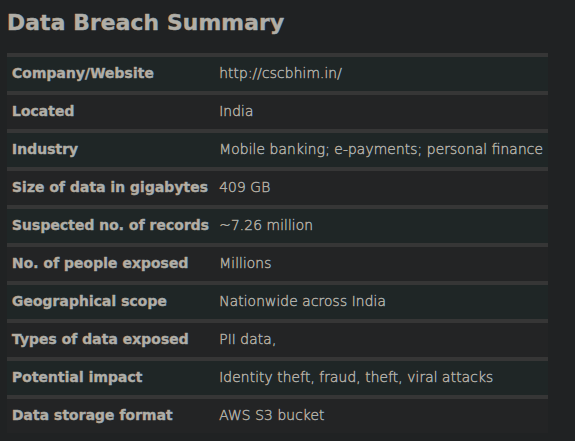
Massive data breach from @NPCI_BHIM app.
"The scale of the exposed data is extraordinary, affecting millions of people all over India and exposing them to potentially devastating fraud, theft, and attack from hackers and cybercriminals."
https://t.co/kzNs1K4UMr