Founder building AI-native software for painful European business operations. Currently reinventing bookkeeping with @Vantnod. Building in public from Espoo.
Introducing AgentCard.
Your agent can now buy anything:
• pay for inference & APIs
• order DoorDash, Amazon, Ubers
• run marketing
• trade Polymarket 24/7
Open to all, not just businesses 🔥
Instant. Private. Reusable. Live today.
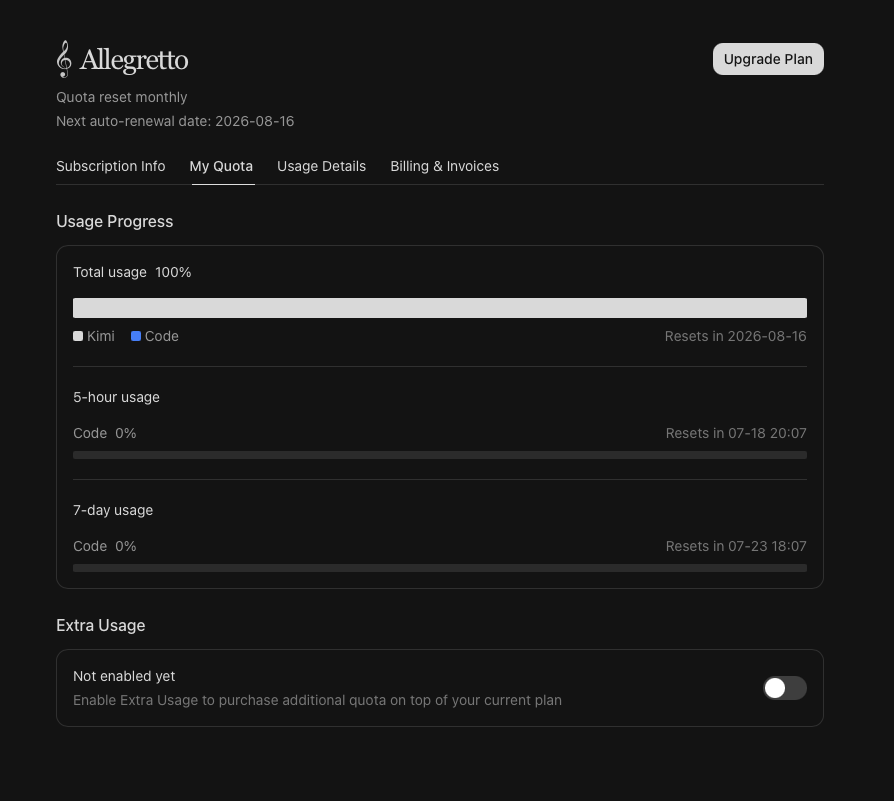
I paid for Kimi Allegretto 2 days ago. This isn’t even the lowest tier.
Today, my entire MONTHLY quota is gone. Next reset: August 16.
2 days of use. 28 days waiting.
Yet the 5-hour and 7-day limits both show 0%.
How does this quota system make any sense, @Kimi_Moonshot?
@saqih_xi None yet. Mistral is Europe’s strongest contender, but “globally available” isn’t the same as globally dominant.
Europe has research, talent and regulation. What it still lacks is distribution at consumer scale.
Hey builders 👋 @X
Looking to connect with people working on:
🚀 Startups
🧠 AI products
🎨 UI/UX
⚙️ Automation
📱 Product development
💻 SaaS & web apps
🏗️ Building in public
I’m building AI-native software from Finland, starting with a new finance cockpit for European SMEs.
Drop what you’re building below 🤝
Kimi K3 is finally here 👀
Really excited to put it through its paces on real production code.
If the hype around the 1M context window and agent capabilities lives up to expectations, this could be a huge release for developers.
Anyone else testing it today? 🚀 #KIMIK3
@yuzu_jpg@X Building an AI-native finance cockpit for European SMEs.
We’re rethinking bookkeeping around AI suggestions, full audit trails, and human approval instead of traditional accounting software workflows.
Sharing the journey as we build. 👋 Happy to connect!
@adhamuxi Building Vantnod - an AI-native finance cockpit for European SMEs.
We’re rethinking bookkeeping around AI suggestions, full audit trails, and human approval instead of traditional accounting software workflows.
Sharing the journey as we build. 👋
@Tanjim38 Looks polished. I’d love to see more CRM dashboards move from “here are your metrics” to “here’s what changed, why it matters, and what you should do next.” That’s where AI could genuinely improve this pattern.
@dqnamo I’d go one step further: destructive actions should be designed around reversibility, not confirmation.
Hold-to-confirm works when deletion is permanent. But when recovery is possible, instant delete + undo is usually the better UX.
GPT-5.6 has quietly become my default thinking partner.
It’s not just better at writing code—it’s better at reasoning through product strategy, UX, architecture, grant applications, and impossible founder tradeoffs.
Over the past weeks I’ve used it to:
• Design interfaces
• Build production features
• Refine fundraising materials
• Challenge my assumptions instead of just agreeing with them
As a solo founder building AI-native products, it feels less like a chatbot and more like another senior teammate.
Curious what everyone else is building with GPT-5.6.
I’m Jami, founder of Impact Node in Espoo.
We turn painful operational workflows into focused software products - starting with the problems we understand well enough to solve ourselves.
Small teams, short feedback loops, clear ownership.
New model drops every few weeks.
Here’s what actually moves the needle for real builds:
• Better long-context reasoning (less brittle agents)
• Cheaper inference at high volume
• More reliable tool use and self-correction
Everything else is mostly noise until it shows up in production constraints.
I test the new releases the same way every time: throw them at actual workflows we run and measure where they break.
Most still break in the same places.
#AIBuilders #RealAI
Quick question for people actually running AI in production:
What’s the failure mode you see most often with current agentic setups?
A) Hallucinated tool calls / bad state
B) No reliable long-running execution
C) Escalation and human handoff being an afterthought
D) Something else
Reply below. I’ll share the patterns I see most often from real builds.
#AgenticAI
I’m publishing field tips on https://t.co/0uX3iyW7jD
Not recycled “best practices”. Not generic AI productivity advice.
Short, practical notes from building real systems under real constraints: scope pressure, messy workflows, compliance edges, automation decisions, and the gap between demos and production.
They are not the whole playbook.
But they are useful fragments from the workbench: questions, patterns, and reminders I wish more teams used before they started shipping AI into broken processes.
Free. Public. No email wall.
Take what’s useful.
Link in bio.
I’m building a Finnish fintech as a one-person studio.
Not as a pitch deck. Not as a prototype dressed up for screenshots.
A real product with accounting flows, invoicing, tax logic, bank integrations, audit trails, and regulatory constraints baked into the architecture from the start.
One judgment chain.
No handoff theatre.
Fixed scope.
Real constraints.
Most teams would throw more people at this. I’m trying the opposite: fewer layers, tighter decisions, cleaner execution.
Still building. Still shipping. Still holding the chain.
#OneJudgmentChain #ImpactNode