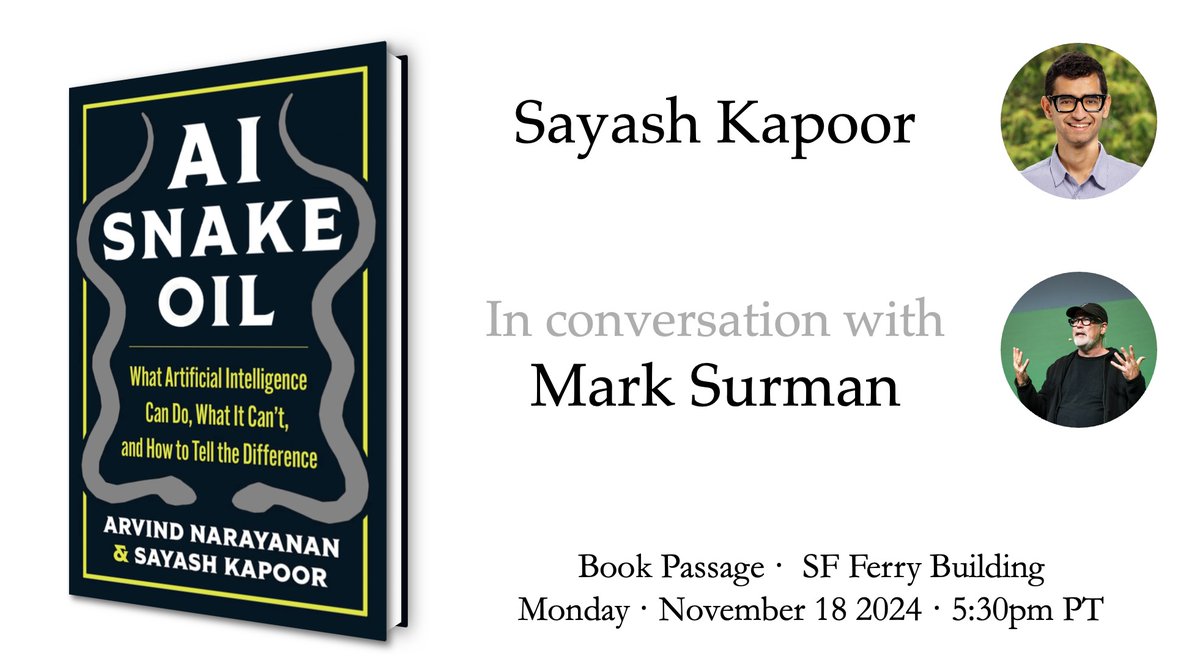
Folks in San Francisco: I'm doing a book talk on AI Snake Oil with @msurman. Come hear us discuss the future of AI, why AI isn't an existential risk, building AI in the public, and what goes into writing a book.
November 18, 5:30pm. RSVP: https://t.co/ILT6q6gNXV
Big big job ad:
🔥Director of the Centre for the Study of Existential Risk (CSER) at the University of Cambridge🔥🏛️
You get to lead this lovely team of researchers and shape the world's first masters in global catastrophic risk - link in next tweet
Are you interested in exploring questions at the ethical frontier of AI research?
If so, then take a look at this new opening in the humanity, ethics and alignment research team:
https://t.co/fEUFqQ678y
HEART conducts interdisciplinary research to advance safe & beneficial AI.
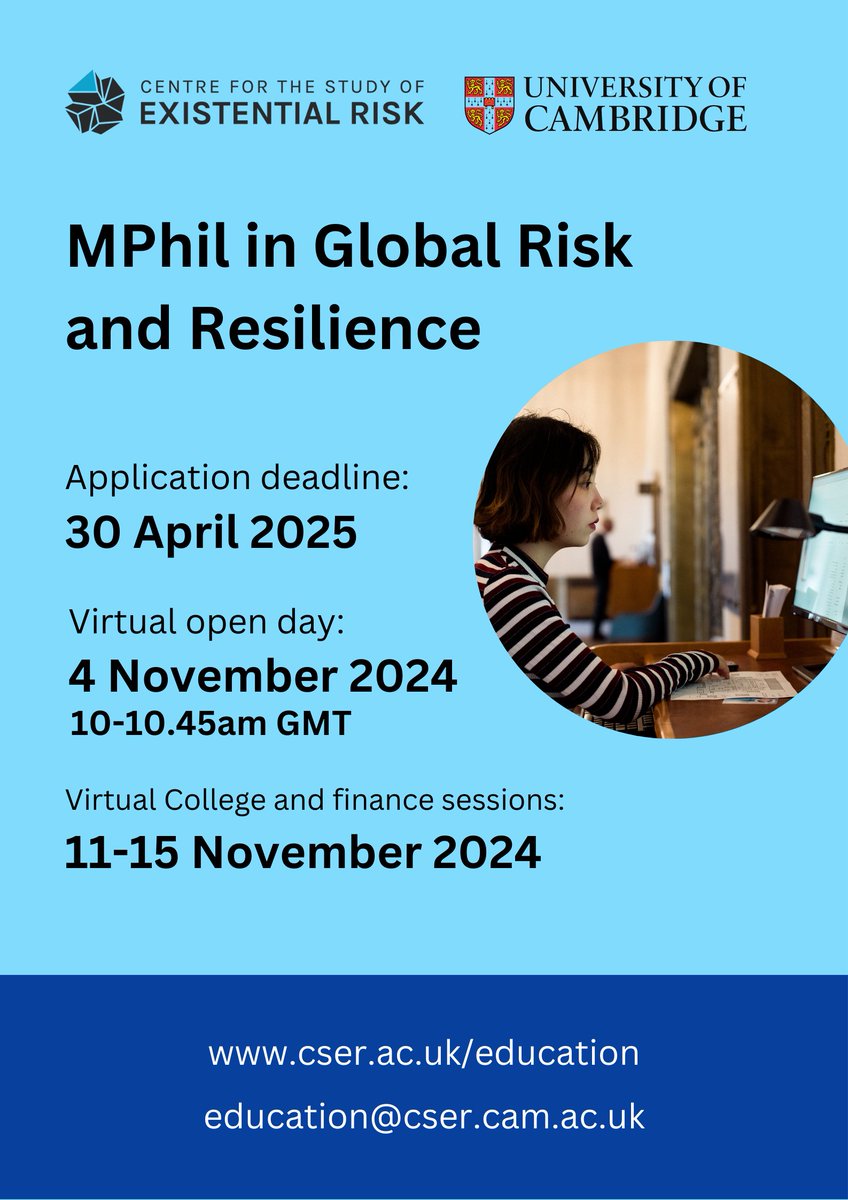
🌍 Applications are now open for CSER's MPhil in Global Risk and Resilience!
If you're interested in learning more, be sure to register for our virtual open day on 4th November 2024.
#cambridge#mphil
Policymakers are pushing for AI labels.
In my latest for @techpolicypress, I explain why that is not enough to support trust in media.
https://t.co/p1wpzoE9dH
Our team spent several months speaking with firms working on foundation model evals. While they can be useful, they are not sufficient for ensuring the safety of a model, and suffer from a range of theoretical, practical, and gaming issues. A critical read for AI safety policy.
This looks like a very helpful framework for thinking about responsible open model releases, thanks to @PartnershipAI and @github for convening the workshop that led to this report! https://t.co/fJ5EF0sI3l
If you're curious about:
– AI agents 🤖
– The values they embed ⚖️
– Human relationships with AI 👫
– The choices in front of us now ✊
Then check out our new podcast with @justinhendrix, @ShannonVallor & @techpolicypress:
https://t.co/Tb1JrTA0zy
Check out this *PUBLIC* webinar I'll be moderating with this stellar, wise crew representing @adobe@witness@OpenAI@BBC, on how they applied PAI's Synthetic Media Framework to real world scenarios.
🗓️June 18, 9amPST/12EST
Register here! 👉 https://t.co/wR7sTAmsgK
New blog post from @halcyene @wonderlikeours and I on the future of the UK AI Safety Institute and AI safety after Seoul.
Tl;dr: We need a shift in the the 'what and how' that AISI works on, backed up with new statutory powers and a joined-up AI regulation strategy.
How can we actively pursue harm reduction strategies for open foundation models without hindering their accessibility? We co-hosted an expert workshop 👇 on this and related questions with @PartnershipAI following up on our NTIA response https://t.co/ak6i0LLFFf
Super excited to share that our Brussels team is growing! 🚀
Join my team to work on EU & international governance and regulation, AI accountability and risk management in practise, rebalancing power and democratic oversight for AI.. and much more!
https://t.co/q7hgTRaV0m
Have your say! @PartnershipAI has just released their Guidance for Safe Foundation Model Deployment and they're seeking public comment until Jan. 15, 2024. @TorontoSRI Director @ghadfield is on the steering committee of PAI's Safety Critical AI Program.
https://t.co/FRfkIfmQP3
This is one of the most comprehensive, nuanced and inclusive frameworks for responsibly building and deploying AI models through an open approach. PAI's leadership has been invaluable in bringing together many different opinions and offering clear guidance for AI model builders.
The @PartnershipAI brings together industry, civil society & experts as companies like ours look for the most responsible ways to develop & release AI models. Its draft guidance establishes much-needed best practices for open & restricted releases - an important step when the world is working out how to strike the right balance between rapid AI innovation & the need for sensible guardrails.
https://t.co/v2zWxMPSpy