This platform would be so much more fun if people had an earnest interest in things abroad instead of just constantly shitting on other countries and cultures. It's so tiring.
@mattpocockuk I am not a fan of plugin route. The beauty is the shadcn model where I can adapt them to my environment. The dependency between the skills are not entirely clear to me, and that seems relevant to document better.
Anthropic === drought incoming
OpenAI === here's the firehose, have fun
Anthropic is making me uneasy with the rationing and unclear TOS (we are losing `claude -p` on subscription now?).
OpenAI is the opposite with the usage resets and very generous limits.
Wrote up Anthropic's self-own about Claude Code pricing from this afternoon on my blog - it turned out they'd reversed course just as I hit publish, so I've tried to update it to reflect the current state
https://t.co/uv6zTExj4q
Yes, the risk of giving mutation permission is questionable here. Especially with Shopifys non existent backup/rollback.
One easy win would be to split mutation permissions into updates and deletes. The biggest risk is losing your GID references via deletion. That is not recoverable right now.
But if you or an AI updates something to garbage (eg. removes all descriptions) at least you can recover with a simple journal or backup.
I would be fine with giving AI permission to almost everything if it just couldn't delete resources.
@liam_at_shopify@ShopifyDevs@tobi
This is really cool, but using it in production feels risky right now. Shopify desperately needs better audit logging and git-like version control: full visibility into what changed + easy one-click undo
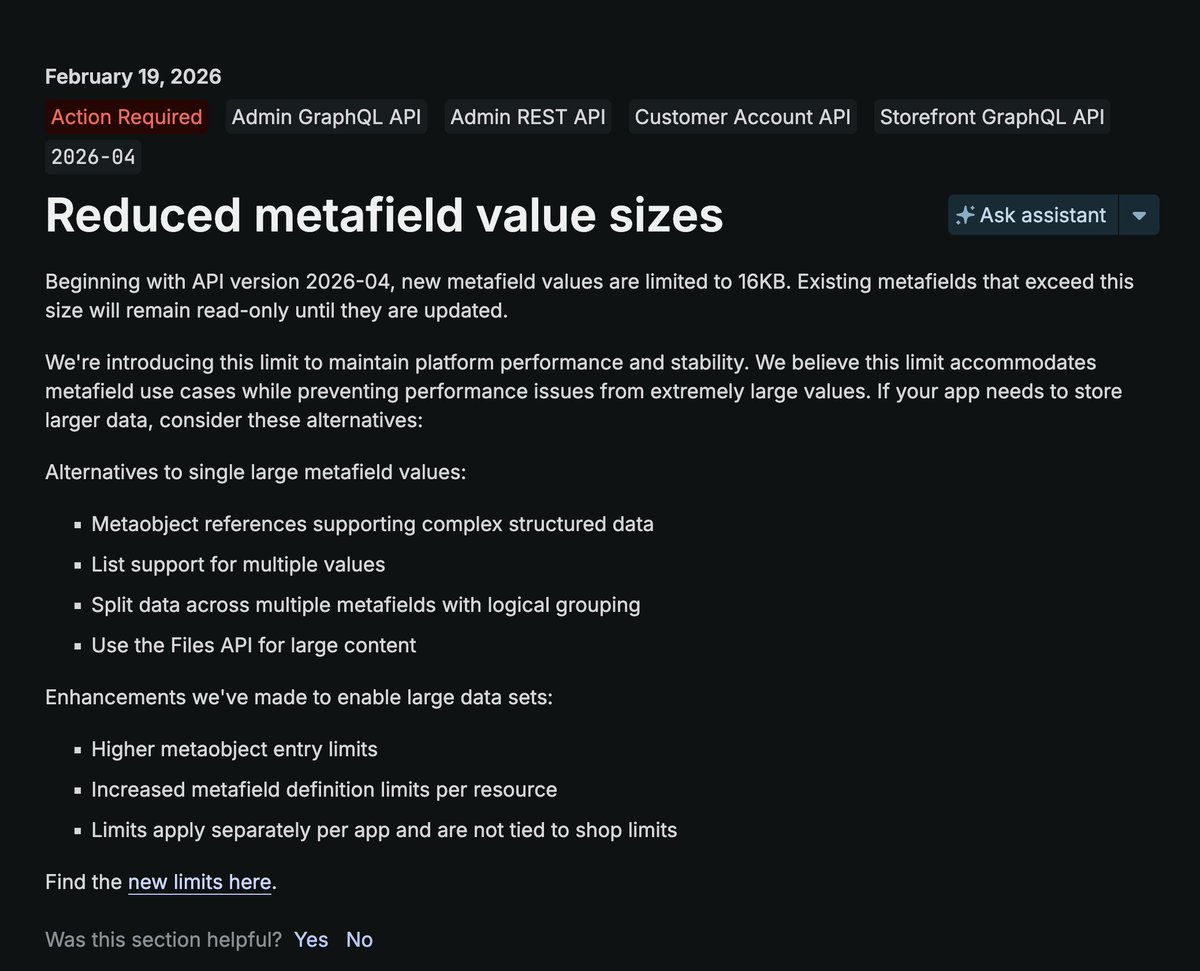
opinion: this is a detrimental change for merchants.
part of what makes building storefront apps easier than before is metafields. it has its issues (like inconsistent caching), but it also allowed us to scale up to serve merchants at insane scale. and merchants + their dev teams love it too. so much so that they explicitly look for apps that expose - and heavily rely on - metafields.
this change effectively forces us to build our own infrastructure, stumble and learn how to do it right along the way.
which is not bad, in isolation, but considering that merchants need apps to be as performant as the work they're putting into their storefront, this means merchants will struggle with building the right experience for their customers.
infra cost to serve this - as a business - is probably something else to think about. i'm going to assume it's not significant for now.
some will see this as a "skill issue". well maybe so, but i'd much rather use our time to expand what our products do.
that's not to say i don't get why they did it. it seems like the decision wasn't easy. the way it's being done though doesn't feel right - more so for merchants (the actual end customer), than anyone else.
Shopify is reducing metafield size by 99%.
This is drastic change. Our setup relies heavily on the flexibility of the metafield system and this reduction is honestly making us less reliant on Shopify. Many processes and flows will be migrated away from Shopify as a result.
It's such a hassle to develop around super strict limits that it becomes easier to choose something else.
@tobi@liam_at_shopify Please reconsider this. I would much rather being charged more if that is part of the issue.
Our house is from the 1960s and has always struggled to stay warm while we've lived here. We blamed the old boiler for years and figured it just couldn't keep up. Yesterday, with Claude's help, I finally debugged it 🥳
After many failed attempts, I found a setting for an outdoor temperature sensor set to "on" even though we don't have one. The manual said it would be ignored without a sensor, but Claude had the idea that there might be a bug/undocumented behaviour where the system overwrites the set temperature to some default every time it tries to read the nonexistent sensor.
That matched what we were seeing. The boiler was set to 80C, but the system kept reporting 50C internally. This wasn't even visible in the normal user interface. I (we?) only discovered it by digging into a hidden "technical service" menu. If I adjusted the dial, the internal temperature would update correctly but an hour later, it was back to 50C.
Set that outdoor sensor setting to 0, and the problem is gone.
It sounds simple but this was maybe the 10th hypothesis I tested with Claude. The boiler interface is deep, endless nested menus, cryptic codes and numbers, all navigated with just 5 buttons. You have to cross-reference the manual (long and technical) constantly. It's been professionally serviced twice, and I doubt any technician would have caught this.
Anyway, after weeks of sub zero temperatures here in Denmark, our house is now absurdly warm. I guess we'll dial it a little back but for now we are just enjoying. Feels like our house levelled up. 🌟
@NickPresta@tobi Oh, not exactly but thank you. I have read and use those. What I meant is a reference of dimensions, measures, joins etc.
I should have been more clear.
@NickPresta@tobi Oh, not exactly but thank you. I have read and use those. What I meant is a reference of dimensions, measures, joins etc.
I should have been more clear.
Did you know you can query ShopifyQL directly from python?
Use it in your jupyter notebooks or tell calude code about it to get any dashboard you want https://t.co/LCNN7Mu23X