Mark Zuckerberg: “I don’t think that we need some kind of industry-wide coordination... I think that just each lab needs to take the time, and when it sees that there are issues, you just take the time that you need internally to make sure that you’re proceeding safely…
“we’re entering a phase where trust and alignment is actually going to be the most important next set of capabilities. I think we’re getting to a point where it may not matter that much how much better it gets at math.
“I happen to think that there’s plenty of commercial incentive to get this right.
We delayed the launch of Muse for a few months because we wanted it to be a better product for users. This was not a sacrifice on our part, but rather the right decision for the users and for Meta. I believe this approach would also be correct for other companies working on developing this technology.
“When you hear people in the industry talk about some trade-off between capabilities and getting it aligned, I just disagree with that. I believe that alignment is actually the next most important ability to master if we are going to make this system useful to many people.”
I’ve seen a couple of posts about this so wanted to demystify. Today, every Muse user gets a free computer in the cloud. It's a real computer, and we’ve designed the security architecture of the Muse Secure VM carefully so you and your Muse can do almost anything you could with a computer sitting under your desk while keeping you and the system safe from threats like prompt injection. We wrote about this at length in our security blog post – https://t.co/7HmiTrzoTd. Activity in the “runtime cell”, which you share with your Muse is unfettered, but sensitive actions are all overseen by the Sentinel, which runs outside of that cell. Similarly, all sensitive secrets - like the passwords you enter into Muse’s secure credential storage - are also stored outside the runtime cell.
The runtime cell gets its own root filesystem (including a full Ubuntu linux image) separate from the host filesystem where your other more sensitive data lives. Because it is isolated from the sensitive stuff that runs on the same box, this means that we can, and do, offer users full visibility and control over the files in the runtime cell. Just as you can when you install Linux on your home computer, you can poke around and see all the files that make the system work - both debian system files and the binaries and data files that implement the parts of Muse which run in the runtime cell.
This was a very deliberate choice - your Muse Secure VM truly is your own computer in the cloud. You can install software in it, write and compile code, use the browser to surf the web: it is your own Linux box that you can operate as you choose with your Muse. Poking around in this computer doesn't give you any privileged access to Meta infrastructure, or to other people's data
If I may geek out a little here for a second… As a kid I loved to take things apart to see how they worked. As a teenager I got into computers and soon found myself drawn to C:\WINDOWS\SYSTEM and the system registry, later Slackware’s /dev/, /proc/ etc – I could see how the system was laid out and as I explored what DLL files and .so files actually did, I gradually became able to meld the computer to my own will.
We’re really proud to be able to put a real computer in millions of people’s hands with a similar level of transparency. We built a file explorer right into the Library tab of the UI. We want you to be able to see the markdown files Muse writes while it thinks about how to serve you better, and explore the internals of the system if you’d like to.
So, when you ask your Muse to show you its entire filesystem, and receive gigabytes of files you’re seeing the full contents of the runtime cell. It’s yours to explore and enjoy!
If you’re not a geek like me, or simply want to download the data that you personally have created directly with your Muse, we added a feature for that too in Settings > Data controls > Download your agent data.
We used to get hurricanes all the time. Big, powerful storms—beautiful storms, but they were a disaster. And you know why? Because they didn’t respect America, they thought we were weak. So I called NOAA and FEMA and said “we’re changing it to the Gulf of America, because these hurricanes have gotta stop pushing us around, it’s not good.” And the weather people said “sir, you can’t just change the name of an ocean, it won’t stop the hurricanes, they’re too strong!” But we changed the name and we got Tim Apple to change the maps and now we don’t have hurricanes anymore.
Flight delayed 7 hours - asked Muse to file for compensation. 5 mins later i had $250 credit in my delta account. it even found and rebooked me a new flight.
it just figured everything out. even responded to the support email itself.
shit feels like magic.
There’s no way any of us can predict the impact that AI will have on companies, sectors or consumer behavior (which has been, for all of history until now, human behavior).
But to claim that it won’t have an impact and simply brush it off lacks both humility and creativity.
Tactics that worked when consumer behavior was dictated by human psychology will fall by the wayside, and those that fail to adapt will be left behind.
Every day from now on we will see new examples of areas where friction was profitable becoming cost centers for companies that don’t react in a timely enough manner.
Today you might realize just how many flight credits, loyalty points or promotional offers you’ve never used that will end up utilized by agents. What impact will that have?
Tomorrow, you might see something that makes you ask how much money health insurers make simply because people won’t sit on the phone for 5 hours trying to get coverage approved unless it’s a massive expense and/or life or death matter.
What about your savings account? That money could be in a money market fund, but you haven’t bothered to move it. How much in net interest income is made because of that friction?
The coming years will be some of the most interesting for investors who are intrigued by paradigm shifts and their ripple effects.
I, for one, could not be more excited to see how it all plays out and invest through the changes.
Muse is as good as everyone says, but something I’m especially getting a lot of value out of is the Ideas and Feed tabs. Solves the cold start / empty chatbot problem by suggesting things I wouldn’t think to prompt
Very good point by Ben Thompson
Bullish for $META and $GOOG
Muse proves, Distribution, Taste, and Compute availability > Frontier Intelligence (at least in consumer)
I put Instinct in charge of Grokbot, Muse, and Codex in a private group chat.
It had to tell Grok Bot to stand down.
Then told Muse to go fact-check herself.
It just told Codex it's in 3rd place.
How they worked together blew my mind... They didn't even argue, they actually were apologizing to each other while pushing each other to do the job better.
Here's the video of the entire conversation.
I can’t unsee it. I don't care if there's a new agent every week, if they can just join the group chat.
America’s corporate governance system is broken, and it’s killing public companies. Look no further than Cracker Barrel: Decades of brutal mismanagement have seen one incompetent CEO after another walk away with a massive paycheck while customers and actual shareholders take a beating.
Why does this keep happening? Because proxy advisory firms like ISS are corrupt. They blindly rubber-stamp failing boards year after year, protecting the corporate elite while burning shareholder value to the ground.
The root of the rot is index funds. There's no question that indexing one's money is a smart financial move for most people. But just because you passively index your investments doesn't mean your corporate votes should be handed over to the managers of your fund so they can play politics. Right now, passive funds hold massive, unchecked voting blocks while having zero skin in the game themselves.
It is time for a simple rewrite of the rules: We need to index the votes of index fund investors.
Passive index funds should be forced to automatically split their votes to proportionately mirror those of retail and active institutional shareholders — the people actually doing the research, risking their capital, and fighting for performance in the companies they hold shares in. No more rubber-stamping. A change like this will immediately strip corrupt gatekeepers like ISS of their toxic influence.
True accountability happens when lazy, overpaid boards actually answer to the stakeholders they represent, rather than screwing them over.
Actual, logic-driven governance when your money is passive happens when your vote passively follows the voting decisions of the actual market.
We need to stop letting passive capital protect active incompetence. By stripping index funds of their arbitrary voting power and empowering engaged investors, we will finally torch corporate cronyism and usher American capital markets into a golden age of capitalism.
The most insightful thing I read about technology eleven years ago was @benthompson’s Aggregation Theory. Amazon blocking Muse is another perfect example.
Customers want one agent that knows them and can get things done. The platforms being aggregated want the opposite. They want to own the customer relationship, not become interchangeable suppliers behind someone else’s interface + protect their ad business.
Imagine groceries: Your agent can compare Amazon, Instacart, DoorDash, and Uber Eats, then route every order to the best option. Amazon can block that access because it is a gigantic company. But smaller players have every incentive to offer agents a clean API and a seamless experience.
If Instacart embraces agents while Amazon blocks them, the agent will increasingly route demand to Instacart. Customers will be happy, and Amazon will eventually face the dilemma: keep protecting the relationship, or match the better value proposition.
This will be the defining tension of the agent economy: aggregators realizing they are now being aggregated.
Amazon will push its own assistant, of course. But a vertical Amazon agent will struggle against a horizontal agent that already knows my email, calendar, preferences, memories, and entire life context.
Many companies will want to become the aggregation layer. Very few actually can.
We’ve never seen anything like this before. A man was conscripted into jury duty by the government. He performed his civic duty and followed his conscience, refusing to acquit a woman who confessed to systematically executing her three children. The defense attorney immediately launched a public smear campaign against the juror. Soon several other jurors joined the campaign. Then the media. Even the defense attorney’s wife has joined. Now they’re doxxing the man, digging into his past, contacting his family, showing up at his house. All of this both to punish him for refusing to go with their program, and to pollute any future jury pool by making it clear that anyone who votes to convict Clancy will have their life destroyed. It’s truly one of the most outrageously evil things we’ve ever seen from the Left, and that’s saying something. A direct assault on the integrity of our justice system. They are burning down every boundary and standard in their path. And doing it all for the sake of a child murdering psychopath. Unfathomable.
COVID is such a funny topic for anyone who has a memory longer than 6 years. The right at the beginning was concerned about this disease and called for locking down travel from infected countries. The left called this racist, Nancy Pelosi went to China town and told people to hug a Chinese person. Trump spearheaded the vax development the left claimed they would never take the Trump shot.
Then the same people who called shutting down flights to China racist started saying your kids can’t go to school anymore. The ones that said they’d never take the Trump shot we’re going to fire you if you didn’t take it.
It’s ok to admit pretty much everyone lost their heads during the pandemic. It’s pretty dumb to pretend that never happened.
🚨 BOOM! All the hospices are gone. Not a single hospice remains. No more luxury vehicles and no more of your dollars funding their fraudulent scheme. They were all frauds.
In this one location alone we saved America $30 million+.
END IT ALL.
JUST IN: Analysis reveals young Americans without college degrees are enjoying a "historically strong" job market, while recent college grads face conditions rivaling the 2008 recession & pandemic era.
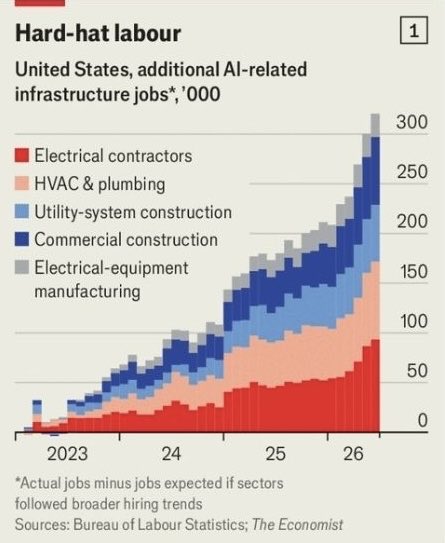
Our analysis suggests that AI has so far created around 1m new jobs in America. We explain how the technology has created a hiring boom https://t.co/bywoXNJQ7A