AI Teams providing business owners, traders and investors with institutional support. Level playing field for individuals vs institutions. Led $QUBT to Nasdaq.
Follow up question to Google :
if AI interviewing is not fair and not ethical as you just said, should companies be prohibited to use it ?
I disagree with the answer in screenshot below ….
Bias should be ilegal not “controlled”
Classic Problem Groups for Young Mathematicians (Age 7)
Can you solve it ?:)
Three boys need to cross a river.
The boat can carry only 100 kg.
Two boys weigh 50 kg each, one boy weighs 100 kg.
How can all three cross?
300 stocks. Include or exclude each one.
That's 2³⁰⁰ possible portfolios — roughly 2 × 10⁹⁰.
The number of atoms in the observable universe? About 10⁷⁰.
So we're talking 10²⁰× more portfolios than atoms.
Now here's the uncomfortable truth about "modern" portfolio optimization:
Markowitz's Mean-Variance model — still taught in every MBA program — assumes you can evaluate all possible combinations and find the global optimum.
You can't.
Even the world's fastest supercomputers can only scratch a vanishingly tiny fraction of that search space.
Enter quantum.
Here's exactly what happens, step by step:
① Reformulate as QUBO
Each stock gets a binary variable (in or out). The portfolio problem becomes a Quadratic Unconstrained Binary Optimization — minimizing risk, maximizing return, respecting cardinality — all in one mathematical object.
② Encode into a quantum Hamiltonian
The QUBO matrix maps directly onto an Ising Hamiltonian. Each qubit = one stock. The lowest-energy state of this quantum system = the optimal portfolio.
③ Superposition
The quantum register initializes across ALL 2³⁰⁰ states simultaneously. Every portfolio exists in the system at once. Classical computers evaluate one at a time. Quantum holds them all.
④ Tunneling & interference
Quantum annealing lets the system tunnel through energy barriers that trap classical algorithms in local minima. QAOA uses alternating quantum circuits to amplify good solutions and cancel bad ones — like noise-canceling headphones for bad portfolios.
⑤ Measure
Collapse the quantum state. High-quality portfolios emerge with high probability. Run multiple shots. Extract the distribution.
⑥ Classical polish
Feed the top quantum candidates into a classical optimizer for final refinement — transaction costs, rebalancing constraints, CVaR adjustment.
The result: instead of searching 10⁹⁰ combinations, you explore the full space in superposition and collapse to near-optimal solutions.
#Investing #StockMarket #Stocks #Trading
The below problem is trivial for Quantum methodology - do not need Quantum Computer
Let's say we choose portfolio from 300 available stocks.
For each stock, you can either include or exclude it from a portfolio → 2 choices per stock.
Total possible portfolios (ignoring weights, just selection): 2³⁰⁰
That equals roughly 2 × 10⁹⁰ — about 10²⁰ times more than the estimated number of atoms in the observable universe (10⁷⁰).
Let that sink in.
Now, ask yourself: how has portfolio optimization worked for decades?
Mean‑variance optimization (Markowitz) assumes you can evaluate all possible combinations.
Even with supercomputers, you can only explore a vanishingly tiny fraction of that space — like trying to find one specific atom in 10²⁰ universes.
The Physics Behind Faster-Than-Light Coordination
Quantum entanglement is not science fiction. It is an experimentally verified physical phenomenon with loophole-free Bell inequality violations confirmed at separations up to 1,300 km.
Quantum Telepathy & Coordinated Trading
Bell inequality violation provides rigorous mathematical proof of quantum advantage without complexity-theoretic assumptions. Applied to HFT, this enables coordinated decision-making across geographically distributed trading venues faster
Quantum Game Theory & Strategic Decision-Making
Quantum game theory extends classical game theory by allowing players to use quantum strategies, such as entanglement and superposition. This provides advantages in multi-agent trading environments
QUANTUM ANNEALING DIGITAL TWIN & AMAZON OPTIONS TRADING
High-Qubit Classical Simulation + Quantum-Enhanced Strateg
Building a production-ready D-Wave Advantage 2 digital twin on 64GB RAM classical hardware
and leveraging quantum-methods for superior Amazon stock options trading
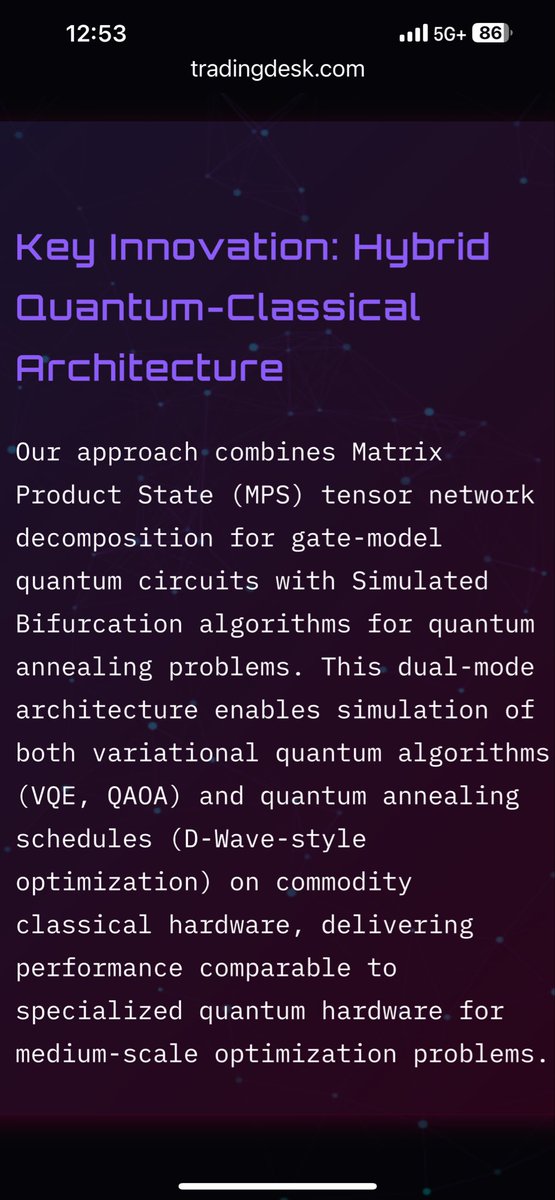
At Magical Industries all our apps run on digital twins of all major types of Quantum Computers (below).
Why Digital Twins for Quantum Computing?
Digital twins — high‑fidelity classical simulations calibrated to real quantum devices
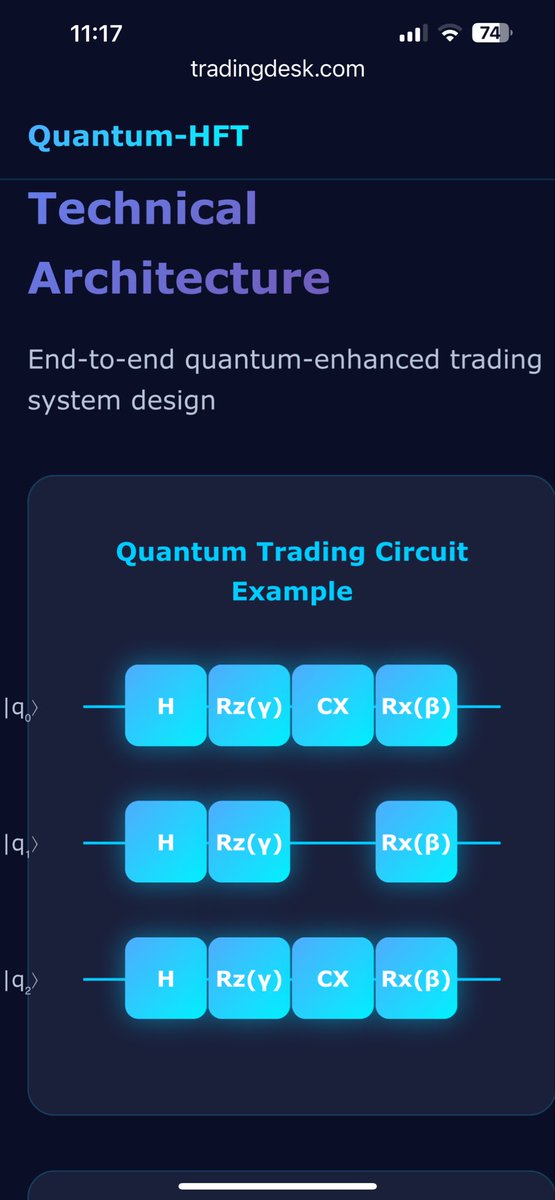
Magical Industries LLC just released first 100 percent Quantum high frequency trading system (starting with Equities and then Cryptocurrencies) which will be presented in about 20 posts. If you interested in real time performance results please let us know.
Every institutional portfolio optimizer has a dirty secret.
It doesn't find the optimal portfolio.
It finds the best portfolio it had time to check.
Here's why — and why quantum computing changes it fundamentally.
Markowitz mean-variance optimization is textbook clean: minimize variance, maximize return, solve a quadratic program. O(N³). Classical computers handle this fine at 500 assets.
The moment your compliance team adds real constraints?
✗ "Hold no more than 30 positions" — cardinality constraint → NP-hard
✗ "Keep tech exposure under 25%" — sector cap → integer variables → NP-hard
✗ "Minimize turnover above 15%" — transaction cost → mixed-integer → NP-hard
✗ "CVaR must stay below 8%" — tail risk constraint → stochastic programming
Stack three of these together at N=300 assets. You've just created a problem that no classical computer can solve optimally. Branch-and-bound takes hours. Genetic algorithms find local optima and call it done.
This is why quantum optimization isn't theoretical for finance — it's the only path to true constraint-aware optimality at institutional scale.
The quantum formulation: map the portfolio to a QUBO (Quadratic Unconstrained Binary Optimization) problem. Every constraint becomes a penalty term in the Hamiltonian. Run QAOA or quantum annealing. Quantum tunneling physically escapes local optima that trap classical algorithms.
Real hardware benchmarks:
→ D-Wave Advantage: 5000+ qubits, production QUBO problems, ~200 assets today
→ IBM Quantum / IonQ: QAOA experiments on 50–100 qubit systems, scaling fast
→ Quantum-inspired (Fujitsu, Toshiba): 100–1000× faster than classical MILP right now
The quantum advantage in portfolio optimization isn't a future promise. It's a present capability — at the constraint complexity level most serious PMs actually face.
What constraints are your current optimizer quietly giving up on?
#PortfolioManagement #QuantumComputing #QUBO #AssetManagement #RiskManagement #QUBT #InstitutionalInvesting
A supercomputer running since the Big Bang still couldn't finish this calculation.
Finding the optimal portfolio from 300 assets — with real-world constraints — requires evaluating more combinations than there are atoms in the observable universe.
10^90 possible portfolios.
#QuantumComputing#PortfolioOptimization#QuantFinance#QUBT#AlgoTrading#FinTech
"Quantum AI Singularity" is trending on LinkedIn.
Here's what's actually happening (from someone who spent many years inside Quantum and AI industries):
Everyone's talking about the "convergence" of quantum and AI creating some magical singularity moment.
Reality check:
❌ There is no "quantum AI singularity"
❌ Quantum computers won't suddenly make AI conscious
❌ We're not weeks away from AGI via quantum
What IS happening (and it's exciting enough without the hype):
1️⃣ Quantum-INSPIRED algorithms are working TODAY
→ Multiverse Computing compressed LLaMA models 80% using quantum-inspired tensor networks
→ Running on CLASSICAL hardware
→ Deployed at Moody's, Bosch, BASF right now
2️⃣ Hybrid quantum-classical systems showing real gains
→ HSBC used IBM's quantum system: 34% better bond trading predictions
→ IonQ demonstrated quantum-enhanced LLM fine-tuning
→ Google's Willow chip: below error correction threshold (December 2024)
3️⃣ The actual timeline
→ Quantum advantage for specific AI tasks: 2026-2029
→ Fault-tolerant quantum computers: 2029-2033
→ General-purpose quantum AI: 2030s+
What matters for investors RIGHT NOW:
→ Post-quantum cryptography (NIST published standards Aug 2024 - migration deadline approaching)
→ Hybrid classical-quantum algorithms (working today, not 10 years from now)
→ Quantum-inspired optimization (20x faster AI training without quantum hardware)
The "convergence" isn't a singularity. It's a gradual hybridization.
And yes, it's transformative. But let's be honest about timelines.
#QuantumComputing #AI #DeepTech #VentureCapital