Simple tools for retail traders: hidden costs, spreads, sizing and discipline. Any platform, any market. Free worksheet below. Education only, not advice.
Most traders judge a strategy before costs. Spread, commission and swap can turn a "winner" into a loser. Free True-Cost Check, a one-page worksheet for any platform or market: https://t.co/O05IHFdLkv
True-Cost Trading Journal & Position Sizer, Excel or Google Sheets, any platform. US$19: https://t.co/8IK6Do6cFs
Education only, not financial advice.
A month can look fine in dollars and weak in R after costs.
If you want a sheet that shows each trade in money and in R, before and after costs, the link is in the next post.
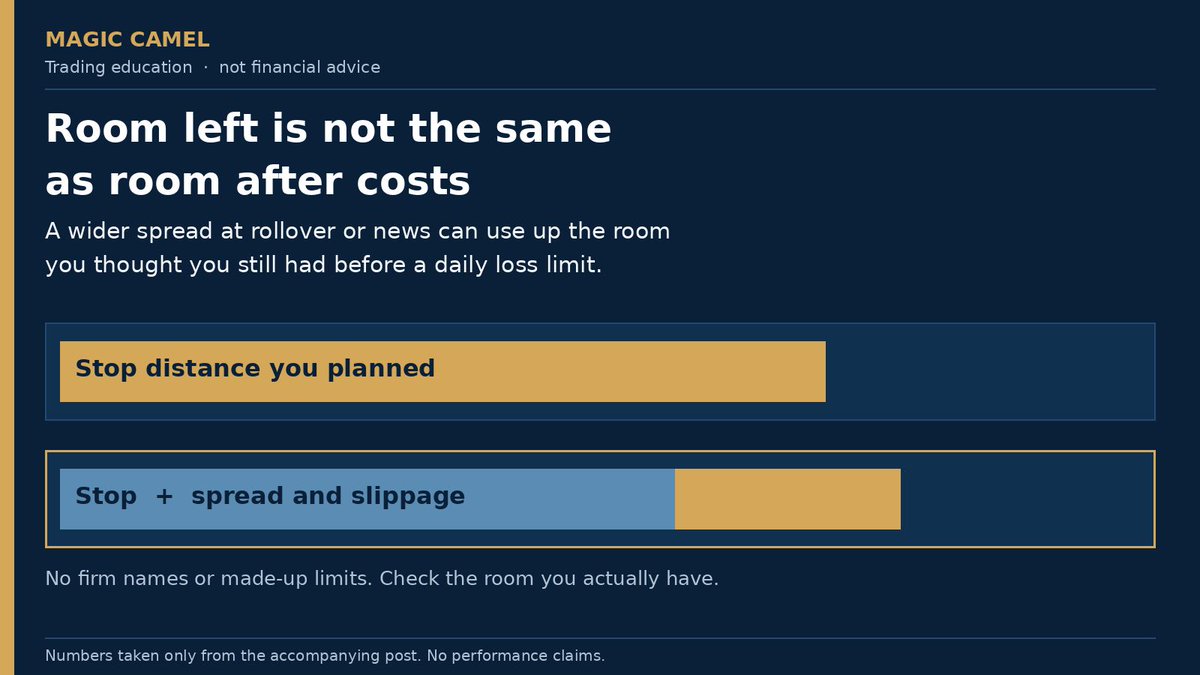
A wider spread at rollover or news can push a stop through a daily loss limit.
The entry wasn't wrong. The all-in cost was bigger than the room you had left.
Are any trades still open over the weekend close?
Weekend gaps can jump past a stop, so the real loss can be bigger than the planned 1R. Log the actual fill, not the stop price.
@Liquidity_Thry More likely many painful losses 🤣 good habits build over time. The process iterates until it becomes boring, repetitive and ultimately less ‘painful’
@Adarsh_Onchain Understanding costs is also key. Edges are tiny in the crowded retail world and profits are easily wiped out once real costs are factored in. Knowing which trades to take and which to leave is an important part of it.
Gross profit is a world with no spread, commission or swap.
Net profit is what you actually keep. When you compare strategies, compare the net numbers.
Costs per trade look tiny. Costs per year rarely do.
Multiply your average cost per trade by how many trades you take in a year. That is the hurdle your method has to clear first.
@amalxit To start with the rules need to be written down, codified and followed. Review the data and when you have a good sample size refine the process and do it all again. Record costs and actual returns to make sure your tracking accurately 👌
A journal only helps if you can trust the numbers.
Log the actual fill, the actual stop and the actual costs. Do you log the fill you got, or the price the platform rounds to?