@HyperTechInvest This advertising isn’t for their future potential customers. It’s advertising themselves as the customers for more land and power purchases
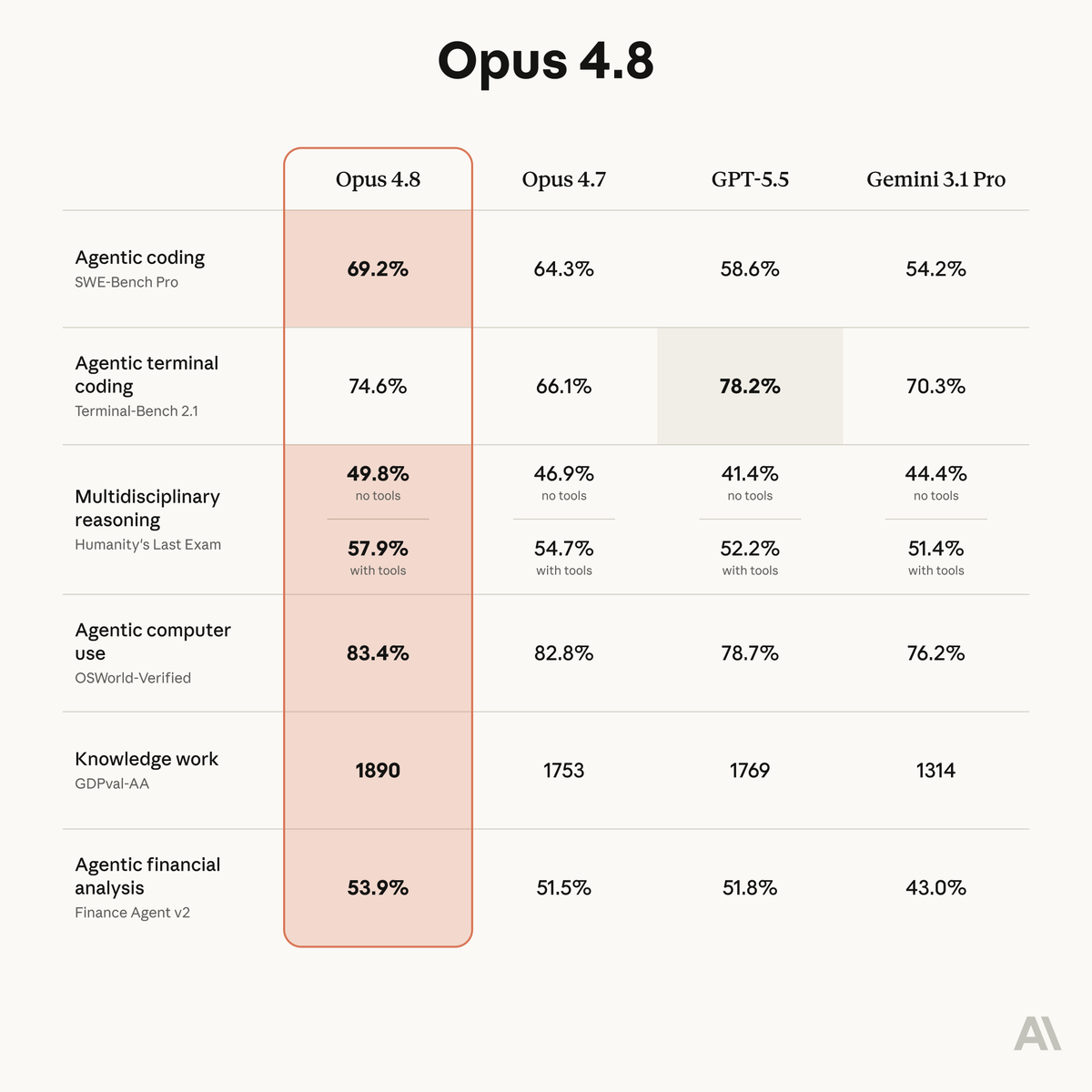
Introducing Claude Opus 4.8: it builds on Opus 4.7 with sharper judgment, more honesty about its own progress, and the ability to work independently for longer than its predecessors.
Available today at the same price.
Fast mode is available for Opus 4.8. It's the same model at roughly 2.5x the speed, and we've made it three times cheaper than before.
Turn it on with /fast in Claude Code. On the API, contact your account manager to request access or join the waitlist: https://t.co/5SLFF77Whn
Dude, this is embarrassing. This post proves you have 0 clue on either $IREN or $NBIS.
Are you seriously claiming the $BE agreement with $NBIS is a type of colocation deal or is replacing Nebius’s existing deal with Data One? Are you seriously this clueless?
$NBIS is paying Bloom Energy ON TOP of what they are paying to Data One (their colo provider). That’s where the criticism stems from. This will squeeze their margins as it relates to their $MSFT deal.
Regarding “designing their own rack”. $NBIS bulls love to overstate this aspect of ‘vertical integration’. But in reality this is a low margin business for OEMs like $DELL.
At this scale, $DELL is making ~5-7% margins on their racks at best. But the reality is, OEMs have a serious manufacturing advantage over $NBIS in terms of economies of scale, which lowers their cost basis.
So in reality, $NBIS could *perhaps* capture 2-3% of that margin at best, and at worst it could actually be more expensive developing & building your own racks.
Manufacturing specialisation exists for a reason. The companies with more scale, in this case the OEMs, will always be able to produce their product cheaper than your custom build.
When $IREN investors talk about full vertical integration, we are referring to the data center facility itself and the land it sits on, not the indvidiual components that make up the data center.
The advantage here is that $IREN has full control of the development process of its facilities, meaning they don’t have to pay rent (colocation lease) to any third party + got a much higher degree of flexibility.
Jensen Huang just settled the AI jobs debate in one answer.
Huang: “All the engineers at NVIDIA today use AI. AI basically does most of our coding. And yet we’re hiring more engineers than ever.”
The largest AI chip company on Earth.
Every engineer uses AI.
AI handles most of the coding.
And headcount is going up.
Not down. Up.
For three years, the consensus was simple. AI automates, humans exit.
NVIDIA just broke that thesis in one sentence.
Huang: “Our ambitions are greater than ever. Our expectations are greater than ever.”
This is the part nobody sits with long enough.
AI didn’t reduce what NVIDIA could do.
It detonated what they were willing to attempt.
The workload didn’t shrink. The vision outgrew it.
When ambition scales faster than automation, you don’t cut people.
You add them.
Because you’re no longer solving last year’s problems.
You’re chasing things that weren’t conceivable twelve months ago.
That’s not a job killer. That’s a job multiplier.
But only inside the organizations that actually moved.
Huang: “How is that a bad condition for our country?”
It’s not.
The bad condition is what’s forming between the movers and everyone else.
Between the companies that retooled and the ones still running pilots.
Between the countries that committed and the ones that formed committees.
Between the workers who adapted six months ago and the ones still waiting for permission.
Huang: “In just the last six months it went from incredible but not useful to useful and incredible.”
Six months.
Not six years. Not a carefully managed transition.
Six months between novelty and necessity.
That’s not a timeline. That’s a verdict.
And when that gap compounds quarterly, “we’ll get to it next year” stops being patience.
It’s a resignation letter you haven’t signed yet.
Huang: “We’re all in on it. Supercharged by it. Exhilarated by it.”
Not cautious. Not hedging. Not “exploring potential use cases.”
All in. Supercharged. Exhilarated.
The man building the infrastructure for the entire era isn’t theorizing about what AI might become.
He’s documenting what it already is.
The shift didn’t send a warning.
It landed. Quiet. Six months ago.
And while half the world debated readiness, the other half became unreachable.
The question was never whether AI replaces you.
It’s whether AI moves the standard your entire industry measures itself against.
NVIDIA just told you it already did.
Not because anyone got worse.
Because the people who moved first quietly redefined what good looks like.
And that new standard doesn’t wait.
Doesn’t negotiate.
It just becomes the baseline.
Whether you moved with it or not.