i joined Nvidia two years ago, and there are a few things i wanted to say.
one of the biggest surprises after joining was finding out Jensen actually read employee emails. he'd write back with informed feedback and sharp, to-the-point questions.
somewhere along the way i decided that presenting in a meeting with Jensen in the room would be an awesome career milestone. i only let myself aim for it because he was that hands-on.
it hurts to know that dream of mine is dead now, and i'm deeply disappointed by how this whole thing has played out.
my fascination with NV goes back much further than that. as a kid i begged my parents for a decent GPU so i could play CoD. and 10 years back, when i wanted to get into AI, i saved up for a 1080 so i could run CUDA. i've followed Jensen closely ever since, watched every interview, and my respect for him only grew. to me, he's a one-of-one visionary and one of the most consequential entrepreneurs of all time.
Jensen stood for something bigger than his own talents: open models. i have a hard time imagining whoever comes next fighting for open models the way he did, since i believe that's exactly why he was removed.
we're at one of the most consequential inflection points in history. the stakes are even higher than the original open-source movement, and fundamentally different: this time, open models won't win by default—we have to fight to keep open source alive. if we don't, we'll pay for it in privacy, security, and extreme power concentration.
Jensen was leading that fight, and he was perhaps the only one who could.
Over the past week, I’ve been overwhelmed by the love and support of friends, industry colleagues, and people I've never met. Thank you to everyone who has shown kindness to my family and me. It means the world to me.
I came to the United States 53 years ago, and becoming an American citizen is one of the greatest gifts and proudest moments of my life. NVIDIA has been my life’s work. Building it into the company it is today alongside my colleagues has been a privilege and an honor. Nowhere but in America could a company like NVIDIA be possible. I love our country, and I love NVIDIA.
I did not live up to the standards expected of everyone at NVIDIA, and I have made serious mistakes in my personal life. I created problems for the Board that I deeply regret. I own my mistakes completely, and I am committed to cooperating with the Board’s independent investigation.
Since my departure, I’ve seen an outpouring of calls from NVIDIA’s employees, investors, business partners, and customers for me to return as CEO. Many continue to reach out to me directly as the company navigates complex technology, market, competitive, and geopolitical dynamics. NVIDIA is a once-in-a-generation company. If the Board of Directors decides that my return is in the best interest of our shareholders, our employees, the company, and America, I would be honored to answer these calls and return as CEO.
Thank you again to everyone who has shared their good wishes. I am profoundly humbled by your support. To my family: I love you, and I will spend the rest of my life being worthy of yours.
Jensen
Nvidia’s board stated today that it has found “no reason to believe that either national security or Nvidia secrets were compromised” as a result of Jensen’s actions.
They are initiating an independent investigation overseen by a committee of independent directors, assisted by outside independent counsel, that will examine all available information. This will be an unbiased, exhaustive and thorough investigation given the fiduciary responsibilities of these independent directors.
Jensen said that “I support the investigation and will cooperate fully. I love our country and our company. I am committed to protecting NVIDIA and supporting America’s national security. I am proud and grateful to be an American.”
I have known Jensen for almost 30 years. I simply do not believe he would ever knowingly do anything to disadvantage either America or Nvidia.
The only thing he has ever said to me about China is the absolute importance of keeping the American hardware ecosystem, led by Nvidia, ahead of China. That’s it.
More detailed thoughts follow below:
Quite happy to say that our paper on representation learning for dynamical systems was accepted to #NeurIPS2026 and I'll be presenting it in Sydney this December!
Very succinctly, our work, titled "Sparse Koopman Autoencoders Identify Local Dynamical Regimes in Multibasin Systems", is about learning linear representations of state for dynamical systems with multiple basins of attraction. Inducing sparsity in a latent representation can be a very powerful method to model multiple basins of attraction with linear dynamics. By training a Koopman autoencoder with a bias for producing sparse latent representations, we find that a sparse-latent model both forecasts the dynamics better and has greater ability to identify the current local regime of the current state compared to a model without sparsity-inducing effects.
More broadly, I think our work on sparse Koopman autoencoders could be relevant to both the robotics/world modeling and interpretability communities (just brainstorming here).
- Robotics: To my knowledge, switching dynamics are common in robotic systems, i.e. trajectories seem to transition between dynamical modes. With a sparse code, you could get a switch between modes for free.
- Interpretability: Sparse autoencoders might not be all the rage anymore, but I think Koopman modeling is still very natural for understanding the dynamics of models that apply the same computation at multiple steps to advance the dynamics. This applies to most recurrent models, such as looped/weight-tied transformers (dm me if you want to discuss!)
Thanks to my amazing collaborators @ukreddy126@mahanfathi@apsarathchandar@RGoroshin. I was thinking about what to say about this (clueless grad student tries to figure out social media) and this post ended up being really late lol, my bad.
See you in Sydney!
Paper: https://t.co/3nu3isFjkz
Code: https://t.co/4XIuew1buK
Meet NVIDIA Nemotron 3.5 Super VL
Our new open model combines reasoning and tool use with text, image, document, and video understanding for long-running AI agents.
120B total parameters with 12B active 🧵
🎆 Nemotron-3.5-Super-VL is here! 🎆
✅ Same base architecture as Super-3.0: 120B total, 12B active plus Vision encoder
✅ Ahead of Ultra-3.0 on most benchmarks! And now with visual reasoning!
✅ SWEBench-Pro 51.79%, AA index of 26 vs 23 for Ultra-3.0
Post-training pipeline is a greatly simplified and improved version of what we had for Ultra-3.0.
We reduced number of teachers, SFT set size while significantly improving data and environments quality and made it multimodal! 1/5
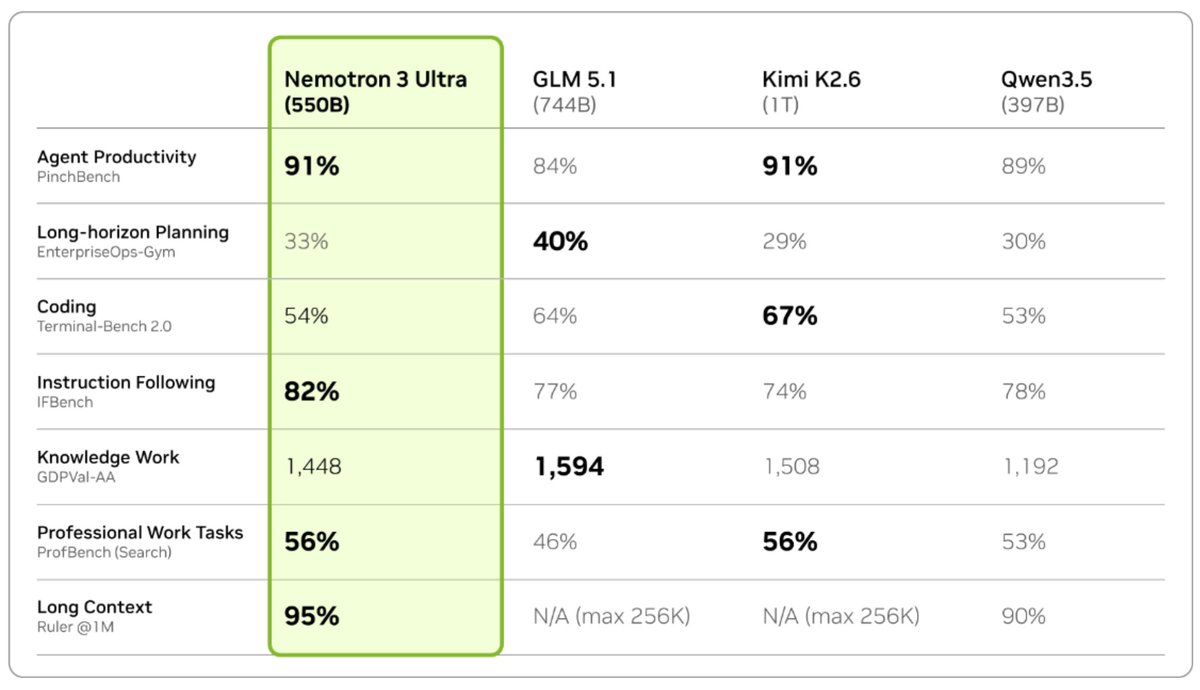
Very excited to share Nemotron 3 Ultra, 550B total with 55B active MoE hybrid Mamba-Attention model post-trained for agentic applications!
This model delivers frontier-level agentic accuracy while being fast and open with weights, training software, and data available for commercial use. 1/4
NVIDIA has just released Nemotron 3 Ultra, the new most intelligent US open weights model, with leading speed for its intelligence
Nemotron 3 Ultra scores 47.7 on the Artificial Analysis Intelligence Index, well ahead of the next strongest US open weights models, Gemma 4 31B (39.2), Nemotron 3 Super (36.0) and gpt-oss-120b (33.3), but behind the Chinese-led open weights frontier (Kimi K2.6 at 53.9).
We partnered with @NVIDIA to evaluate this model for intelligence and speed ahead of its public release. These figures use the final NVFP4 weights that NVIDIA recommends for inference, but our tests show minimal intelligence impact compared to BF16 testing, with higher precision resulting in an Artificial Analysis Intelligence Index score of 48.2 vs. the NVFP4 score of 47.7.
Key Takeaways:
➤ Nemotron 3 Ultra leads in speed for its intelligence: through BlackBox AI ahead of release, Nemotron 3 Ultra is served at over 400 output tokens per second - this is slightly faster than the typical serving speed of gpt-oss-120b despite being >4X larger, and comes with significantly greater intelligence
➤ Largest Nemotron 3 model so far: with approximately 550 billion total parameters and 55 billion active, Nemotron 3 Ultra is significantly larger than its siblings and is the largest and most intelligent US open weights model release ever
➤ Nemotron 3 Ultra is the leading US open weights model on the Artificial Analysis Intelligence and Agentic Indexes by far, but Gemma 4 31B scores ~1 point higher on the Coding Index (comprised of Terminal-Bench Hard and SciCode)
NVIDIA has released Nemotron 3 Super, a 120B (12B active) open weights reasoning model that scores 36 on the Artificial Analysis Intelligence Index with a hybrid Mamba-Transformer MoE architecture
We were given access to this model ahead of launch and evaluated it across intelligence, openness, and inference efficiency.
Key takeaways
➤ Combines high openness with strong intelligence: Nemotron 3 Super performs strongly for its size and is substantially more intelligent than any other model with comparable openness
➤ Nemotron 3 Super scored 36 on the Artificial Analysis Intelligence Index, +17 points ahead of the previous Super release and +12 points from Nemotron 3 Nano. Compared to models in a similar size category, this places it ahead of gpt-oss-120b (33), but behind the recently-released Qwen3.5 122B A10B (42).
➤ Focused on efficient intelligence: we found Nemotron 3 Super to have higher intelligence than gpt-oss-120b while enabling ~10% higher throughput per GPU in a simple but realistic load test
➤ Supported today for fast serverless inference: providers including @DeepInfra and @LightningAI are serving this model at launch with speeds of up to 484 tokens per second
Model details
📝 Nemotron 3 Super has 120.6B total and 12.7B active parameters, along with a 1 million token context window and hybrid reasoning support. It is published with open weights and a permissive license, alongside open training data and methodology disclosure
📐 The model has several design features enabling efficient inference, including using hybrid Mamba-Transformer and LatentMoE architectures, multi-token prediction, and NVFP4 quantized weights
🎯 NVIDIA pre-trained Nemotron 3 Super in (mostly) NVFP4 precision, but moved to BF16 for post-training. Our evaluation scores use the BF16 weights
🧠 We benchmarked Nemotron 3 Super in its highest-effort reasoning mode ("regular"), the most capable of the model's three inference modes (reasoning-off, low-effort, and regular)
Nemotron 3 Super is here — 120B total / 12B active, Hybrid SSM Latent MoE, designed for Blackwell.
Truly open: permissive license, open data, open training infra. See analysis on @ArtificialAnlys
Details in thread 🧵below:
🚀 Nemotron 3 Nano 30B-A3B is here! Open weights + open data + open source.
AA Intelligence Index: 52 (@ArtificialAnlys )
✅ 1M‑token context
✅ up to 3.3× higher throughput vs similarly sized open models
✅ stronger reasoning/agentic + chat
Details + links in the thread 🧵
We're looking for Summer Interns to join the Post-Training Team at @NVIDIA!
DM me with your updated resume and three concise bullets detailing your most relevant experience — e.g. publications, repos, blogs, etc.
RT please to help us find top talent.
@jxmnop@Miles_Brundage the RL updates are indeed small in the sense that they are *sparse*, however they are still *full-rank* (see https://t.co/LO0wZJsO2e). this means that LoRA would fail to recover the true base model even if we assume access to the post-training data.