I started investing at 18. I'm 26 now.
For most of those 8 years, my system was a spreadsheet.
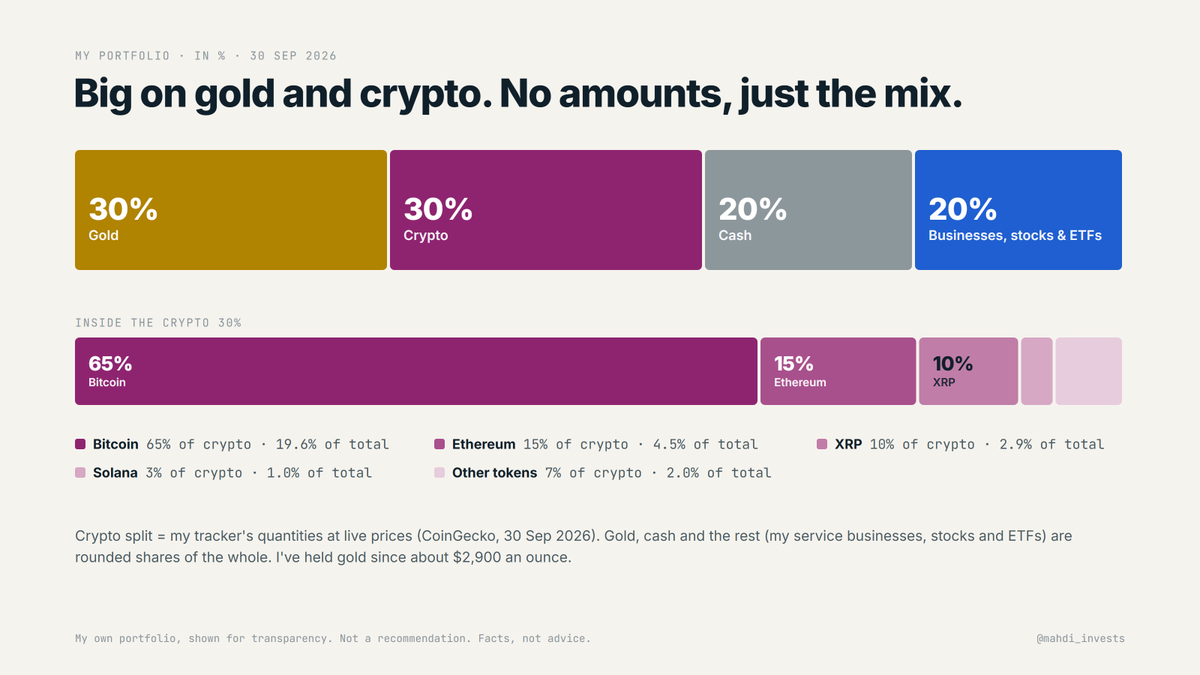
Here's my portfolio today, in %:
30% gold
30% crypto (about two-thirds Bitcoin)
20% cash
20% my service businesses, stocks and ETFs
No real estate for now. I'd rather put money to work than let it sleep in land.
How I invest:
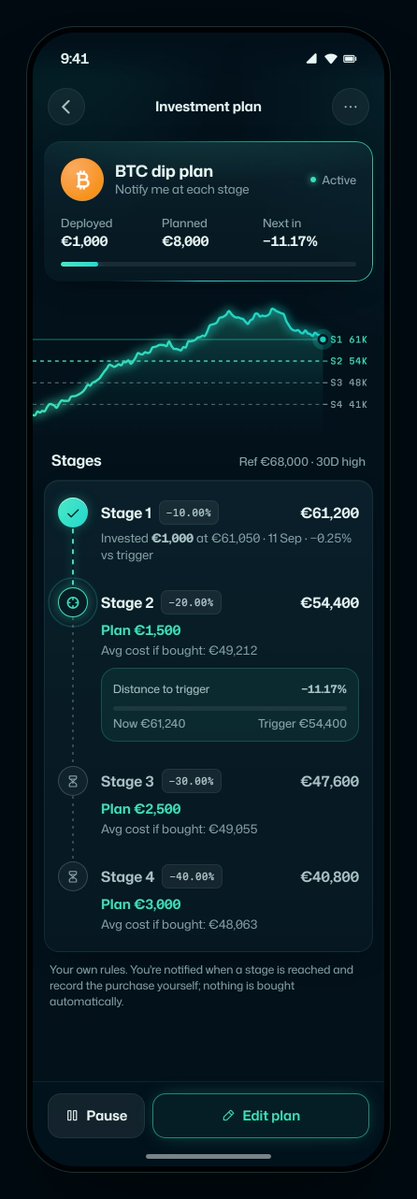
→ I buy in stages, not all at once. My Bitcoin plan has 5 steps, from −10% to −45% below the last high, written down before the drop happens.
→ I sell in stages too, depending on the market. Sometimes all at once, when I'm confident.
→ Gold is my insurance. I've held it since about $2,900 an ounce.
→ I keep cash on purpose, so a drop is a plan, not a panic.
Why a spreadsheet? Because no app works the way I do. I tried several. They track stocks or crypto, rarely both, never my gold, and some want to tell me what to buy.
What the sheet can't do:
→ show everything I own as one number, in dollars and euros
→ tell me when a value is out of date
→ show where my money actually moves: spending, saving, loans, investing
→ remind me of my own rules
So I'm building HOLDZO, for people who own more than one kind of asset and want to see every dollar and euro move, from expenses to investments.
I'm its first user. The goal: know where every single dollar and euro in my life goes, without a spreadsheet.
I'll share my businesses here too, with real numbers.
If that sounds like you, early access is open: https://t.co/bhe7YZadG7
My own portfolio, shown for transparency. Not a recommendation.
Money basics #7: bull, bear, correction.
Correction: a fall of 10% from the last high.
Bear market: a fall of 20% or more.
Bull market: a rise of 20% or more from the last low.
They're labels for distance from a peak or a trough. Nobody rings a bell when one starts.
Two assets can be in different ones at the same time: in 2026 the S&P hit new records while Bitcoin sat more than 20% below its 2025 peak.
Which one does it feel like right now?
Money basics #6: a bond is a loan.
You lend money to a government or a company. They pay you interest, then give the money back at the end.
The part that surprises people: when interest rates rise, existing bonds lose value. Nobody wants your 2% bond when new ones pay 5%.
That's how "safe" US bonds fell about 13% in 2022.
Did you know bonds could lose money?
Money basics #5: diversification is about how things move, not how many you own.
Ten tech stocks that rise and fall together are close to one bet.
What spreads risk is owning things that react differently to the same news: stocks, bonds, cash, gold, other countries.
2022 was the test. US stocks fell about 19%, US bonds about 13%, and gold ended roughly flat.
How many truly different things do you own?
Money basics #4: what inflation does to cash.
If prices rise 3% a year, €1,000 kept in cash buys about:
€971 worth of stuff after 1 year
€863 after 5 years
€744 after 10 years
The number on the account doesn't change. What it buys does.
Do you keep more cash than you need?
Money basics #3: an ETF in plain words.
A basket of assets you can buy like a single share.
One S&P 500 ETF = a tiny slice of 500 companies, in one click.
What to look at before buying one:
→ what's inside
→ the yearly fee
→ which currency it's in
→ whether it pays out dividends or reinvests them
Which of these did you check the first time?
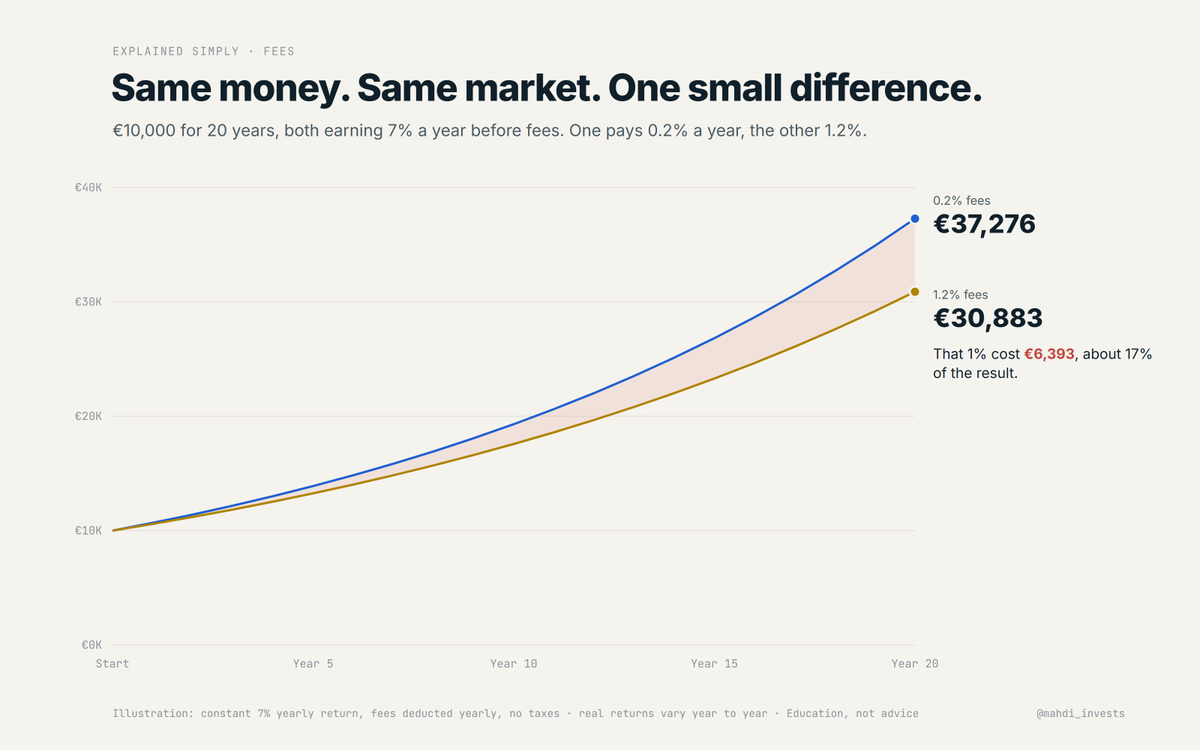
€10,000. 20 years. Same 7% market return.
Pay 0.2% a year in fees → €37,276.
Pay 1.2% → €30,883.
That one percent cost €6,393. About a sixth of the result.
Do you actually know what your funds charge?
Stablecoins, in plain words:
A crypto token built to always be worth $1. Most are backed by dollars and short-term US government bonds held by the company that issues them.
People use them to move money between exchanges fast, or to sit in "cash" without leaving crypto.
There's almost $300 billion of them today, about 1 in every 10 dollars in crypto.
The catch: a stablecoin is only as good as what's behind it, and whether you can get your dollar back when you want it.
Do you hold any?
For years this lived in my spreadsheet. The sheet couldn't tell me which step I was on, or warn me when one hit.
So it's one of the first things I built into HOLDZO. Your levels, your amounts, you decide. Nothing buys automatically.
(app preview, demo data)
Do you buy in one go, or in stages?
Why I do it this way: the decision gets made on a calm day, not in the middle of a −30% week.
No panic buying. No "should I wait one more day?". And I don't need to stare at the chart.
Money basics #2: what an index actually is.
A list of companies plus a rule for how much each one counts.
The S&P 500: 500 big US companies, weighted by size. The CAC 40: 40 big French ones.
You can't buy an index directly. You buy a fund that copies it.
When the news says "the market is up 1%", they usually mean one of these lists.
Which index do you check first?
Money basics #1: the rule of 72.
Divide 72 by a yearly return and you get roughly how many years it takes to double your money.
3% a year → 24 years
7% a year → about 10 years
10% a year → about 7 years
It works the other way too: at 3% inflation, prices double in about 24 years.
What return are you using in your head?
Morning from Europe, where US Bitcoin ETFs just logged a third straight week of inflows.
Last week: +$241M.
The week before: +$2.4B, the biggest since October 2025.
Bitcoin over those two weeks: up about 4%. No frenzy, just steady buying.
Do you own Bitcoin through an ETF, or the coin itself?
@MikeZaccardi@finviz_com A record high with 7 in 10 stocks below their 50-day average. The index is having a much better year than most of the stocks in it.
Rising bond yields, one day, every asset:
US 10-year yield: 5.33% (+6bp)
Nasdaq 100: −0.8%
S&P 500: −0.6%
Gold: −1.5%
Bitcoin: −2.8%
Ethereum: −5.0%
When safe bonds pay more, everything riskier has to compete for the same money.
Which of these do you hold?
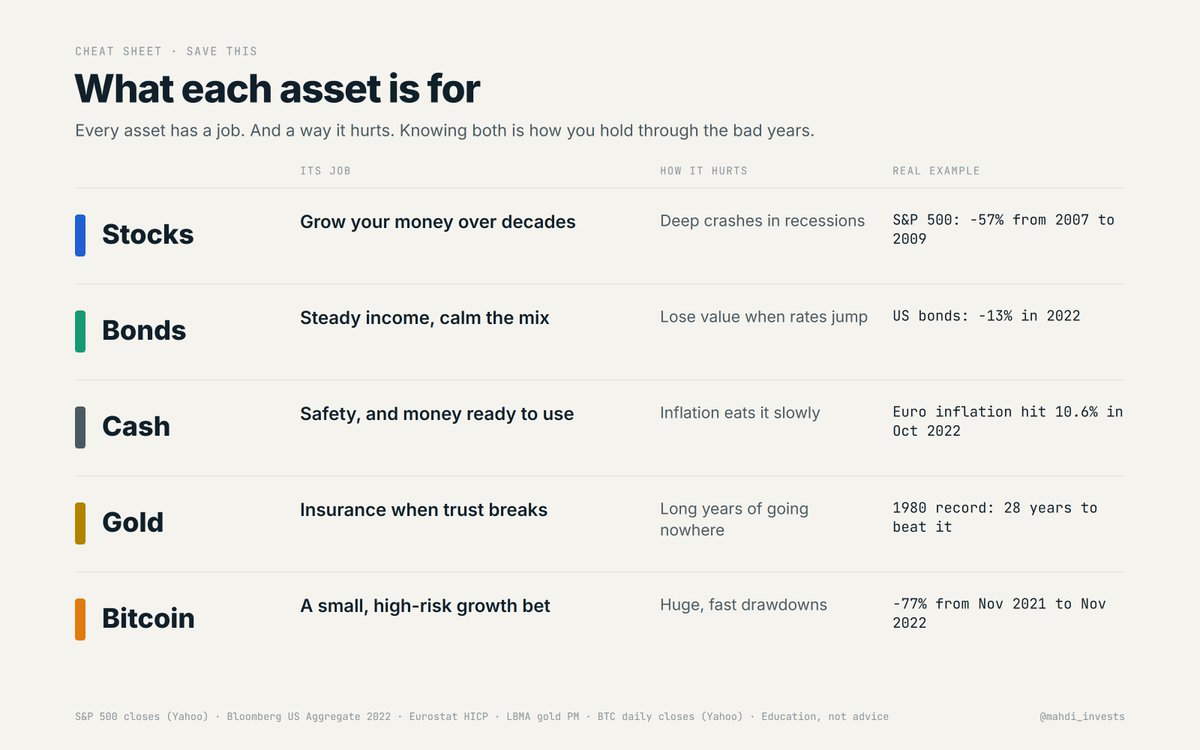
Every asset has a job. And a way it hurts.
Stocks grow. Bonds pay. Cash waits. Gold insures. Bitcoin swings.
Knowing both sides is what lets you hold through the bad years.
Which one do you think people misunderstand the most?