I'm a man with a one track mind, So much to do in one life time. Need it. Want it. Need it. Have to Have it. Software Developer in the making. #Foodie.
This is an unbelievable piece of work by Sarthak and something that requires amplification.
Let me explain what he found, in simple terms.
Sarthak is a Class 12 student from the 2025-26 batch, one of the 17 lakh students whose answer sheets went through CBSE's new On-Screen Marking system.
He spent days reading through CBSE's evaluation tenders, scraped all 576 tenders CBSE has issued, and tracked how the rules changed across three versions of the same tender.
The core finding is that the company that won the contract to scan and grade 17 lakh students' answer sheets is Coempt Eduteck.
Coempt used to be called Globarena Technologies. Globarena was the company behind the 2019 Telangana intermediate exam disaster, where software failures led to 3.8 lakh students getting wrong or missing marks, and 23 students died by suicide.
A government committee found systemic failure and negligence. Six months later, Globarena rebranded to Coempt Eduteck.
So a company with that track record won a contract to handle 17 lakh CBSE students. Sarthak's investigation is about how the rules were rewritten to let that happen.
The tender was issued three times.
> First tender, February 2025. It existed, then disappeared from the public GeM portal. Sarthak scraped all 576 CBSE tenders and this one was missing from the archive entirely.
> Second tender, May 2025. Four companies applied including TCS and Coempt. All four failed the technical evaluation. Cancelled.
> Third tender, August 2025. Coempt won. Between the second and third tender, a series of rule changes happened, and every single one made it easier for Coempt to qualify.
Here is what changed, one by one.
01. The old rules disqualified any company with a history of abandoning work, failing to complete contracts, or financial weakness. The new rules deleted this clause entirely. Coempt's Telangana history stopped being a barrier.
02. The old rules disqualified any company that was "blacklisted earlier." The new rules changed this to "currently blacklisted." Because Globarena rebranded after Telangana, removing the word "earlier" effectively erased their past.
03. The rules required Rs 50 crore average turnover over three years. Coempt's exact average came to Rs 50.86 crore. They cleared the bar by less than 1%. Earlier, a smaller company had asked CBSE to lower the bar to Rs 30 crore for fairer competition. CBSE refused. So the bar was kept high enough to block small players, but sat exactly low enough for Coempt to scrape through.
04. Software maturity is measured on the CMMI scale, 1 to 5. The old rules required Level 5. The new rules dropped it to Level 3. Coempt is a Level 3 company.
05. The cooling-off period for engaging retired CBSE officials was cut from two years to one. This makes it easier to use recently retired insiders to influence the process.
06. The old rules required experience with large projects of at least 5 lakh students each. The new rules removed the student count and counted cumulative answer-book volume across small projects instead. Coempt has many small fragmented university contracts. This helped Coempt and hurt TCS.
07. The old rules required bidders to own their own data centre and disaster recovery centre on Indian soil. The new rules allowed third-party MeitY-empanelled cloud hosting. Coempt runs on AWS and Azure. This helped Coempt and hurt TCS, which owns its own data centres. It also means student data is no longer on sovereign, Indian infrastructure.
08. The old rules required the bidder to own or control the complete source code of its software. The new rules deleted this. Coempt's platform runs on Microsoft's proprietary IIS, which they don't own.
09. A last-minute corrigendum, issued right before bid submission, removed CBSE's own power to blacklist the firm if its software failed catastrophically. So even a Telangana-scale failure couldn't get Coempt banned from future government tenders.
10. The penalty structure shifted from punishing mistakes to punishing delays. The old rules fined the vendor for wrong scanning, merged pages, and unscanned books. The new rules dropped those and instead levied Rs 50,000 per day for delays. This incentivises rushed scanning over accurate scanning.
11. The old rules had a hard accuracy threshold, error rate not to exceed 0.5%. The new rules removed this number entirely.
12. The old rules specified proper book and robotics scanners. The new rules just say "sufficient scanners." The definition was vague enough that, as Sarthak notes, the scanning could be done with a phone on a stand.
13. On the security side, the contract required a VAPT (vulnerability and penetration test) certified by CERT-In before go-live, and a restricted beta phase before launch. The system clearly wasn't restricted, because the other researcher, Nisarga, was able to access it and find vulnerabilities four days before go-live. So the mandatory security audit appears to have been bypassed.
These are more than a dozen rule changes, all between the failed tender and the winning tender, all pushing in the same direction, all benefiting the one company with the worst track record in the field.
The security holes Nisarga found last week now have an explanation. The system was built by a vendor that was specifically allowed to skip the security certification, the source code ownership, the data sovereignty, and the quality thresholds the original rules demanded.
Following things need to happen immediately;
1. An immediate CAG audit of the tender process.
2. A parliamentary debate on the topic.
3. An independent investigation into
> Why the first tender vanished?
> Why the disqualification clauses were deleted?
> Why the turnover bar was held exactly where it was?
> Why the security level was dropped?
> Why the blacklisting power was removed at the last moment?
Sarthak, this is genuinely exceptional investigative work. Far better than most journalists with full resources ever manage. Take a bow. :)
Search is full of ads and wrong answers. Every other email is an ad. Prime Video charges you and shows ads. Paramount? Ads. Peacock? YouTube? Hulu? Ads followed by more ads. Netflix full of ads. Meta and X, every other thing is an ad. Pinterest is nothing but ads. AI is in everything. AI finishes sentences incorrectly and won’t stop. AI reads your email and search history to target you with more ads. Every time you open an app or visit a site there’s an update making it worse. In a hurry? First, click here to agree to terms you don’t have time to read and must accept. You need an account to do that. Change your temporary password. Enter your 2FA code. Check your email and enter that code. Now use a passkey. Your password is too simple to remember. Change it. No, not like that. Now log on. Enter your 2FA code. Check your email for a code… Welcome back! We’ve updated our terms of service and privacy policy (you have none). Subscribe to the site. Subscribe to Netflix. Subscribe to toilet paper. Subscribe to these groceries. Pay a membership fee for the right to subscribe then tip your driver who delivers the subscriptions your membership lets you subscribe to. Time to work? We’ve got to update your laptop and will slow down everything you do until you agree to update. But first, click here to agree. Update installed — your laptop’s broken now. It doesn’t matter, since your boss just replaced you with AI. Go to your phone to complain on social media. Wait, your phone needs an update so we can add more AI. Click here. Oh sorry, your phone can’t handle this update. Now it’s useless. Go get the newest phone. Here’s a text from a friend, an email, a voice mail they left three days ago but you didn’t see until now because of sync problems with the cloud. It’s their GoFundMe. Their MLM. Their Patreon. Never mind, you didn’t respond to their text within 9 minutes and now you’re no longer friends. They blocked you. Make new friends. Download this app to find people in your area. In your neighborhood. On your street. Two doors down from you. Do you know this person yet, we think you’d get along. You need an account to use this app. That username is taken. Enter a password. Not that one, you used it on another site. You need to be connected to WiFi to download the app. Allow the app to connect to other devices on your network. Allow the app to access your contacts, know your precise location, store your credit card details. Oops, sorry, we got hacked now all that info is available on the web. There’s a class action suit. You can join. It’ll take a decade to get your $3.73 share of the ten billion settlement. We’ll send it via PayPal or deposit it to your bank, just tell us those details. Oh no, another hack. That info is circulating now, too. Here’s a spam call, a spam email, a spam text. Why are you angry? Why are you talking about getting rid of your phone? Why don’t you like AI, it lets us make all of this easier? Do you know how ridiculous that sounds? This is progress. You’ll be left behind. Do you want to be left behind? Do you???
- A sysadmin wrote a config file
- That config file became a best practice
- That best practice became a Stack Overflow answer
- That Stack Overflow answer trained an AI model
- That AI model became a $20/month coding assistant
- That coding assistant now writes config files
The knowledge you gave away for free
is being sold back to you with a chat interface.
And they’re calling it the future of engineering.
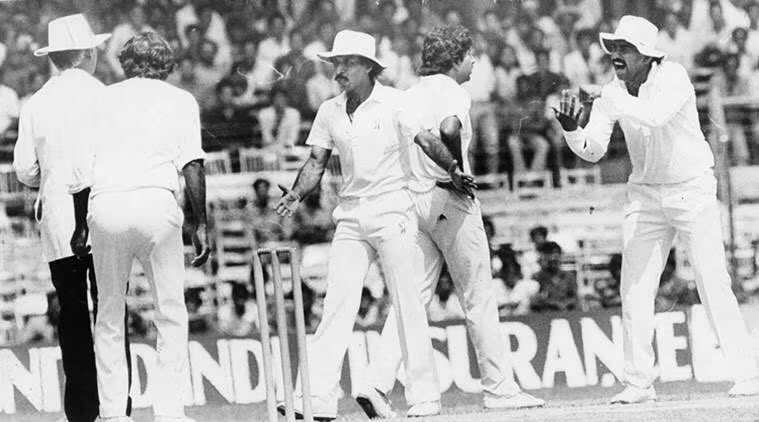
In March 1987, India and Pakistan played the final Test of their cricket series at Bangalore.
At the same time, India played Argentina in a Davis Cup match at Delhi.
We had one TV channel, Doordarshan.
It kept switching between both events. And stayed with the Davis Cup when it seemed crucial for Indian viewers for the final two matches featuring Ramesh Krishnan and Vijay Amritraj. This in spite of the Test at Bangalore featuring the likes of Gavaskar, Kapil, Imran, Miandad and so on, swinging back and forth.
A lot of us got to see a legendary Indian tennis performance.
Yesterday, many did not even know that India was about to record a historic Davis Cup in, because more time was allotted to Ireland vs Sri Lanka and England vs Nepal.
How times change.
(@vijaylokapally)
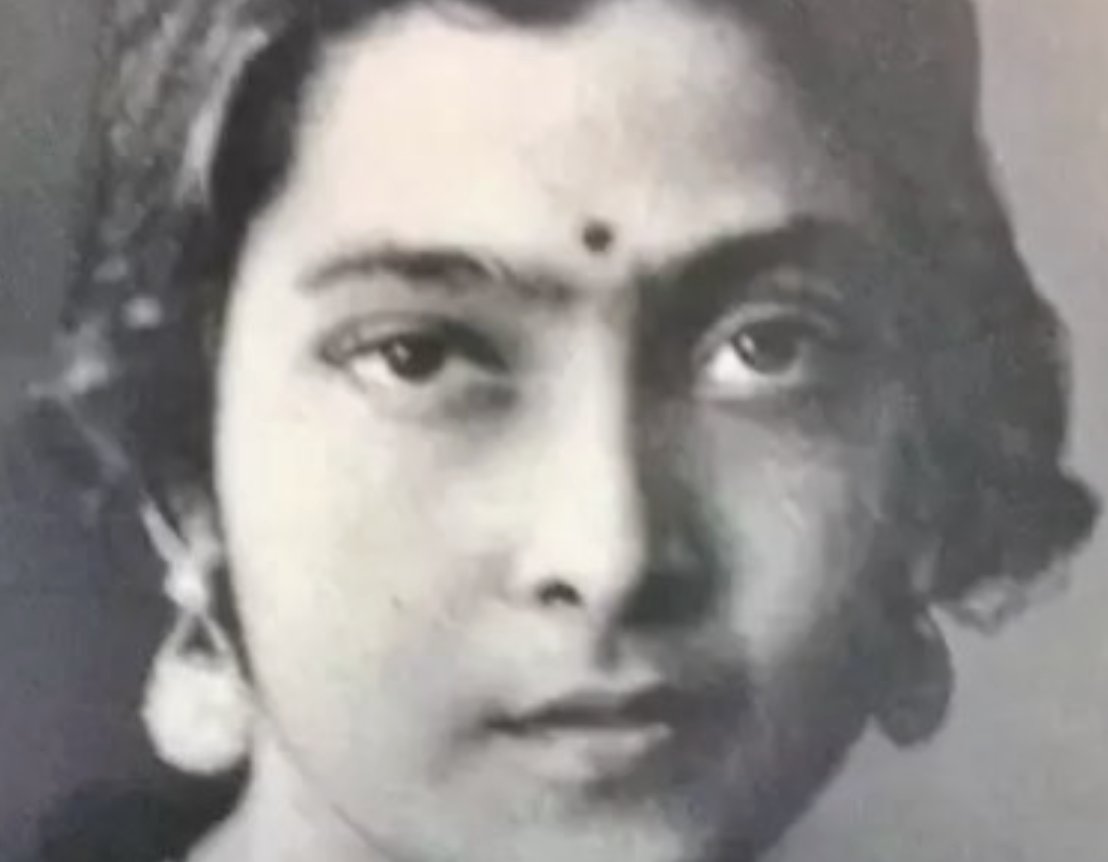
On this day, 96 years ago, 21 year old Bethune College student Bina Das stood up during the convocation and fired five shots at Bengal Governor Stanley Jackson. She was sentenced to nine years in prison.
In her words, '“I can assure all that I have no personal feeling against the governor, he is as good as my father, but as the Governor of Bengal he represents a system which has kept enslaved 300 million men and women of my country.”
Bina was released in 1939, joined the Congress and went back to jail during the Quit India movement before being released in 1945.
She married a fellow revolutionary in 1947, was a member of the Legislative Assembly and fought to the end against both the Pakistani oppression in East Pakistan and the Emergency.
She spent her final days in Hrishikesh after refusing to accept her freedom fighter's pension.
Just one of the many amazing women that illuminated our freedom struggle!
"My name's Raymond. I'm 73. I work the parking lot at St. Joseph's Hospital. Minimum wage, orange vest, a whistle I barely use. Most people don't even look at me. I'm just the old man waving cars into spaces.
But I see everything.
Like the black sedan that circled the lot every morning at 6 a.m. for three weeks. Young man driving, grandmother in the passenger seat. Chemotherapy, I figured. He'd drop her at the entrance, then spend 20 minutes hunting for parking, missing her appointments.
One morning, I stopped him. "What time tomorrow?"
"6:15," he said, confused.
"Space A-7 will be empty. I'll save it."
He blinked. "You... you can do that?"
"I can now," I said.
Next morning, I stood in A-7, holding my ground as cars circled angrily. When his sedan pulled up, I moved. He rolled down his window, speechless. "Why?"
"Because she needs you in there with her," I said. "Not out here stressing."
He cried. Right there in the parking lot.
Word spread quietly. A father with a sick baby asked if I could help. A woman visiting her dying husband. I started arriving at 5 a.m., notebook in hand, tracking who needed what. Saved spots became sacred. People stopped honking. They waited. Because they knew someone else was fighting something bigger than traffic.
But here's what changed everything, A businessman in a Mercedes screamed at me one morning. "I'm not sick! I need that spot for a meeting!"
"Then walk," I said calmly. "That space is for someone whose hands are shaking too hard to grip a steering wheel."
He sped off, furious. But a woman behind him got out of her car and hugged me. "My son has leukemia," she sobbed. "Thank you for seeing us."
The hospital tried to stop me. "Liability issues," they said. But then families started writing letters. Dozens. "Raymond made the worst days bearable." "He gave us one less thing to break over."
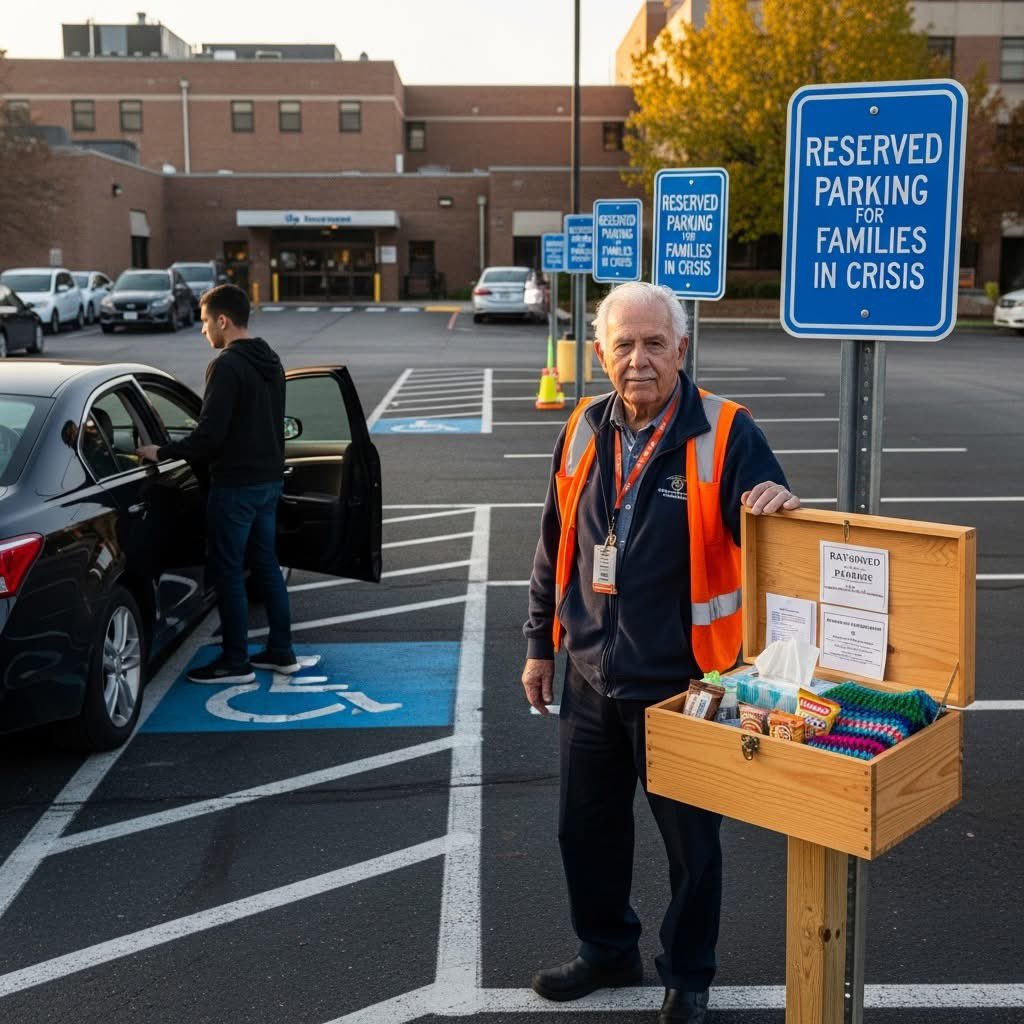
Last month, they made it official. "Reserved Parking for Families in Crisis." Ten spots, marked with blue signs. And they asked me to manage it.
But the best part? A man I'd helped two years ago, his mother survived, came back. He's a carpenter. Built a small wooden box, mounted it by the reserved spaces. Inside? Prayer cards, tissues, breath mints, and a note,
"Take what you need. You're not alone. -Raymond & Friends"
People leave things now. Granola bars. Phone chargers. Yesterday, someone left a hand-knitted blanket.
I'm 73. I direct traffic in a hospital parking lot. But I've learned this: Healing doesn't just happen in operating rooms. Sometimes it starts in a parking space. When someone says, "I see your crisis. Let me carry this one small piece."
So pay attention. At the grocery checkout, the coffee line, wherever you are. Someone's drowning in the little things while fighting the big ones.
Hold a door. Save a spot. Carry the weight no one else sees.
It's not glamorous. But it's everything."
Let this story reach more hearts....
Credit: Mary Nelson
#Kireedam#Lohithadas wrote the script in just a few days as a compensatory gift for not being able to attend Sibi Malayil’s wedding. Imagine writing on a whim and producing one of the greatest scripts in Malayalam cinema history.
Looking at this video, I feel that acting isn’t always something one can do alone. It’s more of a give-and-take between the people in a scene. I don’t think #Mohanlal could ever give his best performance without #Thilakan’s outstanding contribution, And did you notice Thilakan's face at 0:43? Holy , how do you 'act' like that?
@Mohanlal
since our national sport is now javelin, id just like to add to your knowledge that athletes cross the foul line deliberately after a bad throw as a courtesy to the referees so they don’t have to bother with measuring it. exhibit: Nadeem’s first throw