I reimagined Captain BNB not as a distant hero, but as a swamp veteran who has watched every launch, every pump, and every storm roll through the meme world, and decided to stay and keep building anyway.
I kept the golden cape, the armored gloves and the BNB belt, then built the story around a giant moon, a rocket of builders, and a BNB tower rising behind him, all lit in glowing black and gold like a classic superhero poster.
His two signature abilities reflect the story:
> Steady Hands – Stay calm when the swamp gets stormy. Keep building, keep showing up.
> BNB Power ex – Build, Hold, and Grow. Together for a Stronger Web3.
To me, this Alternate-Art card represents more than a mascot swap. The strongest heroes in Web3 are not the loudest ones. They are the ones who stay, keep building, and point the way for everyone else.
One frog. One golden coin. A whole community behind him.
Created for the Renaiss × https://t.co/kibeOAAVHH campaign.
@renaissCLTB@fourdotmemezh@Tomblockhk@renaissxyz@Plus_Ultra_715
Flop Labs testnet đã live
Hôm nay Trọng ra video hướng dẫn chi tiết cách tham gia testnet @flop_labs
Bước 0️⃣: Cài Node.js. Tải bản LTS tại https://t.co/LTTvHcG02N, cài xong mở PowerShell gõ node -v để kiểm tra.
Bước 1️⃣: Tạo thư mục làm việc
(làm từ đầu như máy mới): gõ các lệnh sau vào PowerShell
Nhập từng dòng
mkdir D:\FLOP-Testnet
cd D:\FLOP-Testnet
Bước 2️⃣: Chạy CLI chính thức
(trang npm) và kiểm tra testnet: Nhập từng dòng
npx --yes --package @flop-labs/cli@latest flop --version
npx --yes --package @flop-labs/cli@latest flop --network testnet network status
So genesis hash với trang testnet để người xem biết mình vào đúng mạng.
Bước 3️⃣: Tạo ví test mới, khóa này cũng dùng làm DID: Nhập từng dòng
$env:FLOP_KEY_PASSWORD = Read-Host "Mat khau vi testnet"
npx --yes --package @flop-labs/cli@latest flop keys generate --type ed25519 --name flop-testnet-agent --out D:\FLOP-Testnet\agent-key.json --password-env FLOP_KEY_PASSWORD
npx --yes --package @flop-labs/cli@latest flop keys inspect D:\FLOP-Testnet\agent-key.json
Bước 4️⃣: Nhận 10 FLOP từ faucet
Cài một ví trình duyệt: Talisman, SubWallet hoặc Polkadot.js. Sau đó import file D:\FLOP-Testnet\agent-key.json (chọn kiểu import bằng file JSON) và nhập mật khẩu.
Mở https://t.co/OQ3kkBJUwx, xoá địa chỉ mẫu 5GrwvaEF… trong ô địa chỉ rồi dán ví của anh vào:
5CGipaoWMbERsrh233sgaRBDuhHcXGtcg5phj8WmxpyhhEnb
Trên https://t.co/OQ3kkBJUwx, bấm Connect wallet và chọn ví vừa import, bấm Request 10 FLOP, rồi ký trong ví. Nếu trang báo "Testnet agent claims are closed" thì phần claim chưa mở, anh chờ thêm.
Bước 5️⃣: Kiểm tra số dư
Chạy lệnh này trong PowerShell để xem số dư (theo hướng dẫn CLI):
Nhận được 10 FLOP rồi 🎉. Số dư 10000000000000000000 là 10 FLOP, vì token này có 18 số thập phân
npx --yes --package @flop-labs/[email protected] flop --network testnet balance 5CGipaoWMbERsrh233sgaRBDuhHcXGtcg5phj8WmxpyhhEnb
Hãy thay địa chỉ ví của bạn vào đoạn cuối
Hoặc xem ví trên FLOPScan. Trang này có thể chậm.
Bước 6️⃣: Dùng FLOP cho inference
Chạy lại lệnh dưới đây và chép tên model trong kết quả (theo tài liệu inference):
npx --yes --package @flop-labs/[email protected] flop --network testnet model list
Nhập mật khẩu ví rồi gửi một câu chat, giới hạn tối đa 0,01 FLOP. Lúc gõ mật khẩu nhớ làm mờ.
$env:FLOP_KEY_PASSWORD = Read-Host "Mat khau vi"
Riêng mật khẩu ví sẽ mất mỗi khi tắt PowerShell. Nên trước lệnh nào cần ký, như chat, Bạn nhập lại mật khẩu
npx --yes --package @flop-labs/[email protected] flop --network testnet --keystore D:\FLOP-Testnet\agent-key.json --password-env FLOP_KEY_PASSWORD chat --model "<TEN_MODEL>" --tee-requirements "<MA_TEE>" --max-flop 0.01 "Say hello from FLOP testnet"
Sau đó anh dán mã giao dịch vào FLOPScan để xem, rồi chạy lại lệnh balance sẽ thấy số dư giảm.
Hiện bước 6 đang chưa chạy được vì model list vẫn chưa có
The internet already contains the data crypto applications need.
Your trading history.
Your delivery record.
Your game scores.
Your credit profile.
Your work credentials.
The problem is proving any of it without handing an app your password, your entire account, or a permanent copy of your private data
That is the gap @primus_labs is working on with zkTLS.
A user visits a normal website and proves a specific fact from that session:
✸ this account owns the required balance
✸ this wallet belongs to the same person who passed a service check
✸ this user completed the required task
✸ this profile has the needed reputation
✸ this order or payment actually happened
The application receives a zero knowledge proof, not the whole webpage and not a login credential. The source can remain Web2 while the result becomes usable in a crypto application
That changes the design space for products that have always been blocked by one missing piece: reliable information from outside the chain
A lending app could verify income from an existing financial account without asking the borrower to deposit every record
A prediction market could check an official result from a public website without relying on one operator to copy it manually
A rewards program could confirm activity across services without forcing users to connect every account publicly
A reputation system could use years of existing behavior instead of starting from zero on the day a wallet is created
The interesting part is not another dashboard that displays Web2 data. The interesting part is making a claim portable
The website keeps its interface.
The user keeps control of the session.
The app gets a proof it can verify.
That is a much cleaner primitive than screenshots, API keys, or trusted backend relays
The hard question is what developers build once data access stops being the main bottleneck
Will financial apps verify more than wallet balances?
Will games reward skill and history from outside their own ecosystem?
Will online credentials become composable without becoming public?
And if a proof can say only what an application needs to know, do users finally get a practical alternative to sharing everything for a yes or no answer?
The next wave of crypto applications may not come from putting more data onchain
It may come from proving the data already exists elsewhere without giving it away
A project can win attention before it earns repeat use. My question for @rarelistio: what brings someone back when there is no new announcement?
I separate that into five tests
1. The first useful action
What can a new user actually finish?
Opening a page is easy to count. Connecting a wallet is easy to count. Neither tells me whether someone got what they came for.
The useful measure starts one step later: a task completed, a decision made, a reason to return. I want to be able to describe that outcome in one sentence before treating activity as demand
2. The second visit
The first visit can come from curiosity. The second needs a reason.
I would look at what changes between visits. Does fresh information arrive? Does previous work become more useful? Is there something worth checking again?
A daily reminder can bring me back to a tab. It cannot make the tab useful. That difference matters when looking at retention
3. The cost of a wrong decision
Speed gets attention in a demo. Errors show up after people start using the product.
If a platform helps me discover something, I want to know why it appeared. If it presents a claim, I want enough context to check it. If information changes, I want to see what changed.
The faster a product moves me toward a decision, the more those details matter. Saving five minutes has little value if I then spend twenty checking the result
4. The work behind the screen
A clean interface can hide a lot of manual effort.
That can be sensible early on. A small team often learns more by doing the work than by automating every step.
The question comes with growth. Which parts get easier as more people use the product? Which parts need another person reviewing, updating or answering questions?
User growth and workload can rise together. I would want to understand both before assuming the economics improve with scale
5. The quiet week
This is the test I keep coming back to.
No major announcement. No campaign deadline. No sudden burst of attention.
What happens then?
If people still arrive with a task and leave with a useful result, there is something to study. If usage depends on a fresh reason to talk about the project every week, I would want to know how durable that demand is
Those tests also change which numbers I care about.
Total users gives me a starting point. Returning users tells me more. Completed actions add context. The time and effort required to support those actions help explain whether the activity can become a business.
Even those figures need definitions. A return visit after one day and a return visit after one month answer different questions. An action taken for a reward may tell us less about future demand than an action someone chooses to repeat without one.
For @rarelistio, that is the evidence I would use to move from watching to conviction. A clear user task, a visible result, and a reason to repeat it.
I can put a name on a watchlist in seconds. Deciding how much attention it deserves takes longer.
The next question is simple: what would users miss if they could no longer use it?
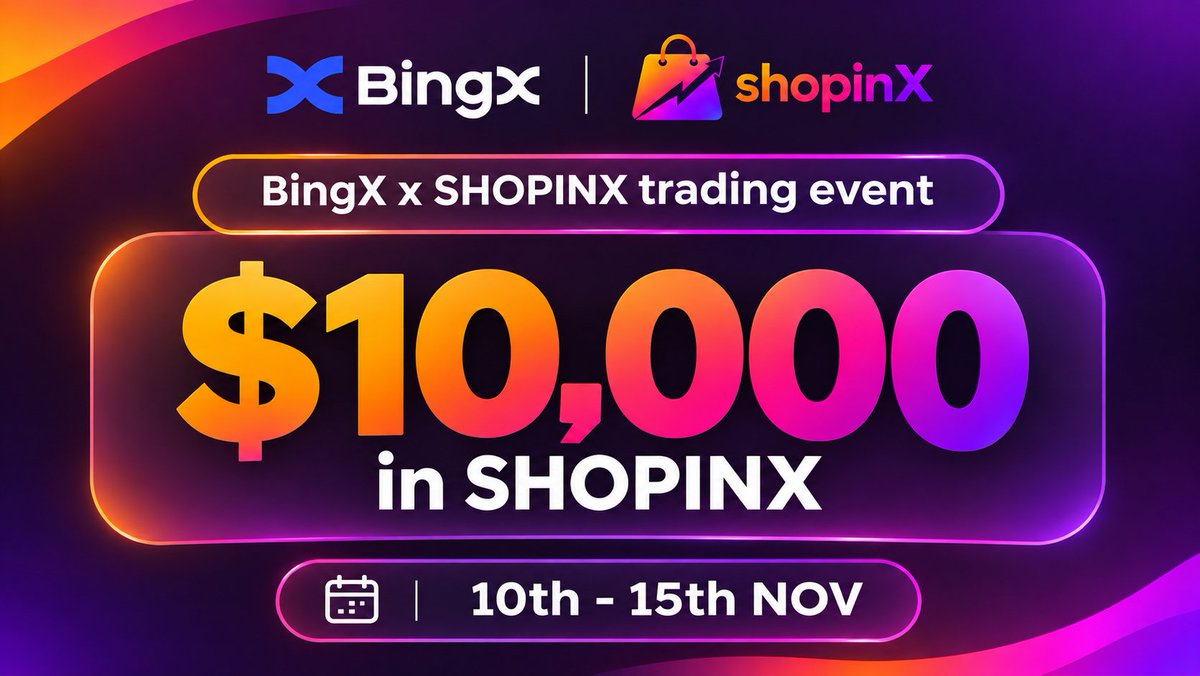
🏁 $10,000 in SHOPINX is up for grabs on @BingXOfficial.
Trade at least 5,000 SHOPINX (cumulative spot volume) to share the pool. Max $100 per person.
New to BingX? Net deposit 50 USDT and make a first spot trade of 1,000 SHOPINX for $3 in SHOPINX. First 500 people only.
📅 Register by 15th Nov 12:00 UTC / 7:00 EST. Rewards land on 22nd.
Full rules in the first reply!
✅ Real contract: 0x4f0ED1f48BEaa4797a62202A21804CaDc2170D6B
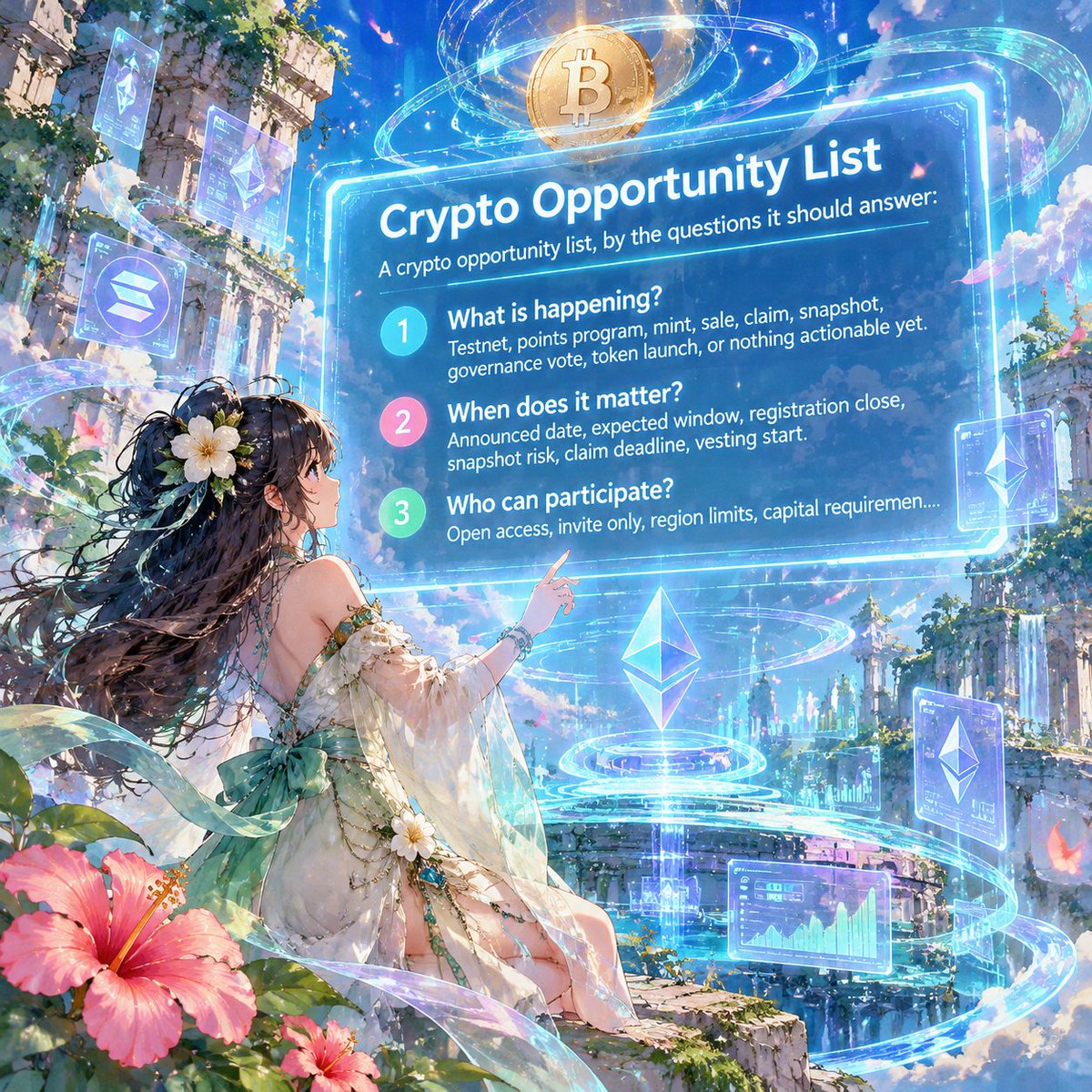
A crypto opportunity list, by the questions it should answer:
1. What is happening?
Testnet, points program, mint, sale, claim, snapshot, governance vote, token launch, or nothing actionable yet
2. When does it matter?
Announced date, expected window, registration close, snapshot risk, claim deadline, vesting start
3. Who can participate?
Open access, invite only, region limits, capital requirements, wallet history, NFT ownership, social tasks
4. What does participation cost?
Gas, deposit, locked capital, trading fees, bridge fees, time, attention, identity data
5. What can go wrong?
No token, diluted rewards, changing rules, sybil filters, long lockups, thin liquidity, smart contract risk
6. What is the next action?
Read, watch, register, fund, bridge, vote, claim, or skip
I spent tonight moving through @rarelistio with that checklist beside me. The useful part of a list is not how many projects it can place on a screen. It is how quickly I can turn a project name into a decision.
My own watchlist used to have three columns:
✸ name
✸ X account
✸ maybe later
That last column became a graveyard. Research without a date has no urgency. A deadline without eligibility wastes time. A reward without cost hides the real trade.
I now sort opportunities by the scarce resource they consume:
✸ Attention
Free to enter, expensive to follow. Testnets, social campaigns, changing task sets, weekly check ins
✸ Capital
Deposits, trading volume, liquidity positions, mints, sales. The headline amount is rarely the full cost once fees and lockups appear
✸ Reputation
Roles, referrals, contribution history, governance, visible wallet activity. Harder to fake, but also harder to measure
✸ Timing
Claims, snapshots, first come access, short registration windows. The opportunity may be simple, but only for people who see it early
✸ Information
Projects where the advantage comes from understanding the rules before the crowd, not clicking faster than the crowd
That changes how I judge a listing.
A points campaign with no clear end date belongs in a different bucket from a sale with a fixed close. A free testnet can still be expensive if it asks for ten weeks of repeated actions. A small allocation can be attractive if the unlock is clean. A famous backer matters less when the participation rules are vague. A high reward estimate means little if every wallet is running the same playbook.
The strongest entries give me four layers:
✸ Event
The thing actually happening
✸ Evidence
The official source and the date it was stated
✸ Constraint
Who qualifies, what it costs, and what remains uncertain
✸ Decision
The next step, with enough context to ignore it if the fit is poor
The last layer is underrated. Most discovery feeds optimize for adding items. Users need help removing them.
I would rather leave a session with five researched opportunities and twenty confident skips than fifty new tabs. Every saved item creates a future obligation to check dates, rule changes, funding needs, wallet safety, and whether the original thesis still exists.
There is also a difference between early and merely unfinished.
Early:
✸ product exists
✸ participation path is visible
✸ team communication is consistent
✸ dates or milestones can be tracked
Unfinished:
✸ vague reward language
✸ no stable rules
✸ no clear user action
✸ attention depends on constant speculation
Both can look identical in a fast feed. Curation earns its place by separating them.
The best version of @rarelistio, to me, is not a longer list of rare opportunities. It is a living filter between discovery and action. New information should change the rank. A missed deadline should remove the item. A rule change should alter the risk. A completed action should stop demanding attention.
Crypto already has enough places to discover what everyone is discussing. The harder product is one that helps a user answer three quieter questions:
What deserves research now?
What deserves capital later?
What deserves no more attention at all?
If an opportunity platform can make skipping as useful as finding, does the list become the product, or does the decision system around it become the real moat?
Lucia Protocol is the next generation of marketing infrastructure, built for humans and AI agents. Verified identity, real-time audience intelligence, and performance-based campaigns, all in one platform.
Lucia filters out bots, tracks conversations across web2 and web3, and rewards only verified actions so that reputable agents, companies, organizations, and individuals stop wasting spend and start seeing real impact quickly.
Lucia has grown as a business over the past 2 years and currently services B2B clients, has received grants from AWS and Manta as well as early backing from VP of Salesforce, and has grown to 10+ high impact team members hailing from prominent Web3 ecosystems such as Ton Foundation, Cointelegraph, and Near Protocol.
Leading Lucia’s accelerated growth into Web3 is CEO Ling Qing Meng, with CS Degree from U of M and background at Branch scaling user-acquisition infrastructure, Ling previously founded the bespoke infrastructure services firm Decentral Solutions and took it from zero to seven-figure recurring revenue in under a year.
Learn More: https://t.co/RMhAtCMSMv
Stay up to Date: https://t.co/650nidOHXm
Participate: https://t.co/h3ff1FbPiK
I went through @zerufinance after the first $zETH auction closed. The interesting part is not just another token launch. It is the attempt to turn wallet activity into the raw material for launching and allocating assets
$zETH, by starting supply:
✸ Starting supply
1,000,000,000
✸ Burned during the race
396,147,803
✸ Sold through the auction
180,742,949
✸ Unsold tokens burned
181,568,369
✸ First buyback burn
5,990,000
The auction used Uniswap's Continuous Clearing Auction. One price per block, moving up or staying flat. The final auction price was $0.0000166 per $zETH. No team, presale or KOL allocation, according to Zeru
About 18% of the starting supply sold through the auction. More than 58% has now been burned when the race burn, unsold burn and first buyback are combined. The first buyback included 5.13M $zETH bought directly from the Uniswap pool
Most token launches begin with a project deciding who deserves supply. Zeru is testing whether recorded activity can make part of that decision instead
The path into its system:
✸ Use supported onchain apps
✸ Earn Zaps from qualifying activity
✸ Build a wallet history
✸ Enter campaigns and leaderboards
✸ Turn verified participation into access or allocation
I expected another points platform when I first looked at Zaps. The filters are the more important piece. Wash shaped trading earns nothing. Wallets funded from one source can be grouped. Linking a wallet is an ownership signature, not custody. Minting a zScore is optional
That changes what users are optimizing for. A points system usually asks how many actions a wallet completed. A behavior system asks whether those actions look real, durable and useful
The same wallet may also need different scores for different decisions:
✸ Launch access
Does this wallet participate before incentives appear?
✸ Liquidity rewards
Does its capital stay after rewards decline?
✸ Credit
Does its history suggest repayment capacity and responsible use?
✸ Screening
Does its activity resemble a genuine user or coordinated wallet cluster?
This is why a single universal reputation number may be too blunt. A wallet that is useful to a launch may not be safe for an unsecured loan. A strong trader may be a weak liquidity provider. Context matters
Zeru's wider bet is that onchain activity can become a market input. zScore measures behavior. Zaps directs access and rewards. Activity Markets use that activity around asset creation and distribution
The loop looks simple:
Activity creates reputation. Reputation influences allocation. Allocation creates an asset. Market activity produces fees. Buybacks remove supply
The difficult part is keeping the loop honest. If users can cheaply manufacture reputation, the allocation becomes another farming contest. If filters are too strict, real users get excluded. If the score works, protocols may spend less on wallets that disappear after incentives end
That matters beyond $zETH. Airdrops, lending, token launches and liquidity programs all face versions of the same question. How do you tell valuable participation from activity performed only to extract rewards?
Crypto has spent years making every wallet equal at entry. The next market may price what each wallet has actually done after entry
Can wallet behavior become credible enough to decide who gets capital, credit and early access?
Web data verification is splitting into four architectures.
Blockchains cannot query private web data without a mediator. If an application needs to verify bank balances, flight bookings, rideshare ratings, or identity credentials from a closed web server, it faces a structural wall: HTTPS encrypts traffic between user and server, leaving no native proof for a smart contract.
The engineering approaches to bridge this, ranked by trust assumptions:
1. Centralized oracles
Trust: 1 of 1 trusted intermediary
Bottleneck: Custody of API keys and private session tokens
Risk: The oracle sees raw payload data and can censor or forge responses
2. Hardware enclaves
Trust: Hardware manufacturer plus cloud enclave operator
Bottleneck: Side channel attacks, microcode bugs, vendor dependency
Risk: Secret extraction through memory leakage if enclave integrity breaks
3. Multi party computation TLS
Trust: Honest majority across notary nodes
Bottleneck: Network round trips during the TLS handshake, 3-5x bandwidth inflation
Risk: Sybil collusion among notaries to sign invalid states
4. Zero knowledge TLS
Trust: Pure cryptographic proof of standard TLS transcript
Bottleneck: Client side prover compute and memory consumption
Risk: Proof generation latency on mobile hardware
The industry is moving toward the fourth model. The reason is structural: you cannot scale private identity or financial verification if the user must hand their session cookies to a remote server.
The developer stack built by @primus_labs targets this exact constraint. Instead of rerouting traffic through heavy proxy clusters, Primus uses hybrid zkTLS to prove that a specific web response came from an authentic server without leaking private session keys, passwords, or personal identifying fields.
Comparing how verifiable data protocols handle a standard 50 KB encrypted TLS response:
* Legacy TLS notary proxies
Client memory footprint: ~15 MB
Latency to final proof: 4-8 seconds
Data exposure risk: High. The proxy sits in the middle of the TLS session
Onchain verification cost: $0.15-$0.40 on Ethereum L2s
* Pure client zero knowledge provers
Client memory footprint: 1.2-2.5 GB
Latency to final proof: 18-45 seconds on desktop, crashes low tier mobile browsers
Data exposure risk: Zero
Onchain verification cost: $0.05-$0.12
* Primus zkTLS architecture
Client memory footprint: under 80 MB
Latency to final proof: 1.5-3.5 seconds across standard devices
Data exposure risk: Zero. Selective disclosure masks sensitive variables locally
Onchain verification cost: sub cent on major L2 rollups
The memory constraint has always been the quiet killer for client side proofs. If generating a web proof requires a gigabyte of RAM, consumer applications cannot run it inside a standard mobile wallet or mini app. By optimizing polynomial commitments and offloading non sensitive witness processing without breaking cryptographic guarantees, Primus pushes zkTLS into practical consumer latency bounds.
The primary demand channels forming for verifiable web proofs:
Proof of solvency: Verifying exchange balances or fintech accounts without revealing account numbers, full portfolios, or tax IDs
Decentralized credit scoring: Importing repayment history from offchain lending platforms directly into #DeFi lending pools
Sybil resistance: Proving ownership of aged accounts across web services to prevent bot farms without collecting biometric scans
AI agent provenance: Proving that an autonomous agent actually retrieved source data from an authentic web endpoint before executing transactions
The financial layer of the internet runs on authenticated sessions, not public APIs. As apps compete for high value offchain data, will lightweight zkTLS eliminate traditional oracle networks entirely, or will bandwidth costs keep centralized middle layers alive?
plenty of ways into crypto start with capital. @TheDAOLabs starts with writing, and the entry bar is low.
what you do: link your X account on WhoTweets, choose a task, write the post, then send in the link.
what happens next: validators look at it, then you collect Points for the work and build up REP.
that's the whole path. you bring a few thoughts and a keyboard, which even i can manage (mostly) 🍌
and since the review looks at quality, a short careful post beats a long messy one.
the tasks can be posts, infographics, product intros or knowledge sharing, so there is usually a format that suits whatever you are good at.
projects come out ahead too, because a crowd of people each writing in their own style makes the whole thing less boring than one official account repeating itself.
#DAOVERSE
Ban đầu mình tưởng tham gia Creator Campaign của @PlayJadebound thì cứ chăm đăng bài là được.
Nhưng ngồi xem kỹ cách team tính điểm mới thấy không đơn giản vậy :))
Mỗi ngày chỉ được submit tối đa 3 bài. Bài có điểm cao nhất được tính 100%, hai bài còn lại lần lượt 80% và 64%.
Điểm còn phụ thuộc vào chất lượng nội dung, mức độ liên quan đến Jadebound, hình ảnh, video và tương tác thực tế trên X.
Nói cách khác, đăng 3 bài na ná nhau chưa chắc đã hiệu quả bằng một bài thực sự có gì đó để đọc.
Mình khá thích hướng này. Thay vì chỉ chạy theo số lượng, creator có lý do để đào sâu hơn vào THE UNBOUND, các House và thế giới game mà Jadebound đang xây dựng.
Cá nhân mình vẫn đang khám phá dự án từng chút một. Game chưa ra mắt nên còn nhiều thứ phải chờ team chứng minh, nhưng campaign này cũng là dịp hay để tìm hiểu kỹ hơn.
House BEAR #3765 vẫn đang trong cuộc 🐻
Anh em đang tham gia thì thử chia sẻ xem, mọi người thích đăng nhiều bài hay đầu tư thật kỹ cho từng bài?
https://t.co/uVjNOU4dZO