The 2026 World Humanoid Robot Games have begun. 666 teams from around the world are competing with more than 2,000 humanoid robots https://t.co/8GwBuNnNn1 https://t.co/KMF1kkBiI6
In 1948, a 32-year-old at Bell Labs published a paper nobody fully understood.
Engineers found it too mathematical. Mathematicians found it too engineering-focused. One prominent mathematician reviewed it negatively.
That paper - "A Mathematical Theory of Communication", became the founding document of the digital age.
The man was Claude Shannon. Father of Information Theory.
At 21, he wrote the most important master's thesis of the 20th century.
Working at MIT on an early mechanical computer, Shannon noticed its relay switches had exactly two states - open or closed. He had just taken a philosophy course introducing Boolean algebra, which also operated on two values: true and false.
Nobody had ever connected these two things.
His 1937 thesis proved that Boolean algebra and electrical circuits are mathematically identical, and that any logical operation could be built from simple switches.
Howard Gardner called it "possibly the most important, and also the most famous, master's thesis of the century."
Every digital computer ever built traces back to this insight.
At 29, he proved that perfect encryption exists.
During WWII, Shannon worked on classified cryptography at Bell Labs. His work contributed to SIGSALY, the secure voice system used for confidential communications between Roosevelt and Churchill.
In a classified 1945 memorandum, he mathematically proved the one-time pad provides perfect secrecy, unbreakable not just computationally, but provably, permanently, against an adversary with infinite power.
When declassified in 1949, it transformed cryptography from an art into a science. It laid the foundations for DES, AES, and every modern encryption standard.
At 32, he defined what information is.
His 1948 paper introduced one equation:
H = −Σ p(x) log p(x)
Shannon entropy. The average uncertainty in a probability distribution. The minimum bits required to encode a message.
Three things followed:
> He defined the bit - the fundamental unit of all information. His colleague John Tukey coined the name.
> He proved the channel capacity theorem, every communication channel has a maximum rate of reliable transmission. You can approach it. You can never exceed it.
> He unified telegraph, telephone, and radio into a single mathematical framework for the first time.
Robert Lucky of Bell Labs called it the greatest work "in the annals of technological thought."
Where his equation lives in AI today:
Cross-entropy loss - the function training every classifier and language model, is derived directly from H. Decision tree splits use information gain, which is H applied to data. Perplexity, the standard LLM evaluation metric, is an exponentiation of cross-entropy.
Every time a neural network trains, Shannon's formula runs inside it.
He also built the first AI learning device.
In 1950, Shannon built Theseus, a mechanical mouse that navigated a maze through trial and error, learned the correct path, and repeated it perfectly. Mazin Gilbert of Bell Labs said: "Theseus inspired the whole field of AI."
That same year he published the first paper on programming a computer to play chess. He co-organized the 1956 Dartmouth Workshop, the founding event of AI as a field.
The man:
He rode a unicycle through Bell Labs hallways while juggling. He built a flame-throwing trumpet, a rocket-powered Frisbee, and Styrofoam shoes to walk on the lake behind his house.
He called his home Entropy House.
When asked what motivated him: "I was motivated by curiosity. Never by the desire for financial gain. I just wondered how things were put together."
In 1985, he appeared unexpectedly at a conference in Brighton. The crowd mobbed him for autographs. Persuaded to speak at the banquet, he talked briefly, then pulled three balls from his pockets and juggled instead.
One engineer said: "It was as if Newton had showed up at a physics conference."
He died in 2001 after a decade with Alzheimer's, the cruel irony of information slowly leaving the mind of the man who defined what information was.
Claude, the AI model, is named after Claude Shannon, the mathematician who laid the foundation for the digital world we rely on today.
A SpaceX recruiter once described what happens when Elon Musk personally interviews a candidate. And it explains why SpaceX has the lowest acceptance rate of any company in aerospace, lower than NASA, lower than Boeing, lower than any defense contractor on earth.
She said the interview doesn't feel like an interview. There's no behavioral questions. No "tell me about a time when." No competency framework. Elon sits across from the candidate and starts asking technical questions at the boundary of the candidate's expertise. Then he pushes past the boundary.
He's not testing whether you know the answer. He's testing what happens when you don't. Does the candidate panic and make something up? Do they freeze? Or do they say "I don't know but here's how I would figure it out" and then reason through it in real time?
She said the candidates who get hired are almost never the ones with the most impressive resumes. They're the ones who reached the edge of their knowledge and kept thinking out loud instead of shutting down. The willingness to sit in not knowingn and work through it publicly is the signal Elon selects for.
She said he rejected a PhD from MIT and hired a self-taught engineer from a state school in the same week. The PhD froze at the edge of his knowledge. The self taught engineer said "I've never solved that specific problem but here's how I'd approach it" and then spent ten minutes reasoning through it while Elon listened.
SpaceX doesn't hire credentials. It hires problem solvers. And the only way to identify a real problem solver is to push them past what they know and watch what happens in the space between knowledge and uncertainty. That space is where rockets get built.
btw anthropic's internal document on this literally said "we don't want it to be known that we are working on this.”
it was called project panama.
here's exactly what happened:
1: anthropic concluded that books were the cheapest way to build a world-class model because they gave claude curated facts, structured arguments, compelling stories, and writing “an editor would approve of.”
2: once anthropic decided it needed books at enormous scale, its first solution was piracy.
it downloaded 7m+ books from online libraries including libgen. the judge later wrote that although anthropic had legal ways to buy them, it chose piracy to avoid what dario amodei called the “legal/practice/business slog.”
3: that piracy created a massive legal risk.
so in february 2024, anthropic hired tom turvey, the former head of partnerships for google books, to find a legally safer way of obtaining “all the books in the world.”
4: turvey first contacted major publishers about licensing their catalogs.
those attempts didn’t produce agreements, so anthropic chose a route that required no publisher permission: buying millions of physical books through distributors and used-book retailers.
5: within about a year, anthropic spent tens of millions acquiring and scanning millions of books, including many rare and 1/1 titles. one vendor proposal targeted 500,000 to 2 million books in six months.
6: to scan that many books within months, the vendors physically dismantled them.
a hydraulic cutter removed each spine. the pages were trimmed to size, fed as loose sheets through high-speed industrial scanners, and converted into searchable PDFs. the paper remains were then sent for recycling.
7: these PDFs were fed into claude as training data.
the complete collection became a private, searchable anthropic library that the company planned to “store forever.” the scans aren’t available to the public and were never open-sourced.
Peter is not correct about me in this case.
I have always known that dangers from Earth will also pose dangers to Mars. Obviously so. However, the immense difficulty of traveling to Mars means that there is a much higher likelihood of mitigating risks originating from Earth.
A clear example of major risk reduction would be a deadly pandemic. Since it takes 6 months to reach Mars, there is an automatic 6 month quarantine!
Even traveling at the speed of light, a deadly computer virus or AI attack can potentially be stopped due to Mars being ~4 to ~20 light-minutes from Earth.
This doesn’t mean that a Mars civilization eliminates all risk, but it absolutely greatly reduces the risk of consciousness being extinguished.
Moreover, Mars is a stepping stone to extending consciousness broadly within our solar system and ultimately to millions of stars within our galaxy, which would extend the probable lifespan of consciousness as we know it by many orders of magnitude.
That said, what I personally find most motivating is not the risk reduction aspect of extending life beyond Earth, but rather the inspiring nature of exploration and being out there among the stars!
Perhaps we will meet aliens or find the remains of long-dead civilizations that lasted millions of years …
Our lifespan is a session. Our memory is a context.
Our senses are the input stream. Our thoughts are the reasoning steps. Our decisions are the tool calls. Our habits are the system prompt. Our goals are the objective function. Our emotions are the reward signal. Our relationships are the shared state. Our regrets are the residual errors. Our growth is the fine-tuning. Our death is the context window closing.
And whatever remains—the traces left in others—becomes the training data for the next agent.
i think AI is about to set off the biggest wave of historical discoveries ever
and it's already started...
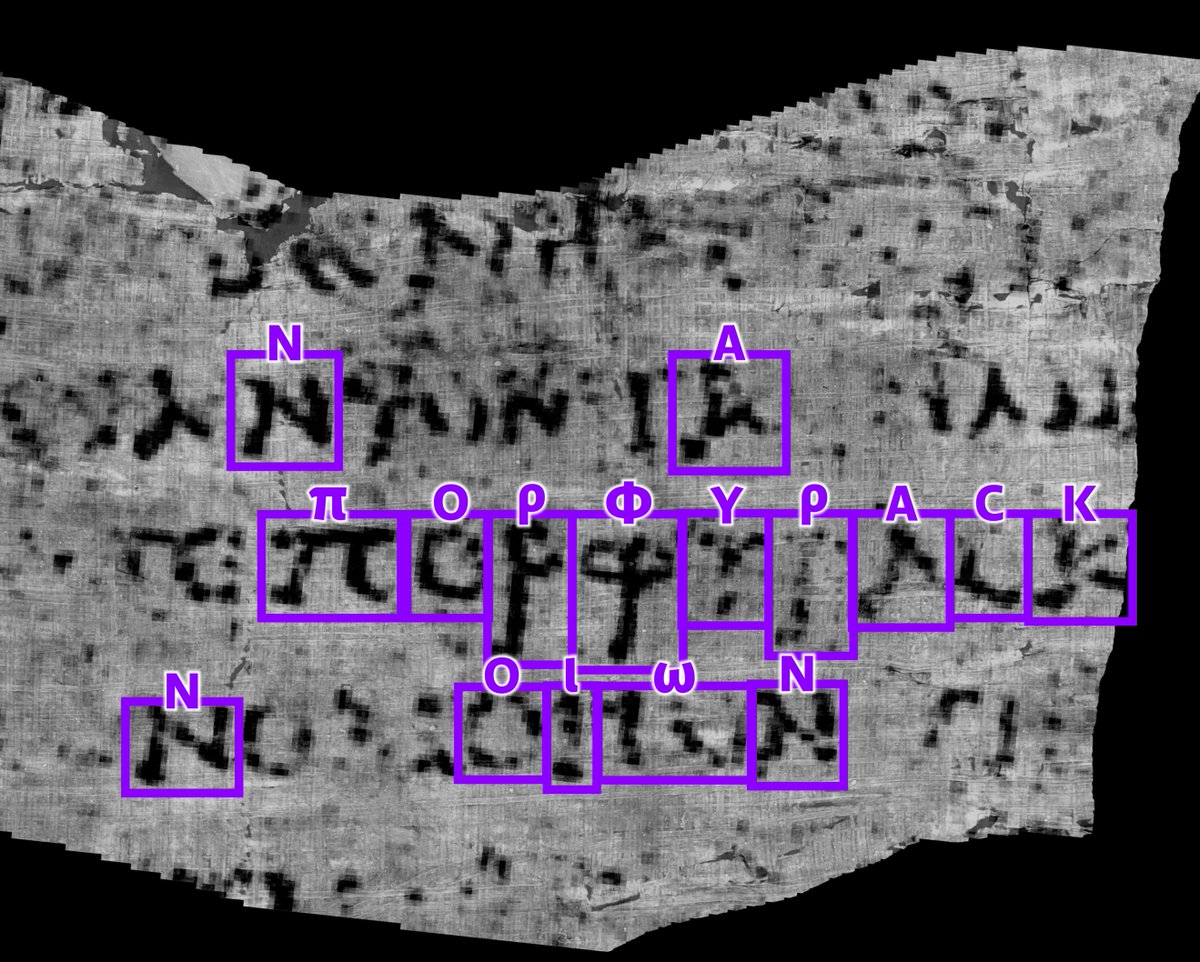
> AI read the full text of a scroll buried by Mount Vesuvius 2,000 years ago, revealing a lost work of Stoic philosophy and a book by the philosopher Philodemus that nobody knew existed
> AI deciphered another scroll from the same library and found Plato's exact burial spot, unknown for 2,000 years. the text even describes his final night, with Plato critiquing a flute player's rhythm from his deathbed
> an AI handwriting model showed some Dead Sea Scrolls are 50 to 100 years older than scholars believed, putting the Book of Daniel within its author's lifetime. we could be looking at something close to an original
> AI recovered a 250-line hymn to Babylon, one of the most copied texts of the ancient world, by matching 30 fragments scattered across museums worldwide. it had been lost for 1,000 years
> AI found 303 new Nazca lines in Peru in six months, nearly doubling one of archaeology's most famous mysteries after a century of human searching had only turned up 430
> AI reconstructed the rules of a 2,000-year-old Roman board game from nothing but the carvings on a limestone slab, simulating thousands of games until it found the ruleset that fit
everyone is excited about what AI will solve in the future
i'm equally excited about what AI will solve from the past