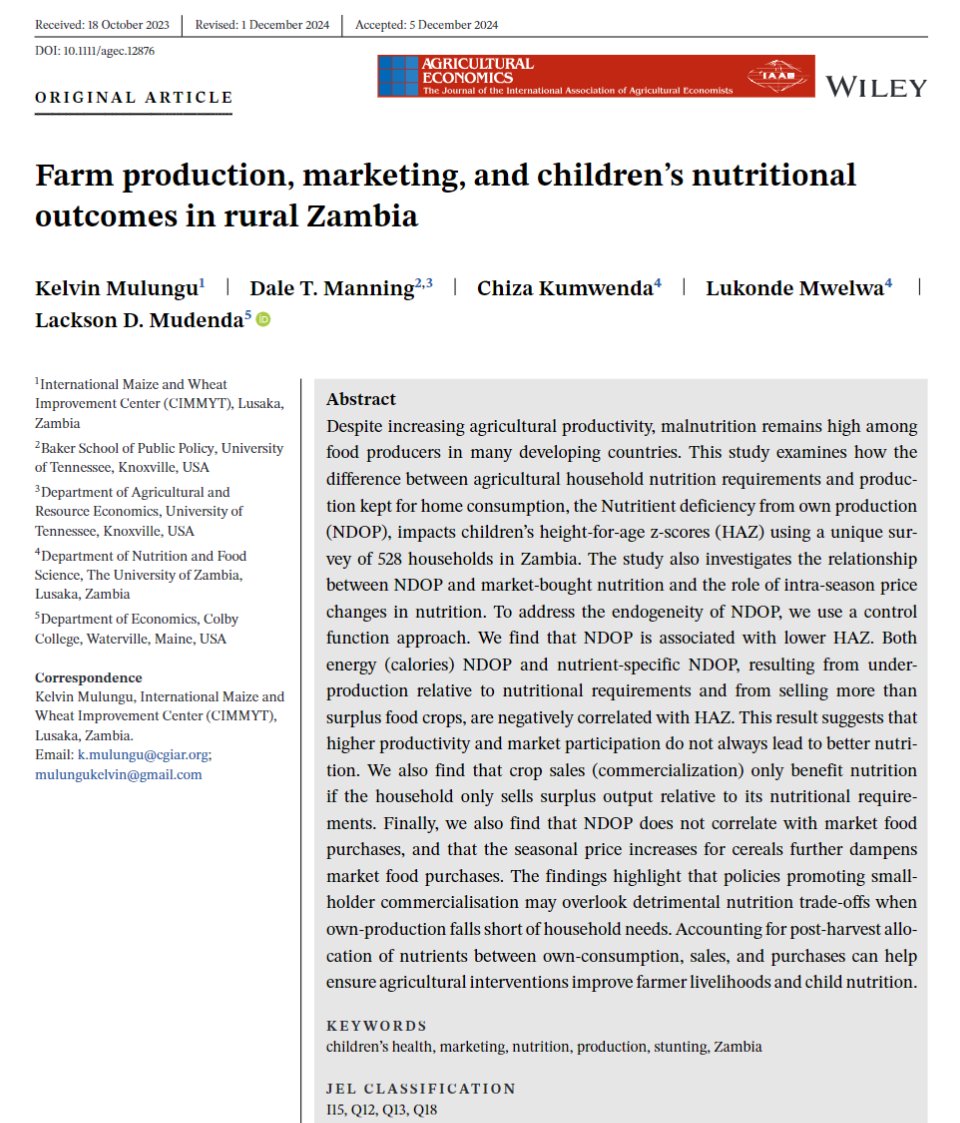
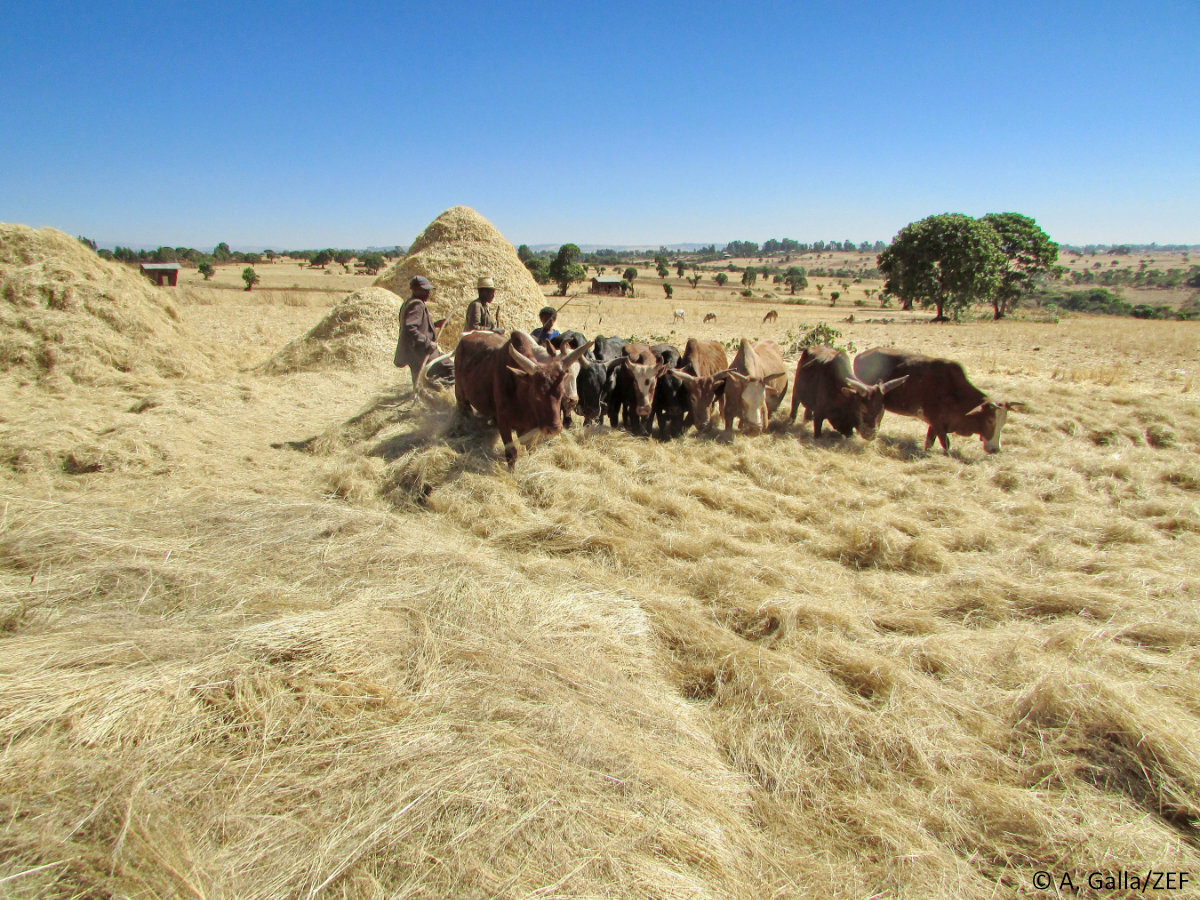
In our latest publication, we find that women's off farm employment improves household nutrition in Malawi. Congrats to Chris and Kelvin for excellent publication and collaboration. https://t.co/EGjJNVow4i
Using data from 4 African countries, our latest publication suggests that providing pest alerts to farmers via digital tools improves farm productivity and income. https://t.co/bA82kMy8In
Aquaculture has tremendous potential to improve nutrition and income among smallholder farmers in developing countries. But does the choice of tilapia species matter in influencing income and diets? For answers, read our newest publication:https://t.co/2pDEBkFKGl.
With panel data from 6 African countries we show that increasing local & regional production diversity is more promising to improve diets than increasing diversity on each single farm. Markets matter more for diet diversity than own-farm production. https://t.co/1hBRDG1f7q
Why do farmers wait so long before adopting agroforestry in Malawi? Landowners take up to 4 years. What can help shorten the adoption lag? @RKhataza and co-authors show in their recent Agroforestry Systems article. https://t.co/ZIxg3vJWZw. @Luanarofficial @CIFOR_ICRAF @ICRAF
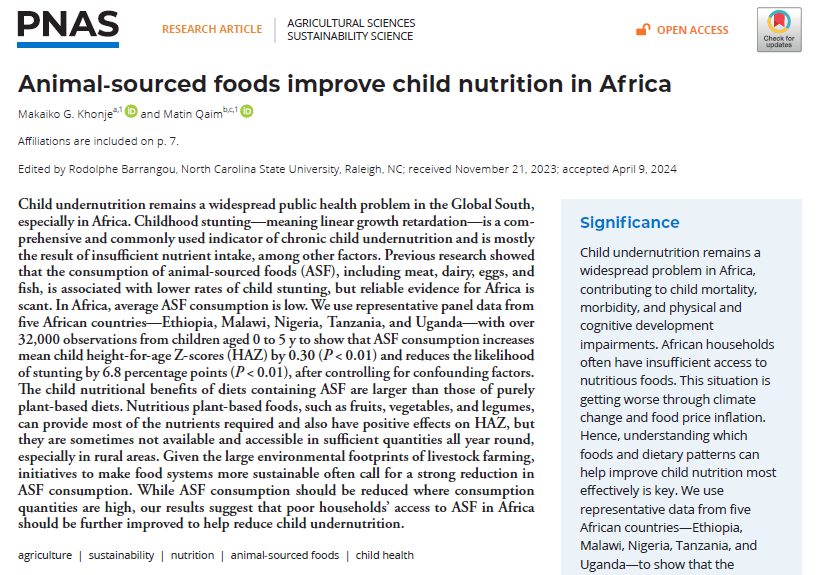
Tierprodukte verbessern die #Ernährung von Kindern in #Afrika: Milch, Eier und Fisch sind gut für die Entwicklung, zeigt eine Studie von @MatinQaim und Dr. Makaiko Khonje @CABI_News veröffentlicht in @PNASNews. Mehr: https://t.co/ZQOZiYSEby & https://t.co/k1C2vh6aQd
Animal products improve child #nutrition in #Africa: milk, eggs and fish are good for child development, shows a study by @MatinQaim and Dr. Makaiko Khonje @CABI_News published in @PNASNews. More: https://t.co/Or4zJg1qz9 & https://t.co/k1C2vh6aQd
With representative panel data frm five countries we show that animal-sourced foods (ASF) help improve child nutrition in Africa. Reduction of ASF is important where consumption is high, but we need to differentiate between rich & poor. Congrats, @makaiko https://t.co/laAkvn9syT
Using panel data from 5 African countries, we find that animal-sourced foods reduced child stunting by ~7%. This a must-read for #FAO, #UNICEF, #WFP, #WHO, #GAIN, etc. In PNAS: https://t.co/uInX2LQOku.
In our newest publication in GFS, using survey data from over 8000 consumers in 5 LMICs, we find that pesticide residue is a major food safety concern for FV market. Pesticide risk reduction is key to stimulate consumer demand for FV in the Global South. https://t.co/PYReEMJ1jw
Several countries are using input subsidies to increase the adoption of improved seed varieties (ISV). However, do these ISV spur long-term food security? In our new publication, we find that ISV increased food security in Malawi. Congrats@ dinahsalonga https://t.co/VHrm0h5fK2?
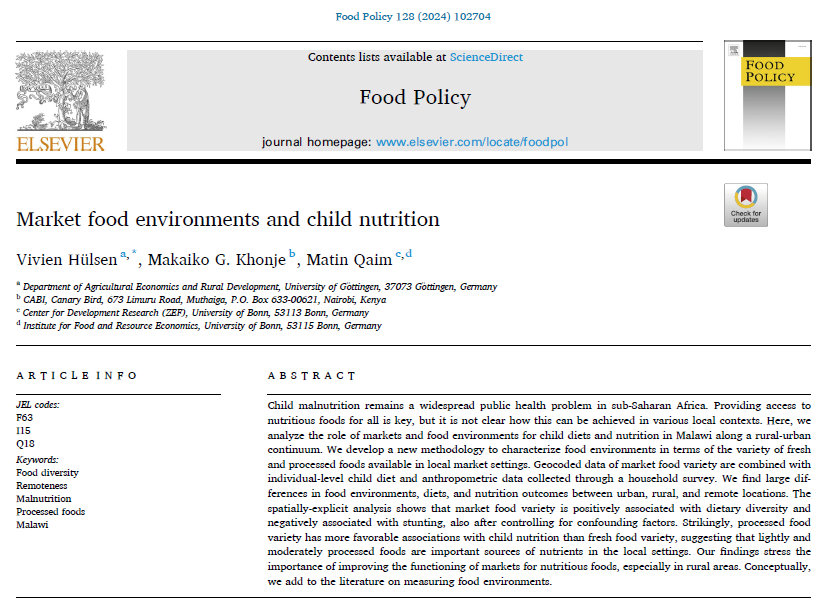
We develop new geocoded metrics of food environments & link these to child diet & nutrition data in Malawi. Food market variety is positively associated with child dietary diversity & negatively associated with stunting. Congrats @vivienhuelsen. OA paper: https://t.co/3SlKAAtDD5
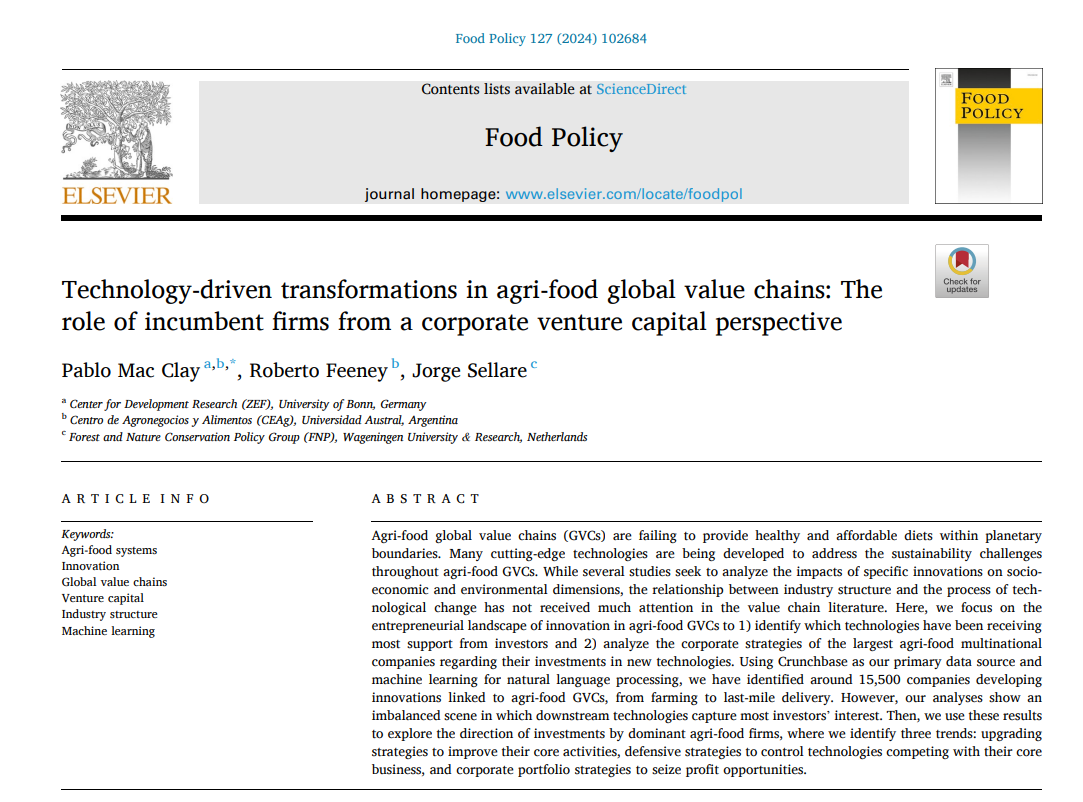
Tech dev is often seen as an important pathway to make #FoodSystems more sustainable. But how does the innovation landscape in #AgriFood VCs look like? Are we making the right investments? We explore these question in our new paper out in #FoodPolicy 1/4
https://t.co/CbHuXsimUR
Are extension agents promoting agri-environmental innovations inadequate? Use WhatsApp and other ICT-based channels. @RKhataza & co-author show positive evidence of ICT promoting adoption of agroforestry in Malawi. https://t.co/foOi4FItF7