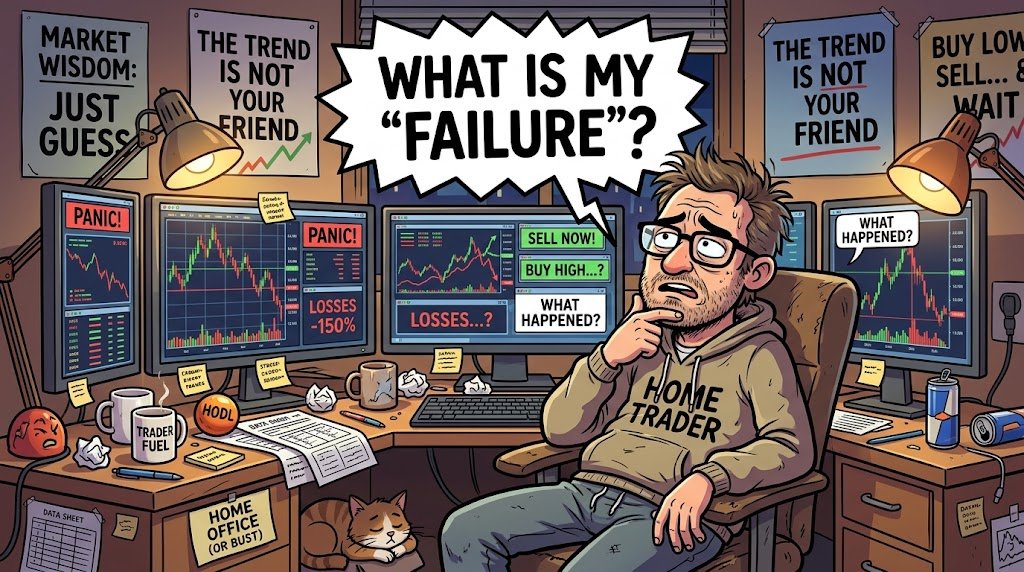
The hardest thing I ever had to learn overcome as a trader was learning to stay confident through drawdowns. The only thing that helped me with this was trusting in math.
Something I noticed about resilient people: They don't have fewer problems. They have faster reset times. Bad news hits at 9am. By 10am, they're back to their priorities. They feel it, process it, and move. The speed of the reset matters more than the size of the setback.
“She shook her head from side to side, resigned to her rebellious brain. Why was there nothing it refused? No misery, no regret, no hateful picture too rotten to accept?”
“The best thing, he knew, was to love just a little bit; everything, just a little bit, so when they broke its back, or shoved it in a croaker sack, well, maybe you’d have a little love left over for the next one.”
Beloved
Toni Morrison
This paragraph by Haruki Murakami hits hard:
“Once the storm is over, you won’t remember how you made it through, how you managed to survive. You won’t even be sure, whether the storm is really over. But one thing is certain. When you come out of the storm, you won’t be the same person who walked in. That’s what this storm’s all about.”
An unfinished strategy protects your hope.
As long as it remains unfinished,
you can keep believing,
"Once it is complete, surely it will work."
If the results do not come, you can say something is still missing.
If testing does not produce a profit, you can think you just need to change something else.
If live trading does not work, you can tell yourself you need to adapt to the current market.
And then you search for more knowledge again.
Every time you learn something new, a little hope comes back.
"Maybe this time I can finally complete it."
But increasing hope and getting closer to a completed system are not the same thing.
Completing a system is not about continuing to increase possibilities.
It is about closing them one by one.
"Maybe this could work too."
"Maybe I should change it in this case."
"Maybe adding one more thing will make it work."
As long as you keep all those "maybes," you will never get an answer about your strategy.
Eventually, you have to let the results of testing through your own hands decide, rather than the hope that "it might work."
An edge may be confirmed.
It may not be.
A real test is not performed to prove that your strategy is correct.
It is performed to determine, independently of your hopes, whether that strategy is worth repeating.
So people whose systems remain unfinished after years of learning are not necessarily lazy.
In fact, many of them keep learning seriously.
But learning and completing are different jobs.
Learning increases your options.
Completing reduces them.
And in the end, you subject what remains to real numbers instead of hope.
Maybe what you are afraid of is not loss.
Maybe you are afraid of discovering that the strategy you have believed in for so long has no edge.
That may be why you leave it in an "unfinished" state and postpone the verdict.
But continuing to trade live on hope when you do not even know whether an edge exists is far more dangerous.
A trader's job is not to protect an idea.
It is to turn that idea into something testable and find out whether it is worth repeating.
If you have spent years repeating "something is still missing," maybe what you need next is not more knowledge.
Maybe what you need is a process that takes your strategy out of the realm of "it might work" and completes it as one testable system.
I put that process into TRADING SYSTEM ARCHITECTURE.
If what you need now is not the next hope, but an answer about your own strategy, I will leave it here for those who need it👇
TRADING SYSTEM ARCHITECTURE
[https://t.co/wcFPtAN9s0](https://t.co/wcFPtAN9s0)
Thank you for reading.
Major cheat code for life: Every pattern in your life repeats until you learn the lesson. The moment you choose differently, the loop ends and growth begins.
Do not mistake the confidence that comes from winning for confidence in your trading.
If a win increases your confidence, then a loss will decrease it.
That is not confidence but simply letting random results decide how you feel.
What you need is not the kind of confidence that says, "I can probably win the next one."
It is trust so solid that your job does not change at all whether you win or lose.
In the world of trading, winning is not always good and losing is not always bad.
Many traders misunderstand the phrase "learn from failure" as "learn from your losses."
As long as you think "loss = failure," you will never achieve consistency.
The time to learn from results and the time to accept every result are completely different phases.
Are you currently at the stage of building a die that favors you, or at the stage of rolling the die you built? If you do not know that, you cannot even define "failure," and you will keep making the wrong improvements.
If you are trading a strategy with an edge in live trading, that edge must already be backed by preparation and trusted, and if you trust it, your failure is "deviating from your rules," not losing.
Turn emotional gambling into a job where all you do is "wait and click."
A step-by-step process for turning your strategy into a repeatable system with an edge👇
https://t.co/wcFPtANHhy
Newsletter👇
https://t.co/nbu7ATvgoo
Thank you for reading.







Thank you for reading.](https://pbs.twimg.com/media/HRYKN6WacAA8LHG.jpg)