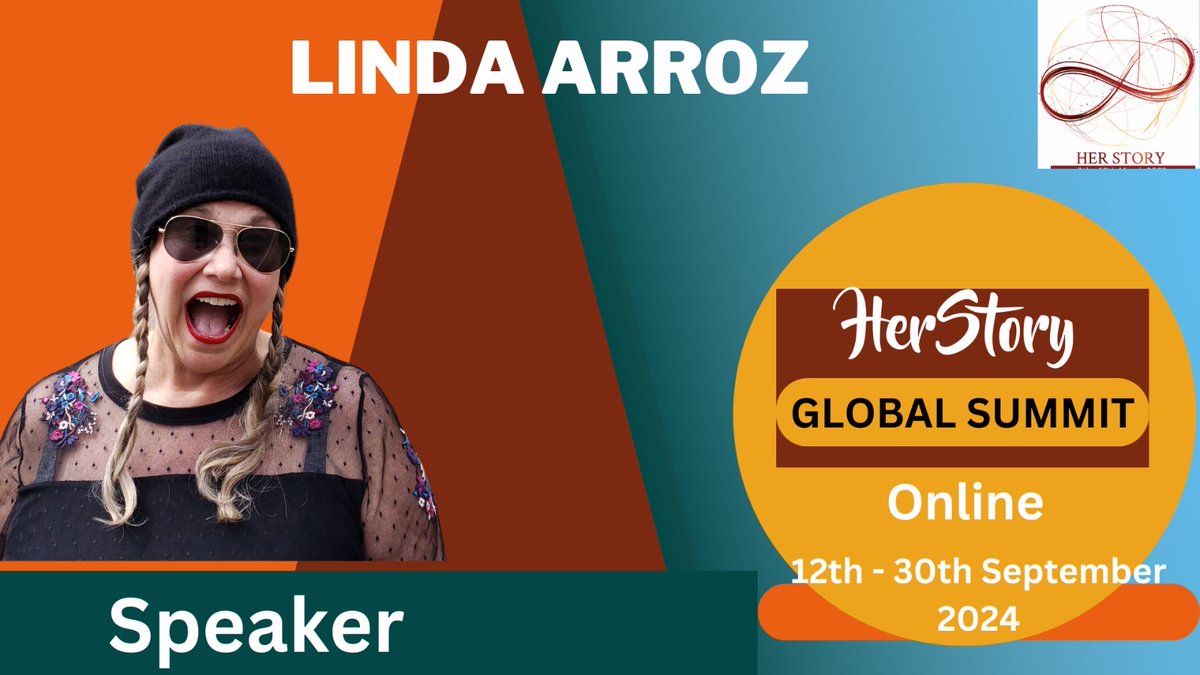
We're pleased to announce @lindaarroz will be a speaker at the HerStory Global Summit. She's sharing a very personal story about her experience as a child bride in the United States, which is legal in 38 states.
https://t.co/zhsnYKDujE
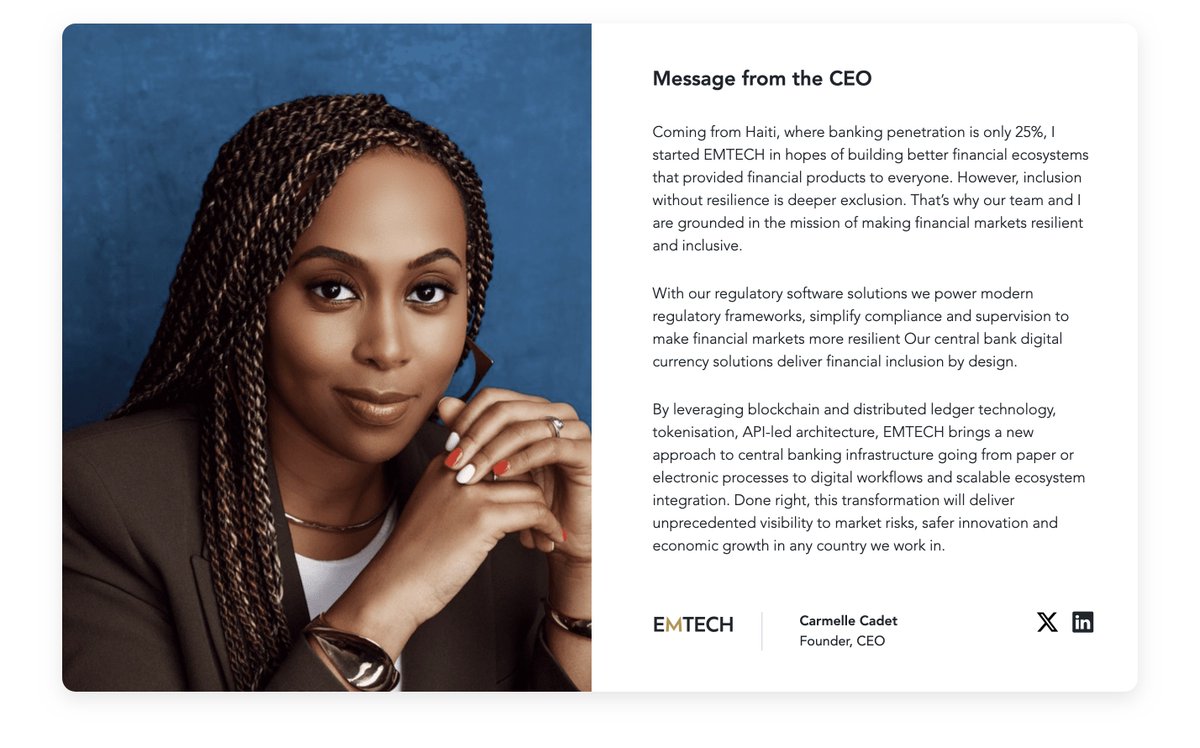
The Gender Gap in Tech isn't closing. Let's shine a spotlight on women trailblazers, founders with courage and good ideas. I'll start w @CarmelleCadet whose innovations in risk & compliance are game changers.
Fill the comments with others like Carmelle!
Fintech is still trailing behind other sectors in terms of employing women at senior levels. The work around? Become a trailblazer with innovative tools to minimize risk! @CarmelleCadet founded @emtech_inc she is one to watch.
https://t.co/o4kFOgreC0
@alisonbcoleman@Forbes Hi Alison, thanks for making all these great points. I'd like to introduce you to a trailblazer in the risk and compliance space, @CarmelleCadet founder of @emtech_inc and Beyond Compliance. She is a blockchain pro with stellar credentials and her take on things is eye opening.
@zachpettet Here you go, Zach! Meet @CarmelleCadet founder of @emtech_inc She's a blockchain pro who identified the dearth of tools to manage risk & compliance. She had a beta of "Beyond Compliance" in Ghana and Nigeria! She's launching globally now https://t.co/BwvJBoVi2S
@robblackwellAB Carmelle Cardet advocates for financial inclusion. She'll be an engaging guest on your Banking With Interest Podcast.
As one of the handful of women in the risk management and compliance space, she launched Beyond Compliance https://t.co/BwvJBoVi2S
Who's Who in Fintech? Meet Carmelle Cadet, founder of NYC based @emtech_inc
A passionate advocate 4 financial inclusion & economic development helping Central Banks adopt modern technologies 2 provide financial inclusion by design & develop resilient financial mkt infrastructures
@Nicholasbariyo The @WSJ coverage of this has been stellar. Now we wait for the options, movie rights, mini series, docudrama. Not to trivialize this, this is such a big story and a win the west.
Chasing Cycles: The Obsession That's Missing the Forest for the Trees
In the world of Venture Capital and Startups, there's an unhealthy obsession with “cycles” that's about as useful as a chocolate teapot. Investors and Founders often behave like amateur meteorologists, constantly checking which way the wind is blowing and panicking at the first sign of a storm.
The truth is that if you're aiming to build a company that'll still be standing decades from now, worrying about whether we're in a bull or bear market right now is like fretting over a pebble when you're climbing Everest.
To be crystal clear: Timing matters. A fledgling startup caught in an economic downturn might struggle to keep its head above water. It's like being a newborn gazelle during lion season - not ideal. But truly great companies, the ones that reshape industries and define generations, will face multiple economic cycles throughout their lifespans. They'll weather booms, busts, and everything in between.
Consider this: Amazon was born in the relative calm of the mid-90s, survived the dot-com bust, thrived during the 2008 financial crisis, and came out of the COVID-19 pandemic stronger than ever. If Jeff Bezos had obsessed over every economic hiccup, we'd probably still be buying books from Borders (sorry!).
The problem with cycle-watching is that it often leads to short-term thinking. Investors might pass on great opportunities because the economic tea leaves don't look favorable. Founders might make decisions that compromise long-term vision for short-term survival. It's like trying to win a marathon by sprinting every time you feel a tailwind.
Don't get me wrong, being aware of economic and market conditions is important. But it should inform strategy, not dictate it. The best Startups and Investors know how to adapt to different environments without losing sight of the bigger picture.
So, what's the takeaway? Stop obsessing over cycles and start focusing on fundamentals. Are you building something that solves a real problem? Can your business model withstand different economic scenarios? Do you have the grit to push through tough times?
Some Startups have the ability to “make their money last” by going into turtle mode during tough times. But not all can which then requires dealing with the big elephant in the room: Do you have Investors on your cap table who can support you when everyone else is spooked? If you can’t go into turtle mode to outlast a bad environment and you’re thinly capitalized with “one and done” Investors who can’t provide additional capital during a bad cycle (or look for someone else to lead) then you’re walking a pretty thin tight rope. Counting on market conditions to remain favorable is the reality of how most Startups are built, but when cycles turn it becomes obvious how devastating the impact can be of not planning for the worst.
The last thing to remember is that every economic winter is followed by spring. The Startups that survive winter get to benefit from much better market conditions. And the beauty of cycles is that the down cycles are almost always much shorter than the up cycles. The number of “good years to build” outnumber the number of “bad years to build” by a factor of 4 or 5.
In the end, a Founder’s job is to build something that can thrive no matter what comes their way. And an Investor’s job isn’t to predict cyclicality but to make sure that a Startup is properly capitalized to be able to withstand the inevitable shifting of the winds.
What are the greatest risk factors in FinTech? Regulatory Complexity and Changes: FinTech companies must navigate a complex and constantly evolving regulatory landscape. Staying current with new laws, regulations, and standards can be challenging.
@asemota I was so fascinated when I read this. It makes so much more sense than previously held theories. PS I can't live with out my @AppleNews + subscription!
@PHindle looks like you've abandoned ship here on X! Please come back, this is a great platform for the global exchange of energy, information and ideas in technology and fintech