What happens to managers when AI writes the code?
Columbia Business School's Mattan Griffel says: everyone gets promoted. Engineers who once typed code now direct 5–10 AI agents at once, and non-technical managers can now lead technical work. Most of us, he argues, have 5–10 weekly tasks AI could do 2–3x better. The biggest untapped gains sit outside tech.
But if AI does the work, what makes a leader worth following?
Jamie Dimon ($JPM), speaking at Columbia, keeps it simple: leave the boardroom so directors can speak freely; study a candidate through peers and subordinates before the interview; and never make big decisions on a Friday, or when angry.
So where is the next frontier for the machines themselves?
Stanford engineers just sent data using thermal noise, the static of vibrating electrons, with no active signal: up to 1,000x less energy than radio, and a 100x faster data rate after modelling (PNAS). Think medical devices and sensors that rarely need charging.
And the risk? MIT alumni are building startups to secure enterprise AI, because most corporate networks were never designed for agents.
The thread: AI moves human work from doing to directing, judging and securing.
Which of these will reach your organisation first?
Not investment advice.
"Demand is extraordinary. Capacity is the constraint." — Jensen Huang
This week $NVDA showed what that means in practice. Rather than wait for supply, it is prepaying the supply chain to secure 2027–28 capacity:
• Substrates: Ibiden, Samsung Electro-Mechanics and Unimicron expanding 2.5x, plus a multibillion-dollar advance for Ibiden's new plant in Japan
• Advanced packaging: $AMKR adding 300%+ capacity by end-2028 under a new $1.3B agreement
• Testing: KYEC with a $1.1B capacity reservation
• Co-packaged optics: SPIL scaling CPO engine capacity 15x by H2 2027
At the same time, the market punished the renters of compute. $CRWV slid as its bond yields spiked, and Australia's NextDC fell ~40% after cutting guidance. Meanwhile SpaceX's results, with AI cloud revenue surging, sparked a relief rally across AI stocks.
Three takeaways:
1. The bottleneck has moved from GPUs to substrates, packaging, testing and optics.
2. Prepayments signal multi-year demand visibility, not a one-quarter spike.
3. The AI trade is splitting: those who own scarce capacity, and those who rent it with borrowed money.
Capital is no longer chasing "AI exposure". It is chasing control of the constraint.
Not investment advice.
@StanfordGSB Congrats Marcus! Fellow SEP here! — your story of chasing challenges from the Airborne Rangers all the way to the ISS and now Saab really resonates. The program’s emphasis on diverse perspectives is powerful. Looking forward to seeing how you apply it!
Finally graduated!
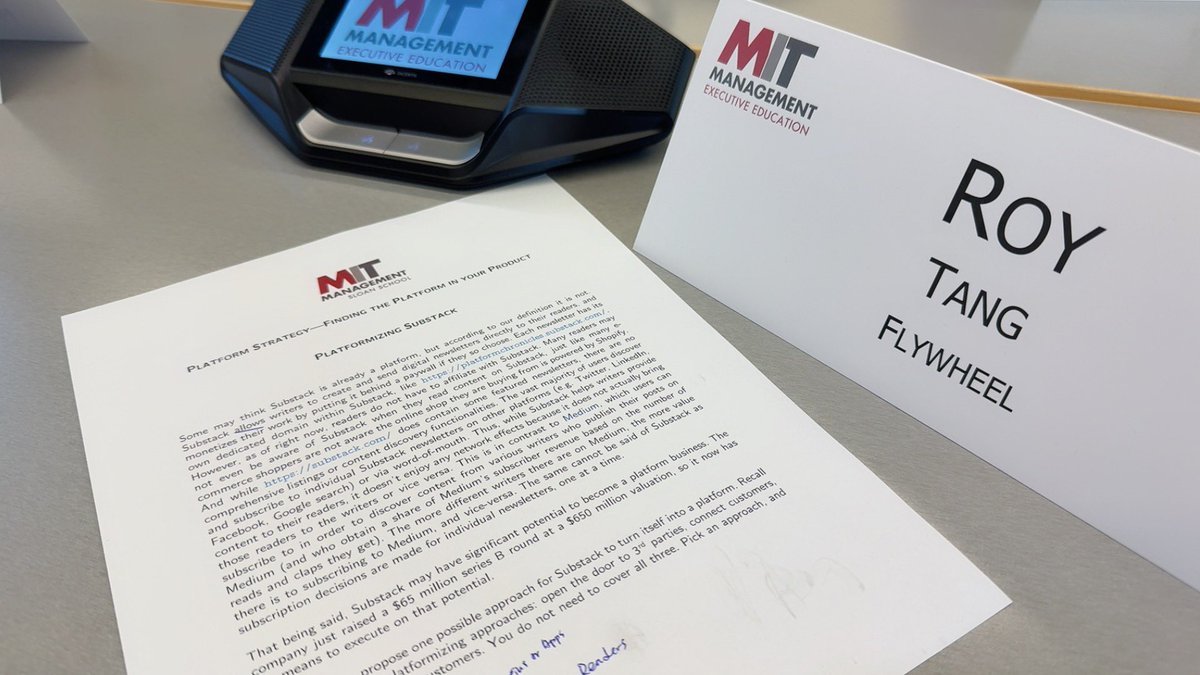
After almost a year of hard work, I am so honored to graduate from the world's top school! Being able to overcome numerous obstacles and challenges, as well as countless online and offline courses, endless homework, and strict requirements from the instructor, I really like this learning environment, and I like pressure! I love a challenge! I love MIT!
#MIT
終於畢業了!
差不多一年的努力,實在太榮幸,在全球排第一的學校畢業!能夠通過重重障礙和挑戰,還有無數線上線下課程,源源不盡的功課,還有導師嚴格的要求,我非常喜歡這樣的學習環境,我喜歡壓力!我喜歡挑戰!我喜歡麻省理工!
#MIT
It’s my honor and surprise to got a tailor made knowledge from Pro David Robinson!
I’m thrilled to say, MIT EPGM is full of surprises always in knowledge, and what I can evolve! I LOVE IT!