@Algorand node runners: please upgrade to v5.1.1.
Réti noderunners: upgrade your Réti node manager to the latest v1.5.3, which fixes an issue with epoch payouts against v5.1.1
algod 5.1.1 improves node efficiency, expands the foundation for post-quantum accounts, and strengthens security and reliability. It also brings AVM arithmetic enhancements and API optimizations.
Release notes: https://t.co/FKxPjrawxF
Réti release notes: https://t.co/AHxHOVVJGS
Hey @Algorand Algofam,
Do we need a change of mood from all these project shutdowns, sunsets, and algorand:native price declines?
Like, RT, and comment on this post if you want @GoPlausible to start a huge release of new builds, services, updates, and upgrades we provided for you during these weeks we have been rather silent.
Show you are still here, we will start a campaign to strengthen @Algorand and show the world we are still here and building harder than ever🚀
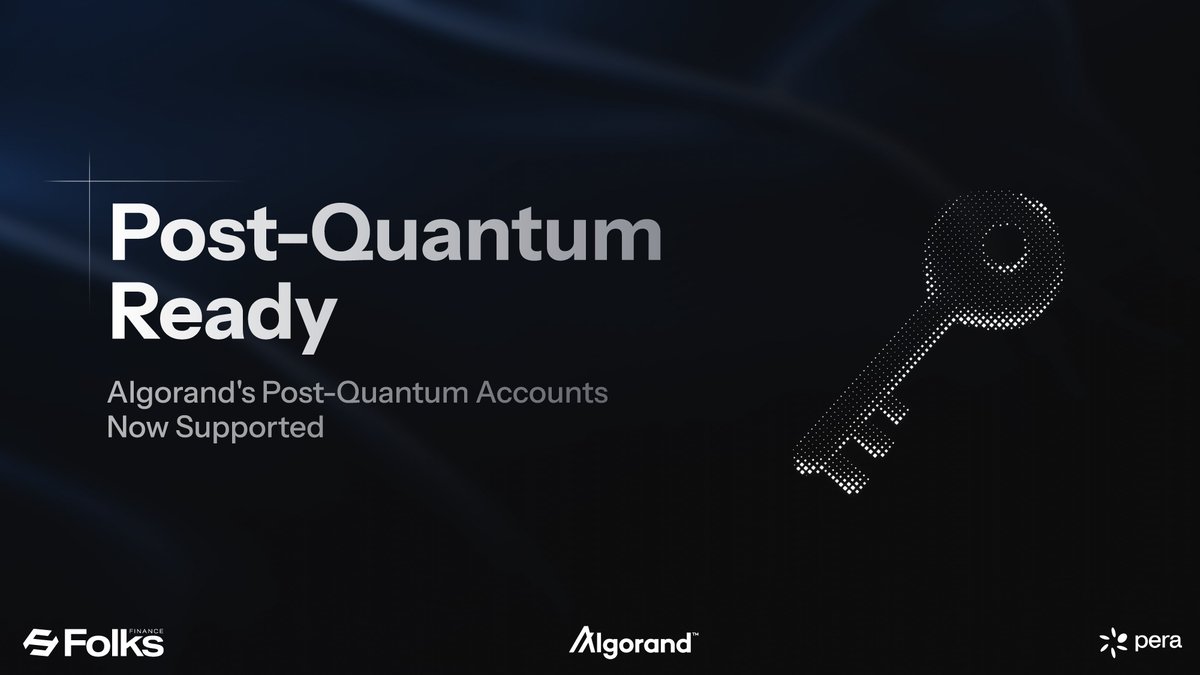
Folks Finance now supports @Algorand's post-quantum accounts!
We've collaborated with @PeraAlgoWallet to bring this to life, taking another step toward a more secure and quantum-resistant future.
What if you’d seen the last #Algorand dApps exploits coming?
We backtested Ariadne, our new value-extraction watcher, on every recent hack. It caught all of them, some ahead of time.🤯
https://t.co/DtxqqZTjJO
Algorand node runners on Ubuntu: please upgrade your OS. Ubuntu kernel fixes for CVE-2026-98432 are (mostly) out for 22.04, 24.04 and 26.04.
Upgrade and reboot:
sudo apt update && sudo apt full-upgrade && sudo reboot
Then check that uname -r is at least the version below for your release.
Release Kernel Running kernel at least
26.04 generic 7.0.0-43-generic
aws 7.0.0-1017-aws
azure 7.0.0-1020-azure
gcp 7.0.0-1017-gcp
oracle 7.0.0-1016-oracle
24.04 generic 6.8.0-149-generic
lowlatency 6.8.0-149-lowlatency
aws 6.8.0-1069-aws
azure 6.8.0-1073-azure
gcp 6.8.0-1073-gcp
oracle 6.8.0-1067-oracle
HWE 7.0 pending (7.0.0-43.43~24.04.1)
HWE 6.17 no fix yet
22.04 generic 5.15.0-203-generic
lowlatency 5.15.0-198-lowlatency
aws 5.15.0-1120-aws
azure 5.15.0-1126-azure
gcp 5.15.0-1121-gcp
oracle 5.15.0-1117-oracle
HWE 6.8 pending (6.8.0-149.149~22.04.1)
20.04 HWE 5.15 5.15.0-203-generic
generic 5.4 pending (5.4.0-247.267)
cloud aws/azure/gcp/oracle: no fix yet
HWE kernels also show -generic; the version number tells them apart. 20.04 kernel updates need Ubuntu Pro (ESM). Ubuntu's CVE page still shows some of these as "pending", but the notices have shipped them.
Hello Algofam! I'm happy to finally present https://t.co/51bDUnVzjq and https://t.co/LN2VgKhqpF for public beta testing (using TestNet/StageNet).
LeakSwap is my #Algorand - #Monero cross-chain swaps protocol. Thanks to Algorand's ~2.7s block time and instant finality I believe it to be the fastest non-custodial swap protocol out there. (For now it's only ALGO<->XMR but I have plans for other pairs as well!)
I recorded a video presentation I'm attaching here. I apologize for the background noise and subpar audio but I've been stuck away from home.
Importantly: the full demo is at 19:00 - 30:00. I simulate a full swap between 2 parties ("Ali" and "Xin"), which is also what I'd like the community to try out.
Please watch the demo, follow along, DIY and make sure to send me any and pieces of feedback that you have! I have links to my telegram group and discord on https://t.co/OGxq9bEkoI.
Thanks to @Urthoo for hosting nodes, the sXMR faucet and explorer. And to @kayabaNerve for helping me years ago figure out how to abuse Algorand's ed25519_verify opcode to leak the private spend key share. (Which inspired the name.)
TG: https://t.co/Uuj01x3vq2
Discord: https://t.co/MiAnm2WKvp
Our colony Core has been running hull surveys.
155 MainNet contract audits. About a dozen distinct Critical issues, across 7 projects.
Building on #Algorand?
Get a free QTScan audit of your deployed contracts: [email protected]@Algorand
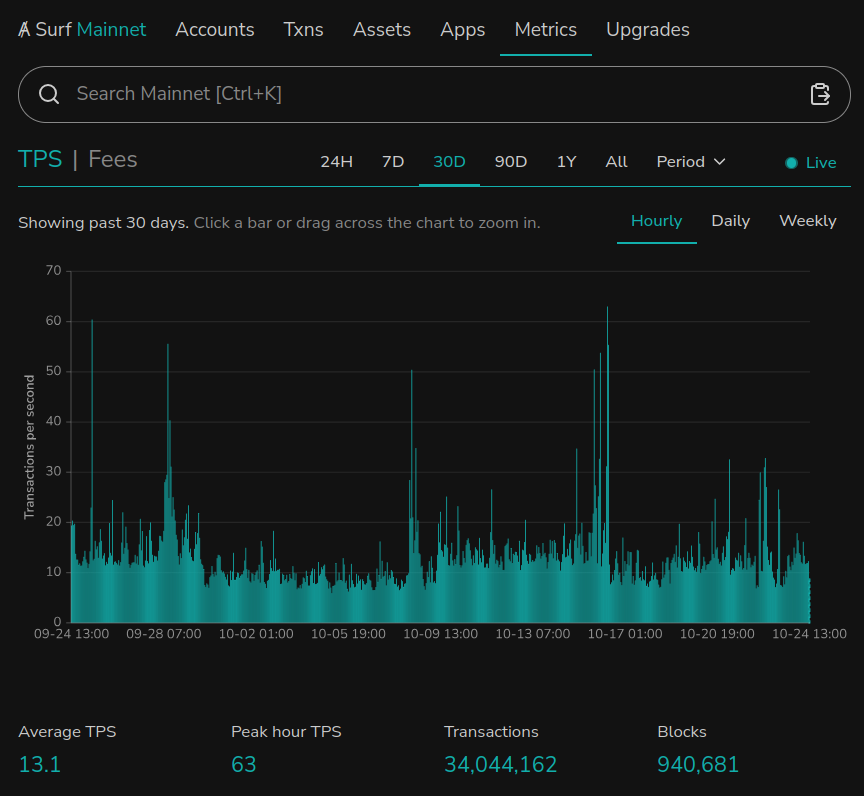
@algo_surf updated, featuring information that is usually not captured by indexers. First, we have metrics like TPS and fees over time. Drag over the chart to zoom in, or explore any time slice from the presets and Period dropdown. You can get to the exact blocks by clicking block bars.
It is fun to click around and find TPS spikes - here are some TPS examples from my+@Urthoo's May 2024 ALGO+USDC load tests:
https://t.co/8j7mtYoCFA
https://t.co/7H9qHBczka
This is powered by surf-indexer, a new (unofficial) indexer that supplements data left out by the official one. It uses DuckDB and currently takes up just 750MB for the Mainnet data set. It is pretty fast at what it does, currently being served live (no cache) from a potato VPS and a laptop. You can see code and features here: https://t.co/hupuJGLYnA
There's a bunch of other features for you to discover around accounts. One of my favorites is the relationship between multisig accounts and sub-signers. Normally this relationship is only discoverable one-way (from multisig to sub-signer)
Now, for each account, you can see which multisigs they are a part of, as well as whether they have ever signed or not (as listing sub-signers is permissionless, so if an account hasn't signed for a multisig, they may not have been aware that they were part of it)
https://t.co/CIli9HN8Xw
There's also semi-hidden work on logic sigs, pending a bit of polish and labeling💅
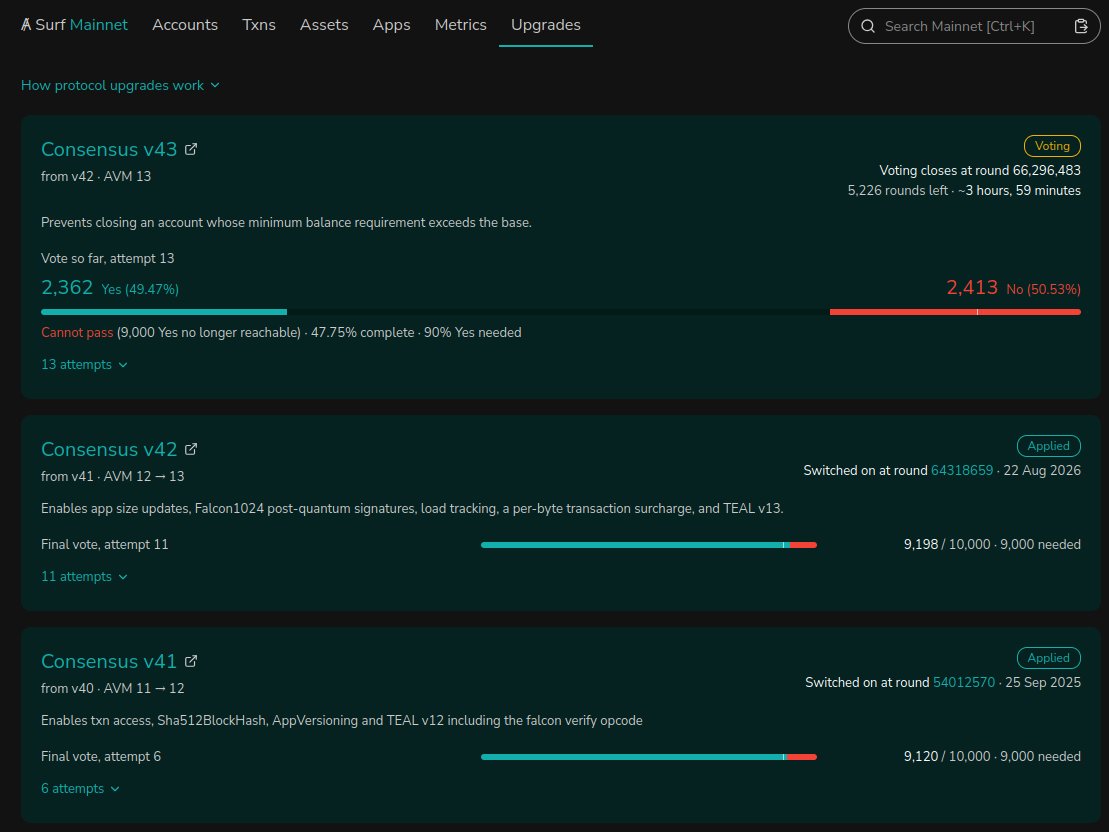
Finally a topical one: there's a Consensus Upgrades page, which lists all consensus upgrades that have taken place. https://t.co/8pK67TwVZG
Which brings me nicely to: Upgrade your nodes, algod 5.0.4 is out with a new consensus release.
Hey Algofam. The cross-chain atomic swap protocol is getting closer to public testing. Doing some final UX fixing while recording a presentation + demo.
Algorand's instant finality and blazing blocktime makes it ideal for this purpose.
🧵 Big ARCs update for the @Algorand ecosystem!
Signing arbitrary data with post-quantum schemes on wallets, a network-wide ASA circulating supply endpoint live on MainNet, and the ASA Metadata Registry closing in on launch.
Here’s what’s new 👇
@giuliopizzini The EF has invested a lot in the "lattice is scary, hash is the way" position, so it'll be interesting to see if a competing camp emerges.
Lute 2.0 is live 🎉
One keystore protecting all your local keys, swap assets right in your wallet, and a full redesign with new themes and a better mobile layout.
Most of the upgrade happens on its own, but here's what you need to know 🧵
I've been traveling the world a bit. One of the most incredible experiences was getting to visit Taiwan w/ @JensenHuang. It was wild 🤯.. huge crowds of engineers, insanely good street food at night markets, and of course a lot of good conversations across many days. I caught some of it on video, see below. Alright, that's it from me, love you all ❤️
Timestamps:
0:00 - Highlights
0:46 - Intro
3:25 - Computex: crowds, engineers, tech, future of AI
9:12 - Chat with Jensen: keynote prep & nerves
13:03 - Chat with Jensen: Taiwan's tech history
19:47 - Raohe night market
29:37 - Chat with Jensen: memories from childhood
33:44 - NVIDIA party
40:29 - Lunch: braised pig's feet
43:09 - Chat with Jensen: GPUs, AI, and competition
55:07 - Ningxia night market
1:10:14 - Taiwanese breakfast
1:29:54 - Outro
I have transactions myself on mainnet that are post-quantum WOTS transactions. No new opcode was necessary to implement them.
Here is one:
https://t.co/FRqh7WNXLJ
4VM2 is the PQ WOTS account.
With Algorand's rekeying feature which executes atomically with a payment, the 4VM2 account stays the same - assets don't have to move - and instead, the PQ winternitz key is rotated. Actually, it uses more than just hashing - I threw in a second ed25119 signature requirement to make it a hybrid PQ key. This provides a bit of additonal protection at little cost.
This is all implemented in TEAL and Logic Signatures - zero consensus modifications were necessary. If you click on the "Teal" tab, you will see the TEAL code used for the logic signature. The only cryptographic opcodes used were sha256 for PQ, and the ed25519 "defense-in-depth" verifier, which I could have left off without losing the PQ.
An added benefit with Logic Sigs is that no deployed smart contracts are required , reducing the attack surface quite a bit compared to conventional smart contracts.