@SenYeezus This was a great read. Making me thing of how better to surface those "weak signals". E.g. a month after onboarding, directly ask people "what have you seen so far that has made you say WTF?"
@sebbodenstein Great post! I learnt a lot. For injecting noise and the n initial moves where we sample from the policy, are there some principles for selecting those hyperparams for new games, or efficient ways to learn them?
@sebbodenstein Unfair in 1990, fair in 2020. With every new C++ standard there are additional ways to do mundane things, and now there are too many ways to chain them together into head-scratchers. Easy to write, potentially extremely hard to read depending on the discipline of the author.
@ilyasut Hacky old gym environments I made for it if anyone wants to play around/extend: https://t.co/YU92F0FSBq. Option for py_mini_racer emulation or running with Selenium.
When people visit your startup, they should be surprised how few people you have. A visitor who walks around and is impressed by the magnitude of your operation is implicitly saying "Did it really take all these people to make that crappy product?"
🎉 Introducing sotabench : a new service with the mission of benchmarking every open source ML model. We run GitHub repos on free GPU servers to capture their results: compare to papers, other models and see speed/accuracy trade-offs. Check it out: https://t.co/MuvJCLY901
We see more significant improvements from training data distribution search (data splits + oversampling factor ratios) than neural architecture search. The latter is so overrated :)
We opensourced AutoAugment strategy for object detection. This strategy significantly improves detection models in our benchmarks. Please try it on your problems.
Code: https://t.co/7iLsA4ZSCF
Paper: https://t.co/2bee7rYr96
More details & results 👇
The release of the Beta for TensorFlow 2.0 is here! We've closed over 100 issues you reported against the alpha release. Your feedback has helped us get to where we are today, please keep it coming!
Get more info here → https://t.co/glR25MmaQE
"Sparse Architecture Search for CNNs on Resource-Constrained Microcontrollers": https://t.co/lOtWpTgvKP - fascinating work from Arm Research, running models with less than 2KB of memory on embedded systems.
Getting closer to the dream! A network that uses unlabelled images to boost performance when labels are scarce (new SOTA), and it's no worse than ResNet when labels are plentiful. Also: Unsupervised net + just a linear on top outperforms original AlexNet! https://t.co/04r4rLxRYI
Training ever bigger convnets and LSTMs on ever bigger datasets gets us closer to Strong AI -- in the same sense that building taller towers gets us closer to the moon.
@kehoste@TensorFlow Ok thanks, appreciate the pointers. I hadn't thought of numpy as a bottleneck before. Are there any good intros for how to set up numpy to use a BLAS optimised for your instruction set? For tf itself, that should be covered by "-march=native" yeah?
Building @TensorFlow gets easier with every release, but still requires consolidating a few sources of information. Here's a little guide for installing 2.0 Alpha with GPU support on Ubuntu 18.04: https://t.co/g232VJ1g9B
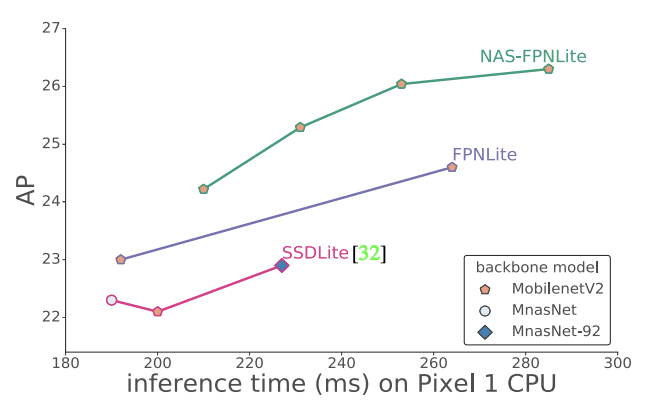
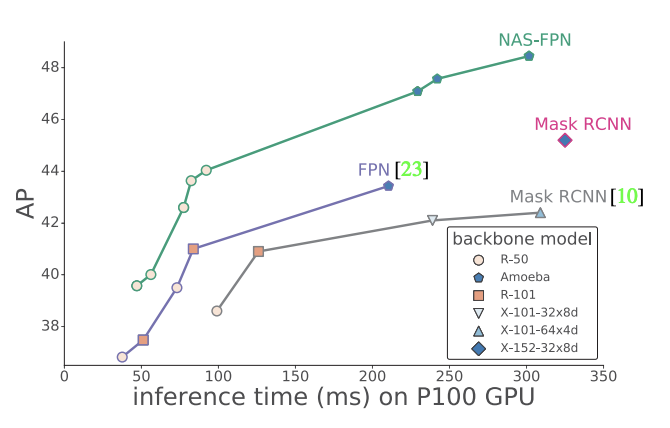
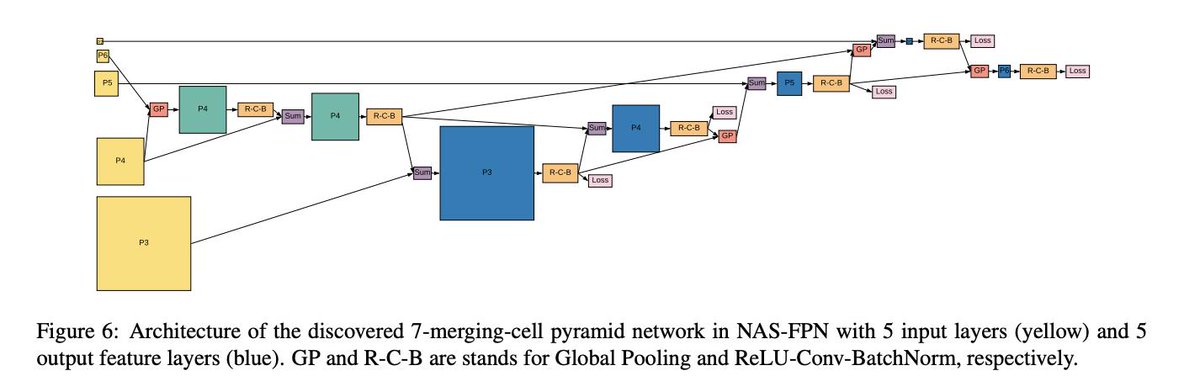
We used architecture search to find a better architecture for object detection. Results: Better and faster architectures than Mask-RCNN, FPN and SSD architectures. Architecture also looks unexpected and pretty funky. Link: https://t.co/8tyWChp5Uw
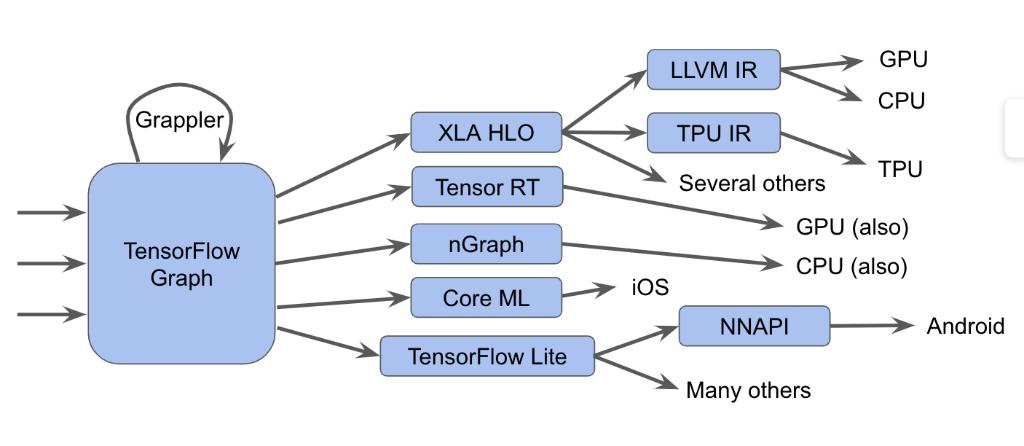
MLIR is a new compiler framework designed to optimize the execution time of #machinelearning models and make it easier to add support for new devices to TensorFlow.
Check out this article to learn more → https://t.co/9hFRoScSnU
and our Github repo → https://t.co/lL8kuWdZpd