Miko Peled, whose grandfather signed Israel’s Declaration of Independence:
“Are we out of our minds for condemning the resistance of the people that have been oppressed and killed and subjected to genocide for 75 years?!”
Forecast News coverage: https://t.co/mLSSNZfWG1
The U.S. Secretary of State has warned against “quoting laws to men with swords.”
Humanity has already paid a heavy price for its indifference toward such a destructive arguement. Following the Reichstag fire, Hitler invoked national security to declare a state of emergency, suspend fundamental rights, and pave the way for dictatorship. He did not abolish the law outright; he hollowed it out from within, invoking necessity as a justification for dismantling the very principles it was meant to uphold.
Today, as the war against Iran is justified through claims of morality and national security, while the very power advancing those claims exempts itself from accountability, the international community should not imagine that it is insulated from the consequences. If the United States believes that wielding the sword places it above the law, what meaningful distinction remains between this logic and the one employed by ISIS?
The international order begins to unravel precisely when the powerful claim rights for themselves that they refuse to recognize in others.
James Madison, one of America's Founding Fathers, wrote in The Federalist No. 51: "First, you must enable the government to control the governed; and in the next place, oblige it to control itself.”
The American people should regard Rubio's words as a serious cause for alarm. The principle Madison articulated is not merely a constitutional ideal; it is a warning against unchecked power. A government that refuses to restrain itself cannot indefinitely guarantee the freedom of others.
Thousands of people across Portugal are angry about rising rental prices, demanding the government take action to end the housing crisis. Authorities have begun implementing changes aimed at lowering prices, but protesters tell Al Jazeera’s Rosie Birchard more must be done.
By my own count, if one includes these latest sanctions, the EU has now sanctioned 8 European citizens for speech:
- 3 German citizens: Alina Lipp, Thomas Röper and Hüseyin Doğru
- 3 French citizens: Xavier Moreau, Adrien Bocquet and Sylvain Afoua (aka Egountchi Behanzin)
- 1 Lithuanian citizen: Ernest Mackevičius
- 1 Irish citizen: Chay Bowes
The sanctions include freezing these people's assets and making it a crime for anyone in the EU to pay them, hire them or even lend them a single euro.
They also include a travel ban, which leads to some absurd situations: Doğru - based in Germany - was invited by some members of the EU parliament to Brussels to plead his case but he couldn't go due to the travel ban. As one of the MEPs who invited him - and made 40 phone calls to try, unsuccessfully, to get him cleared to come - put it: "It really was like something out of a Kafka novel" (https://t.co/lvF0WLFtCb).
And, probably worst of all, all of this was decided without any charge, trial or court ruling - simply as a unilateral decision of government ministers. Yesterday's sanctions, for instance, were decided at the Foreign Affairs Council meeting of EU Foreign Ministers and were simply signed by Kaja Kallas alone on behalf of the Council (https://t.co/XP7zeb9ueZ).
Put it all together, and this violates at least half a dozen of what the EU keeps saying are the fundamental values and principles it supposedly fights for:
1) Separation of powers: here we have government ministers - members of the executive branch of their countries - acting as prosecutor, judge and jury
2) Presumption of innocence (Article 48 of the EU’s own Charter of Fundamental Rights): they’re punished without guilt ever being established, and without being given a chance to plead their case before the decision
3) Right to a fair trial (Article 47): there was no trial at all, let alone a fair one
4) Freedom of expression and of the media (Article 11): they were sanctioned - explicitly so - for what they said and published. For instance, in these latest sanctions, Chay Bowes was sanctioned for, among other things, the speech crime of "participat[ing] in the spreading of anti-Western and anti-Ukraine disinformation at the UN Security Council" (https://t.co/XP7zeb9ueZ). Sanctioned in part for a speech at the UN, a forum that exists precisely so that clashing views on international matters can be heard, quite the message to send from the EU...
5) Freedom of movement (Article 45): they're under a travel ban
6) Right to work and to property (Articles 15 and 17): their assets are frozen and nobody may employ or pay them
You can think whatever you want about these 8 people. But ask yourself this: even if you are pro-Ukraine, pro-EU, anti-Russia and you view these people as malignant Russian operatives... what is the EU fighting for here, exactly?
This is more profound than you may think: we're speaking about the very foundation of modern European civilization, built on the very idea that political power alone cannot decide what is true.
I'm not exaggerating. What we’re witnessing is a return to the pre-Enlightenment playbook, when monarchic or religious authorities defined the truth, deviations from it were called heresy, and heretics were excommunicated - cut off from the community, so that no one could trade with them, employ them or help them. In Europe's darkest times, heretics were even famously burned at the stake - like Joan of Arc or Giordano Bruno.
It took literal centuries of religious wars and debates, and the likes of Voltaire, Kant and Mill, to replace it with a basic idea: that no single power, however legitimate, gets to be the final judge of what is true, and that you answer for your words only before a court, under laws written via a process separate from the power that does the accusation.
You can find countless works of European literature on this very matter. Take Spinoza, excommunicated in 1656 by the Portuguese-Jewish community of Amsterdam, with a decree ordering that "no one should communicate with him" nor "accord him any favor". He went on to write the Theological-Political Treatise, one of the founding texts of the Enlightenment, with an entire chapter arguing that "in a free state every man may think what he likes, and say what he thinks." Or Mill, two centuries later in On Liberty, Chapter 2: "All silencing of discussion is an assumption of infallibility." Or Kafka’s The Trial, the story of a man accused by an authority nobody can quite locate, of something nobody will explain.
How is what Europe is presently doing anything other than going back to that very system, under new appellations? The authority: government ministers. The heresy: "disinformation". The excommunication: assets frozen, banned from travelling and nobody may pay them, hire them or lend them a single euro.
It’s basically Spinoza’s excommunication decree on EU letterhead, with a bit of Kafka sprinkled in given that the man invited to the European Parliament to contest his punishment couldn’t attend because of the very punishment he wanted to contest.
You don’t have to like these 8 people, or even care about them, to see the problem. Heck, this system was developed precisely for the people nobody likes: consensual ideas never needed protecting.
No, the real question here is this: do you want Europe to be the heir of Spinoza - or of Voltaire, or of Galileo, or of any of the countless Europeans who suffered or even died for thinking differently - or of their persecutors?
Gen Z worker CRASHES OUT on Kevin O'Leary
Kevin O'Leary: “Why don't you take your 15% of what you make each week and invest it in every company?”
Gen Z worker: “Do you know what people are spending? Where are they going to get 15%? Do you know how much gas has gone up in the last four years?”
Kevin O'Leary: “If I went into your closet, I'd show you 20 or 30…”
Gen Z worker: “Dude, I've had this jacket for 5 years. You're not going to pull the savings thing on me”
Kevin O'Leary: “You mean you have no clothes except those?”
Gen Z worker: “Right. That's right. This is the only thing I own. You're so right, Mr. Wonderful”
Kevin O'Leary: “The point is you have bought a lot of stuff you don't need”
Gen Z worker: “What frustrates me about you specifically is you have a platform. People listen to you right?”
“You have a platform. You're here doing podcast after podcast. You could have gone on CNBC this morning. People listen to you”
“And you're here bullying a bunch of kids to work harder when you could go toe-to-toe with other people in the industry and say, ‘Hey, the economy is not working for a lot of people. Maybe we should change that’”
“But you're lecturing us to work harder”
“I gave you so many examples of real life people that are going through struggle and you're not giving any factual things back”
Kevin O'Leary: “Well, I'm trying to figure out what you'd like to change. Would you like to tell businesses… look, you're going to give more of your profits to the workers?”
Gen Z worker: “Why not? Why don’t we do that?”
@Bob_Rooney1@Itzmark90@TizzyEnt someone is so desperate to put the sticker on the other side.
so much that doesn’t even know that one of the characteristics of fascism is the overbearing anti-communism.
so yeah, keep calling leftists fascist to show off your ignorance.
How does anyone buy this nonsense?
-British East India Company — Corporate conquest, taxation, and extraction of wealth from India.
-Dutch East India Company — Military conquest and monopolization of the spice trade.
-Banda Islands massacre — Mass killing and dispossession to monopolize nutmeg production.
-Atlantic slave trade — The buying and selling of millions of enslaved Africans for profit.
-American plantation slavery — Enslaved labor producing cotton, tobacco, and sugar for capitalist markets.
-Royal African Company — A chartered corporation trafficking enslaved Africans.
-Opium Wars — British military force used to secure commercial privileges in China.
-Congo Free State — Forced labor, terror, and mass death in commercial rubber extraction.
-British colonial India — Land dispossession, coercive taxation, and extraction of agricultural wealth.
-British enclosure movements — Common lands enclosed and customary rights extinguished to establish new property relations.
-Indigenous land dispossession — Native American territories seized and transferred into private ownership and commercial development.
-California Gold Rush — Indigenous dispossession and mass violence accompanying mining expansion.
-United Fruit Company — Concentrated landownership, political influence, and exploitation in Central America.
-Amazon rubber boom — Indigenous enslavement and forced labor for commercial rubber production.
-British South Africa Company — Corporate conquest, territorial appropriation, and colonial exploitation.
-Industrial capitalism and labor repression:
-Ludlow Massacre — Armed repression of striking coal miners and their families.
-Homestead Strike — Carnegie Steel's use of Pinkerton agents against striking workers.
-Pullman Strike — Federal troops deployed against railroad workers.
-Battle of Blair Mountain — Armed conflict between coal miners and forces defending mine-owner interests.
-Haymarket affair — Labor repression and controversial prosecutions amid the struggle for the eight-hour workday.
-Triangle Shirtwaist Factory fire — 146 workers killed in a factory with deadly safety failures.
-Company towns — Employers controlling workers' housing, stores, and economic lives.
-Convict leasing — Prisoners, disproportionately Black Americans, leased to private businesses for forced labor.
-Industrial child labor — Children employed in dangerous factories and mines.
-Ford Hunger March — Police and Ford security personnel fired on unemployed demonstrators.
Memorial Day Massacre — Chicago police killed ten people during a steelworkers' demonstration.
Colonial rubber plantations — Coercive labor arrangements supplying industrial markets.
Radium Girls — Workers poisoned by radioactive materials in industrial production.
Asbestos industry — Corporate failures to protect workers and consumers from known health hazards.
Bread and Roses strike — Textile workers fighting low wages, dangerous conditions, and employer resistance.
Imperialism and commercial interests:
Banana Wars — U.S. military interventions protecting commercial and strategic interests.
U.S. occupation of Haiti — Foreign financial control and coercive labor practices.
Guatemala coup of 1954 — CIA-backed overthrow of a government pursuing land reform that threatened United Fruit holdings.
Iran coup of 1953 — British and American intervention amid disputes over oil nationalization and Cold War politics.
Chile, 1973 — Overthrow of Allende followed by dictatorship, repression, and extensive market-oriented restructuring.
Anglo-Persian Oil Company — Unequal oil concessions benefiting British commercial interests.
Colonial Congo mining — Extraction of minerals under coercive and racially unequal colonial institutions.
Apartheid South African mining — Corporate profits supported by a racially segregated labor system.
Indonesia, 1965–1966 — Anti-communist massacres followed by an economic realignment favorable to foreign investment.
Iraqi oil concessions — International petroleum companies securing privileges under British imperial influence.
Financial extraction, fraud, and public bailouts:
Wall Street crash of 1929 — Financial speculation and leverage contributing to economic devastation.
Savings-and-loan crisis — Fraud, reckless lending, institutional failures, and enormous public costs.
Enron scandal — Accounting fraud concealing financial problems and destroying employee and investor wealth.
WorldCom scandal — Corporate accounting fraud on a massive scale.
Financial crisis of 2008 — Predatory lending, securitization, excessive leverage, and widespread foreclosures.
Bank bailouts — Extraordinary public financial support used to stabilize private financial institutions.
Predatory subprime mortgages — Borrowers steered into expensive or unsuitable loans.
Wells Fargo fake accounts — Millions of unauthorized customer accounts created under corporate sales pressure.
LIBOR manipulation — Major banks manipulating benchmark interest rates.
Bernie Madoff Ponzi scheme — Massive financial fraud against investors.
Opioid industry scandals — Deceptive pharmaceutical marketing and failures in drug distribution.
Corporate wage theft — Employers illegally withholding workers' earned compensation.
Price-fixing cartels — Corporations conspiring to raise prices and suppress competition.
Foreclosure-documentation scandal — Improper and defective documentation used in mortgage foreclosures.
Post-Soviet Russian privatization — State assets transferred into private hands amid corruption and insider dealing.
Monopolies, corporate abuses, and public resources:
Standard Oil — Monopolistic practices, preferential railroad rates, and exclusionary competition.
Railroad land grants — Vast transfers of public land to private railroad corporations.
Crédit Mobilier scandal — Corporate insiders extracting profits from federally supported railroad construction.
Teapot Dome scandal — Corrupt leasing of public oil reserves to private interests.
General Motors streetcar controversy — Corporate efforts to monopolize sales of buses and related products.
Tobacco industry deception — Companies concealing or misrepresenting evidence about smoking and addiction.
Bhopal disaster — Thousands killed by a catastrophic gas leak at a Union Carbide subsidiary.
Deepwater Horizon — Catastrophic oil spill involving BP and major failures of industrial safety.
Volkswagen emissions scandal — Corporate deception of regulators and consumers.
Flint water crisis — Cost-driven government decisions and oversight failures exposing residents to contaminated water.
Private prison industry — Corporate revenue derived from incarceration contracts.
Boeing 737 MAX crisis — Corporate safety and regulatory failures contributing to 346 deaths.
East Palestine derailment — Norfolk Southern train disaster releasing hazardous chemicals into an Ohio community.
Love Canal disaster — Industrial chemical waste contaminating a residential neighborhood.
DuPont and PFAS contamination — Industrial pollution, litigation, and allegations of concealed environmental and health risks.
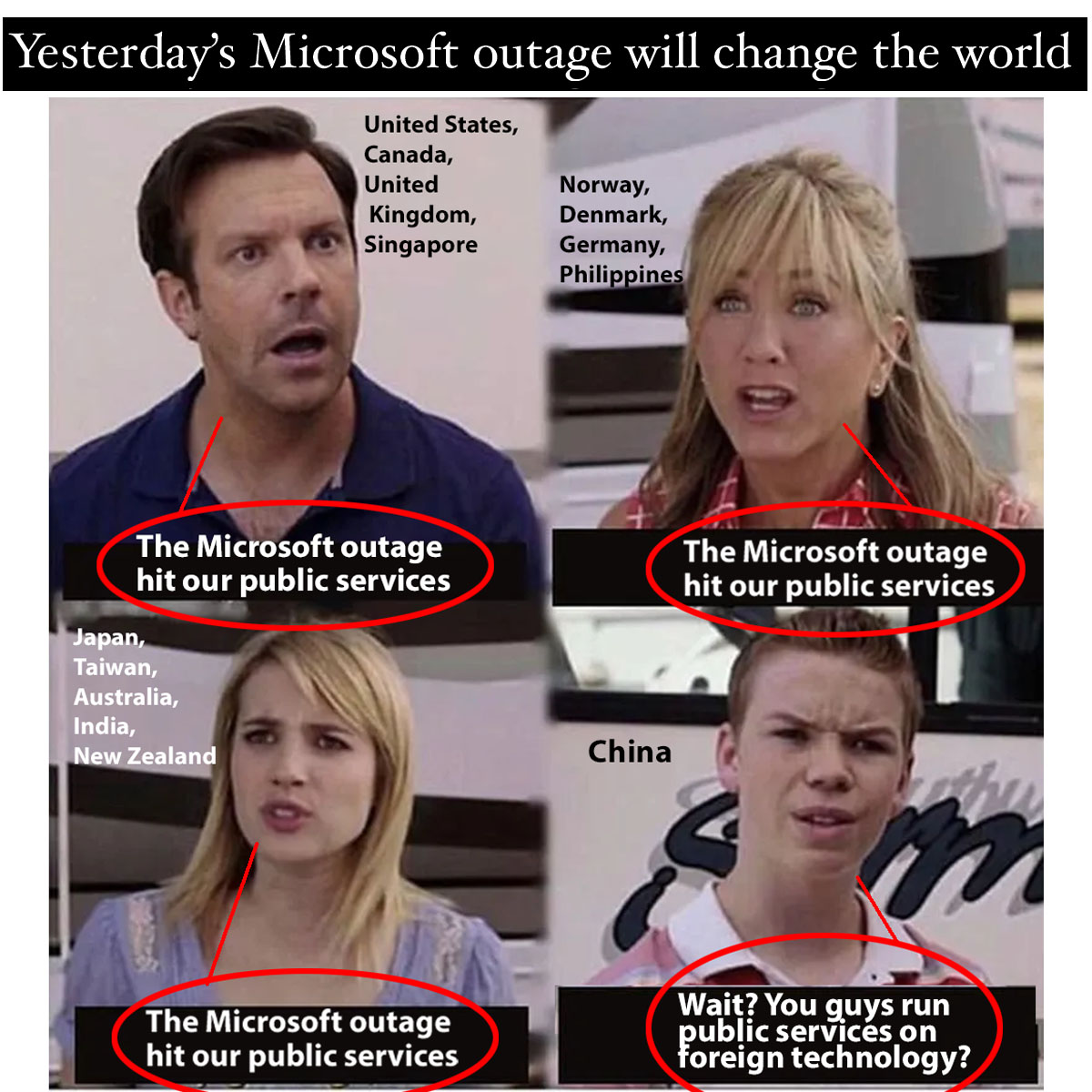
The Microsoft outage will change the world. The UK sounded the alarm today.
This is an “I-told-you-so moment” highlighting Britain’s dependence on US tech, said Tim Clement-Jones, former chair of the House of Lords artificial intelligence select committee, in the Guardian this morning.
The Microsoft outage brought down multiple UK government services, including hospital communications.
.
74 COUNTRIES HIT
Some 74 countries and territories were hit yesterday, including the United States, Canada, United Kingdom, Norway, Denmark, Germany, Japan, Australia, India, Singapore, Philippines and New Zealand.
But China was okay. While many private businesses use Microsoft services, important ones like government departments, banks, and airlines tend to use their own software.
China has WPS, an easy-to-use program that can interact with MS Word, Excel, and so on, with 672 million active users a month. It has a free version, plus 41.79 million annual paid individual users in China, and nearly 1.89 million overseas paid users--and that was from a mid-2025 count. Its creator, Kingsoft, is listed on the Hong Kong stock market.
.
CUTTING THE CORD
The move away from dependence on US software has already begun. The Netherlands is following China, France, and Russia in moving to break the global stranglehold of US tech dominance, it was revealed in September.
The Dutch government was shocked into action after the US remotely disabled the computers of judges in the Hague who criticized Israel leader Benjamin Netanyahu. The sudden loss of ICC staff’s Outlook email accounts caused significant problems.
The Dutch government is creating its own digital work environment based on the Dutch Linux distribution NixOS.
.
HARDWARE TOO
China moved well in advance, making changes in software and hardware. Beijing in 2019 ordered government offices to switch away from foreign PCs, and fortunately has a great many locally produced computers to fill the gap.
China’s Ministry of State Security this summer told some state-linked organizations to quickly remove a customized version of Windows 10 from their machines, Bloomberg reported in August. Other organizations are set to “clean” their systems of the program by February of 2027. However, most PCs in China still use the Microsoft operating system.
Russia, France, Germany, Switzerland, Denmark, Italy and Austria are also replacing Microsoft programs with alternatives in various public area, particularly in military sectors. In Hong Kong, a number of government departments have already replaced Microsoft Office products with alternatives.
.
.
🚨HOLY SHIT!🔥🔥Well that’s a wrap, this guy will never be invited onto a cable news show again, but damn if he didn’t tell the truth about income inequality in the US. Bravo sir!! You’re going to want to watch this!👇
My latest footage of Al Khiam, Lebanon. Despite being almost completely razed to the ground, the Israeli army is still carrying out airstrikes and controlled demolitions of civilian homes and infrastructure.
“The idea that capitalism is a free-market system has become indefensible.
It is no longer possible to hide the fact that capitalism rests on collusion between powerful monopolies and states.”
https://t.co/q3eIVwLXjI
não gosto de pedir nada mas posso pedir-vos para espalhar este tweet? é uma realidade sentida cá e muito abafada. na manif estiveram presentes alguns continentais que agora vivem na Madeira e disseram-me que sentem isto, que aqui na ilha sente-se esta ditadura. ninguém faz ideia!
Un groupe néonazi espagnol préparait un coup d'État et envisageait de s'attaquer à la France. Et personne n'en parle !
14 membres de Núcleo Nacional viennent d'être arrêtés en Espagne, dont leur porte-parole Isabel Peralta.
Chez elle, les policiers ont découvert un véritable arsenal : des fusils d'assaut, des pistolets, des dizaines de boîtes de munitions, mais aussi un buste d'Hitler et des croix gammées.
Dans des conversations interceptées par les enquêteurs, cette militante néonazie évoquait même l'idée de se rendre à Paris avec un fusil semi-automatique pour tirer sur des personnes.
Plusieurs membres du groupe s'étaient rendus en Ukraine pour s'entraîner auprès de la brigade Azov. L'organisation recrutait également des adolescents dès 14 ans.
Et l'enquête ne s'arrête pas à l'Espagne : Núcleo Nacional appartenait à un réseau néonazi européen comprenant plusieurs groupuscules français.
En France aussi, les passerelles entre mouvances néonazies et partis d'extrême droite sont documentées. Au RN, Éric Miné, ancien membre du groupuscule néonazi FANE, était encore candidat aux sénatoriales en septembre 2026. Chez Reconquête, le QG d'Éric Zemmour à Vannes partageait ses locaux avec un groupe identitaire.
Derrière les discours racistes, antisémites et anti-immigration, des groupes s'organisent, recrutent, s'arment et envisagent le passage à la violence.
Le danger néonazi n'appartient pas au passé. Nous sommes à un point de bascule.
Ils nous trouveront sur leur chemin.