Co-Founder & CEO — behind-the-meter compute powered by stranded energy. Live in months, not years. Prev: KPMG, GeoCities, Avamar, TrueCar. Competitive sailor
After watching the data center industry for a few years, It's pretty clear that over the last few decades, data centers have been commoditized. The variable today that outweighs cost or the environment is time.
Standardization removed product differentiation from a data hall long ago, leaving only two axes of competition: what capacity costs, and whether you can get it.
Today the second one binds. Capacity is being rationed rather than priced — the buyer's alternative is not a cheaper megawatt; it is no megawatt for five years.
Demand and competition therefore run on time-to-power, and margin runs on cost. In a commoditized market with demand and supply out of balance, we win on both.
At a point, this will come down to cash flow. Debt to purchase a rapidly depreciating asset (silicon).. I hope the debt structure matches the true market depreciation curve.
CoreWeave bows to investor pushback on debt linked to Anthropic contracts https://t.co/yJDAQ6YV2Y via @ft
MORGAN STANLEY: “INSUFFICIENT POWER TO SUPPORT PLANNED AI DATA CENTER BUILD-OUTS.”
The firm sees a power shortage between 2026 & 2027 totaling 38 gigawatts
“We believe that converting existing Bitcoin mining operations and pipeline MWs to AI DC’s represents an attractive proposition, especially given the time-to-power advantage powered shell providers can offer.”
An undeniable fact. Data centers are getting more expensive to build and taking longer to energize. Regulation, backlash, supply chain issues, and a lack of qualified people drive up time and cost, but demand is not slowing, creating an opportunity for new solutions such as ours.
In depth reporting by NYT on what it takes to develop a $50b data center project, covering Meta's huge investment in Louisiana (MISO)
- Meetings b/w Meta dev team and Entergy team to secure land, energy infra (Hyperion will be 50% of Entergy load), 10 gas turbines coming
- State officials working to attract Meta investment incl. data center equipment tax breaks
- NDAs, top secret effort to prevent deal leaking
- Financing side: Meta JV with Blue Owl who hold most of the risk, Meta can drop out after 4y
- Insurance is challenging for the site given being built in a flood plain, if a natural disaster shuts down the data center for >2y, Meta can walk away
- Construction so big Meta is paying for dozens of off-duty sheriff’s officers to monitor roads, 6,000 temporary workers pouring into a parish of 20,000 people, some existing residents priced out
- Local Economic Development Group President: “Every economic indicator in the parish is improving”
- Meta to pay running costs for half of turbine lifespan (15/30y)
- Amazon now planning for a $12b data center in Louisiana NW
https://t.co/KOrLc1uriP
For those watching this AI data center "thing" play out, it's worth noting that >90% of new data center capacity is moving "behind-the-meter", colocating with energy sources that never hit the grid to save time and costs. Today the race is about "Time-to-Power."
I’ve spent the weekend working with Claude on presentations, financial models, and the usual grind. The utility is undeniable. These tools are already productive.
But I can’t stop thinking about the economics underneath the frontier models — the capital intensity, the implications of rapidly improving open-source alternatives, and the circular “round-trip” financings that keep appearing in the ecosystem.
It strikes me as a fragile house of cards.
I lived through the dot-com bubble and sold out ahead of the collapse. The pattern recognition is uncomfortable. When the same dollars get counted as both investment and revenue across adjacent parts of the stack, when valuations lean more on narrative and scarcity than on free-cash-flow trajectories, and when open-weight models are already compressing the price of “good enough” intelligence, the structure starts to look brittle.
I agree with Bill Gurley, Mark Cuban, and the others sounding alarm bells. In my world it has always come down to DCF, not hype or multiples. Technology can be real and still produce a very expensive capital cycle.
The companies that survive will be the ones that can turn capability into durable cash flow after the current round of excess capital and excess narrative clears. Many will not.
You mean the “Renewable Computing” model that doesn’t work without 50-70% grid support when the wind doesn’t blow and the sun doesn’t shine. Minor point, your “cost advantage” on power is trivial when compared to $13M per MW buildouts. Thank heavens you have a great balance sheet to borrow the necessary capital. Oh wait.
This maps with what Oracle is doing. I seriously wonder what to think of tying up hundreds of billions of dollars in static fixed assets, built to meet the demands of a point in time. The bet is that demand is infinite. Not sure I agree.
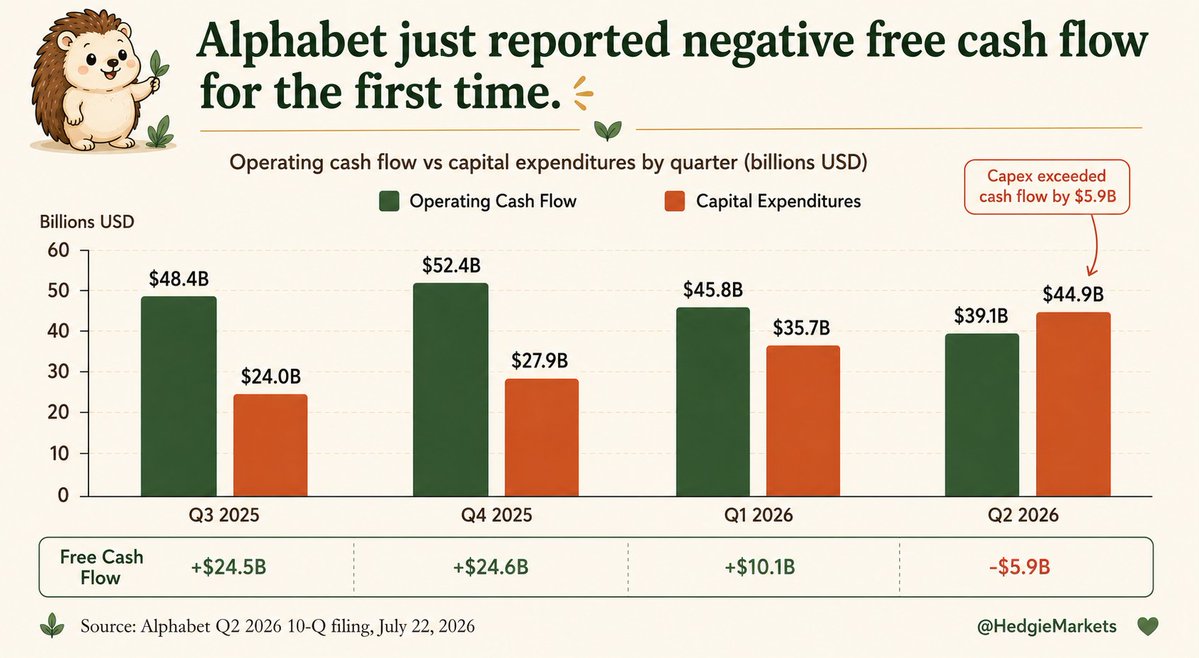
🦔Alphabet beat on every headline number tonight. Revenue up 24%. Cloud up 82%. EPS of $9.11. But $6.26 of that EPS came from paper gains on Alphabet's Anthropic stake, not from operations. Strip that out and operating EPS is about $2.85. Free cash flow went negative for the first time in Alphabet's history. Long-term debt more than doubled in six months. Stock buybacks dropped to zero.
My Take
Cloud grew 82% and I'll give them credit for that. But the company spent $44.9 billion in capex during a quarter where cloud brought in $24.8 billion. Alphabet raised $49.6 billion in equity and $20.3 billion in bonds in Q2 alone, roughly $70 billion in outside capital in a single quarter to fund AI infrastructure that the business itself can no longer cover from cash flow. A year ago Alphabet was buying back $13 billion in stock per quarter. Now it's issuing stock instead of repurchasing it. That shift is a bigger deal than the revenue beat.
The $9.11 EPS will be the headline on every financial site tomorrow and most people won't dig deeper. Alphabet booked $77 billion in unrealized gains because its Anthropic stake went up on paper ahead of the IPO. Nobody paid Alphabet $77 billion. If Anthropic's IPO prices lower or gets delayed, those gains reverse. The actual operating business just crossed into negative free cash flow for the first time while doubling its debt. I think this earnings report will age differently than the headline says.
Hedgie🤗
David Sacks: Anthropic Wants to Ban Open Source AI in America
Listen to All-In to stay a few weeks (or months) ahead of everyone else
@DavidSacks back in May:
“I think where it's all leading to is an effort to ban open source models.
There's a lot of breadcrumbs leading here.
You look at a lot of the rhetoric around how models need to have guardrails, and that with open source models, the guardrails can be removed and therefore they're dangerous.
You see this rhetoric already in Anthropic's blog posts.
Any threat that they describe, they kind of go out of their way to take that shot at open source models.
They're trying to create ideas or put predicate facts in the public record to justify an action later on.
I think it's just a matter of time before they feel like they're at a position where maybe they can push for that type of ban directly.”