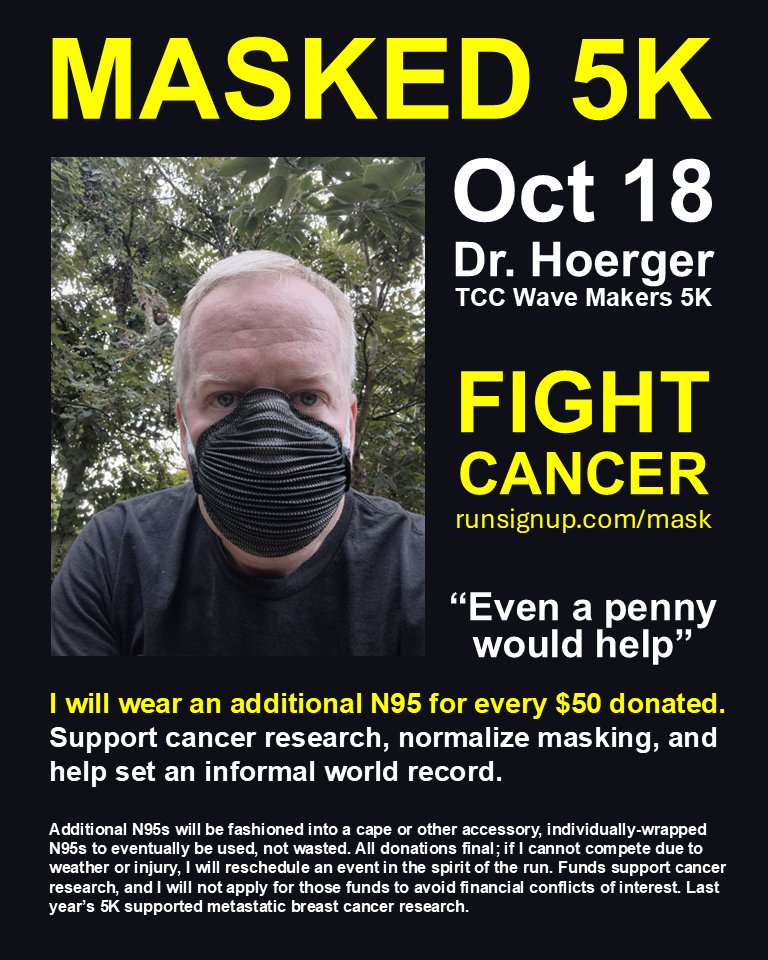
I’m doing a 5K on October 18th to support research at the Tulane Cancer Center, here in the Deep South.
I wanted to do something fun, so in addition to wearing an N95, I will wear an additional N95 on my person for every $50 donated (https://t.co/1e7EJ7BhMd).
$50 = 1 N95
$500 = 10 N95s
$5,000 = 100 N95s
$50,000 = 1,000 N95s
Any partial donation would help. $10 would add an additional mask for 1K of the race. A penny would add 1 meter with an additional mask. I’ll sum partial donations and round up in the end. Even a penny🪙 or reshare🔁 would help.
FAQs
World Record
🔹There does not presently appear to be a Guinness World Record for most N95s on an individual in a 5K.
🔹This year, I will go for an informal record. Guinness has not yet responded to my request to go for an official record, but there is always next year.
Good Health, Safety, and Environmental Modeling
🔹I will mask properly. Extra masks will not be worn on top of my mask.
🔹All masks will be individually-wrapped N95s. I will eventually wear them or donate them, if someone wants them.
Caveats
🔹It’s a fun run. All donations are final, even if weather or an injury strikes.
Inclusivity
🔹There are many ways to support health and health justice. Please also contribute to your local mask bloc or engage in advocacy in other ways too. There are many great causes.
🔹Many people with chronic and serious illnesses are housebound or cannot run or could run but would then crash for days or weeks after. This is no endorsement of the primacy of exercise-based activities.
How Your Donation Helps
🔹Your donation supports the fight against cancer and normalizes masking.
🔹Funds support the Tulane Cancer Center. Last year’s funds went toward a project to reduce the chances of bone metastases in the context of breast cancer.
🔹I avoid financial conflicts of interest like the plague, so I will not accept any payments or apply for any funds.
Please help spread the word!
@michael_hoerger This is incredible Mike. Thank you for all the work you are doing to provide this valuable information.
As listened to your presentation, I found myself wondering if there is data on therapeutics (like Paxlovid), and how it may reduce the risk of excess disease and death?