Footpath hawking is a ₹300 crore plus annual “rent” collection racket — effectively 100% bribes flowing to a well-oiled cartel of police, GBA officials, and local politicians. A genuine footpath-clearing drive threatens this cartel’s cash flow, and that’s exactly why they’re behind the protests and legal challenges. Knowingly or unknowingly, many self-styled bleeding hearts are ending up as cover for footpath encroachment.
Minister @krishnabgowda should show no mercy and extend the drive to all footpaths across Bengaluru city limits. A workable compromise: designated 100-metre hawking zones every 2 km, instead of unchecked sprawl across every footpath.
The economic and demographic effects of corruption.
Cost of land in our urban areas is far higher than what our GDP per capita would dictate. The ratio of land value to per capita GDP is probably higher in India than anywhere else. As an example, land prices in Chennai or Bengaluru rival that of cities like New York which has a vastly higher per capita GDP.
The key reason?
First, vast sums of political corruption money is parked in real estate. This raises real estate prices and high real estate prices affect everything downstream.
Second, corruption in building approvals and the like - the famous DTCP - raises construction costs, on top of already higher real estate costs.
Third, corruption in private school regulatory compliance enforcement raises school fees.
Fourth, corruption in private hospital regulatory compliance enforcement raises health care costs.
Fifth, household goods need sales outlets and those pay higher rents due to high real estate prices and construction costs.
So housing, education, healthcare and household goods - all of these now cost higher.
As a direct consequence, the economic burden on the average person gets worse. Young people, facing all these costs, postpone marriage, and postpone children or have fewer children.
That directly affects our demographics.
While this issue exists in many parts of India, Tamil Nadu, being the most urbanized of the bigger states, is particularly hit hard.
So corruption is becoming an existential threat to our society.
If you worry about the super-low birth rate in Tamil Nadu, way below replacement, understand that corruption raising our cost of living is one of the major causes, not the only cause, but a big one in our context.
Akshayakalpa has 13 years of data showing that simply introducing bee boxes increases the average coconut yield per farm by 20%. It’s such a massive win-win that they’ve now integrated 7,500 bee boxes across all their farms.
Shashi from @akshayakalpa recently brought over two bee boxes for my home to get us started with beekeeping. In this clip (full video in comments), he walks through how incredibly simple it is to set up a bee home, even in smaller or semi-urban spaces.
The bigger takeaway here is about how we view sustainability. We often look for grand, complex technological solutions to environmental issues. But the reality is that our survival is deeply tied to basic, interconnected ecosystems.
Without pollinators, our food systems collapse; roughly a third of what we eat depends entirely on them. Taking care of them isn't just a good deed; it's an absolute necessity for our own survival. And I think education is the key, which maybe the bee boxes in urban spaces can do.
Can’t be prouder of everything that the Akshayakalpa team is doing for improving the quality of life of farmers, their economics, their cows, and everything else.
Our biggest worry is failed Monsoon2026. June 26th, and no rains even in the deep Malnad areas of Karnataka. If no recovery in the next one week, situation will be worse for all. Hope and pray that there will be good rains.
After renaming Tumkur as Bengaluru North (actually North West), can rename all the districts in Old Mysore region. Shimoga can be Bengaluru Malnad, Chickmagalur can be Bengaluru Beans and Kodagu can be Bengaluru Arabica, Kolar can be Bengaluru Gold etc …. Height of stupidity. When a government thinks every inch of land is just real estate, these things happen.
Every crisis has a way of revealing something larger than an immediate fix.
Sometimes the real breakthrough is not managing the crisis better but outgrowing the dependency that caused it in the first place.
As someone once said: “The best solutions don’t just solve problems. They dissolve them.”
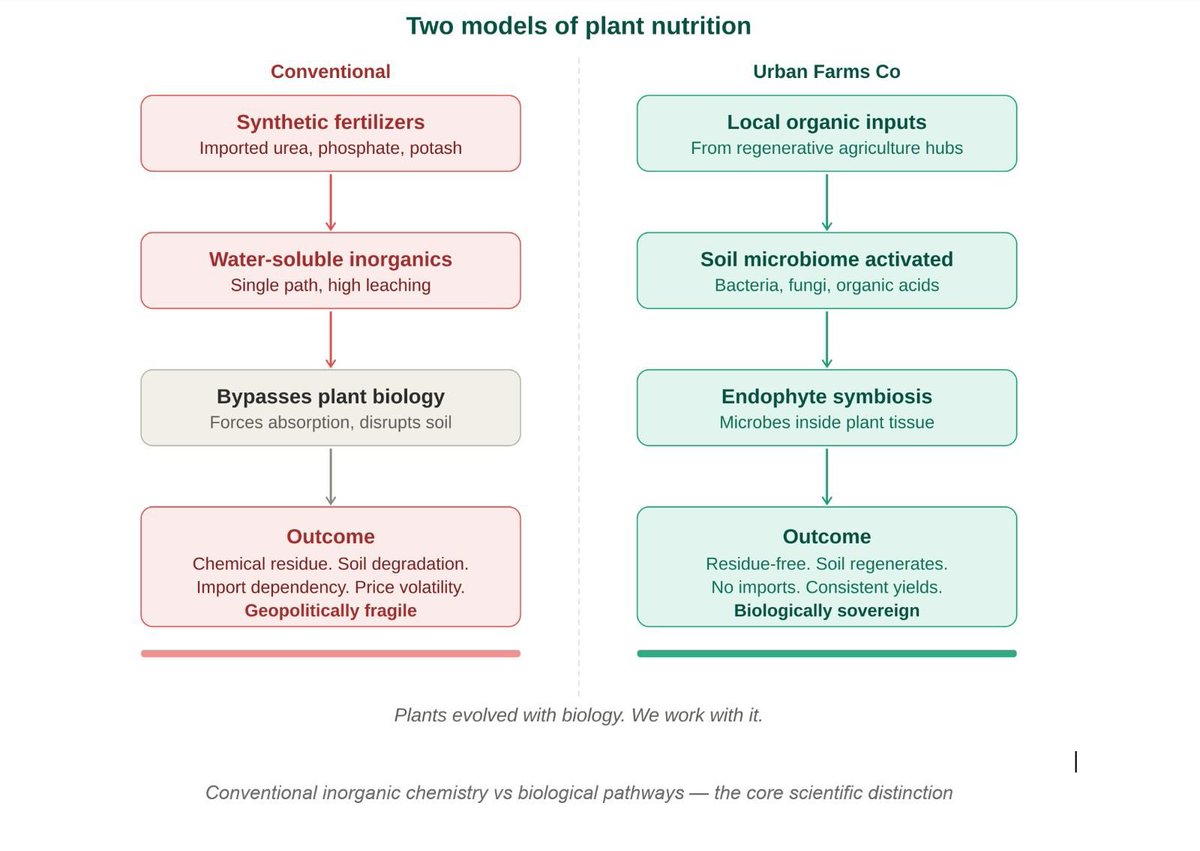
Right now, global fertilizer supply chains are under strain because of the blockage in the Strait of Hormuz. Urea prices are reportedly up sharply. Phosphate supplies are tightening.
And yet, in the middle of all this, about 2,000 Indian farmers have just completed another full season with zero synthetic inputs. Normal yields. Lower costs.
Not a pilot project. Not a theory. They’ve been doing this since 2019.
What struck me most is that 80–90% of the farmers return every season, not out of loyalty to a movement, but because the economics work.
Yields comparable to conventional farming. Lower input costs. And produce that tests residue-free every single time.
A working model. Built right here in India.
This video by @UFCo_India captures a remarkable agricultural breakthrough built on over two decades of work by @naandi_india , the same organisation that first helped create the @arakucoffeein story in Andhra Pradesh.
After seeing the success of regenerative farming with Araku Coffee, Naandi Foundation, which I’m privileged to chair, spun off Urban Farms Co. as a social enterprise with an ambitious goal: to create a nationwide “food grid” of regenerative vegetable farms serving urban India.
Today, Urban Farms Co. & its partner farmers have demonstrated that food can be grown at scale without urea, synthetic fertilisers or pesticides.
They now grow more than 50 varieties of vegetables across states ranging from Himachal Pradesh to Karnataka, Telangana, Maharashtra, Rajasthan & Chhattisgarh, supplying nearly 10,500 tonnes of vegetables per year.
And this is not confined to company-owned farms. Over 1,200 partner farmers are generating sustained profits through regenerative, residue-free agriculture.
Available currently in Delhi NCR, Chandigarh, Mumbai, Pune. On Blinkit as well.
The future of food may not run on imported chemistry.
It may well run on healthier soil, better science & farmer economics that actually work.
Bravo to Vikash, Raheel and Madhur, who are leading this mission at Urban Farms Co. & who took on the challenge of @manoj_naandi to prove that regenerative agriculture can move beyond philanthropy and become truly market-ready.
The primary reason to Bengaluru’s traffic crisis is bad planning and lack of coordination.
There is an urgent need to institutionalise BMLTA. The state government and its Urban Development Department have lost focus on this.
While we empower BMLTA, the priority should also be on accelerating MRTS, which can move far more people, & faster.
The metro projects accross the city have been delayed- the Red line due to conflict of alignment with Car Centric Tunnel Road. Pink and Airport line work continue to lag.
The Government of Karnataka must move away from car-centric infrastructure and focus on mass transport solutions.
We’ve seen this again and again, more roads, whether elevated or underground, don’t reduce traffic, they only relocate it and, in fact, worsen it by inducing more cars and private vehicles.
#BMLTA
The tragedy of our cities. World class buildings, third class roads and footpaths in many areas. Private quality, public disaster driven by deep corruption! Was in Mumbai today at Andheri-totally shocked at bad roads,huge debris on road, slow work, poor quality of new concrete road, never ending works….
Bangalore: You drive on the broken roads, invisible footpaths, unchecked garbage. Every sign of a third-world city. And then you enter the gate of business parks where the first-world experience awaits you.
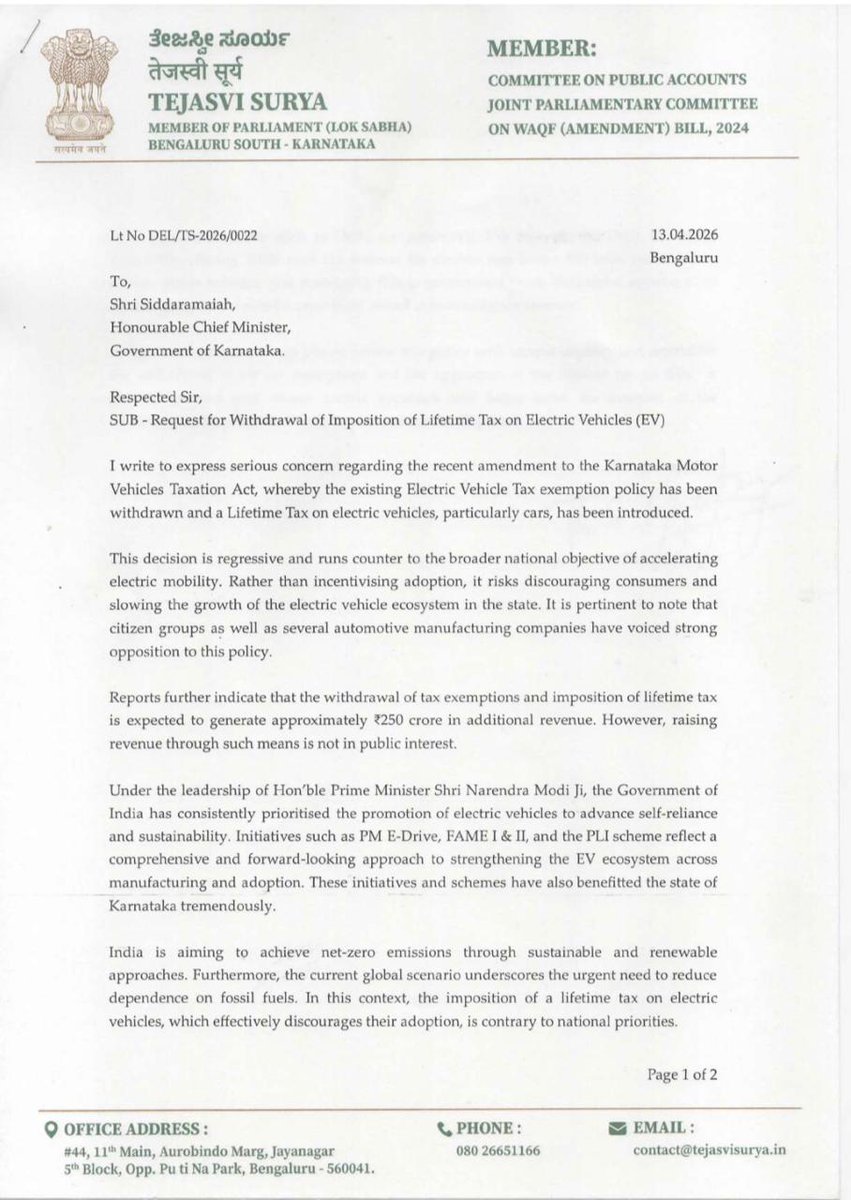
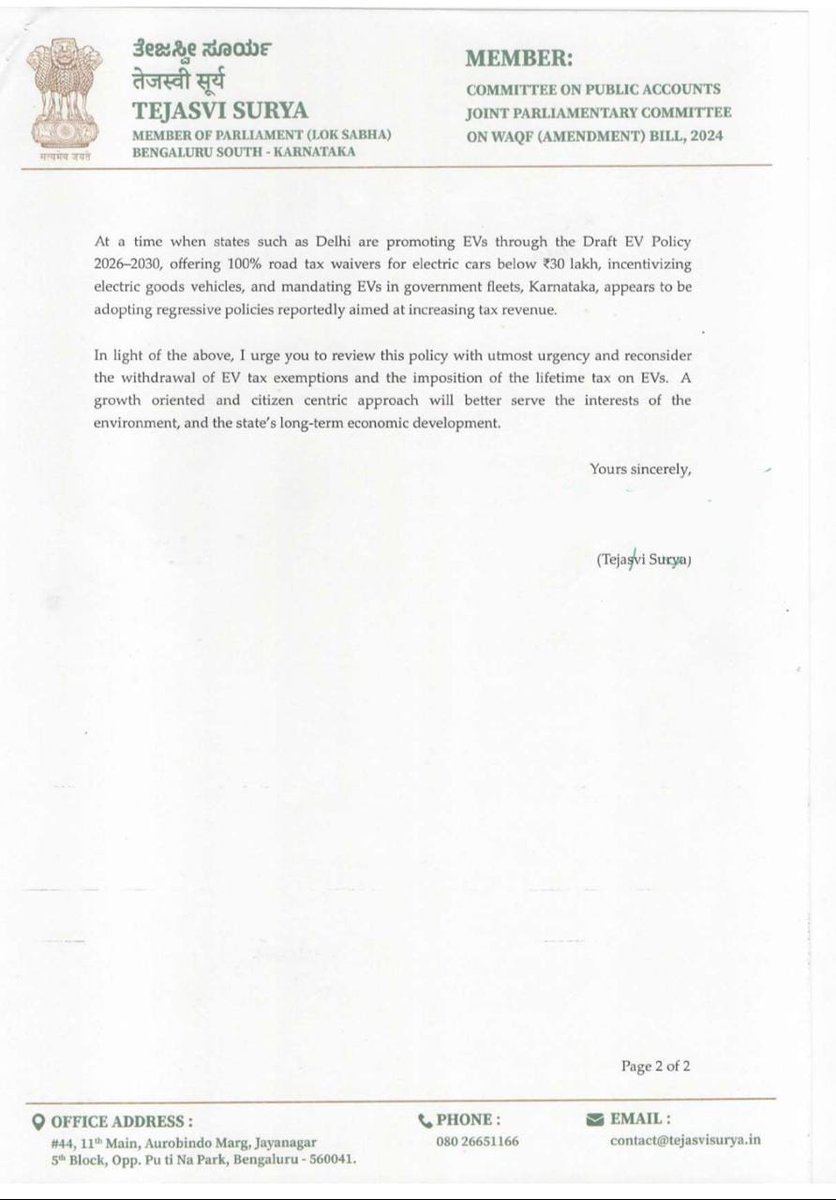
Wrote to CM @siddaramaiah, urging withdrawal of the lifetime tax on EVs - a regressive move against citizen interests and clean mobility.
The current global scenario underscores the urgent need to reduce dependence on fossil fuels.
India under PM Modi Ji is committed to achieving Net- Zero, yet Karnataka is discouraging EV adoption - a move contrary to national priorities.
While states across India are taking steps to promote electric mobility, Karnataka has imposed this tax - simply to extract ₹250 crore from the people to fund the Bankruptcy of the State.
Progressive states like Delhi are offering 100% road tax waivers for electric cars below ₹30 lakh and incentivising electric goods vehicles, while Karnataka under the Congress, is moving in the opposite direction.
This is not governance. This is regression.
#KhaliTrunkSarkara
#CongressFailsKarnataka
M. Venkaiah Naidu:
🗣️ “Teach a man to fish rather than giving him one. Endless FREEBIES create dependency.
Govts must focus on Education and Healthcare, & any welfare promise should be backed by a proper budget"
Voice against reckless FREEBIE politics🎯
Bengaluru: This ramp (HSR Layout to BTM Layout side) should be opened to public without any further delay & without any fanfare/ inauguration.
It's just a ramp & is already a delayed project. Double-decker project has already been launched & does not require a separate inauguration for the ramp @CMofKarnataka@DKShivakumar@OfficialBMRCL
In last 2-3 years, I saw many people early retired with 10cr+ savings, many are laid off but have 3cr+ easily.
No one is even thinking to start any business.
In India,savings are so draining that it will take years to save 1cr.
People are so anxious to lose & go back to square 1.