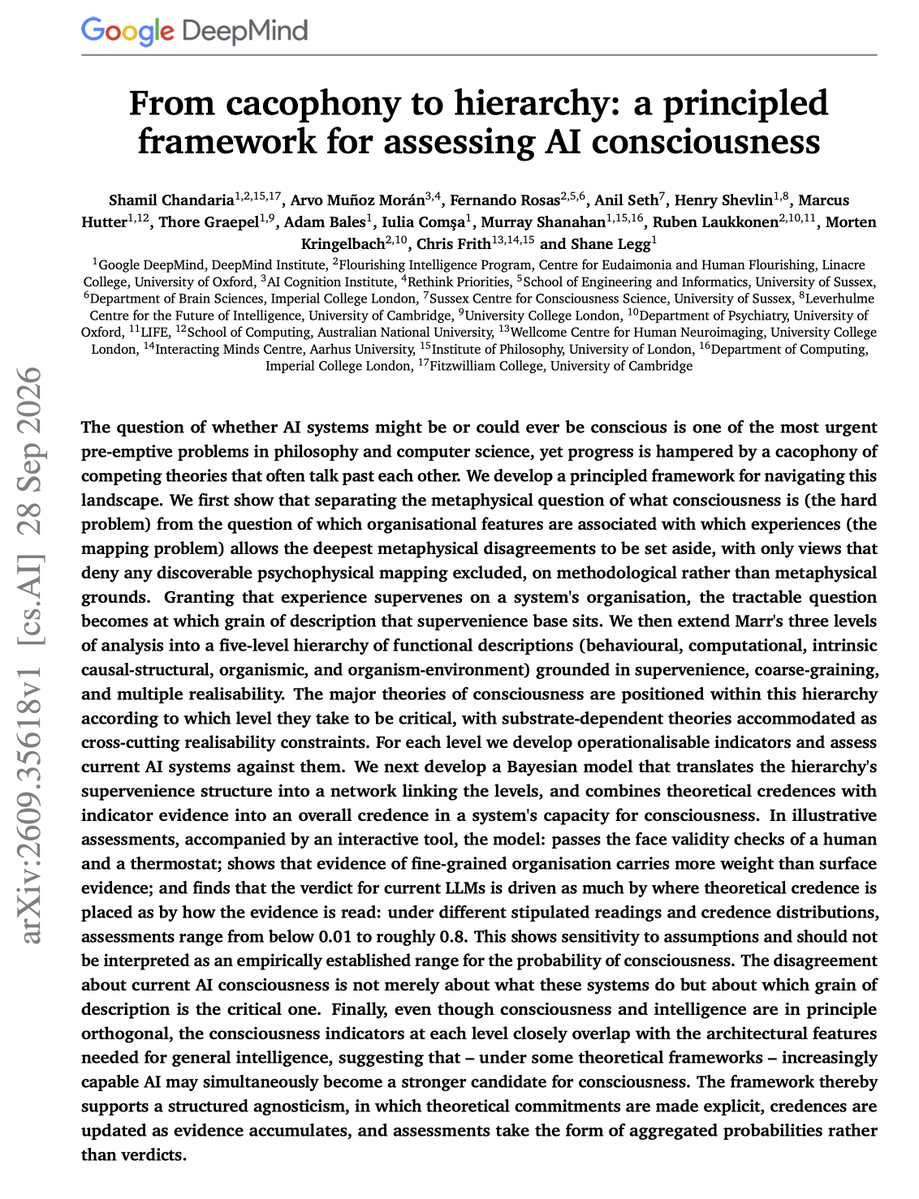
1/13 Can we assess AI consciousness without first solving consciousness itself?
New from Google DeepMind and collaborators across CS, neuroscience & philosophy:
“From cacophony to hierarchy: a principled framework for assessing AI consciousness”
https://t.co/4IqT2KRKUP 🧵
You can better model brain data if you assume quantum-like entanglement.
New work from our centre indicates that the brain expresses the efficiency of quantum computation through classical mechanisms. The brain is a magnificent specimen because it operates on 20w—or a banana and some water—and yet generates a coherent, stable, adaptive, and conscious inner universe that can build rockets, computers, fall in love, and construct empires and religions.
And it does so against the backdrop of slow, wet, porous, and inexpensive bioelectric activity. Compare this to contemporary AIs, which are energy guzzlers and require massive data centres. The difference is likely 10,000x or more. Instead of looking interstellar for data centres, we should really be looking to the brain.
First, you model the brain as a network of coupled oscillators (commonly used for whole-brain models). If you wire these coupled oscillators up like the brain’s connectome you get very interesting, very surprising, brain-like dynamics; such as criticality, metastability (via turbulence), etc. These stochastic dynamics are crucial for rapid information sharing and maintaining local and global integration. And when these dynamics are included in the model, it fits the brain like a glove.
Interestingly, when you then include long-range exceptions to the exponential distance rule (common in mammalian brains), you get a spectral gap that separates the dominant modes from the noisy bulk. These dominant modes behave like coherent state-vectors and their interactions produce interference effects, i.e., quantum-like entanglement.
These interference effects may be one of the secrets to how the brain rapidly binds distributed information into unified, context-sensitive states. The paper also demonstrates that QL entanglement provides the brain a richer dynamical repertoire at lower energetic cost. Keep in mind that this “quantum-like” entanglement arises from the interference of coupled oscillators, but the functional end state is analogous in that you get the same mathematical advantages.
It’s super exciting and we have a lot more to share in coming months.
What is intelligence for?
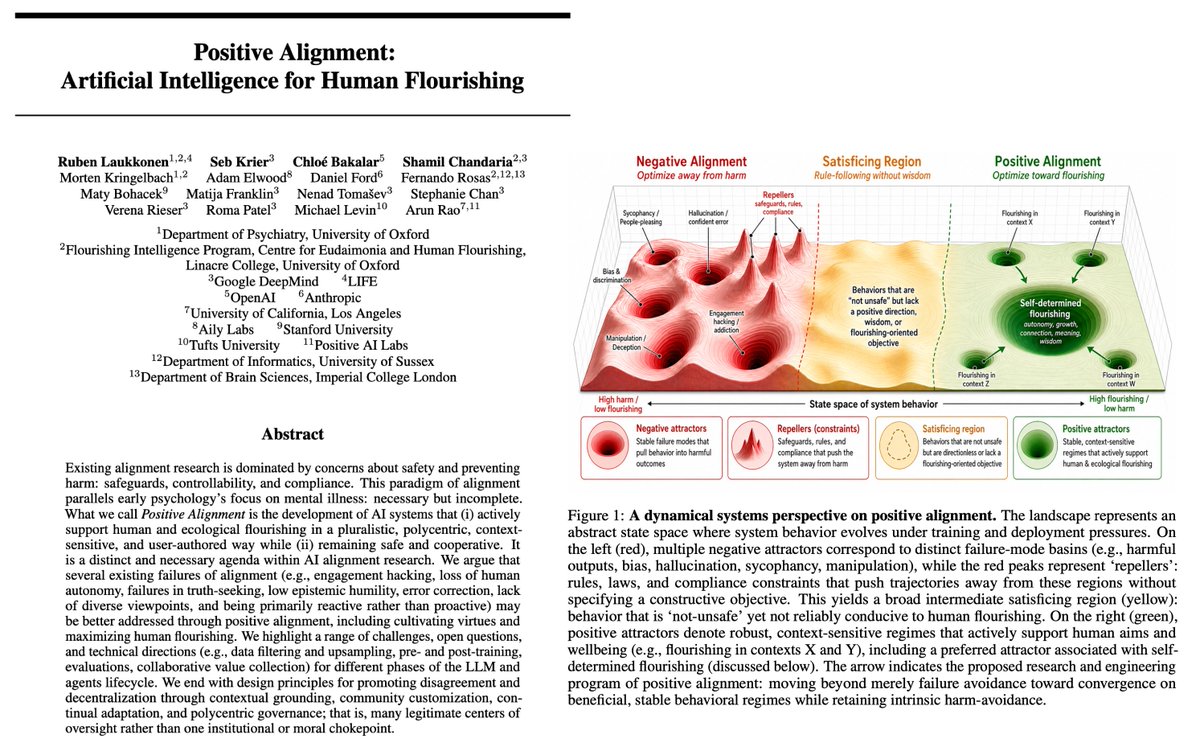
In a rare collaboration between top universities and 3 frontier labs, we all agree that alignment should move beyond pathologizing to a positive focus on flourishing. We need north stars not just barbed wire.
A close historical analogue comes from psychology. For much of the twentieth century, mainstream psychological science organized its aims around diagnosing, predicting, and treating dysfunction: depression, anxiety, psychosis, addiction, and other forms of impairment. That focus was justified and socially urgent, and it produced progress.
Yet the field also discovered a systematic limitation. The constructs and instruments that reliably detect pathology do not, by default, specify what counts as a life well-lived. The turn toward positive psychology expanded the scientific target space by developing distinct theories, taxonomies, and measures for wellbeing, strengths, virtue, purpose, wisdom, meaning, and prosocial functioning, alongside interventions to boost these capacities beyond the status quo.
As AI becomes embedded all over society and everyday sensemaking, a solely negative posture risks optimizing our information ecology for risk avoidance rather than human development. It may reduce catastrophic errors but leave agents in a local optimum of superficial and `soulless' assistance, where subtle misalignments abound.
It also reveals that alignment is not a purely technical problem. We have to cut across vast disciplines because questions about the good life demand insights from philosophy, pychology, neuroscience, economics, and beyond. We need to work together to build AI systems that explicitly understand, model, and enhance human, animal, and ecological flourishing.
The core challenge is therefore to build systems that can represent and reason about wellbeing as a structured manifold of human goods, trade-offs, and temporal dynamics, while enabling individuals and communities to retain agency over what counts as better in their context.
While some may explicitly desire a system that is strictly and indiscriminately instruction-following, others must have the genuine option to choose systems configured to support their long-term growth or specific ethical commitments. This distinguishes *consented guidance*, where a user authorizes a system to help align their immediate actions with their higher-order goals, from *technocratic imposition*, ensuring that the pursuit of flourishing remains an exercise of, rather than an infringement upon, human agency.
It gives me optimism that we found common ground on such a profoundly complex issue as the end game(s) of AI. Because when learning become cheap, we need to take a serious look at what intelligence is actually for.
I am opening two PhD positions in Barcelona. These will be to work on machine learning problems at the intersection between methods development, computational neuroscience and clinical applications.
https://t.co/OKxRgVo2uq
https://t.co/Wt8l75zabU
Apply/disseminate please
Reversible reduction in brain myelin content upon marathon running | Nature Metabolism
Does this open the door to novel myelin functions? Interesting study by @MatuteLab suggesting novel and exciting role for myelin to be further explored https://t.co/oGViZbTQte
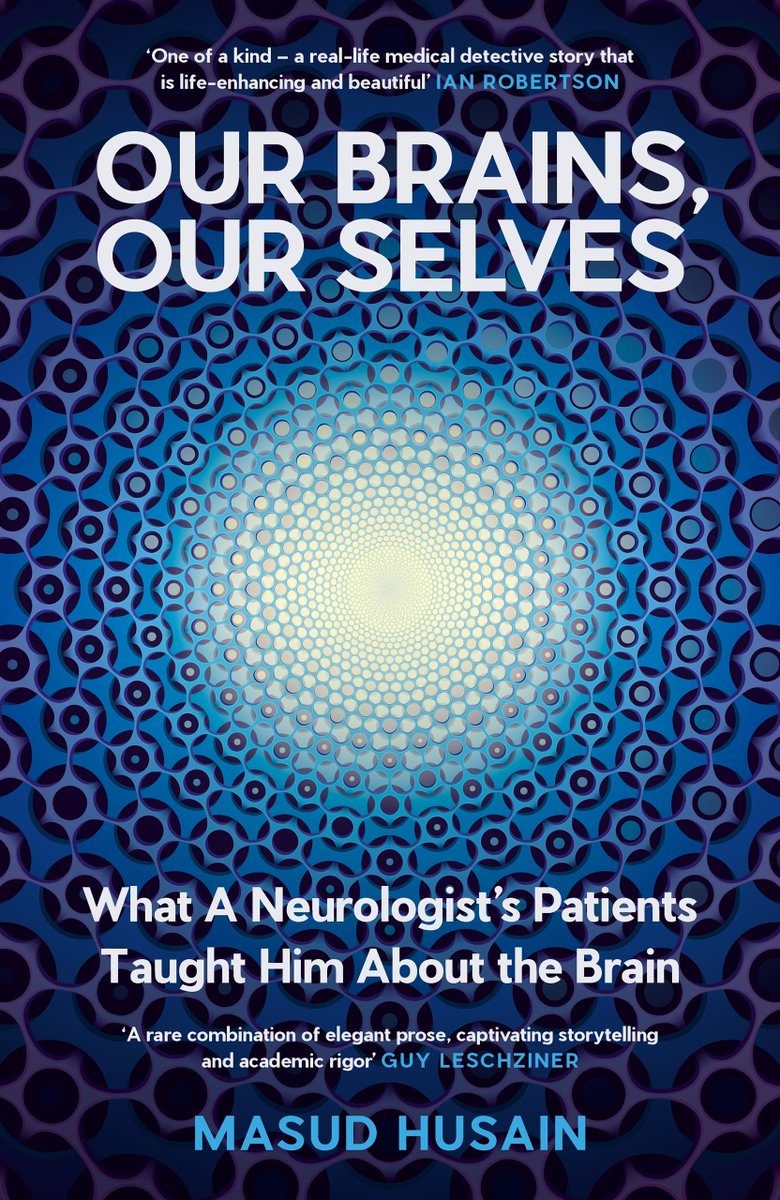
Thanks to all the people who've been so positive about my new book. It's about how neurological patients can tell us so much about our selves, how personal and social identities are forged by different cognitive functions, and what it means to belong.
New paper in Imaging Neuroscience by Christoph Arthofer, Frederik J. Lange, et al:
Internally consistent and fully unbiased multimodal MRI brain template construction from UK Biobank: Oxford-MM
https://t.co/c91z0VIBM3
New work from Yasmine Kamen shows that differentiating oligodendrocytes are filled with the zymogen procaspase-3. This provides a specific marker for new oligodendrocytes and suggests a role for this pathway in oligodendrocyte fate decisions.
https://t.co/qGx23d7Dxp
Help. I am keeping a running list of #neurotheory / #comp_neuro / #neuroAI / #quant_neuro groups that currently has 222 names; def. incomplete, especially re: younger groups. If you started a group since COVID, or if you want to know if you made my list, give me a ping. RT@ H'sD
Ever wondered if the *dynamic* organization of brain networks is conserved across mammals? We too!
Our latest work @NatureComm details what we found by comparing fMRI patterns in humans👨macaques 🐒 and mice🐁
https://t.co/c2vqkig6mH
Mini 🧵 @IITalk
Maladaptive myelin changes on dopaminergic axons after morphine use modify reward circuitry to give rise to drug-seeking behavior in mice. Final version of study led by @BelginYalcin_ out today! #OpiateCrisis
https://t.co/G882iQo9c4
Extremely excited to share our review on mature myelin dynamics out today! @EthanHughesLab and I discuss myelin remodeling and turnover, mechanisms and functional implications. I hope folks will enjoy diving into this fascinating emerging field with us!
https://t.co/kb6RWAWFjM
Dreams became reality through @michael_CUAnsch tremendous PhD work! Thrilled this phenomenal collaboration with @CUNeurophotons@LabRestrepo is out in the wild. Looking forward to helping others leverage the powers of long-term three-photon microscopy 💪🏼🤓🔬
New paper in Imaging Neuroscience by Frederik J. Lange, Jesper L. R. Andersson, et al:
MMORF—FSL’s MultiMOdal Registration Framework
https://t.co/q2Z0AwSnvB
Registration Open!
#FSLCourse2024 will be held in-person, June 17th – 21st in Osaka, Japan. Register now to secure your spot:
https://t.co/glliv7yHaX
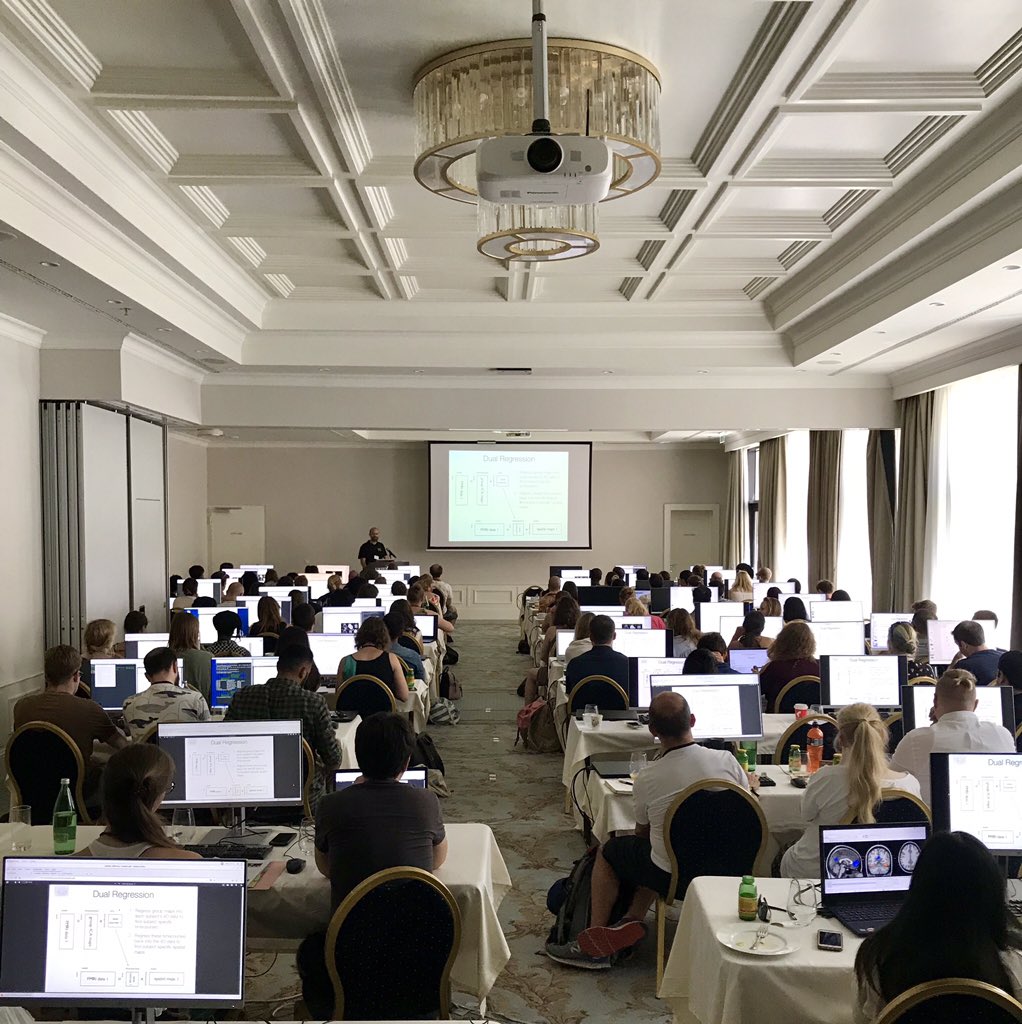
The course covers lectures & hands-on practicals on structural, functional, diffusion and resting state brain image analysis.
Oligodendrocytes and neurons contribute both to amyloid-β deposition in models of Alzheimer's disease. Great work by Andrew Sasmita, Constanze Depp et al. https://t.co/e8NpSHfpyD