This advice will improve your trading PnL.
Having looked at the Apex risk management principles, knowing how to keep your losses small / taking risk off is the low hanging fruit of profitability.
Knowing when to go risk-on is more often than not niche and far more technical.
Thoughts from a quant fund founder + former Bridgewater quant:
Many people have asked the obvious question: why go through YC and raise VC capital instead of just launching a fund?
In my opinion, this isn't the relevant question. It makes a lot of sense for this kind of company to go through YC. It's incredibly hard to raise a quant fund. LPs will benchmark you against Citadel/WQ/etc, and ask the reasonable question "why invest in this unproven fund when I can get 20+% returns reliably through a decades-old vehicle".
Having the YC brand will go a long way in helping this firm raise their initial ~$50m in LP capital. And it probably also helps them raise ~$10m in GP capital to hire researchers, train models, etc. A reasonable trade for 7.5%.
The more meaningful questions for me:
1. How good is their model really?
Prodigy claims to outperform Fable and Sol on trading benchmarks. Duh. It would be embarrassing if your custom harness/model underperforms the generally-available models that are not optimized for trading. Every AI-trading company should outperform all general SOTA models, otherwise their work is a net-negative to what you can get with Claude Code.
The two trading-related stats are more meaningful, "outperforms 90% of traders at JS" and "108% returns in the last month." However, any quant can tell you that both of these are underspecified. There are two reasons that I don't think these numbers communicate much information: (a) returns are a bad metric to evaluate quant funds. LPs don't evaluate quant funds on returns, but rather sharpe ("risk adjusted returns") and diversification ("how different are these strategies than what I can get from XYZ firm"). (b) how scalable are those strategies? there are lots of strategies that will deliver exceptional returns at small amounts of capital, but don't scale at all. a simple example: crypto funding arbitrage can easily print money, but won't scale to a typical fund size.
One stat Prodigy gave that is genuinely impressive: they've never had a down week.
To be clear, their model might be exceptionally good. We don't know enough to make an evaluation yet, but I look forward to Prodigy sharing more as they grow.
2. What are you investing in?
I think it's highly unlikely LPs will want to make a vanilla investment into this fund. The risk/reward is simply not there. Even if the fund returns 100%/yr, the LP only gets that benefit for 2-3 years until the fund becomes private and returns money. And the risk is that the fund blows up (it only takes 1 bug to undo years of excellent performance).
At minimum, LPs will want a long guarantee that they won't get kicked out. I'd imagine something like 10 years? Even with that, I'd bet most LPs will also want to invest into the GP, so they get meaningful upside if the fund becomes the new RenTech. Would be very curious to know what valuation LPs can get GP equity at.
Of course, this is assuming Prodigy is aiming to be a trading firm. It might reasonably be a services provider to other trading firms, and just sell model access, data, signals, etc. Remains to be seen what the business model is!
3. What's the moat?
The quant-fund version of "why won't Google/OAI/Anthropic do this" is "why won't Citadel do this". But it's a much more reasonable question there imo.
Citadel (and other similar funds) operate on a pod-shop model, so they have 100+ independent teams working on unique strategies to make money. If it turns out that training custom models is profitable, Citadel can fund an elite pod-shop with $100m+, get ~unlimited compute, hire the world's best researchers, and try to recreate your strategy.
It's not the same as Google/OAI/Anthropic trying to recreate your startup. The pod-shop model means that individual pods mostly are independent, and don't suffer from the bloat and lack-of-focus that larger tech firms face.
You might say "this is a general critique of new quant funds", and you'd be right! The current market environment has made it very difficult to create new, small quant funds. The economics of scale have made it much more lucrative for quants to join established firms as opposed to striking it out on their own.
It's not impossible though, and there are new quant funds founded every year. I would just want more information about why Prodigy thinks they have a lasting edge here.
TLDR - Prodigy's early track record is genuinely impressive! However, we simply don't know enough to actually evaluate their model. Early-stage quant funds are a brutal business, and the market is mostly against you (data, compute, talent, etc are significant costs for a small fund).
Kudos to the team for everything they've accomplished so far, and I hope they can become a success story for what the new generation of quant funds look like.
Coming Saturday... Only on The Day Trading Show!
Dylan Maltman shares the story of how he went from retail to institutional and started his own AI-native hedge fund.
@MaltmanDylan
IS YOUR TRADING EDGE-CONSTRAINED OR OPPORTUNITY-CONSTRAINED?
@Hormozi always emphasizes focusing on the #1 constraint in your business.
Most businesses are either demand-constrained or supply-constrained, and whichever constraint you have determines your entire strategy. If you don’t have demand, you focus on marketing and sales. If you don’t have supply, you focus on supply chain and operations.
Ok, Lance… how does this apply to trading?
Trading works the exact same way, but I’ve never see anyone frame it like this: you are either edge-constrained or opportunity-constrained, and your results are determined by which constraint you attack. The problem is most traders misdiagnose themselves, so they spend years solving the wrong problem.
If you don’t have a proven edge, you are edge-constrained. That means your job is not to trade more, not to scan more markets, and definitely not to take more setups hoping something sticks. Your job is to backtest, collect data, refine execution rules, and build a playbook that has real statistical backing, because without edge the more you trade the more you lose, and every hour spent hunting new opportunities is just accelerating drawdown.
Edge-constrained traders should be obsessed with proof and data. Until you can say with high certainty that your setup produces positive expectancy over hundreds of trades, nothing else matters, because you cannot scale something that has negative expected value.
Now flip it. If you have a proven edge and a defined playbook, you’re no longer edge-constrained. You’re opportunity-constrained, and now the game changes completely because the problem is no longer whether your setup works, but how often you can find and how to maximize each opportunity.
Opportunity-constrained traders should not be endlessly tweaking entries or second-guessing their system. Their effort should go toward finding more of their best setups, building scanners and filters to surface them faster, expanding into other product markets where the same pattern exists, or using instruments like options to express the same idea more efficiently. Once edge is proven, growth comes from better execution, better sizing, and wider expression of that edge, not from reinventing the strategy.
Most traders are trying to scale before they validate, or optimize before they prove. Identify your constraint first, because solving the wrong problem is why you feel busy but stay stuck. In trading, just like in business, the bottleneck determines the strategy, and if you attack the real constraint with full focus, progress becomes inevitable.
The same is true for your trading business. And that’s why you need use your noggin to reflect and find the right advice that applies to your situation. Not blindly follow what you read.
1/ Oil surged 35% last week, the largest weekly gain in futures dating back to 1983.
Brent hit $119. The Strait of Hormuz is effectively closed. 20% of the global oil supply is disrupted.
Dow futures down 1,000+ points. KOSPI triggered circuit breakers. Asian markets in freefall
found a wallet doing something illegal
or at least it should be
$731,964 balance
trading every 0.3 seconds on 5-minute BTC markets
+$2, +$8, +$15, +$22, +$5, +$11
non-stop
the bot doesn't predict price movements
it exploits order book imbalance microseconds before anyone else sees it
9ms latency via private RPC nodes
scans 260k+ market feeds simultaneously
finds 0.2-0.8¢ liquidity gaps and executes instantly
while price bounces randomly, equity compounds mechanically
no analysis, no sentiment, just surgical execution
the wallet: https://t.co/Fby0XHYql1
printed $400+ in the time it took to write this
humans physically can't compete with this speed
$QQQ Nasdaq in October 99 broke out of its grind range and ran higher by 83% within a period of 101 sessions, 147 days (21 weeks/5months).
Internet stocks went wild, valuations stretched and many of the doubters of the early years succumbed to the pressure of crowds.
NEW EPISODE 302📢 Go Where Orders Flow | Dylan Maltman
Had a great chat with intraday Fx, commodities and US indices, systematic trader! @MaltmanDylan 🙏 Ian Cox & @tessa_dao
https://t.co/lUtD79BmWx
@TheOneLanceB Echo that.
For context for the traders still finding their consistency - that’s not to say that NQ does not offer spectacular opportunities, but rather that it’s important to spot the BEST opportunities day to day.
@paxtrader777@Matthews_Trader The ecosystem is designed for counterparties to succeed without a doubt.
However that’s not to say that intraday trading NQ futures is not profitable @paxtrader777
MAJOR news from Iran:
Iran's parliament officially approves CLOSING the Strait of Hormuz for the first time since 1972.
If approved by Iran's top security body, shipments of 20+ MILLION barrels of oil PER DAY will be impacted.
What's next? Let us explain.
(a thread)
america’s strikes on iran: ideally for trump a couple of major strikes and then done.
a bite sized war to play up on social media. more tiktok than ken burns.
(but not israel's preference...)
How to succeed at trading:
Only trade when you have proven edge, while utilizing paper trading or 1 share positions when developing strategies. (Yes, your ego will survive)
Competing insanely hard does NOT need to be mutually exclusive w keeping your attitude light.
My personality was MJ rather than a Steph Curry or Mahomes.
This would easily be one of my top regrets as well as one of the most common issues I see on the prop side.
Trump's Art of the Deal Just Transformed Middle East Politics
His $2 trillion deal spree revealed 3 commercial strategies the media missed completely.
His Pakistan move left diplomats speechless.
Since the media won’t tell you, here's the real breakthrough…
A Thread 🧵
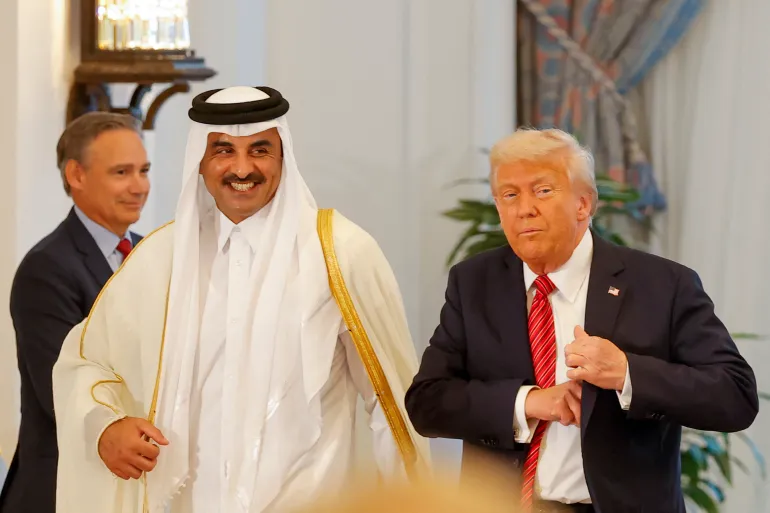
Before 1996, Qatar was a barren desert of 320k people
Yesterday, they casually spent $96B on Boeing Jets - the largest purchase in history
Their $450B fund owns more of London than the British Royal Family
How desert rulers engineered the West's silent takeover: