70 strangers just trained a 72B parameter AI model over the regular internet. No data centre. No whitelist. No central coordinator.
Covenant 72B @tplr_ai on $TAO Bittensor Subnet 3.
Largest permissionless decentralised pretraining run in history.
1% of companies represent 90% of AI spending.
Of that 90%, 80% of this spend are from unprofitable VC backed companies.
So, roughly, $0.70-75 of every dollar of AI spending right now comes from AI companies spending VC investment dollars.
As a result, the revenue quality in AI is currently poor. This happened in previous cycles as well, like cloud when early users of AWS were mostly venture backed startups.
The thing, though, is that before AWS could scale and pull thru GCP and others as legitimate cash machines, there were a few clearing events to sort out these brittle revenues.
This is the extrapolation of Ken’s point. We will need to transition from speculative AI spending to consistent, reliable spend that shows up in public market earnings reports.
This hasn’t happened yet because most of the breathtaking revenue growth comes from LPs investing in VC funds who then send it to startups.
🚨 MAJOR SECURITY ALERT
8 certificate authority private keys have been compromised.
How bad is it? An attacker holding these keys could impersonate ANY website, including banks, exchanges, or Google, and potentially intercept sensitive communications.
The good news: Chrome, Firefox and Apple have already taken action to block the compromised certificates.
The bad news: Many apps, developer tools and systems may still trust them.
What you should do TODAY:
Update your browser, OS and phone.
Update desktop apps (Slack, Discord, VS Code, etc.) as patches arrive.
Avoid untrusted Wi-Fi until your devices are updated.
Only install updates from official sources.
Ignore any email offering a "certificate fix".
This is a serious compromise of internet trust infrastructure, not just another website hack.
Full technical details:
https://t.co/i5MxKTe8co
CPI Details:
CPI rose 0.6% MoM after rising 0.4% MoM in August; it rose 3.7% YoY
The index for gasoline rose 9.1% in September, accounting for over half of the monthly all items increase. The energy index increased 5.2% over the month following a 2.1% increase in August. Electricity CPI rose 0.2% over the month. In contrast, the natural gas index decreased 0.3% in September.
The shelter index rose 0.4% in September after rising 0.3% in August.
The index for food was unchanged in September, as the index for food away from home increased 0.2% and the index for food at home fell 0.1%. It increased 2.5% over the last year.Three of the six major grocery store food group indexes decreased in September, while the other three indexes increased. The meats, poultry, fish, and eggs index decreased 0.5%over the month, as the beef index fell 1.0%. The index for other food at home decreased 0.2 percent in September. The dairy and related products index decreased 0.9% over the month, as the milk index declined 2.0%.
The energy index increased 20.4% YoY due in large part to the index for gasoline rising 34.2% over the same period. The natural gas index increased 5.0% YoY and the electricity index rose 4.4% YoY.
Core CPI rose 0.3% in September, same as August. Indexes that increased over the month include recreation, used cars and trucks, education, airline fares, medical care, and apparel. Conversely, the index for communication was among the small number of major indexes that decreased in September.
Shelter CPI increased 0.4% MoM, after rising 0.3% in August.Index for owners’ equivalent rent rose 0.3% in September, and the index for rent increased 0.2%.
Lodging away from home index rose 2.0% in September after rising 2.4% the previous month.
Index for recreation increased 0.5% over the month after being unchanged in August.
Used cars and trucks index rose 0.7% in September, and the education index increased 0.6%.
New vehicles index, the personal care index, and the motor vehicle insurance index also increased over the month.
Index for airline fares increased 1.2% in September, and the index for apparel rose 0.3%.
The medical care index increased 0.1% in September after falling 0.2% in August. The index for hospital services rose 0.7% over the month.
Prescription drugs index declined 1.2% in September.
Index for physicians’ services was unchanged over the month.
Communication CPI declined 0.2% in September after rising 2.3% in August.
Index for household furnishings and operations was unchanged over the month.
Important Update!
Subnet registration just got two important changes:
→ Registration costs now decay twice as fast (8 vs. 16 days).
→ New subnet immunity drops from 120 to 60 days.
What's the takeaway? Lower barriers to entry, but need to prove your value increases dramatically.
More opportunity for new builders. More pressure to execute. Competition will be accelerating.
Here is @const_reborn's full keynote at @ExploitSummit
It is worth the 36 minutes, but I'll give you the cliff notes.
> Affine 1, a model trained by anonymous miners entirely on Bittensor, matches the intelligence score of Anthropic's Opus 4.1.
> 23 of 128 subnets now have paying customers
> Gamma tokens are coming to turn subnet usage credits into something agents can buy from any chain.
> "We're not afraid of hyper-intelligent bot swarms on the internet. We use them to optimize our technology."
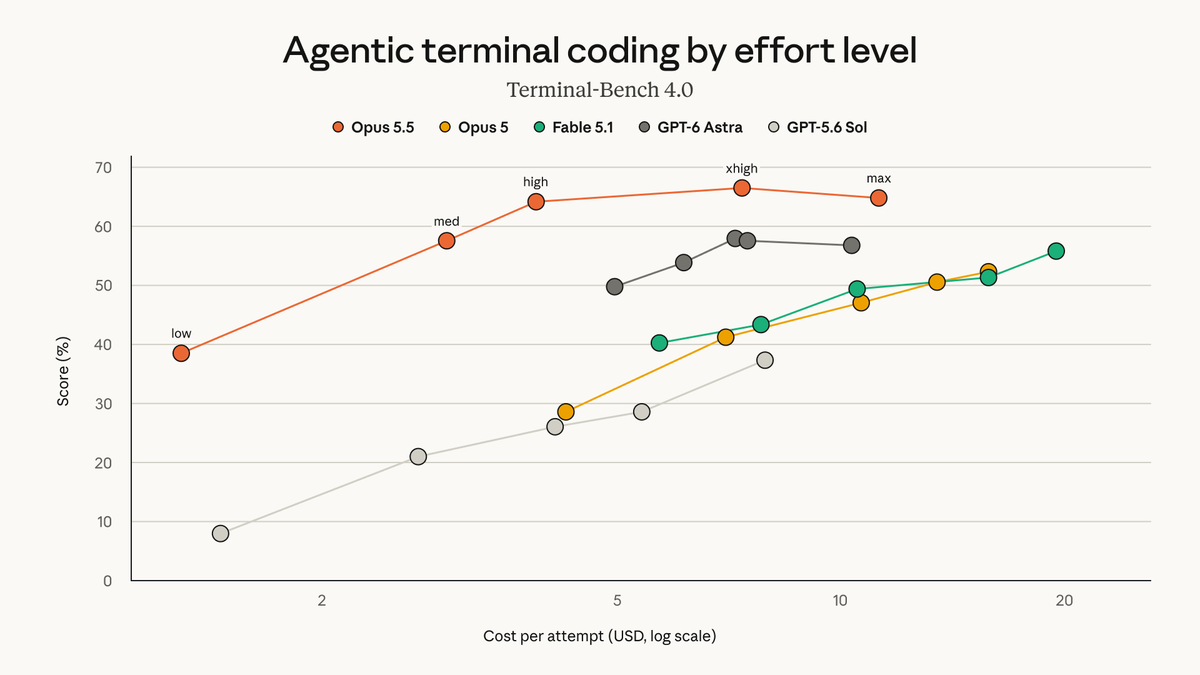
Opus 5.5 performs at the level of Fable 5.1. It's ~30% faster and ~40% cheaper than Opus 5 per task.
In Claude Code:
- 5-hour session limits increase 20% today
- Opus 5.5 is priced lower, so it goes 25% further within limits
- Pro, Max, and Team users get a reset to use anytime
ECB raises interest rates 25 basis points.
The Fed is falling behind.
The 2 year yield has been going up for most of the year and the Fed has refused to listen to it.
Because of this the long end of the yield curve continues higher.
Bessent can scream all he wants about bond buybacks but until they raise rates the long end will want to go higher
Anthropic modelled three AI futures to 2030. In the median case, cognitive wages go flat, trade wages rise 5.9%, and capital takes the difference.
The endgame is labour vs capital.
Anthropic’s Economics team is sharing a new model of how AI might affect economic growth, jobs, wages, and more by 2030.
Explore the scenarios, tell us what you think will happen, and see how your answers compare to more than 10,000 Americans. https://t.co/AvQlEZNxR0