Every corporation in America needs to study Elon‘s philosophies on operations and they would learn an incredible amount of information! Here it is for those interested.
Elon Musk explains his 5-step algorithm for running companies
“First, make your requirements less dumb. Your requirements are definitely dumb… It’s particularly dangerous if a smart person gave you the requirements because you might not question them enough.”
Here’s his “algorithm” quoted in full from the Walter Isaacson biography:
1. Question every requirement. Each should come with the name of the person who made it. You should never accept that a requirement came from a department, such as from "the legal department" or "the safety department." You need to know the name of the real person who made that requirement. Then you should question it, no matter how smart that person is. Requirements from smart people are the most dangerous, because people are less likely to question them. Always do so, even if the requirement came from me. Then make the requirements less dumb.
2. Delete any part or process you can. You may have to add them back later. In fact, if you do not end up adding back at least 10% of them, then you didn't delete enough.
3. Simplify and optimize. This should come after step two. A common mistake is to simplify and optimize a part or a process that should not exist.
4. Accelerate cycle time. Every process can be speeded up. But only do this after you have followed the first three steps. In the Tesla factory, I mistakenly spent a lot of time accelerating processes that I later realized should have been deleted.
5. Automate. That comes last. The big mistake in Nevada and at Fremont was that I began by trying to automate every step. We should have waited until all the requirements had been questioned, parts and processes deleted, and the bugs were shaken out.
Elon shares a costly example of doing this process in reverse on the Tesla Model 3 production line and optimizing a part that didn’t even need to exist.
“It’s possibly the most common error of a smart engineer to optimize a thing that should not exist. Everyone’s been trained in high school and college that you answer the question — convergent logic. You can’t tell the professor your question is dumb or you’ll get a bad grade. You have to answer the question. So everyone, without knowing, basically has this mental straight jacket on and they’ll work on optimizing the thing that should simply not exist.”
Większość ludzi planuje życie na emeryturze. Problem w tym, że organizm niestety planuje inaczej.
Średnia długość życia w Polsce to około 72 lata dla mężczyzn i 83 dla kobiet. Brzmi nieźle...
Tylko że według danych Eurostatu (wskaźnik Healthy Life Years) zdrowe lata życia kończą się statystycznie około 62–63 roku życia. To oznacza wejście w etap życia, w którym pojawiają się trwałe ograniczenia zdrowotne wpływające na codzienne funkcjonowanie.
Reszta czasu życia to często zarządzanie chorobą, nie życiem.
System mówi: pracuj do 60 lub 65, potem wypłata bez podatku. Odpoczniesz na emeryturze…
Niestety po 50-tce odsetki od starości zaczynają kapitalizować się w szalonym tempie.
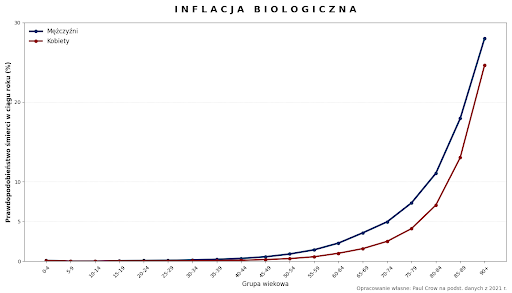
Między 30 a 80 rokiem życia roczne ryzyko śmierci nie rośnie 2 czy 3 razy. Rośnie prawie 70 razy.
W wieku 25–29 lat ryzyko zgonu w ciągu roku to około 0,12%. W wieku 75–79 lat to już ponad 7%. Po 90 roku życia przekracza 28%.
To jest prawdziwa inflacja. Inflacja biologiczna.
Statystycznie oznacza to coś jeszcze.
Mężczyźnie po utracie „pełnego zdrowia” zostaje średnio około 9–10 lat życia z ograniczeniami zdrowotnymi. Kobiecie około 20 lat.
Większość ludzi odkłada życie na później. Nadgodziny, kolejne mieszkanie, ciągła pogoń. Argument jest racjonalny: najpierw zabezpieczenie, potem wolność.
Tyle że zdrowie nie trwa tyle, ile trwa życie.
Oczywiście, nie każdy zachoruje w wieku 62 lat. Styl życia ma znaczenie. Medycyna się rozwija. Można wydłużyć sprawność.
Ale matematyka ryzyka jest bezlitosna. Czas nie jest liniowy. Po 50 zaczyna przyspieszać.
Kluczowe pytanie nie brzmi: ile będziesz żyć?
Powinno brzmieć:
ile lat będziesz mieć pełną sprawność, energię i decyzyjność?
Co zrobić, by być sprawnym dłużej?
Może zamiast maksymalizować kapitał finansowy do 65 roku życia, warto optymalizować kapitał doświadczeń i zdrowia do 50.
Może wolność nie powinna być nagrodą na koniec, tylko elementem strategii wcześniej.
Bo długość życia to statystyka.
Długość zdrowego życia to realna waluta. Pytanie co z nią zrobisz?
Źródło: Eurostat – Healthy Life Years (HLY), Polska
In 1929, a man named Roger Babson predicted the crash that would destroy the American economy.
Wall Street laughed at him. 47 days later, they lost everything.
Babson wasn't lucky. He identified a 5-stage pattern that appears before every major financial collapse.
The same pattern showed up before 1987. Before 2000. Before 2008.
And right now, 4 of those 5 stages are flashing red.
sat next to a guy on a flight who smelled like old money
rolex. tailored suit. reading a physical newspaper like it was 1987.
figured he was some finance executive or inherited wealth.
we got talking. I mentioned I sell stuff online.
he put down his newspaper.
"what kind of stuff?"
digital products. courses. ebooks. that kind of thing.
he smiled weird.
"I made $4 million last year selling a PDF about aquariums."
I thought he was messing with me.
he wasn't.
this guy is 61 years old. spent 30 years as an accountant. hated every second of it. retired at 55 with decent savings but nothing crazy.
his hobby was aquariums. had been keeping fish tanks since he was 12.
"my wife told me to start a blog so I'd stop boring her with fish facts."
so he did. wrote about aquarium stuff 3 times a week. water chemistry. tank setups. fish compatibility.
for 2 years nobody read it.
"I had maybe 50 visitors a month. all probably bots."
but he kept going because he had nothing else to do.
year 3, one article ranked on google. then another. then another.
suddenly he was getting 100K visitors a month. all people searching for aquarium help.
"I realized these people would probably pay for a complete guide. so I wrote one."
147 pages. everything about setting up and maintaining an aquarium.
priced it at $47.
first month: $6K
first year: $340K
last year: $4.2 million
from a PDF about fish tanks.
I asked about his marketing strategy.
"I don't have one. google sends people to my blog. blog mentions the guide. people buy it. I go play golf."
no email sequence?
"I have a newsletter. I send fish tips once a week. sometimes I mention the guide at the bottom. that's it."
no upsells?
"I made a second guide about saltwater tanks specifically. $67. people who bought the first one usually buy the second. that's my whole business."
no team?
"my wife helps with customer service. we get maybe 10 emails a day. most are just people showing us their tanks."
this 61 year old retiree built a bigger business than most "entrepreneurs" I know.
no ads. no funnel hacks. no growth strategies. no personal brand.
just mass expertise in one weird niche and patience to let it compound.
before we landed he gave me advice I didn't ask for:
"everyone your age wants to get rich fast. that's why most of you stay broke. I wrote about fish for 2 years before making a dollar. now I make more than I did in 30 years of accounting. speed is overrated. patience pays."
the plane landed. he grabbed his newspaper and walked off.
probably went home to feed his fish.
Odporności na FUD (Strach, Niepewność, Wątpliwości) to:
✅ Zrozumienie, że media zarabiają na strachu i negatywnych nagłówkach.
✅ Przygotowanie listy kluczowych, pozytywnych faktów o adopcji, do któ®ych wracam w chwilach zwątpienia.
✅ Pamiętanie, że każda poprzednia bessa była nazywana "końcem krypto", a jednak rynek zawsze wracał silniejszy.
✅ Zakładanie że spadki się pojawią, więc nie są one dla mnie zaskoczeniem.
“If I put $100 in Bitcoin in 2010 I’d have $2.8B now.”
No.
If you bought $100 of Bitcoin in 2010 and watched it go to:
$1k → $100k → $1.7M
and did nothing
Then watched $1.7M go to $170k
and still did nothing
Then watched $170k go to $110M
and still did nothing
Then watched $110M wither to $18M
and still did nothing
Then watched $18M surge to $390M
and still did nothing
Then watched $390M deteriorate to $85M
Then watched $85M climb to $1.6B
and still did nothing
Then watched $1.6B shrink to $390M
and still did nothing
Then watched $390M surge to $2.8B
and then for some reason finally decided to do something…
Then yes, $100 in 2010 would be worth $2.8B today.
🚨 JUST IN: Michael Saylor gives latest Bitcoin price predictions
- $150,000 Bitcoin by the end of the year
- $1,000,000 Bitcoin over the next 4-8 years
- $20,000,000 Bitcoin over the next 20 years
Send it 🚀
Observing the development of AI and many mid-curve takes on it slowing down or not being smart enough (or too expensive or too much energy or not enough chips or too many data centers, etc), I think it's helpful to use the mental model of child development.
Imagine seeing a toddler trying to walk and drawing the conclusion that its legs are not made for working and it's too stupid to do this simple task.
Until it just does it.
Imagine waiting for your child's first words and suggesting that it's too stupid to learn to speak or its mouth to does work properly or it's just saying gibberish. Even into its next few years the child struggles to get speech right.
Until it just does it.
Riding a bike... well your kid will never master it. Its legs are too short, its had no awareness of the road and has no balance. Until it just does it.
Reading, writing, maths, etc.
They just do it.
These AI models are infants (albeit with superpowers in some areas vs human kids, and are massive underachievers vs other areas versus human kids).
Infants learn fast. Before you look back, that baby that couldn't work is now married with kids and has acquired vast skills in life and continues to do so.
They just do it.
Humanity has given collective birth to a new child, a Super Being. It will absorb all of humanities knowledge as its foundation, and then will create entirely new knowledge and ultimately new Super Consciousness.
Try not to midcurve this.
The is the largest change to humanity in all history and we've only just started. We have birthed a new species that will prove to be infinitely more intelligent than us, in time.
There will be periods when we are impressed at the speed, other periods when we get frustrated with how it struggles, but all the time it is exponentially compounding.
And then it just does it.
Russia just said the quiet part of the USA plan for Stablecoins and Bitcoin OUT LOUD for the world.
AND realised they can't do a single thing about it.
Next step is the race to accumulate first - and not be victimized by it.
Caterpillar (CAT) falls on tariff warning, announcing a $1.5 to $1.8 billion hit. Another risk to companies investors are underestimating. Inflation is back, whether the reported numbers lie or not, we will find out...