@comuflauta Claro, como no se ha podido probar que se incurrió en un delito de tráfico de influencias, pues no te condenan por ello.
Pero sí te condenan por prevaricación administrativa y cooperación que fue necesaria (probado)
¿Sabes leer o eres mala persona y sueltas esa gilipollez?
La economía política del caso Leire va mucho más allá del epifenómeno de los pagos ilegales a la “fontanera” del PSOE.
La evidencia apunta a que se montó una estructura, casi con seguridad desde Moncloa, para subvertir los pilares del Estado de derecho y preservar el poder de Pedro Sánchez. Es, desde el caso GAL, el escándalo más grave de nuestra democracia.
Este socavamiento, sin embargo, forma parte de un patrón más amplio: el desmantelamiento del Estado en el que el PSOE se embarcó el 13 de noviembre de 2003, cuando Zapatero prometió en el Palau Sant Jordi que “Apoyaré la reforma del Estatuto que apruebe el Parlamento de Cataluña”.
La realidad electoral española, cada vez más clara, es que el PSOE solo puede gobernar con los votos del nacionalismo (o cuasinacionalismo) de Cataluña, País Vasco y Navarra. Sin los escaños de estas tres comunidades, la derecha nacional habría tenido mayoría absoluta en todas las elecciones desde 1996 hasta 2023, salvo en 2004.
Pero para lograr esos votos, el PSOE tiene que comprometerse con el desmantelamiento del Estado, ya sea de forma directa (la reforma de la financiación autonómica) o indirecta (el control partidista de las instituciones). De ahí a intentar destruir la UCO solo hay un paso, y se da a la primera tentación.
Por tanto, el PSOE solo elegirá como secretario general a alguien como Zapatero o Sánchez, a quienes el Estado trae al fresco. No son accidentes: son la respuesta estructural del sistema. No hay “PSOE bueno”, porque un “PSOE bueno” no puede gobernar y la mayoría de sus militantes no tienen vocación de suicidio político. Para suicidarse, es mucho más rápido apuntarse a Podemos.
Enfrente solo hay un PP sin la menor visión de futuro (la reciente visita de Feijóo a Cataluña demuestra, por enésima vez, que el PP no tiene plan para nada) y un Vox con un Santiago Abascal que no da más de sí (que Vox ronde el 18%-20% en las encuestas, dada la situación actual, debería leerse como un fracaso).
El problema es que no veo salida en el marco actual. Tras la crisis del euro surgieron dos proyectos de reforma: C’s y Podemos. Los votantes rechazaron ambos. Sí, los dos partidos cometieron errores tácticos y de liderazgo, pero, a fin de cuentas, el votante mediano prefirió lo malo conocido (PSOE y PP) a lo malo por conocer (C’s y Podemos). El votante mediano no quiere que nada cambie porque vive del Estado, de forma directa (pensiones, empleo público) o indirecta (transferencias varias, regulaciones).
Creo que todo esto saltará por los aires en algún momento hacia 2030, año arriba o año abajo. Pero no descarto que sigamos, en su lugar, un camino de declive irreversible. Con una fecundidad de 1,1 hijos por mujer y la inmigración que tenemos, quizá en 2080 la España que conocemos desde 1492 ya no exista.
Y si usted, lector, me pregunta qué se puede hacer: no solo no lo sé, sino que dudo que pudiera arreglar nada aunque yo fuera el que tomara las decisiones.
- Necesitamos aumentar y abaratar la oferta de vivienda para que puedan formarse más hogares a precios más asequibles.
- Estás tratando a la gente como números. No te metas con el bueno de Don PSOE (salvo para darle la razón a Don PSOE).
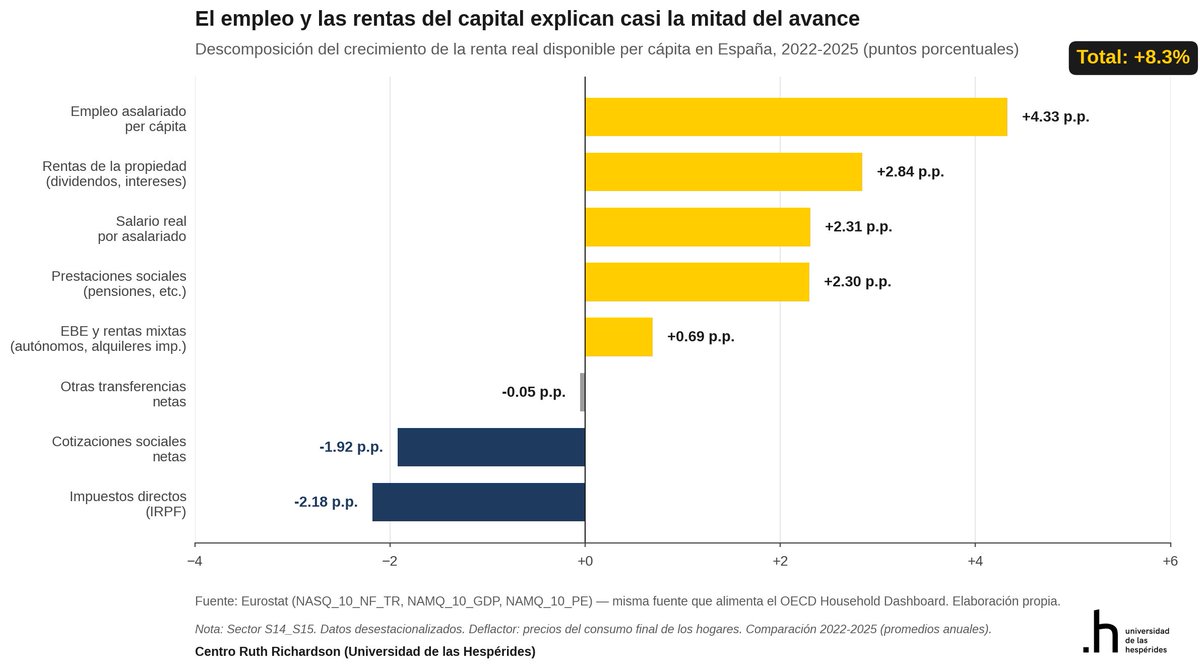
El 8,3% dice muchas cosas. Más que las que dice el gráfico del Presidente.
Vayamos por partes.
Lo primero, qué hogares avanzan. Cuando descomponemos la renta real disponible por edad, la mediana de los hogares con personas de 65 y más años crece un 9,2% real entre 2021 y 2024, por encima incluso del 8,3% del tuit. Los hogares en edad laboral suben un 4,2% real. Los menores de 18, un 0,05%. Una mejora muy desigual entre generaciones, concentrada en los mayores.
Segundo, de dónde viene ese 8,3%. Casi la mitad procede del componente extensivo: más gente trabajando. El salario real medio en España apenas crece un 2,9% en tres años, frente al 4,7% de Alemania.
Tercero, las rentas de la propiedad y los alquileres imputados también suben con fuerza. Buena parte de esa subida refleja el aumento del precio de la vivienda en un país con grave escasez de oferta inmobiliaria.
Cuarto, los impuestos directos crecen un 31% nominal y drenan 2,2 puntos del avance, por la progresividad en frío del IRPF: los tramos no se actualizan con la inflación y cada año los contribuyentes pagan un tipo medio efectivo más alto sin haber ganado capacidad de compra real.
El 8,3% es cierto. Está concentrado en los pensionistas y en los propietarios de activos. Lo financia el cotizante joven, al que ni se le actualizan los tramos del IRPF ni le crece el salario real por encima de la inflación.
spain needs a different growth model.
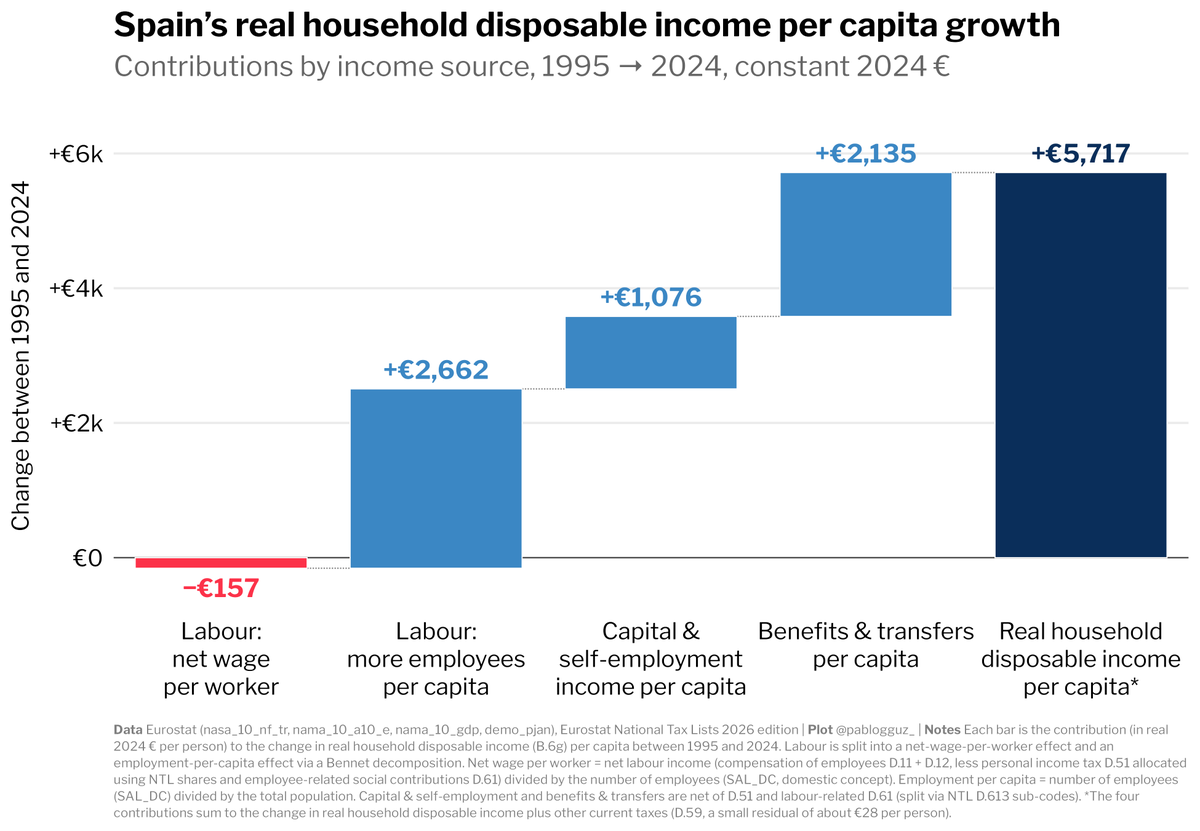
in the last 30 years, real household disposable income per capita has grown by roughly 38% in real terms (around €5.7k per person at 2024 prices). this can be decomposed into growth in net labour income per capita (+16.7 pp), cash benefits such as pensions (+14.2 pp), and capital and self-employment income per capita (+7.2 pp).
however, the labour contribution came entirely from the extensive margin (pulling more people into employment) rather than from higher real wages per worker. in fact, the average spanish employee takes home slightly less in real terms today than in 1995!
going forward, this model is unlikely to keep working. the extensive-margin gains came from two channels, both of which leaned on favourable conditions that are (most likely) not going to repeat. the first is that the working-age population grew faster than the total population during the 90s and 2000s, mainly because of the favourable age structure left behind by spain's baby boom (the large cohorts born in the 1960s and 1970s moved into prime working age while the cohorts behind them were smaller), but also because of immigration waves that were disproportionately working-age. this is what demographers often call a demographic dividend, which lifts the employment-to-population ratio purely by composition (even with no change in how much any given working-age person works). the second channel is that, within the working-age population, the employment rate rose substantially, from below 50% in the mid-1990s to around two-thirds today.
of course, none of this is bad, but there is only so much further either channel can go. the demographic dividend is already reversing: the baby boom cohorts are now moving into retirement, the cohorts replacing them are much smaller, and ageing will push the working-age share of the population down. the employment rate itself is approaching a natural ceiling -- there is still a gap relative to the average advanced european economy but it is not large, and closing it would only buy spain a few more years of compositional growth.
immigration, often raised as the way out, cannot realistically offset the demographic drag ahead. the scale of net inflows required to offset ageing on a sustained basis is multiples of any plausible figure consistent with social and political constraints in european countries, and even if such flows materialised, immigrants themselves age and accrue the same retirement pension entitlements as natives. in other words, sustaining the current demographic structure would require a permanent inflow large enough to offset both the ageing of the native population and that of past migrant cohorts, indefinitely. fertility, however, is now falling across virtually every region of the world, and the global working-age population is projected to peak within a few decades and then decline. there is simply no migrant pool waiting to be drawn from on the scale spain would need.
this is also why cash benefits cannot keep doing what they have been doing. it is worth being explicit about why retirement pensions, specifically, are at the centre of all this. spain runs a defined-benefit, pay-as-you-go public pension system: pensions are not the actuarial outcome of what each worker contributed, but a function of years contributed and final wages, paid out of the contributions of those currently working. the current system promises retirees an internal rate of return on their contributions that is significantly higher than anything the payments into the system can plausibly grow at. and because the payments into the system are, mechanically, the number of contributors times the average wage on which they contribute, a gap of that kind is sustainable only as long as the contributing base keeps expanding fast enough relative to the receiving one. the same demographic dynamics that enabled the extensive-margin growth of the last three decades are what allowed this to (sort of) work, but these are now reversing. on top of that, the system already runs a structural deficit: only about three-quarters of contributory pension expenditure is covered by social contributions, and the rest is financed out of general taxation paid by the entire population.
and pensions are not an independent source of household income. they are funded by taxes, and taxes have to be levied on income generated somewhere in the economy. in spain, as in any developed country, that income is overwhelmingly the wage bill: personal income tax and social contributions on labour. so the real question is whether labour income per worker is growing.
gross compensation per worker (including social security contributions) has in fact risen slightly in real terms since 1995, by around 5%. but the entire gain (and a little more) has been absorbed by a widening fiscal wedge, so that the take-home wage is marginally lower today than it was thirty years ago. in other words, the modest productivity gains the spanish economy has managed to deliver have not reached workers. they have been routed, in their entirety, into financing the rising weight of transfers.
one could argue, of course, that if wages eventually start growing, the additional income can simply be taxed away to keep financing rising benefits. but that is just another way of saying that the take-home pay of the average spanish worker is supposed to stay flat for the foreseeable future, and that whatever productivity gains eventually arrive will be routed straight through to retirees. i will leave it to the reader to judge what kind of social contract that describes.
thirty years of stagnant wages is already a long experiment in that direction. either policymakers start taking productivity growth seriously or the bill comes due on a model that was always going to run out of room.
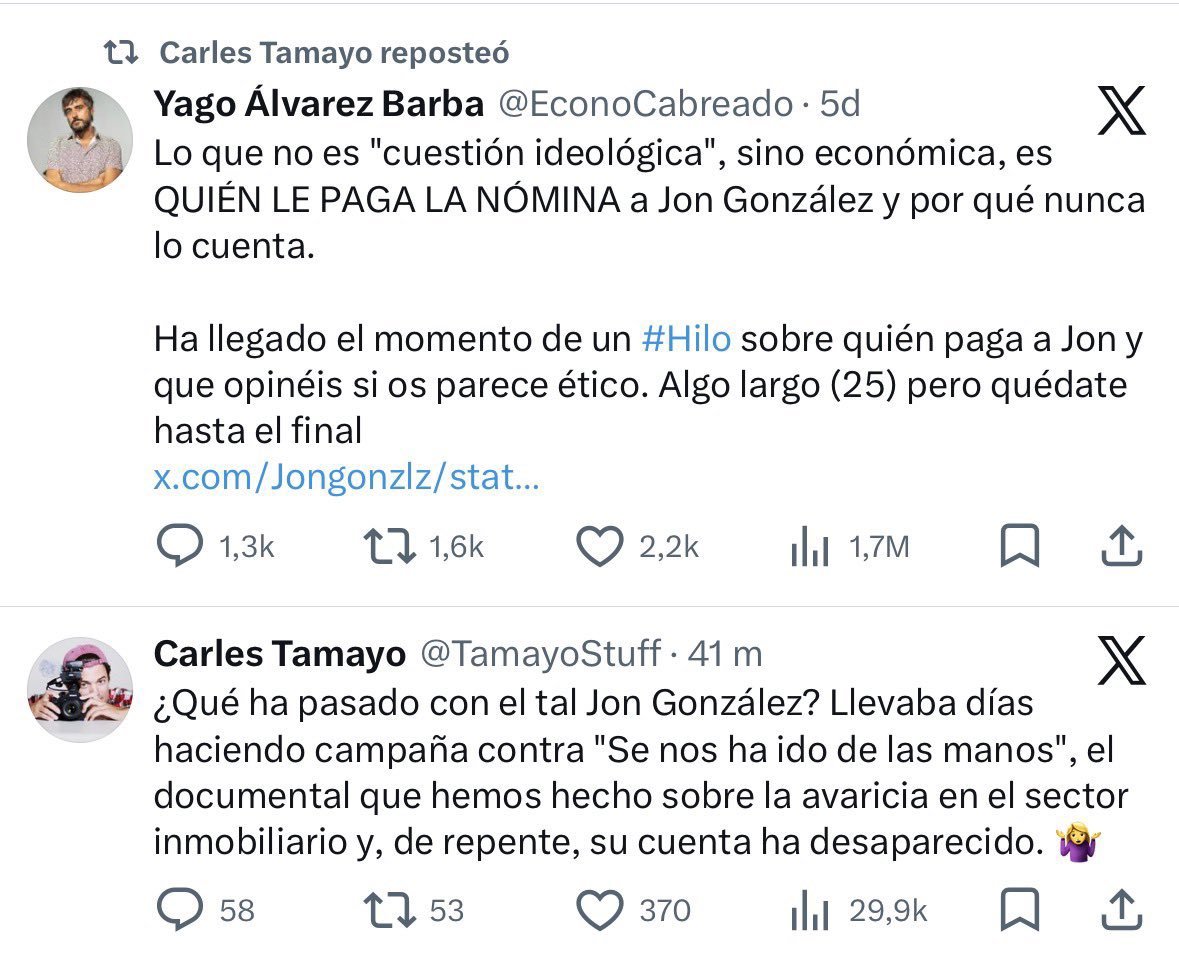
Jon se ha marchado porque ha conseguido acallarlo la izquierda intelectualmente impotente y socialmente inquisidora. Pero recordad que tenéis disponible su trabajo en esta web. Usadlo para combatir los bulos antieconómicos de quienes lo han echado ha conseguido echarlo https://t.co/cb5AjYmely
Tamayo ha quitado el RT.
Si entráis en su perfil ya no lo vais a ver.
Se habrá dado cuenta de que quedaba como un cabrón y eso perjudica su imagen de ir de bueno.
Mala suerte, hay capturas.
A tus nuevos fans del PSOE les dará igual, pero el resto ahora saben que eres un cabrón.
Los imperdonables pecados por los que había que amordazar a Jon:
a) Hay que deflactar el IRPF
b) Hay que transitar a un sistema público de pensiones con cuentas nocionales como en Suecia
c) Hay que construir mucho más
d) La baja natalidad y la baja productividad son un problema
@Gisbert_SB Es la única esperanza, pero Jon se expone a mucho, y el que cobra del erario público no tiene ni un ápice de vergüenza en atacar como ya hicieron con Jon. Unos pierden muy poco o nada, otros como Jon pueden perder muchísimo.
En su momento expliqué que la campaña contra Jon tenía como objetivo desacreditarlo y, en última instancia, forzar su amordazamiento.
Daniel me advirtió de que también buscaban meter miedo a otras personas que pudiesen querer hacer divulgar en público sus ideas, como hacía Jon. Pues bien, hoy mismo me han hablado de dos personas (mucho menos conocidas en redes que Jon) que, visto lo visto, también han decidido rebajar por completo su perfil.
Esto es lo de siempre en Economía: lo que se ve y lo que no se ve. Vemos al Jon que perdemos; no vemos a los Jon que no llegaremos a tener.
Las personas de izquierdas que difundieron el infundio de que Jon estaba en Twitter para defender los intereses del BBVA, ¿rectificarán o se disculparán ahora que Jon ha tenido que suspender su cuenta? ¿Les importa mínimamente el daño personal y laboral que pueden haberle provocado a una persona solo por discrepar de sus ideas (más bien, por ser incapaces de refutarlas)?
No, no les importa lo más mínimo porque toda su ideología es una mentira: dicen defender la libertad de expresión y ahora se recrean en haber conseguido censurarla; dicen luchar por los derechos de los trabajadores y han lanzado unas campaña en redes sociales para linchar a un trabajador e intentar que lo despidan.
Ni libertad de expresión ni derechos de los trabajadores. Lo único que les obsesiona es conquistar y retener el poder político y, para lograrlo, no tienen el más mínimo reparo en mentir, difamar y triturar a quien se interponga en su camino. No vais a hallar en sus cuentas ni la menor señal de arrepentimiento sincero por lo que han hecho.