TRADING 1️⃣0️⃣1️⃣
✅Trading System
◾ Build edges
◾ Study charts
◾ Create plans
◾ Execute them
✅Risk Management
◾ Create plans
◾ Follow rules
◾ Set goals
◾ Achieve them
✅Psychology
◾ Build confidence
◾ Emotional control
◾ Long-term thinking
◾ Be in control
Day trading is actually really simple, you just need to:
1. Stop trying to get rich this month.
2. Accept that randomness exists.
3. Define one model.
4. Delete the other five.
5. Master one setup before adding another.
6. HTF narrative first.
7. DOL second.
8. Entry confirmation last.
9. Stop treating every V-Shape as a setup.
10. Understand WHY the V-Shape is forming.
11. Know what price is drawing toward.
12. Know what liquidity has already been taken.
13. Respect time.
14. Stop ignoring context because the entry looks clean.
15. Trade one session.
16. Trade one instrument.
17. Stop staring at charts all day.
18. Define exactly when you are allowed to trade.
19. Define exactly when you are NOT allowed to trade.
20. If all DOLs are taken, be done.
21. If there is no clear draw, don’t invent one.
22. Stop trying to predict every candle.
23. Wait for price to come to you.
24. Learn to sit on your hands.
25. Learn to watch a move happen without you.
26. Missing a trade costs $0.
27. Forcing one can cost an account.
28. Accept that you will never catch every move.
29. Stop watching other traders’ PnL during your session.
30. Stop comparing your day to somebody else’s screenshot.
31. FOMO is self-sabotage.
32. Decide risk before entry.
33. Never move a stop further away.
34. Stop micromanaging every candle.
35. Don’t move BE emotionally.
36. Move BE because your model tells you to.
37. Let the trade invalidate properly.
38. Let winners reach the planned target.
39. Know your win rate.
40. Know your average R.
41. Know your max historical drawdown.
42. Be emotionally prepared for worse.
43. Risk less than your ego wants to.
44. Cut size in half.
45. Then cut it again if you still can’t execute.
46. Stay small until your execution is boring.
47. Never scale emotionally.
48. Never increase size just because you feel “locked in.”
49. Stop trading after revenge impulses.
50. Stop trading because you’re bored.
51. Stop trading to feel productive.
52. Stop trading because yesterday was a loss.
53. Never trade to recover money.
54. Never trade to prove anything.
55. Never trade because you “need a winning day.”
56. Trade to execute. Nothing more.
57. Journal the trade.
58. Journal the narrative.
59. Journal the DOL.
60. Journal the time of entry.
61. Journal what liquidity was taken.
62. Journal your emotional state too.
63. Review your losses deeper than your wins.
64. Stop calling every loss “unlucky.”
65. Find what YOU could have done better.
66. Accept that a correct bias can still produce a losing trade.
67. Accept that a bad trade can still win.
68. Outcome ≠ execution quality.
69. Grade the execution, not the PnL.
70. Backtest hundreds of examples.
71. Screenshot every clean setup.
72. Build your own database.
73. Build conviction through data, not Twitter.
74. Stop strategy hopping.
75. Stop indicator hopping.
76. Stop adding confirmation until the trade is gone.
77. Stop needing every LTF candle to agree with you.
78. HTF structure matters more than one random 30S move.
79. Time matters.
80. Context matters.
81. Location matters.
82. Delivery matters.
83. The V-Shape is just the trigger.
84. The V-Shape is NOT the entire edge.
85. Understand what price is reacting from.
86. Understand where price is likely drawing next.
87. Stop trying to make every day a trading day.
88. One clean setup is enough.
89. Zero trades is still a valid trading day.
90. Focus on one mistake at a time.
91. Protect capital aggressively.
92. Respect your maximum daily loss.
93. Accept flat weeks.
94. Accept slow months.
95. Accept boredom.
96. Stop looking for a holy grail.
97. Accept that YOU are the main variable.
98. Think in years, not individual trades.
99. Trust your data more than your emotions.
100. Stay in the game long enough for your edge to actually work.
Trading isn’t complicated.
Most traders just make it complicated because waiting for one clean setup feels harder than taking ten bad ones.
For Traders, weekends are the most critical days.
The market is closed.
But this is when you can level up as a trader!
Here’s how to use those 2 days.
Thread 🧵
9 years ago I quit a stable job to trade full time. The first few years were genuinely hard. Not because my strategy stopped working. Because of all the things I had decided were not important enough to plan for.
If you are thinking about going full time, fix these 5 things first. 🧵
TRADER WEEKEND ROUTINE
1: PROFESSIONAL TRADER PLAN
FRIDAY — REVIEW
Review every trade from the week.
Identify what worked, what failed, and why.
Study your biggest mistake—not your biggest win.
Update your trading journal.
Check your weekly P&L and risk management.
SATURDAY — STUDY
Review the weekly and daily charts.
Mark major support & resistance levels.
Study volume, price action, and market structure.
Build a watchlist of stocks showing strength.
Study one trading concept deeply.
SUNDAY — PREPARE
Scan the overall market: Bullish, bearish, or neutral?
Build your watchlist for the week.
Mark potential entry, stop-loss, and target levels.
Create different scenarios: If this happens → I do this.
Check the economic calendar and major market events.
Decide what you will NOT trade.
MONDAY — EXECUTE THE PLAN
Don't come to the market looking for a trade.
Come looking for your setup.
2: BEGINNER TRADER PLAN
FRIDAY
Check how much money you made or lost.
Blame the market for the bad trades.
Forget about the losing trades.
Start searching for the next “hot” stock.
SATURDAY
Watch random trading videos.
Jump between different strategies.
Add 20 new indicators to the chart.
Look for someone else's signals.
SUNDAY
Build a watchlist from social media.
Search for “100% breakout” stocks.
Change your strategy again.
Enter Monday without a real plan.
MONDAY
“Let’s see what the market gives me.”
And that's where the trouble usually begins.
The professional prepares before the market opens.
The beginner prepares after the trade goes against him.
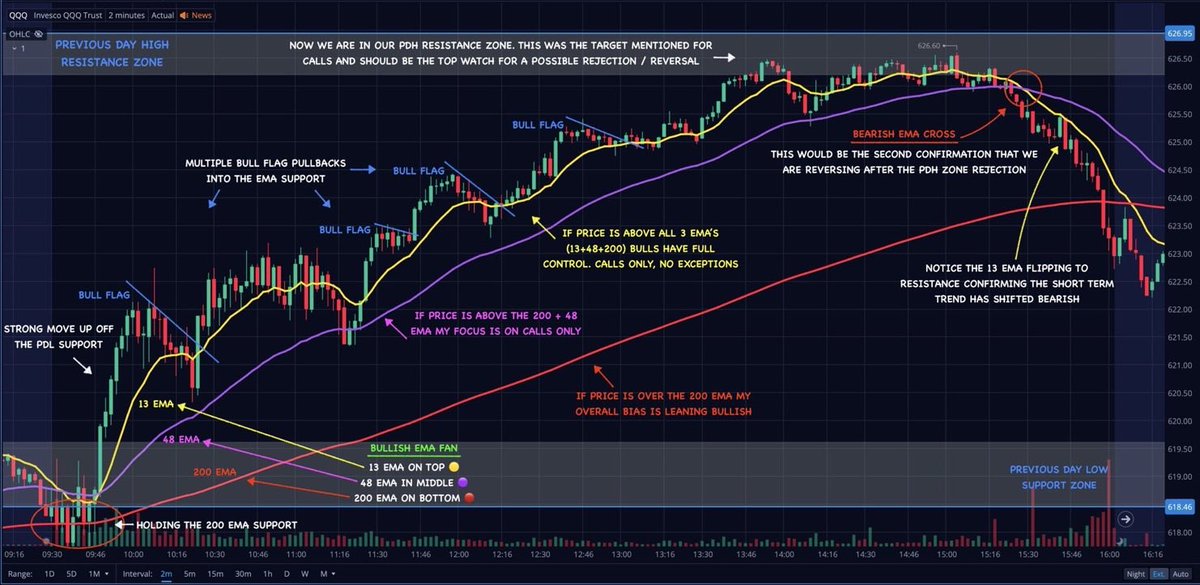
Here’s my blueprint for day trading 📝
$SPY $QQQ $IWM
Mark these 4 levels ✍️
Previous Day High ✅
Previous Day Low ✅
Pre Market High ✅
Pre Market Low ✅
Then add these EMA’s to your chart 📊
13 EMA 🟡
48 EMA 🟣
200 EMA 🔴
Now learn to spot these 2 simple chart patterns 👀
Bull flags 📈
Bear Flags 📉
Focus on only taking 1 or 2 trades a day with confluence. Small size. Base hits.
Follow this for 1 month and watch your new found discipline turn you into an absolute beast!
Then SLOWLY start to size up and hold runners.
Here’s a few slides to study… They contain more useful information than any expensive trading course👇
I started trading with $100.
Today, I can make $100,000 from a single trade.
It took me years of blowing up accounts to figure it out.
I want to give you the shortcut I wish I had.
Here’s the strategy behind my trades (& how you can use it too): 🧵