Worst ever experience..What sort of planning has gone we don't know .... Have started my journey to Trichy to perform my duty to cast a vote .... Due to poor management am still roaming in Chennai circle for almost 8 hours ...don't know will vote or not @ECISVEEP@TNelectionsCEO
Master thread on Custom TradingView indices 🔥🧵
In this thread, I will explain:
⦿ What is a custom symbol/index
⦿ Different types of custom indices
⦿ What is an Equal weighted (EQW) index
⦿ Pros and cons of an EQW index
⦿ How to create an Equal weighted index
Before we get started, please retweet this thread and follow me @imfamousrajat for more informative content. 🔥
✅What is a custom symbol/index
Creating a custom index is a crucial step in understanding the collective performance of a group of symbols.
Whether you aim to analyse sectors or industries lacking predefined symbols or simply wish to explore various symbol combinations, the custom indices/symbols can provide valuable insights.
✅Types of custom indices
Broadly, there are two types of custom indices:
- Simple Equal Weighted
- Custom Weighted
Each approach comes with its own pros and cons. In this post, I'll be focusing solely on equal weighted indices.
✅What is an Equal Weighted index
A simple equal weighted index is a type of index in which each constituent is assigned an equal weight within the index.
In other words, regardless of the individual market capitalizations or other financial metrics of the components, each constituent holds the same influence or importance.
✅Pros and cons of an Equal Weighted index
⦿ Pros:
- Useful in creating symbols for sectors that do not have a predefined symbol.
- Easy to understand and implement as all components have an equal weight
- Provides high diversification as each component carries the same weight, reducing concentration risk.
⦿ Cons:
- Ignores fundamental factors like market capitalization, company size, and financial health.
- Equal weighting may lead to higher volatility, as smaller and potentially more volatile companies exert the same influence as larger, more stable ones.
- May underperform market-cap weighted indices, especially during periods when larger companies outperform smaller ones.
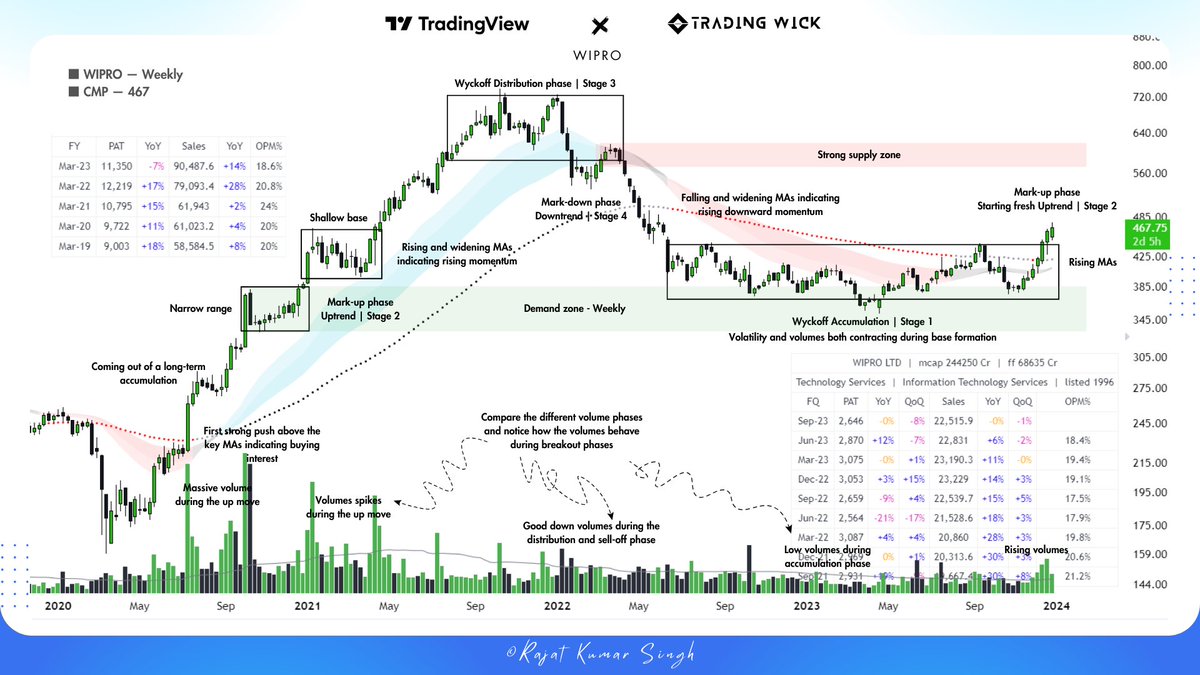
Understand how a stock goes through various stages
Spend just 5 mins on reading this case study on Wipro.
⦿ Stage 1 - Accumulation
⦿ Stage 2 - Uptrend / Mark-up phase
⦿ Stage 3 - Distribution
⦿ Stage 4 - Downtrend / Mark-down phase
Found this to be helpful?
Retweet and Follow me @imfamousrajat for more such useful content. 🔥🔥
#Wipro #Stocks #StockMarketindia