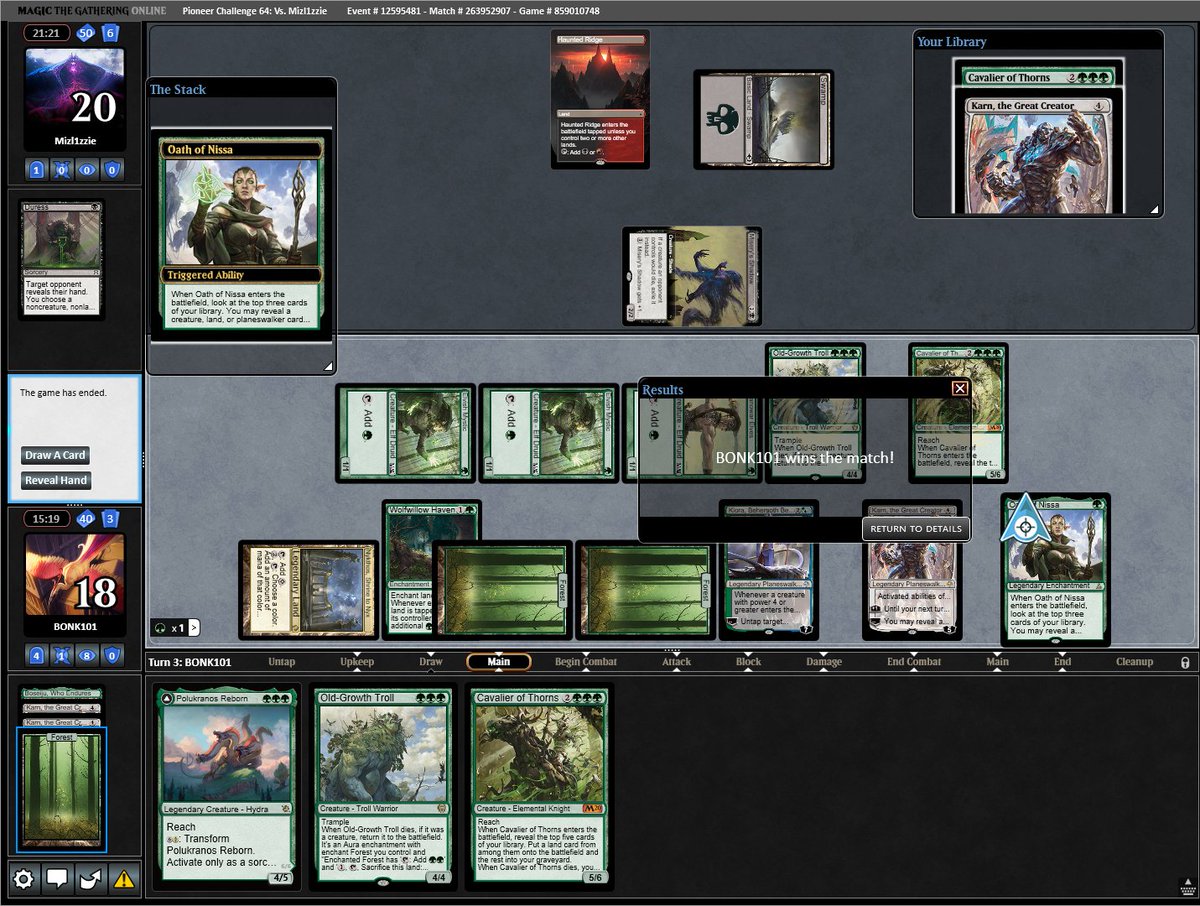
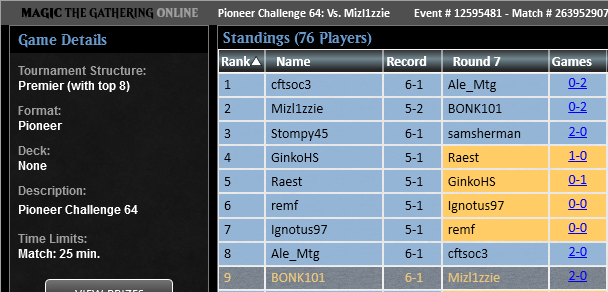
To celebrate the release of MH3. I am giving away 3 codes for 120 play points thanks to MTGO!
All you have to do to win is
Like ✅ (lol)
Retweet ✅
Follow ✅
Winner picked this Sunday!
I understand that most engineers won't compute integrals at their jobs, but that doesn't mean learning it is a waste of time. I'm not even remotely suggesting that everyone should learn calculus. But *no one* learning calculus would not be good either.
I can't speak for the medical field, but I can speak to calculus's uses for engineers. The world is a computationally dynaimc place, and much of engineering design is based on mathematical modeling. So this is why I tell my students that calculus matters ...
2. Engineers have to solve complex problems. You need to use logic and critical thinking to arrive at conclusions based on evidence. That's what calculus (and all quantitative reasoning) is. Practicing calculus is practicing your ability to reason.
@masoneclark I like your 4 + JTMS. I'll admit I wasn't playing during Caw Blade, but it doesn't seem like a card that suddenly makes control good, especially without fetches.
I want to get a Settle into the main deck and think that Jwari Disruption is the cut. Rest is Peace doesn't feel super needed right now but I'm not sure what to replace it with. Dromoka continues to be excellent. Will consider Sphinx Rev over Finale for more aggressive metas.
Solid 5-2 with UW Lotus in the Pioneer Challenge for 16th. I think I played well all evening despite the losses. Matchups and notes below ...
R1: UR Creativity WLW
R2: RB Sac WW
R3: Mono G LWL
R4: UR Creativity WW
R5: RB Mid WW
R6: UW Control LL
R7: UR Phoenix LWW
@fireshoes
@WUCtrl Love the Pioneer take. Modern became the great format it is when they printed efficient interaction to keep pace. If every deck could play meaningful (or non conditional) 1 mana interaction, the format would get much better.
In 1897, there were two notable circus performers known as George Moore, also known as "the living skeleton," and Fred Howe, nicknamed "the fat man." Unfortunately, there is a scarcity of information about them during that time period. However, from the limited available sources, here is what I could gather:
Fred Howe's father worked as a carpenter in Pennsylvania, and young Fred initially followed in his footsteps to learn the trade. However, due to his increasing weight, he had to abandon that path. At the age of eighteen, he joined the Forepaugh Circus as a "tat boy" and it was there that he first encountered his future sparring partner.
On the other hand, George Moore was born in Helena, Montana. His father owned a small dry goods shop, but George had a strong desire to explore the world beyond his hometown. When a major circus arrived in Helena, the manager offered him an opportunity to showcase himself as the "living skeleton." Eager to pursue his dreams, George immediately accepted the offer.
As fate would have it, Howe and Moore developed a friendship and would engage in private sparring matches for amusement. One day, the circus manager witnessed their impromptu bouts and saw potential in their dynamic. He promptly offered them a longer engagement, with a higher salary, to publicly box each other.
According to available information, George Moore stood at an impressive height of 6 feet 3 inches and weighed a mere 97 pounds, while Fred Howe was significantly shorter at 4 feet 2 inches and weighed a staggering 422 pounds.
@TandyMTG I was the first to try out the book-mutavault combo in Pioneer (at least in this devotion shell), split the finals of a challenge in July 2021. First time a brew of mine ever felt successful.
@uman109@WUCtrl Lotus combo is pretty impossible game 1 but feels very winnable after sideboard if you know what hands to keep. Thalia is definitely not fun, feels like you gotta have an early doomskar for those games.