🟥خمس إشارات في مشهد واحد.. ماذا كشفت أزمة توقيع الاتفاق العراقي–التركي؟
📍أولاً، يكرر بعض المعارضين والصحفيين أن تقدّم الرئيس رجب طيب أردوغان في السن أثّر في قدرته على متابعة التفاصيل، لكن ما جرى خلال مراسم التوقيع قدّم صورة معاكسة تماماً. فقد انتبه أردوغان فوراً إلى وجود نقص في عدد الوثائق، وتدخل قبل بقية المسؤولين مؤكداً بثقة أن الاتفاقات خمس وليست أربعاً، ما أظهر مستوى عالياً من التركيز والمتابعة الدقيقة.
📍ثانياً، عندما تطور الموقف، توجّه أردوغان مباشرة إلى هاكان فيدان قائلاً: «هاكان، خمسة». استعان به دون غيره من الوزراء والمسؤولين، ثم ظهر فيدان وهو يراجع أوراق الاتفاقات ويتحقق من تفاصيلها. وهذا يعكس موقعه المتقدم داخل منظومة القرار التركي، بوصفه المسؤول الذي يعود إليه أردوغان في الملفات الحساسة والمواقف المفاجئة.
📍ثالثاً، لا يمكن الجزم حتى الآن إن كان غياب توقيع وزير النقل العراقي وهب سلمان الحسني ناتجاً عن خلل بروتوكولي من الجانب العراقي، أم عن موقف شخصي أو سياسي. لكن انتماء الوزير إلى منظمة بدر المقربة من إيران يفتح باب التساؤلات بشأن موقف بعض القوى المرتبطة بطهران من مشروع طريق التنمية، ومدى قدرتها على التأثير في قرارات الحكومة العراقية.
📍رابعاً، حمل المشهد رسالة واضحة: الجانب التركي يتابع التفاصيل ولا يتعامل مع الاتفاقات الكبرى باعتبارها إجراءات شكلية. وأي محاولة للمناورة أو تمرير نقص في اللحظة الأخيرة قد تظهر أصحابها بصورة محرجة أمام الكاميرات.
في النهاية، تم توقيع الاتفاق، وهو مشروع يصب في مصلحة العراق وتركيا معاً؛ لأنه يربط العراق بالموانئ والأسواق الأوروبية عبر الأراضي التركية، ويمنح البلدين موقعاً مهماً في خريطة التجارة والنقل الإقليمية.
STANLEY DRUCKENMILLER MADE A QUARTER OF A BILLION DOLLARS IN ONE YEAR, AND HE REVEALED IT CAME FROM THE ONE THING EVERY BUSINESS SCHOOL WARNS YOU NEVER TO DO WITH YOUR MONEY
Every professor he had taught one safe way to handle money. He built the best record on Wall Street doing the opposite.
That is Stanley Druckenmiller. Thirty years running money, 30% a year, and when they asked how many losing years, he answered with one word: zero.
What he does instead sounds reckless until you hear him explain it in this interview.
His words: "I like putting all my eggs in one basket, and then I'm watching the basket very carefully."
Most portfolios hold 30 or 40 stocks, and almost all of the year's gain comes from two or three of them. The rest is noise. So he put real money only into the two or three ideas he was most sure of, and left it there.
He found it by accident. At 27, running a bank's money with no experience, he put everything into oil and defense stocks because he didn't know he was supposed to diversify. It shot up. Everyone called him a genius. He wasn't, he says, he just didn't know any better. Years later that same nerve made him a quarter of a billion dollars in one year.
Most people own forty things so they never have to be right about one.
Watch the interview where he calls the whole idea of spreading your risk nonsense they teach at business school.
Warren Buffett says he could collect 20 to 40 billion dollars a year from government bonds without taking any risk, and that is the number he holds AI spending against:
"AI companies, you're putting out huge amounts of money. And I can put huge amounts of money into government bonds and get, you know, 20 or 30 or 40 billion dollars a year in terms of payments from them."
"So a good business is one that earns a lot more than, and has prospects of continuing to earn a lot more than the returns on essentially riskless investments, which you could define as Treasuries."
"But if you take something like American Express, you know, most of the banks earn 13, 14% on capital."
"But it's so different that it earns 30% plus on capital, and it does not incur more risk in doing so than the banks that earn 13 or 14%."
"And the trick in life is to find, I mean in investing, is to find businesses that are going to earn high returns on capital for an extended period of time."
"A long period of time gets to be very important because those doubles later on are very big numbers."
That is a hurdle rate, and you can hold the next AI capex announcement against it the same day you read it.
His second condition is the harder one. Earning high returns for an extended period means somebody has to show the returns will hold, and almost every number that would show it for AI is published by the company doing the spending. When the entity being measured also runs the measurement, what you are reading is marketing.
Buffett has been able to check American Express against decades of audited filings. There is no equivalent for an AI model yet, and building it is the whole job.
- Warren Buffett, chairman of Berkshire Hathaway, on CNBC (@CNBC).
هكذا يكون التصريح عن صفقة تأجير أنابيب النفط كما ورد على لسان السيد نواف سعود الصباح .. بالضبط هذا الشرح والتوضيح وبيان الجوانب الاقتصادية وآلية التمويل والمنفعة على المؤسسة والدولة والخزينة العامة هو المطلوب ..
A dopamine deficit is the real reason nothing feels good.
It brings anxiety, insomnia, irritability, and a flatness Dr Anna Lembke calls akin to depression.
If I wanted to reset it without medication, here are 8 things I'd do for 30 days:
1. Expect to feel worse first
The moment everything goes quiet, you reach for your phone.
Naval Ravikant says that’s not boredom.
It’s a mind that no longer knows how to sit with itself.
Here are 5 practices he uses to quiet his mind—without apps:
1. Sit alone for one hour—no phone, music, reading, or guided voice.
Cortisol = a puffy face.
If cortisol stays high, the puffiness won't drain — no matter how clean you eat.
These are the best ways to bring it down:
1. No food 3 hours before bed.
Warren Buffett: "If we can't make a decision in five minutes, we can't make it in five months."
In a Q&A, a shareholder from Munich, Germany asks Buffett a specific question: how large is the universe of companies whose intrinsic value he carries in his head — the ones he could act on within a day or two if the market offered an attractive price?
Buffett doesn't give a number. He reframes the question entirely.
Speed, he explains, doesn't come from knowing more. It comes from refusing to think about most things at all.
"Our immediate decision is whether we can figure out what's being offered to us or not. I mean, there's a go no-go signal."
That signal fires almost immediately:
"Charlie and I are often thought to be rude when we think we're just being polite and not wasting the other person's time. So, as they start mid-sentence in their first conversation with us, we just say, 'Forget it.'"
He continues:
"We know very, very, very early in the conversation whether somebody's talking about something that there's any chance is actionable by us, and we don't worry about the ones we miss."
The filter isn't about the quality of the opportunity. It's about whether Buffett is equipped to judge it:
"We want to make sure that we don't waste any time thinking about things that, when we got all through thinking about them, we're not going to know enough to make the decision on. So we just rule those out, and that rules a lot of things out."
What survives that filter gets decided on immediately:
"So we make decisions—we can make a decision in five minutes very easily. I mean, it just is not that complicated."
Then comes the line that explains the whole system:
"If we can't make a decision in five minutes, we can't make it in five months. You know, there's—we're not going to learn enough in the following five months to make up for the fact that we went in deficient in the first place."
Deliberation doesn't fix a knowledge deficit. If you weren't already competent to judge the thing, five months of study won't close the gap — it will only manufacture the confidence to act badly.
So when the input arrives — a phone call about a business for sale, or a price in a newspaper, a magazine, an annual report, a 10-K — the only thing Buffett is looking for is a "significant differential between price and value." If it's there, "we move right then."
"And Charlie and I don't need to talk to each other about it; I mean, we both think the same way and we have generally similar spheres of knowledge."
Charlie Munger then names the mechanism directly:
"The answer to your question is we can make a lot of decisions about a lot of things very fast and very easily, and we're unusual in that respect. And the reason we're able to do that is there's such an enormous other lot of things that we won't allow ourselves to think about at all. It's just that simple."
He gives his own example:
"I have a little phrase when people make pitches to me, and about halfway through the first sentence I say, 'We don't do startups; they don't exist.' Well, if you blot out startups, there's a whole layer of complexity that goes out of your life."
And he confirms this is a system, not a one-off:
"And we've got other little 'blotter out' systems, and using those we finally find out that what remains is still a pretty large territory that we can handle."
Buffett closes with the part most people get backwards:
"We waste—I would say we waste a lot of time, but we waste it on things we want to waste our time on. And then we're very selective about that, and then we're good at it."
The five-minute decision is not actually made in five minutes.
Source: 2008 Berkshire Hathaway Annual Meeting
Most importantly, you need to have principles that deal with reality. Embrace reality, deal with it, and have those core principles.
If everyone took the time to write down their principles and think about how to deal with specific situations, the world would operate a lot more effectively.
I’ve been through those experiences and I wrote down my recipes. You can consider my recipes, or anyone else’s recipes, but at the end of the day, you must believe them and do what is good for you.
Because if you don’t have principles, everything looks the same. I encourage you to have your own principles that you understand and believe in, wherever you get them.
#Principles #PersonalGrowth #DecisionMaking
16 مليار دولار… لكن هل باعت الكويت خطوط أنابيبها النفطية؟
بعد الإعلان عن مشروع «شاهين»، انتشر هذا السؤال على نطاق واسع.
شاهد الفيديو لفهم تفاصيل واحدة من أكبر الصفقات الاقتصادية في تاريخ الكويت… بعيداً عن الشائعات والانطباعات الأولى.
In 1998, Warren Buffett gave a 1-hour masterclass on how to never lose money investing.
Here are the 22 most valuable lessons from his lecture:
1. You only have to get rich once. If you have $100 million and can make 10% unleveraged or 20% leveraged, the difference between $110 million and $120 million at year-end means nothing to your life, your family, or anything. But the downside, especially with other people's money, is disgrace, humiliation, and facing the friends whose money you lost. The equation never makes sense.
2. To make money they did not need, they risked money they did have and needed. That is just plain foolish, Buffett says, regardless of your IQ. If you hand him a gun with a million chambers and one bullet and offer him any sum to put it to his temple and pull once, he will not do it. There is nothing on the upside that justifies the downside. People do this financially all the time without thinking.
3. The smartest people in finance went broke, and that is the most fascinating story Buffett knows. Long-term Capital Management had 16 people with possibly the highest average IQ of any business in the country, 350 to 400 combined years of experience, and most of their own net worth in the firm. They still went bankrupt. Buffett says if he ever wrote a book, it would be called why smart people do dumb things.
4. Beta and sigmas tell you nothing about the real risk of going broke. The LTCM team relied heavily on mathematics and believed a six- or seven-sigma event could not touch them. They were wrong. History does not tell you the probabilities of future financial events. The real risk is not volatility. It is a permanent, irreversible blind spot in something crucial, often caused by knowing a great deal about something else.
5. Invest only in businesses you can understand. That one rule narrows the field by about 90%, and that is fine. Buffett can understand Coca-Cola. he cannot value an internet company, and he says if a student handed him a valuation of one on a final exam, he would flunk them. People thought Enron was incredible because it had a good track record, but almost nobody understood how it made money. That was the signal to avoid it.
6. You want a business that is a castle with a wide moat around it. Inside the castle, you want an honest, able, hard-working duke. The moat can be low cost, like Geico in auto insurance, or brand, or patents, or location. But a wonderful castle will always be attacked, so the job of every manager Buffett owns is one thing: widen the moat. Throw crocodiles and sharks into it to keep competitors out.
7. Moats change slowly and invisibly, but they change. Thirty years ago, Kodak's moat was as wide as Coca-Cola's. They had share of mind; the little yellow box meant best in everyone's head. Then they let Fuji into the Olympics and narrowed their own moat. Coca-Cola's moat, by contrast, is wider now than 30 years ago. Every time infrastructure gets built in a country that is not yet profitable, the moat widens a little. You cannot see it day by day, but in 10 years, the difference is enormous.
8. Share of mind beats share of market. When you say Disney, every person in the room has something in their head. Say Universal Pictures or 20th Century Fox, and you have nothing. A mother with two kids will pick the $17.95 Disney video over the $16.95 alternative because she knows it will be fine and does not want to preview ten videos to decide. That little bit of certainty in the customer's mind is worth a fortune.
9. The best businesses have pricing power and require little capital. see's candy sold 16 million pounds at $1.95 when Buffett bought it for $25 million. The entire thesis was whether the price could go to $2.25 without hurting sales. It could, because nobody wants to hand their valentine a box of candy and say, "This year I took the low bid." Today, See's makes $60 million on the same formulas and still takes almost no capital. Compare that to GM, which had to reinvest every dollar into better factories and whose stock barely moved over 50 years.
10. The best businesses earn a royalty on other people's capital. Coca-Cola sells a formula and collects a royalty on every drink. American Express takes a few percent of every dollar you spend. You put up the capital, they take a cut. Low capital intensity is one of the most underrated qualities in a business and one of the surest paths to durable wealth.
11. Define your circle of competence and stay inside it. The size of the circle does not matter. Staying inside, it does. If you know which 30 companies out of thousands you actually understand, you are fine. Buffett understood H.H. brown shoes and Frank Rooney, so he closed that deal in five minutes. If you do not know enough to understand a business instantly, you will not understand it in a month either.
12. Ignore the macro entirely. Buffett has never bought or skipped a business because of a feeling about interest rates, the economy, or any macro forecast. If Alan Greenspan and Bob Rubin both whispered exactly what they would do for the next 12 months, it would not change what he pays for anything. You want to focus on what is important and knowable. The macro is important but not knowable, so you ignore it.
13. Inactivity is the strategy, not a flaw. Wall Street makes money on activity. You make money on inactivity. A broker is like a doctor paid by how often he changes your pills. If everyone in a room trades their portfolio with everyone else every day, they all end up broke, and the intermediary keeps the money. Buffett looks for one good idea a year and rides it to its full potential. He measures Berkshire by how little turnover there is, like a church where the same people fill the seats every Sunday.
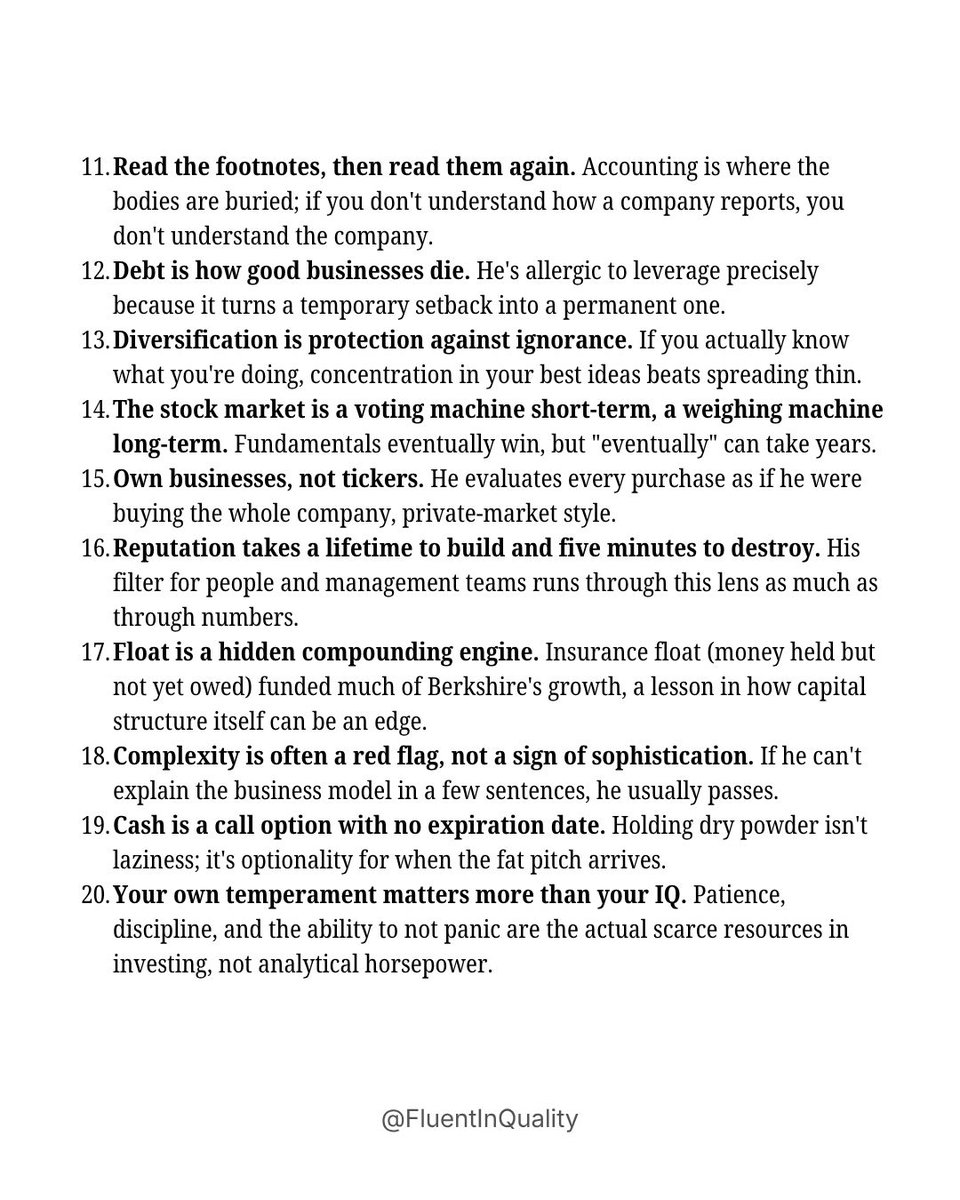
14. If you understand businesses, diversification is a mistake. For the 99% who will not evaluate businesses, Buffett recommends a low-cost index fund and extreme diversification. But if you bring real intensity to evaluating companies, owning more than six is a terrible idea. Very few people got rich on their seventh best idea. A lot of people got rich on their best one. Buffett keeps about half his money in what he likes best.
15. Buffett's biggest mistakes are mistakes of omission, not commission. The times he understood a business well enough to act and instead sat there sucking his thumb. He passed on healthcare stocks during the Clinton plan and on Fannie Mae in the mid-eighties, each a multi-billion-dollar miss. Accounting never captures these. The $2,000 he put into a Sinclair service station as a young man, money he lost, has an opportunity cost of about $6 billion today.
16. Focus on what will happen, not when. Coca-Cola went public in 1919 at $40 a share and dropped to $19 within a year. There was always a reason not to buy: the great depression, world war, sugar rationing, thermonuclear weapons. But one share bought then and reinvested would be worth about $5 million. If you are right about the business, you will make a lot of money. The timing is the tricky part, so do not focus on it.
17. When hiring, look for integrity, intelligence, and energy. But if the person lacks the first one, you actually want them dumb and lazy. Because a person with intelligence and energy but no integrity will destroy you. Buffett borrowed this from Pete Kiewit. The trait everyone screens for last is the one that matters most.
18. Here is a thought experiment Buffett gives students. Imagine you could own 10% of one classmate for the rest of their life. You would not pick the highest IQ or the best grades. You would pick the person you respond to best, the one who is generous, honest, gives credit to others, and has leadership qualities. Now imagine you also had to short one classmate. You would pick the egotistical, greedy, slightly dishonest one. The qualities that decide both are not talent. They are character.
19. Every quality on the admirable side is achievable, and every quality on the repellent side is removable. The things that make you want to own 10% of someone are not the ability to throw a football or run fast; they are behavior, temperament, and character, all of which anyone can choose. Buffett's point: you already own 100% of yourself, so you might as well become the person worth betting on.
20. The chains of habit are too light to be felt until they are too heavy to be broken. Buffett sees people in their forties and fifties trapped by self-destructive patterns they can no longer change. At a young age, you can choose any habits you want. Ben Franklin and Ben Graham both did exactly this, looking at people they admired and simply deciding to behave like them. There was nothing impossible about it.
21. Take a job you would take if you were already independently wealthy. Buffett told a 28-year-old at Harvard who wanted a consulting job "to look good on his resume" that it was like saving up sex for your old age. There comes a time to just start doing what you love. Buffett offered to work for Ben Graham for free, was told he was overpriced, and kept pestering him for years. Take the job you would jump out of bed for. You cannot miss.
22. You won the ovarian lottery, and that should shape how you think. Buffett imagines a genie 24 hours before your birth letting you design the world's rules, with one catch: you do not know which of 5.8 billion balls you will draw. Born here or in Afghanistan, with an IQ of 130 or 70, male or female, able-bodied or not. If you could put your ball back and draw one of 100 random others, most people would not, because they are already in the luckiest 1%. Buffett knows he is perfectly wired for a market economy that pays him like crazy, while an equally good citizen leading scout troops and teaching Sunday school is not, purely by luck.