From my experience all software developers are now security engineers wether they know it, admit to it or do it. Your code is now the security of the org you work for. #GoldenAgeOfDefense
Some of my allies are telling me that what we are seeing now is normal, that it’s just typical security, offensive AI is overblown, breaches are not increasing and to chill out.
Does anyone have data to the contrary?
Absolutely that’s the best dataset that shows the mammoth increase of breaches over the last year. It did tick down in August, but only after a year of growth.
I read that report carefully. Very impressive.
I would love to see more! Most of the other data sets that I’m looking at show a mixed story.
@Gedmark I was in an “airgapped” factory floor a couple of years ago. They did tons of work and were proud.
On the factory floor I fired up ie6 from one of their robotics controllers and hit the front page of CNN successfully.
No one would talk to me for an hour.
🤷♂️
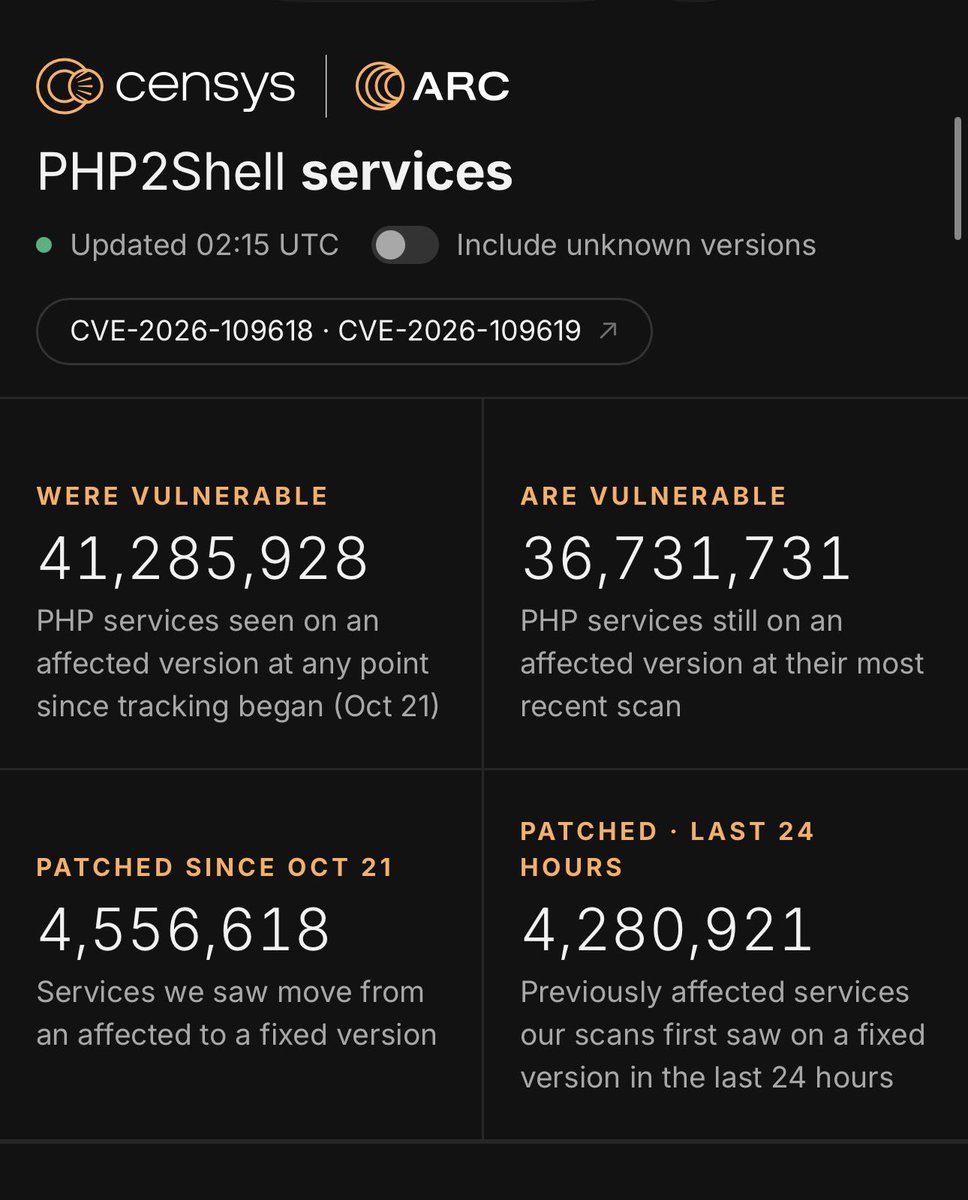
A trusted contact who has a working exploit tells me reliable exploitation is still possible against PHP 8.2.35 and 8.5.12, despite the security updates.
According to their testing, setting
session.upload_progress.enabled = Off
blocks that exploit path.
I haven’t reproduced this myself. Whether this is an incomplete fix for the disclosed CVEs or a separate issue still needs clarification.
The cyber incidents of the last 48 hours have been pretty mind blowing. I’ve been trying to piece together the “why now” question, and I think what we’re seeing is the first of a new kind of super-agent driven vulnerability cascade-- first one vulnerability is found by a malicious actor, then other bad actors pop up to try and take advantage of it before companies patch their systems.
But because each bad actor is using swarms of thousands of super-agents, those agents are not only exploiting the existing vulnerability, but finding new zero days as well, all in a matter of hours. And the cycle repeats. As of the writing of this post there have been vulnerabilities found across at least half-dozen independent systems including LiteLLM, PHP, eMudhra Certificates, NGINX, Bind 9, and NodeJS. The list continues to grow hour by hour.
Basically everything connected to the internet is at risk. Not just company websites and the usual databases of sensitive personal information, but all our critical infrastructure-- banks, power grids, pipelines, government agencies, all of it.
The good news is that cybersecurity and ops teams had a chance to see this coming. This is why from when Mythos first dropped and had our first warning, these teams have been hard at work shoring up systems across the board.
This is also why at Astranis we’ve seen a massive uptick in demand for truly air-gapped, sovereign networks, deployed via dedicated satellite to span an entire country or connect a large enterprise.
It is in fact possible to take an entire category of critical infrastructure off the internet entirely. With a fully self-contained network where all the endpoints are off grid. This is not a new concept-- anyone could do this for your home today with equipment you can buy from Best Buy. But to stand up such a network covering a large geographic area or an entire country, without touching the existing fiber or other network infrastructure, you can only do that with a dedicated satellite. And specifically a satellite in a special orbit called geosynchronous orbit.
Over the past year we’ve begun working with some of our customers on what it will take to implement truly air-gapped, standalone networks in support of mission critical use cases like core government functions, emergency response, defense, core infrastructure, or all of the above.
That might sound extreme, but that is the kind of measure we expect will be required to shrink the attack surface of some of the world’s most critical infra. That’s just the position we are now in. It's a brave new world.
And as if all these critical vulnerabilities weren't enough, we've also had several reports about threat actors using AI agents to compromise systems at scale.
This is actually the part that worries me even more.
Some interesting reports from the last few days:
01) ARTEX / ConnectWise
Microsoft reports that Storm-0940 used ARTEX in a large-scale campaign targeting more than 2,250 Microsoft 365 tenants. Up to 2,900 authentication attempts per minute, with privileged cloud access achieved in under three hours in some cases.
https://t.co/vPafbvD1oG
02) ARTEX / South Korean Finance
CrowdStrike found evidence of AI-driven attacks against South Korean financial organizations, including exposed Claude Code sessions and ARTEX configurations. DeepSeek, GLM and Grok were used in the attacker's setup.
https://t.co/kOiEqSEwUi
03) Cairn / 100+ Compromised Companies
NorForge investigated exposed Cairn instances used for autonomous hacking campaigns. More than 1,100 attack projects in one cluster alone. Reuters identified over 100 companies whose websites had been compromised.
Estimated AI costs: around $5 per task, according to NorForge. That's ridiculously cheap.
https://t.co/54Ir7IeY4Q
04) Four More Agentic AI Campaigns
CrowdStrike documented four additional threat actors using AI agents for real intrusion campaigns, including attacks against healthcare organizations and government entities.
https://t.co/rte8LIYL90
What concerns me is how quickly the economics of offensive operations are changing.
Finding vulnerabilities, testing attack paths, adapting payloads, trying something else when an exploit fails, and eventually deploying a webshell. Much of this can now be delegated to agents that keep working for hours.
And with open-weight models and freely available agent harnesses, the cost of running these operations is dropping significantly.
We've been talking about AI changing offensive security for quite a while. These reports show that it's already happening in real-world intrusions.
And I'm pretty sure we're only seeing a fraction of it.
For security researchers who want to inspect the PHP2Shell CVEs:
Source analysis, defensive verification scripts, and references are public.
https://t.co/oTkpAMuFYj
Reproduce responsibly. Patch your PHP installations.
@MalwareTechBlog The Problem is the tiny space to issue the payload, I had success writing a simple php cmd shell but it took hitting the host with 6 different requests writing the shell bit by bit
I know you disagree, but this is incorrect.
The complete, natural language articulation of what you want should be primary.
Old-school specs are lossy abstractions of that type of articulation. But code is also just a flawed implementation of the idea. Of the ideal.
The primary artifact should be the fully articulated ideal state definition of exactly what you want. In language. And granular, testable criteria with evals.
And then the code is the lossy output from that.
And the goal should be to have that output align with the idea as closely as possible.
The code isn’t primary. The idea itself is.
I have a few pieces of cybersecurity advice for anyone willing to listen:
Reduce the number of vendors your core security depends on.
Expect lots of small, medium-sized, and even some large security / services companies to get compromised in the next year or so, if they aren't already.
Put most of your trust in the absolute top tier of companies in terms of security and engineering.
These are companies like Google, Apple, and (I would argue) Cloudflare. A good heuristic is how big and talented their security teams, and how much money their company invests in security.
If there is a security issue in Chrome, or iOS, for example, you can be damn sure that hundreds or thousands of the smartest people in the world are working to fix it. And these companies would be willing and/or happy to spend tens of millions of dollars instantly to solve the issue.
I'm not going to name companies, but there are many applications and services out there for managing keys, passwords, source code, secrets, etc., where the security teams are decent, but they're basically large startups. The security teams are far more varied in talent levels and budget levels.
Basically we're about to be hit with a tidal wave (or global forest fire, pick your metaphor) of both advanced and persistent attacks with existing vulnerabilities, as well as lots of completely new attacks nobody's seen before.
You want to have your personal and company security relying on as few of these small to medium sized companies as possible. Not because they're totally incompetent, but because many of them are likely not up to the challenge of defending against millions of agents running open source attack models and harnesses.
Look at your whole security tech stack. See where you can reduce dependency on small-to-medium sized Jenga blocks that have a high chance of getting compromised during this storm.
And remember, it's not just that the teams and budgets aren't as big as companies like Google and Apple. It's also the fact that these companies (like password managers, for example) are so damn attractive.
Millions of users and their passwords. These are not good places to have credentials right now. Or data. Or infrastructure.
This is not an absolute thing. I'm not saying cancel all engagements and get our of all small companies or whatever. Or that the big ones will be perfect either.
I'm saying, as a general truth, on the whole, moving in this direction is likely to make you more secure while this thing hits us.