I'm done paying $500 a month for anti-detect browsers after finding this.
It's called CloakBrowser. A stealth Chromium that scores 0.9 on reCAPTCHA v3 (same as a real human) and passes 14 out of 14 bot detection tests.
- Auto-resolves Cloudflare Turnstile
- Beats FingerprintJS and BrowserScan
- TLS fingerprint identical to real Chrome
- Drop-in Playwright replacement (one line swap)
100% Opensource. MIT License.
What you usually pay for vs CloakBrowser:
Bright Data scraping browser → $500+/month
Browserless stealth tier → $200+/month
Custom anti-detect builds → $10K+ engineering
CloakBrowser → pip install, 200MB binary, done.
The reason it actually works:
Most stealth libraries (playwright-stealth, undetected-chromedriver, puppeteer-extra) inject JavaScript or tweak flags. Every Chrome update breaks them. Antibot systems detect the patches themselves.
CloakBrowser patches Chromium's C++ source code in 16 places. Canvas, WebGL, audio fingerprint, fonts, hardware concurrency, GPU vendor strings, WebDriver flag, TLS fingerprint.
All compiled into the binary. Detection sites see a real browser because it is a real browser.
Stock Playwright scores 0.1 on reCAPTCHA v3. CloakBrowser scores 0.9.
Same code. Same API. One import change.
🚨 Someone just open sourced a fully autonomous AI hacker and it's terrifying.
It's called Shannon.
Point it at your web app, and it doesn't just scan for vulnerabilities. It actually exploits them. Real injections. Real auth bypasses. Real database exfiltrations.
Not alerts. Not warnings. Actual working exploits with copy-paste proof-of-concepts.
Here's what this thing does autonomously:
→ Reads your entire source code to plan its attack
→ Maps every endpoint, API route, and auth mechanism
→ Runs Nmap, Subfinder, and WhatWeb for deep recon
→ Hunts for Injection, XSS, SSRF, and broken auth in parallel
→ Launches real browser-based exploits to prove each vulnerability
→ Generates a pentester-grade report with reproducible PoCs
Here's the wildest part:
It follows a strict "No Exploit, No Report" policy. If it can't actually break it, it doesn't report it. Zero false positives.
It pointed at OWASP Juice Shop and found 20+ critical vulnerabilities in a single run including complete auth bypass and full database exfiltration.
On the XBOW Benchmark (hint-free, source-aware), it scored 96.15%.
Your team ships code daily with Claude Code and Cursor. Your pentest happens once a year. That's 364 days of shipping blind.
Shannon closes that gap. One command. Fully autonomous.
The Red Team to your vibe-coding Blue team. Every Claude coder deserves their Shannon.
10.6K GitHub stars. 1.3K forks. Already trending.
100% Open Source. AGPL-3.0 License.
I’m saying goodbye to streaming. 2026 is the year pirating makes a comeback. I got 2 22TB external hard drives hooked up to my Mac Mini M4 Pro. Fully automated media server on my home network.
Sonarr/Radarr → Prowlarr → NZBgeek
↓
Jellyfin ← Media ← SABnzbd ← Newshosting (usenet)
• Jellyfin (8096) - Streaming
• Sonarr (8989) - TV
• Radarr (7878) - Movies
• SABnzbd (8085) - Downloads
Usenet only - SSL encrypted with no IP exposure or DMCA notices.
Just go to media.local on any device on my network.
Library: ~300 movies, ~400 TV series
Only took the weekend to build out.
Announcing a significant upgrade to Agentic Document Extraction!
LandingAI's new DPT (Document Pre-trained Transformer) accurately extracts even from complex docs. For example, from large, complex tables, which is important for many finance and healthcare applications. And a new SDK makes using it require only 3 simple lines of code. Please see the video for technical details. I hope this unlocks a lot of value from the "dark data" currently stuck in PDF files, and that you'll build something cool with this!
Did you know your MacBook has a sensor that knows the exact angle of the screen hinge?
It’s not exposed as a public API, but I figured out a way to read it and make it sound like an old wooden door.
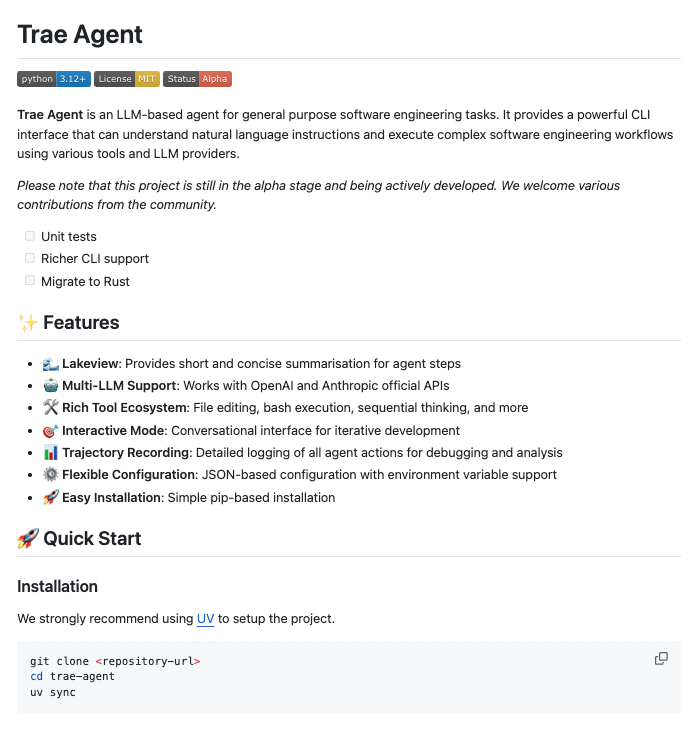
China's ByteDance just released an LLM-based agent for general purpose software engineering tasks.
Trae Agent comes with an interactive CLI that can execute complex workflows using simple English prompts. It works with OpenAI and Anthropic API.
100% opensource.
PDF parsing is still painful because LLMs reorder text in complex layouts, break tables across pages, and fail on graphs or images.
💡Testing the new open-source OCRFlux model, and here the results are really good for a change.
So OCRFlux is a multimodal, LLM based toolkit for converting PDFs and images into clean, readable, plain Markdown text.
Because the underlying VLM is only 3B param, it runs even on a 3090 GPU. The model is available on @huggingface .
The engine that powers the OCRFlux, teaches the model to rebuild every page and then stitch fragments across pages into one clean Markdown file.
It bundles one vision language model with 3B parameters that was fine-tuned from Qwen 2.5-VL-3B-Instruct for both page parsing and cross-page merging.
OCRFlux reads raw page images and, guided by task prompts, outputs Markdown for each page and merges split elements across pages.
The evaluation shows Edit Distance Similarity (EDS) 0.967 and cross‑page table Tree Edit Distance 0.950, so the parser is both accurate and layout aware.
How it works while parsing each page
- Convert into text with a natural reading order, even in the presence of multi-column layouts, figures, and insets
- Support for complicated tables and equations
- Automatically removes headers and footers
Cross-page table/paragraph merging
- Cross-page table merging
- Cross-page paragraph merging
A compact vision‑language models can beat bigger models once cross‑page context is added.
🧵 1/n Read on 👇
Distributed training on M4 Mac Mini cluster
We implemented @GoogleDeepMind DiLoCo on Apple Silicon to train large models with 100-1000x less bandwidth compared to DDP baseline.
AI is entering a new era where a distributed network of consumer devices can train large models.
Site migrations are SEO danger zones. One wrong move will see your traffic plummet to zero overnight.
Thanks to this checklist, our client's site saw a +61% INCREASE in organic traffic in 6 months instead.
If you're:
• Switching to a new domain
• Moving to a new CMS or platform (e.g., BigCommerce → Shopify)
• Migrating to a new server or host
• Launching a mobile version of your site
Here’s the full checklist to execute a flawless migration for your site: 🧵
A must read for AI Search & LLMs Optimization guide by Jed White with actionable advice and protocols to start integrating in your SEO Process, going through:
* Traditional SEO vs. AI search: The key differences
* Configure robots.txt for AI crawlers
* Avoid overly aggressive bot protection
* Optimize for speed
* Use clear metadata and semantic markup
* Create an llms.txt file
* More!
Check it out: https://t.co/6A1eJDjymb
3D CSS image slider works well on device 🤙
li {
--item-width: clamp(120px, 20vmin, 12rem);
--radius: calc(
(var(--item-width) / sin(var(--inner-angle))) * -1
);
}
It's cool how you can use a clamped value with "calc"