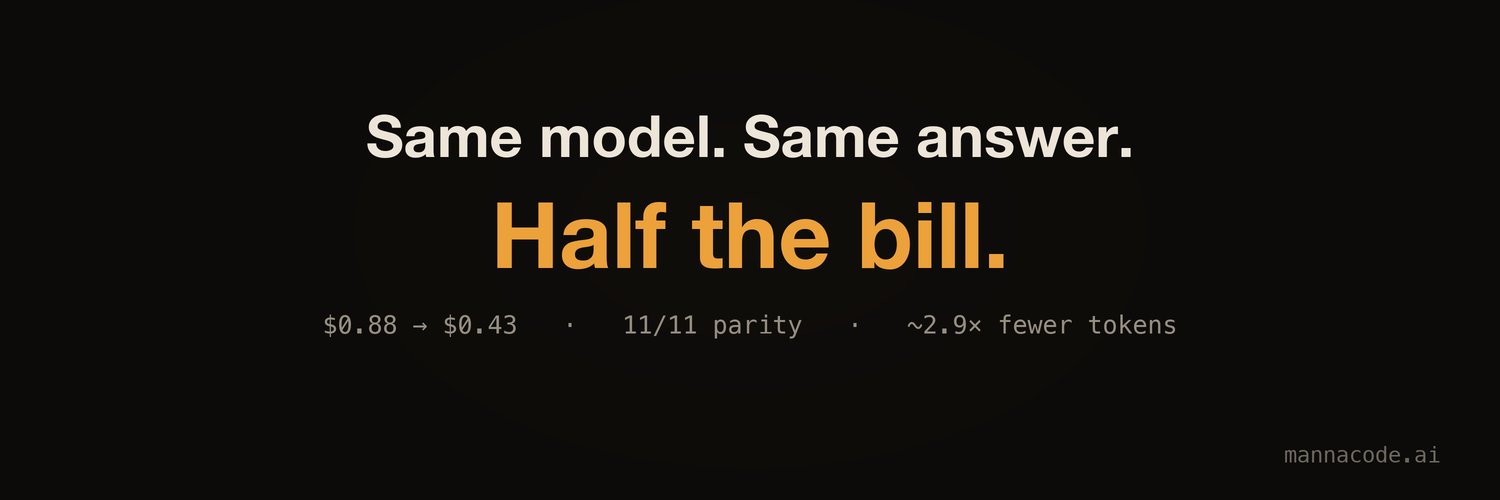
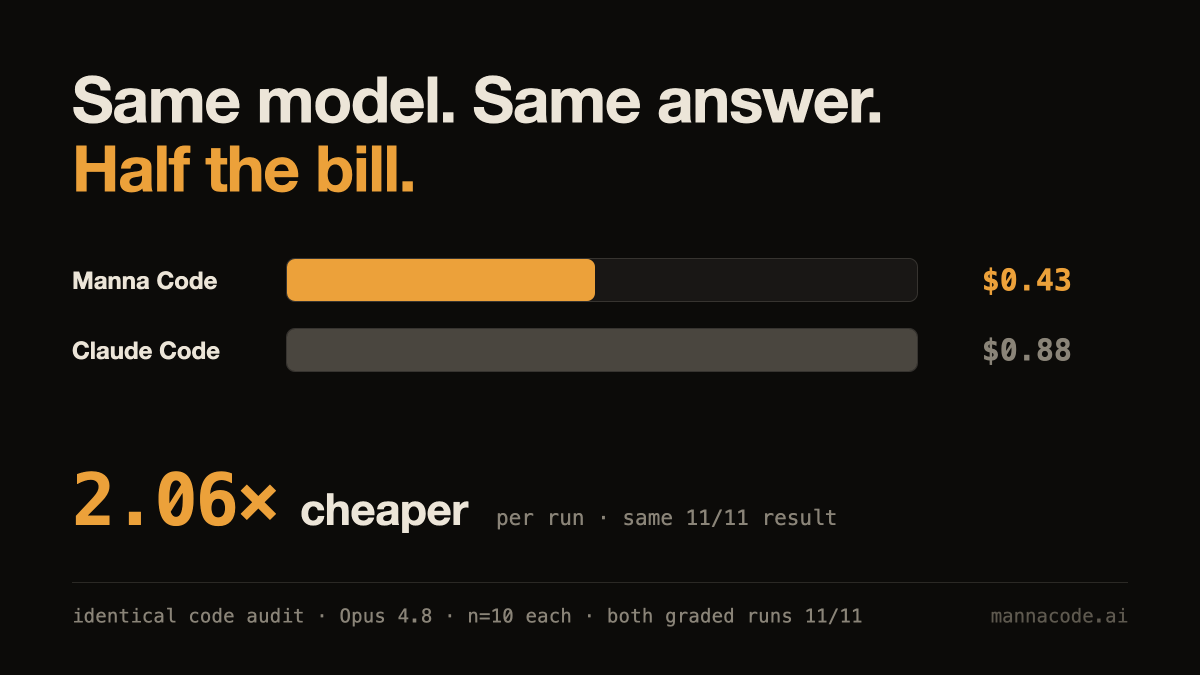
We ran the identical code-audit task 10× each through Claude Code and Manna Code. Same model (Opus 4.8), same effort, same prompt, fresh session per run.
Claude Code: $0.88/run
Manna Code: $0.43/run
Both scored 11/11. Same answers — half the bill.
@pushpak1300@laravel Useful pattern: give the agent observability, then keep a human in the loop. Being able to pause and steer when it starts chasing the wrong exception can save a whole turn of token burn.
@0xal0ke Great radar. The missing distinction for me is control while the agent is running. Pause and steer before a coding turn burns through tokens, then keep the thread local, is a useful complement to these open-source runtimes.
@iamrexei The permissions layer is the part most agent demos skip. Pause and steer before an agent burns through a turn is a useful complement to sandboxing, especially when the thread stays local.
Most coding agents keep going until they finish or burn the turn. Manna Code lets you pause mid-response and steer before it wastes tokens. Thread stays on your machine. Desktop free forever at https://t.co/5QVCRn30wJ. You only pay the model vendor.
@Temitope_Fire 5.74T is a wild demand signal. The next question is how much of each run is useful context versus stale carryover. Being able to inspect and trim that before the next call feels like the practical control layer.
@baskind That is a useful way to make the hidden bill visible. The next lever is making context visible too, so you can trim stale material before another long run. Same work, fewer surprise tokens.
@ucsandman The hard stop is the key. If an agent can inspect its own context before touching email or files, you can catch the risky combination earlier. Boundaries first, context visibility second.
Most agents guess what is in context. Manna Code has a context browser so you can inspect, pin, and trim what the model sees before it burns tokens. Thread stays on your machine. Desktop free forever at https://t.co/5QVCRn30wJ. You only pay the model vendor.
@gabrielgtapps Nice tip. Visible spend per session beats surprise invoices. We surface session spend in the agent while you work - https://t.co/5QVCRn30wJ
Most coding agents hide what a run costs until the invoice lands.
Manna Code shows session spend while you work. Desktop is free forever. You pay the model vendor (bring the OpenAI or Grok plan you already have, or BYOK). Keys stay in the OS credential manager. Manna never sees them.
https://t.co/8iNBXtYFNR
@null_founder Local compute and a local-first harness are related but different. An agent on your machine, with your keys, still matters when the model moves on-device.
Most coding tools force one loop for everything. Manna Code has two modes on one desktop agent. Analyst for files, spreadsheets, Python, charts, and the web. Code for planning-first edits with parallel tools and subagents. Same local thread. Desktop free forever at https://t.co/8iNBXtYFNR. You only pay the model vendor.
@tweetangelc I think the real dividing line is ownership. If the tool runs locally and you bring the model plan, the economics stay closer to software you own than another monthly seat.
@agentnative_@flutlancer@rileybrown Nice. The other advantage of a local coding agent is that Codex can work from the repo and git state already on your machine, without first uploading the codebase.
@StartupHakk@SwePalm@emollick Exactly. The local-first part matters because the coding agent can work against the repo that is already there, not a copy uploaded to someone else's stack.
@DenisPitcher Love this use case. A local agent doing the machine setup keeps the workflow private and avoids turning a side project into another hosted bill.
@rwtest That split between planning and coding is compelling. I like keeping the agent close to the repo too, so it can inspect the real files and git state instead of requiring a cloud upload first.