Dr. Manoj Prasad's lab (fondly called 'MP103') at NIPGR, New Delhi, India is known for its outstanding contributions to plant molecular genetics and genomics.
We are thrilled to share our paper, ‘The Sw5a gene confers resistance to ToLCNDV and triggers an HR response after direct AC4 effector recognition,’ published in PNAS @PNASNews!
https://t.co/TlPIDquTvb
We heartfully acknowledge the support of @DBTIndia, @serbonline, @NIPGRsocial!
🌱 New Publication Alert! We're excited to share our latest review in @PlantCellEnvir , on "Delineating microRNA169-Nuclear Factor Y-Subunit A Module for Its Potential Implications in Crop Improvement"
📘 DOI: https://t.co/3Mfx8zKFNi
@NIPGRsocial
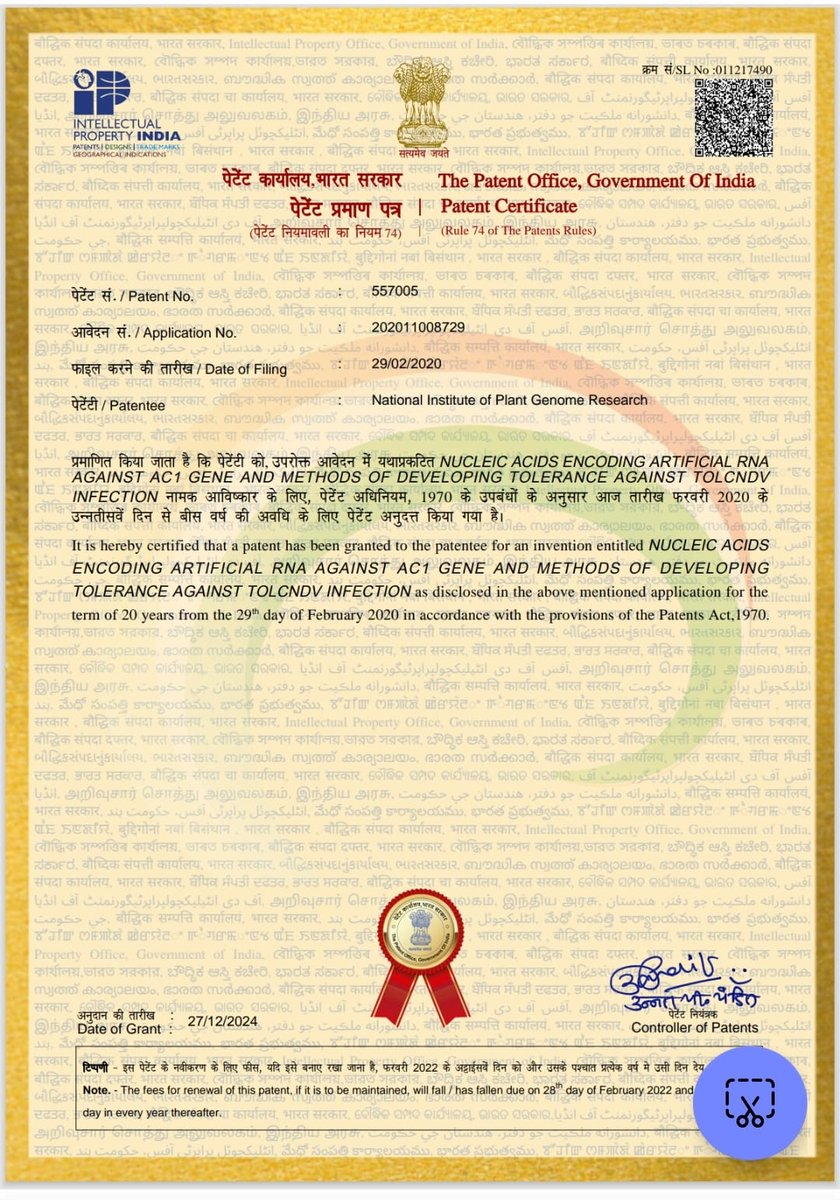
We’re excited to share that our invention, “Nucleic Acids Encoding Artificial RNA Against AC1 Gene and Methods of Developing Tolerance Against ToLCNDV Infection,” has been granted a patent!
@NIPGRsocial@DBTIndia@manoj_prasad70@SciComm_India
This review also describes how viruses exploit these signaling pathways, favoring their pathogenesis.
We are proud to contribute to advancing plant science and sustainable agriculture. Your feedback and discussions are welcome! 🌱✨
Our latest review, published in the @JXBot, explores the role of phytohormone signaling pathways during plant-virus interaction in activating plant antiviral immune responses.
Full article: https://t.co/CqbQQGh7sW
@manoj_prasad70@NIPGRsocial@SciComm_India
Transcription factors (TFs) are pivotal proteins that orchestrate gene expression. This review focuses on factors defining the TFs' functionality and how TFs regulate plant development and adaptation to environmental challenges.
Glad to share our recent review on ‘Decoding the Functionality of Plant Transcription Factors: Key Factors and Mechanisms’ published in ‘Journal of Experimental Botany’
Full-text: https://t.co/UkmZmsfzit
@JXBot@manoj_prasad70@NIPGRsocial@Delhiuniversit@SciComm_India
Our study provides insights into the regulation of N responsiveness at molecular and physiological levels in foxtail millet, which has significant implications for better understanding this important agronomic trait that helps achieve high yields under sustainable N conditions.
We’re glad to share our recent research article on ‘Identifying the mechanistic basis to nitrogen responsiveness in two contrasting Setaria italica accessions’ published in the ‘Journal of Experimental Botany’
Read: https://t.co/BNMKLAesCD
@JXBot@NIPGRsocial@manoj_prasad70
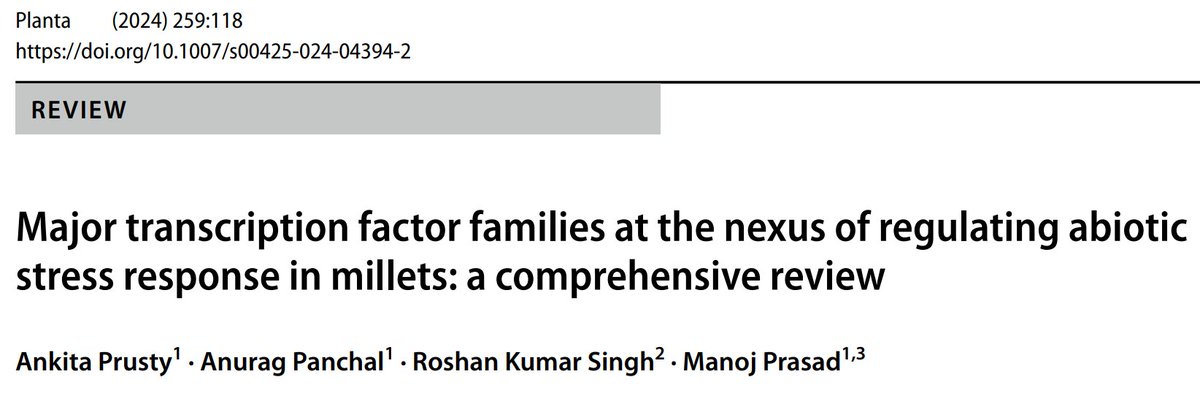
This review illuminates transcription factors that govern diverse abiotic stresses and confer tolerance in millets. It also explores the potential of TFs in developing stress-tolerant crops and presents a comprehensive discussion of diverse strategies for their integration.
Happy to share our article on 'Major transcription factor families at the nexus of regulating abiotic stress response in millets: a comprehensive review' is published in 'Planta'
Full text: https://t.co/H2IgwHBtPl
@manoj_prasad70@NIPGRsocial@nipgr_roshan
The article highlights the recent studies on small proteins encoded in viral genomes (like TuMV and SARS-CoV-2) that are essential for viral pathogenesis.
We’re pleased to share our focus article on ‘Deeper look into viruses: replication intermediates do code!’ published in ‘Plant Cell Reports.’
Full text: https://t.co/LAWOLc6JpL
@manoj_prasad70@NIPGRsocial
Six SNPs showed pleiotropic effect and were associated with two or more nutrients, whereas 24 candidate genes were identified for 28 MTAs involving seven traits. Significant SNPs, desirable alleles and candidate genes identified in this study will be helpful in breeding programs.
In this work, a total of 104 foxtail millet accessions were evaluated for 11 nutrients in three environments and 67 high-confidence marker–trait associations were identified.
New beginnings.. joined as Professor @Genetics Dept. UDSC https://t.co/BPMzGp8xzc
Thank you everyone for your support, encouragement, motivation and blessings.. 🙏
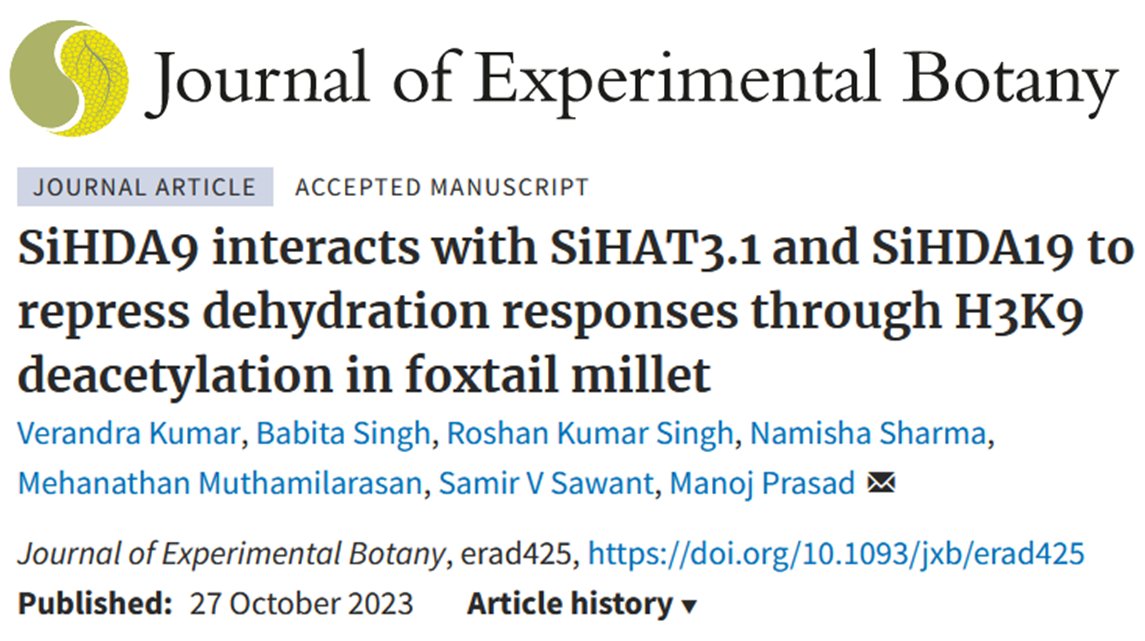
We’re pleased to share our article on ‘SiHDA9 interacts with SiHAT3.1 and SiHDA19 to repress dehydration responses through H3K9 deacetylation in foxtail millet’ published in ‘Journal of Experimental Botany.’
Full text: https://t.co/Nxo9E3FXRC
@JXBot@manoj_prasad70@NIPGRsocial
SiHDA9 physically interacted with SiHAT3.1 and SiHDA19, which might form a repressor complex that suppresses dehydration-responsive genes, including SiRAB18, SiRAP2.4, SiP5CS2, SiRD22, SiPIP1;4 and SiLHCB2.3 via. H3K9 deacetylation in foxtail millet.