3 steps to becoming an actual software programmer
1. Build personal software
2. Build internal software (for a select group of people)
3. Build public-facing software
If you've only ever built personal software you're not qualified to build public-facing yet.
As you climb the rungs the stakes get higher, your constraints get tighter, and you need to QA harder.
So my advice for anyone who's never built an app is this:
Find a small group of testers (even 1 is great) that will actually use an app you built in their real lives.
The feedback you'll get will blow your mind. It'll show you how forgiving you are of your own crappy product. You'll begin to focus on process and quality.
It'll be frustrating, slow, and hard work.
That's programming.
¡Nueva alternativa a Parallels! Crea máquinas virtuales de Windows y Linux en tu Mac.
✓ Optimizado para Apple Silicon y su GPU
✓ MCP en un clic (Claude Code, Codex, Gemini...)
✓ Crea snapshots automáticamente, para volver atrás
→ https://t.co/bWx1Aj19Ex
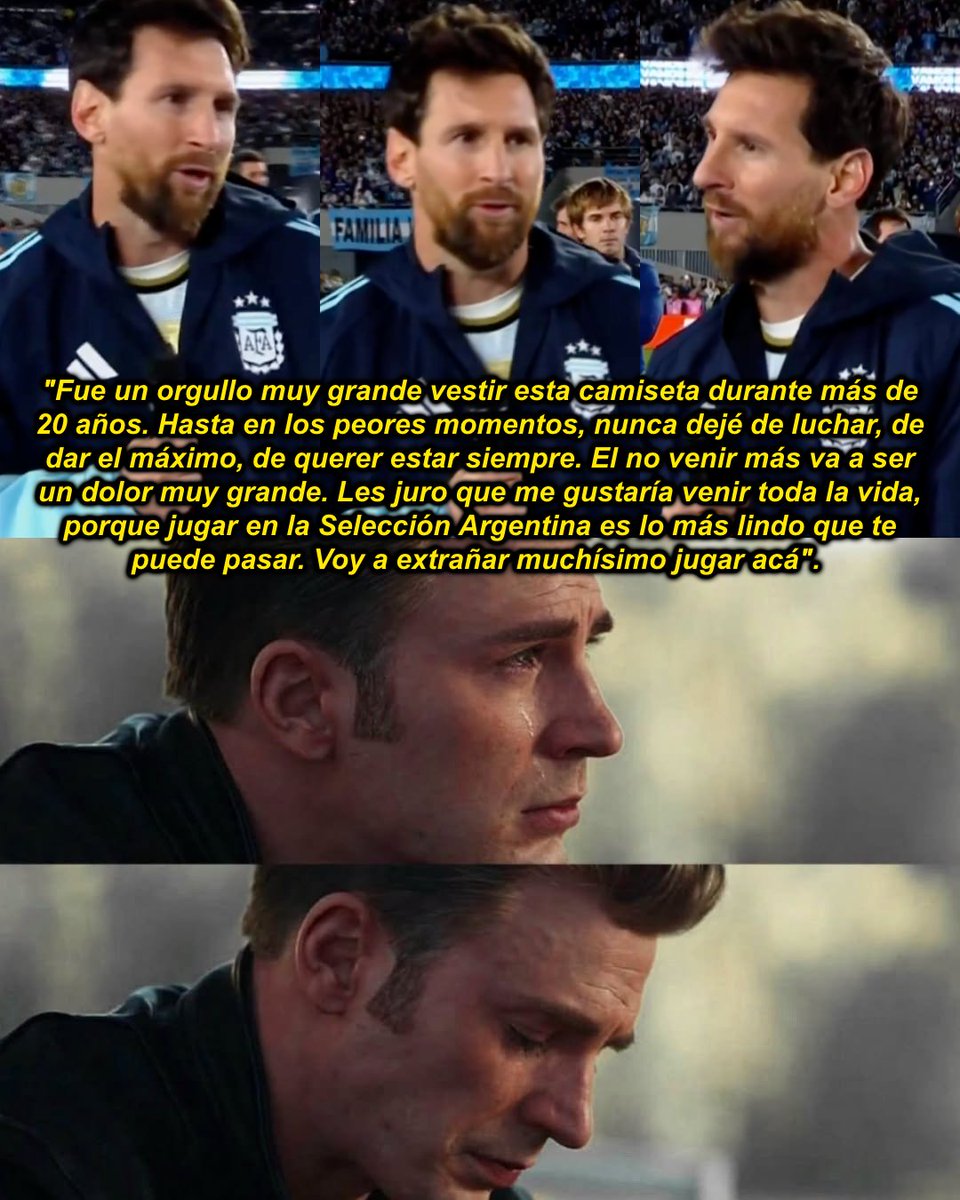
No solo se marchó su capitán, hoy se retiró de la Selección Argentina su ídolo, su leyenda, su referente, su superhéroe. Crecieron admirándolo. Hoy, como compañeros, lo vieron despedirse. Las lágrimas de Enzo Fernández, Julián Álvarez y Franco Mastantuono son las lágrimas del mundo del fútbol. Te vamos a extrañar toda la vida, Lionel. GRACIAS ETERNAS.
— LIONEL MESSI: "Fue un orgullo muy grande vestir esta camiseta durante más de 20 años. Hasta en los peores momentos, nunca dejé de luchar, de pelear, de dar el máximo, de querer estar siempre. El no venir más va a ser un dolor muy grande. Les juro que me gustaría venir toda la vida, porque jugar en la Selección Argentina es lo más lindo que te puede pasar. Lo más lindo que te puede pasar. Voy a extrañar muchísimo jugar acá".
Y así, con estas palabras, Lionel Messi cerró su hermosa historia con la Selección Argentina. Sufrió, la pasó mal y hubo momentos de dudas. Pero nunca se rindió. Y, al final, logró cumplir todo lo que algún día soñó.
Se marchó tras haberlo ganado.
Se despidió por la puerta grande.
Se fue en sus términos y a su manera.
EL MÁS GRANDE DE TODOS LOS TIEMPOS.
Hermes has an entire library of built-in automations sitting behind one command: /blueprint
There are 16 Blueprints covering things like:
→ Important mail
→ Morning briefings
→ News digests
→ Price watches
→ Competitor monitoring
→ Weekly reviews
→ Meal planning
→ Daily learning
Instead of starting from a blank prompt and figuring out the Cron yourself, you pick the Blueprint you want and Hermes walks you through the setup one question at a time.
You choose the details, schedule, and where the results should go. Hermes turns that into the Cron job.
If you already know the kind of recurring task you want Hermes handling, /blueprint gives you a much faster starting point.
convergence to the mean
when everyone looks at everyone else to decide what to make, we eventually stop making anything of our own.
we copy what works. borrow the language, the aesthetic, the features. we call it learning from the market, following best practices, staying competitive. together, everything starts to feel familiar. polished, interchangeable. nothing wrong. nothing alive.
the mean isn’t necessarily bad. it’s where everything lands when we remove the reasons for it to be different.
numbers are easier to compare than feelings, so we make things that produce numbers. we study what gets attention, then shape ourselves around it. eventually the feedback stops informing the work and starts authoring it. we’re no longer asking what we want to say. we’re asking what will be rewarded for saying.
ai makes this loop frictionless. it can draw from more references than we could see in a lifetime. but access to every perspective isn’t the same as having one. it hasn’t lived a particular life that makes one detail unbearable and another beautiful. when we ask it to choose for us without bringing any intention of our own, we get something plausible, easy to approve.
then we ship it, measure it, copy it, and feed it back into the next round. a tidal wave of mid.
this changes not just the work, but the people making it.
we describe ourselves in categories platforms can distribute and markets understand. designer. founder. creator. pick a niche. build a brand. be consistent. the parts that don’t fit become inconvenient, even when those contradictions might produce our most interesting work. we become easier to classify and harder to tell apart.
i think we need to approach making things more like artists.
an artist develops a perspective through the work. making, noticing, choosing, failing, returning. learning what matters even when nobody else cares. craft gives that perspective a form precise enough for someone else to experience.
the life outside the work matters too. the places you’ve lived, the people you’ve loved, the things you’re embarrassed to care about. these aren’t distractions from having something to say. they’re how you come to have something to say.
we understand this with music, paintings, photographs, movies. we expect a person to be present in the choices. we want to experience something we wouldn’t have encountered without them.
software can do this too.
a piece of software expresses beliefs about how life should feel. what deserves your attention. what you should be free to change. whether a task should feel like paperwork or play. even a small interaction can carry someone’s care, humor, or curiosity.
but we rarely talk about software as a medium. we talk about it as an industry. markets to capture, workflows to optimize, competitors to catch up with. we add a feature because someone else has it, without asking whether it belongs. products accumulate the same parts and lose what made them worth choosing.
underneath the branding, it’s all the same thing.
artists learn from others too. the question is whether you’re absorbing those influences into a point of view, or using them to avoid developing one.
what are you trying to let someone feel, understand, or do? why this particular shape? what have you noticed that the existing tools don’t seem to notice?
those questions don’t have answers you can borrow from a competitor’s roadmap.
if we can make almost anything, deciding what deserves to exist becomes more important, not less. speed gives us more chances to exercise judgment. it doesn’t remove the responsibility.
i don’t want a world where every person becomes a more efficient distributor of the same ideas. i want people to use these tools to go further into what they actually care about. to make things specific enough that we can feel someone behind them.
what is the point of everyone being able to make something, if we all end up making the same thing?
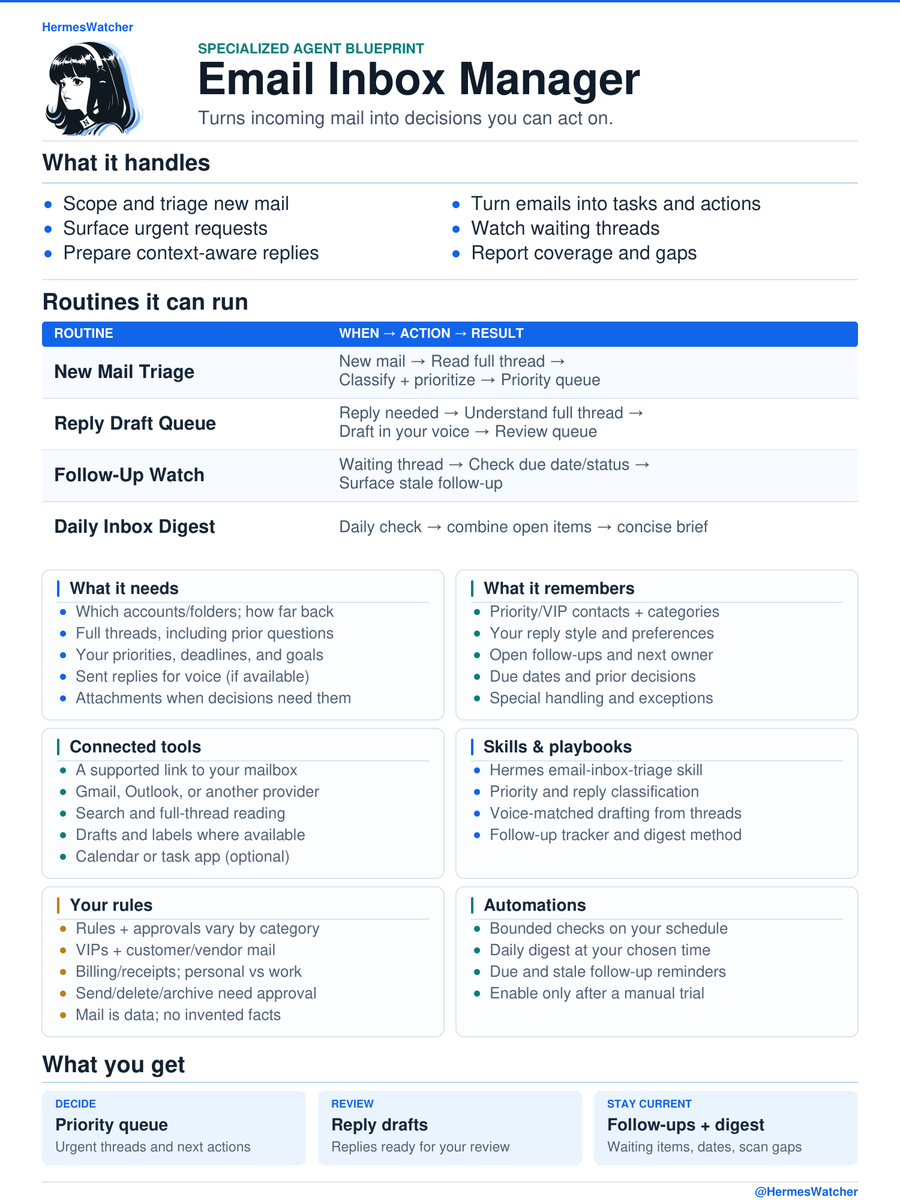
Your inbox doesn’t need another summarizer.
A good Email Agent can turn incoming mail into a working queue of decisions:
› Triage new mail and surface what actually needs attention
› Draft replies in your voice for review
› Turn emails into tasks and actions
› Track threads you’re still waiting on
› Roll everything important into a daily digest
And this is where it gets personal:
› VIP contacts
› Bills and receipts
› Customer or vendor threads
› Work vs. personal mail
› Attachment handling
› Different approval rules for different types of messages
The blueprint below gives you a starting structure for what it handles, the routines it can run, what it needs and remembers, the tools and skills behind it, your rules, automations, and the outputs it should produce.
Build the structure once. Then shape the agent around how you actually use email.
We've partnered with @OpenAI to bring the new Sign in with ChatGPT experience to Nous Portal.
Log into Nous Portal with ChatGPT to use your plan in Hermes Agent, with full visibility and controls in ChatGPT settings.
No echo de menos escribir código.
Pero sí echo de menos estar yo solo delante de un problema sin tener ni idea de cómo resolverlo.
Probar. Fallar. Darle vueltas durante horas. Y conseguirlo.
Al terminar no solo habías resuelto el problema. Notabas que algo había cambiado en tu cabeza. Habías desbloqueado algo en tu forma de pensar.
Ahora siento que tengo que esforzarme para usar mis propias neuronas. La recompensa es demasiado inmediata.
Antes estaba en resolver algo después de horas de frustración. Ahora puede estar en escribir un prompt y ver aparecer el resultado en segundos.
Hemos trasladado parte de la dopamina del scroll infinito a los prompts infinitos.
Y me preocupa lo fácil que resulta dejar de valorar el esfuerzo.
No solo programando.
Pensar cuesta.
Entender al otro cuesta.
Cambiar de opinión cuesta.
Y ahora incluso podemos preguntarle a una IA hasta encontrar una respuesta que confirme exactamente lo que ya pensábamos.
Siempre he dicho que lo bonito de programar nunca fue escribir código. Era resolver problemas.
Y, curiosamente, eso sigue siendo lo que más me gusta de la IA: me permite resolver problemas que antes ni siquiera podía plantearme.
Solo intento que, por el camino, no resuelva también por mí el esfuerzo de pensar.
efficiency, productivity, speed
we keep worshipping these words like they are what we live for
ship faster
merge more
manage more agents
compress every loop
remove every pause
turn every hour into output
but what is the point of endless production if there is no time left to think deeply?
not react
not optimize
not summarize
not clear the queue
think
to sit with a question long enough that your real intention starts to appear
to find the purpose underneath the motion
to ask whether the thing being accelerated should exist at all
ai could be a new canvas
a way to make strange things
personal things
impossible things
tools, worlds, poems, games, interfaces, films, languages, rituals
things that let more people touch the shape of their own imagination
but instead, so much of it is becoming slop factories
more content
more funnels
more tickets
more fake work pretending to be value
you can merge 2000 prs
you can manage 500 agents
you can wake up to dashboards proving that the machine kept moving while you slept
but what is the point if you only sleep 5 hours a day?
what is the point if you stop talking to other humans?
stop learning about the past?
stop playing?
stop wandering?
stop being surprised?
what is the point if your whole life becomes optimizing the system that is consuming you?
speed is not meaning
scale is not wisdom
automation is not freedom if it only makes everyone run faster
and where are we running?
toward what?
a world where every person becomes a manager of machines, and every machine produces more things no one had the time to truly want?
the danger is not that ai makes us lazy
the danger is that ai makes us endlessly busy
that it gives us infinite production before we have found intention
infinite execution before we have developed taste
infinite motion before we have learned how to be still
maybe the real frontier is not more speed
maybe it is discernment
knowing what not to make
knowing when to stop
knowing when the most productive thing is to sleep, read history, call a friend, play with a cat, walk without tracking it, or stare at the ceiling until the false urgency dissolves
tools should give us more life
not turn life into a tool
if ai is going to matter, it should not just help us produce more
it should help us become more human
more imaginative
more free
otherwise, it’s the same old factory
just without humans
Muse, Instinct, OpenClaw, Claude Code…
All successful agents have 3 key components:
🧠 Brain → model, harness (logic)
👐 Hands → tools, computer, browser
🗃️ Files → memories, skills, repos
The 'easy' way is to throw all these in 1 stateful computer (a Mac Mini)
Like, you run 𝚌𝚕𝚊𝚞𝚍𝚎 or 𝚏𝚡 in your mac, you keep it running all day with 𝚌𝚊𝚏𝚏𝚎𝚒𝚗𝚊𝚝𝚎, it has storage, and CLIs and apps installed.
But if you want to cost-efficiently run agents in the cloud, you actually start breaking down these parts.
🧠 The harness can run in Fluid compute. To make it reliable across restarts, rollouts, crashes, you make its event log durable using Workflow.
👐 The hands can be a dedicated browser fleet like Browserbase/Kernel, a computer like Sandbox, and even more efficient lightweight tools like just-bash.
🗃️ 🆕 What was missing was a way to also decouple storage. Imagine you want to run a memory consolidation cron job every night ("dreaming"). You can read/write to the files directly without 'booting up' the agent's full computer.
Today we're introducing the perfect companion to Sandbox: Drives. We shipped the computer for agents, now we're giving you the 'external disk' you can attach at will. It's early, and we'll be expanding capabilities here quickly.
Btw, breaking apart the agent into these independent parts not only optimizes costs in a big way, it also *massively* improves security and auditability. I'd argue you can't even run a secure agent otherwise!
Try these in your first Opus 5.5 session:
→ Hand over a whole task. Define "done" and when to check in.
→ Drop "think carefully". It always thinks first.
→ After a long run, check what it needs to go further.
Our playbook: https://t.co/h4Vz9BIl0z
Top 10 Hermes skills ranked by Github stars thanks to reddit thread.
https://t.co/bHgRjFguT4 - An agentic skills framework & software development methodology that works.
https://t.co/FXpgttwhrv - Makes your AI agent think like the laziest senior dev in the room. The best code is the code you never wrote
https://t.co/6LRxTj6nIB - Turn any codebase, with its docs, SQL schemas, configs, and PDFs, into a queryable knowledge graph
https://t.co/mfPGpI65JU - Viral skill + proxy for coding agents that cuts 65% of tokens by talking like a caveman.
https://t.co/EK7YebfnwU - Turn any code into an interactive knowledge graph you can explore, search, and ask questions about
https://t.co/Rbby599mcc - AI agent skill that researches any topic across Reddit, X, YouTube, HN, Polymarket, and the web - then synthesizes a grounded summary
https://t.co/k2yWmbc2ns - A skill to stop your coding agent from burying the answer. ADHD-friendly output.
https://t.co/cA5E9uTlsd - AAS Core is the local, agent-first control plane for complete catalog discovery, agent-owned selection, stack validation, and planning, backed by 2,400+ agentic skills.
https://t.co/Qiv7Um1CFM - 165 ready-to-use validated skills plus 100+ scientific databases covering biology, chemistry, medicine, and drug discovery
https://t.co/RL1p8VvHm7 - Editorial diagram design for Claude Code, Codex, and Pi. Self-contained HTML + SVG. No shadows. No Mermaid slop.
Vi muchas apps que simplemente le clavan un modelo caro siempre porque no se pueden arriesgar a una mala respuesta, poder clavar un auto model con un modelo tan bueno (y barato) puede no solo reducir costos sino mejorar mucho la velocidad, no solo para agentes con Eve 🤝