I'm in! 🎯
Just joined the @MAYZProtocol Incentives Campaign — a fun and easy way to support Cardano’s DeFi ecosystem 💪
Complete a few simple tasks, earn $gMAYZ, and help grow decentralized finance on Cardano 🚀 https://t.co/b8bc1zCOyS
The most powerful tool in quant trading right now isn't AI. It's a piece of math from 1906 called a Markov chain.
Citadel runs it inside the algorithms behind roughly 20% of all US stock trades - and never lets it outside the building.
Somebody just rebuilt the whole thing where anyone can see it.
There's now an app that runs all this math in two clicks.
Full breakdown below. Save it before you need it.
The Kalman filter isn't a separate algorithm. It's recursive least squares wearing a state-space costume.
That's the actual conclusion of Tony Lacey's tutorial. Most people learn the KF as a tool.
This is the KF as what it actually is.
Bookmark! Worth ten minutes.
An algorithm that turns $1 into $36 billion over 22 years sounds like a false headline right.
It's actually Table 3 of a University of Johannesburg working paper (Nkomo & Kabundi, ERSA 394), a Kalman-filtered, momentum-extended Anticor algorithm (K-ACM), backtested on NYSE data from 1962–1984.
No capacity constraints. 10bps in costs, full liquidity assumed.
The mechanism trade on deviation from Kalman trend, not raw returns is genuinely interesting. The headline number is a backtest artifact.
Bookmark this!
this is f*cking dangerous
someone just open sourced the entire "LOOP ENGINEERING" framework for free
build a hedge fund printing alpha 24/7 by feeding it into claude code with my article below
bookmark before someone takes it down
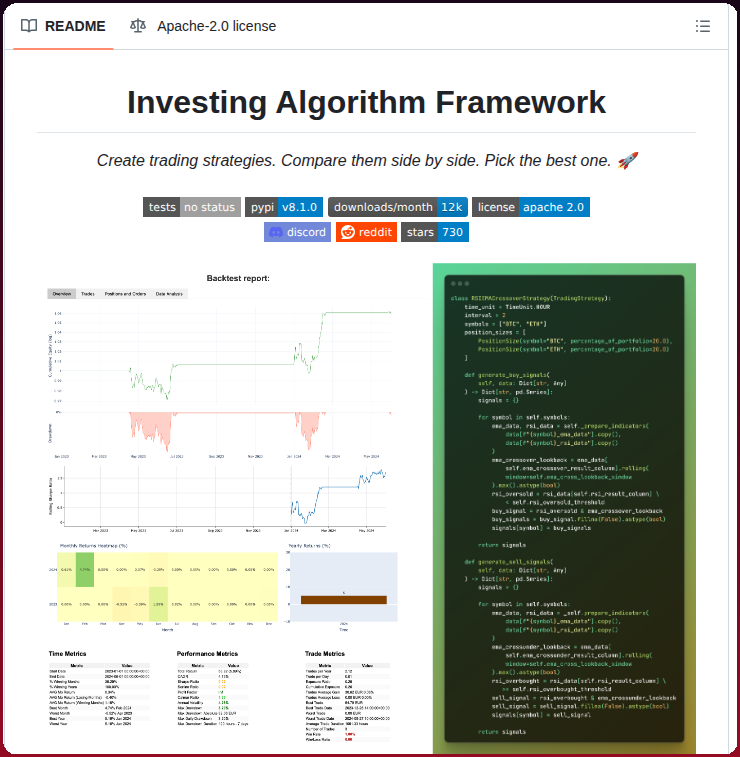
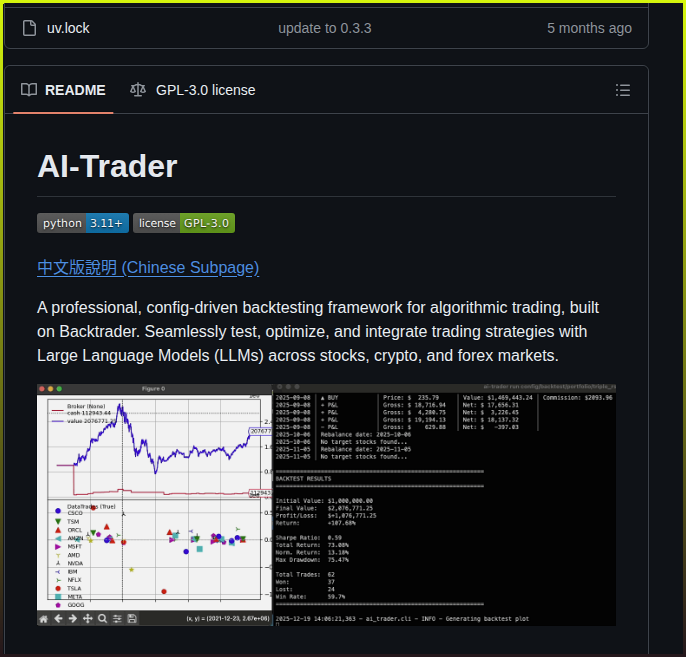
🚨BREAKING: Python's Newest Algorithmic Trading Tool.
Introducing Nautilus Trader. 100% free.
Here's what it does (and how to get started in under 3 minutes):
A lawyer in Manhattan gets a 500-page contract. Every clause needs to be searchable. By hand: one week.
An accountant in Chicago gets 200 scanned invoices. Every number needs to land in a spreadsheet. By hand: four days.
A researcher at Stanford has 50 academic papers. Tables, formulas, charts locked inside PDFs. By hand: two weeks.
Every one of them is losing days of their life to copy-paste.
Now meet MinerU.
A free and open source tool that reads any PDF, Word doc, PowerPoint, Excel sheet, or scanned image. It pulls out the text in reading order. Tables become clean HTML. Equations become LaTeX. Handwriting handled. 109 languages.
You give it a 200-page PDF. You get clean Markdown back in 90 seconds.
What makes it different from every other PDF tool:
- Multi-column layouts. It reads top to bottom within each column. Not left to right across the page. Like a human reads.
- Scanned documents. OCR built in. Point it at a photo of a printed page from 1995. Get clean text back.
- Math formulas. LaTeX-quality recognition. Every equation renders correctly.
- Tables. Merged cells, multi-row headers, tables that span three pages. All preserved.
- Ten-thousand-page documents. Sliding window processing. No manual splitting.
- Batch mode. Point it at a folder of 500 documents. Walk away.
Three ways to use it:
- CLI. One command per document.
- Python SDK. Five lines of code.
- Web app at https://t.co/AIC2NNey41. Upload, click, download. No install.
Plugs into Claude Desktop, Cursor, Windsurf, LangChain, LlamaIndex, RAGFlow, Dify, and FastGPT. Feed extracted documents straight to your AI agent.
The story:
The OpenDataLab team at Shanghai AI Laboratory needed to extract clean text from millions of scientific documents to train a language model. Existing tools failed. They built their own. Then they open sourced it.
68,551 stars. MinerU Open Source License, built on Apache 2.0. Free for personal and commercial use. Three technical reports on arXiv.
Adobe Acrobat Pro charges $239.88 a year. It still loses your tables.
ABBYY FineReader Corporate charges $165 a year. It still cannot do equations.
Mistral OCR charges $2 per 1,000 pages. Your bill never stops.
MinerU costs $0. Runs on your laptop. Your documents never leave your machine.
Here is the wild part.
The lawyer got her contract back in 4 minutes. Every clause searchable.
The accountant fed 200 invoices in. Every number landed in a spreadsheet in 12 minutes.
The researcher fed his 50 papers in. He wrote his literature review on a Sunday afternoon.
The document your company has been processing by hand for years takes MinerU minutes.
Your documents become text. Your text becomes data. Your data becomes answers.
The week you used to lose to paperwork is back in your hands.
A CHINESE TRADER BUILT A SECOND BRAIN IN OBSIDIAN THAT GENERATES 3 TRADING IDEAS EVERY MORNING AT 6AM AND MADE $180,000 IN 6 MONTHS.
No Bloomberg terminal.
No analytics desk.
No team of analysts.
A Mac Mini by the wall.
An iPhone in his pocket.
One local Obsidian vault.
Six N8N pipelines running 24/7, pulling every article he reads, every podcast he listens to, and every voice note he drops into a Telegram bot—directly into the vault.
Every night, a neural network reads across 4,000 connected notes and finds the strongest connections between fresh information and old theses.
Every morning at 6AM, a brief lands in his inbox:
- 3 trading ideas with confidence scores
- The emerging thesis of the week
- Any note that contradicts an active position
The system only wakes him up when a fresh note contradicts his thesis, or when an idea breaks 90% confidence.
Everything else runs without him.
The monthly bill: $120 in API costs.
The monthly return: approximately $30,000 into the account.
Traditional quant funds pay teams of 8 people to produce the same flow of insights.
He pays $120 and a Mac Mini.
The full system breakdown is in the article below.
Bookmark this before you pay for a Bloomberg subscription.
Follow @cyrilXBT for every solo operator setup that changes what one person can build.
This 17 page pdf reveals the same technique Hedge Funds like Jim Simons' Renaissance Technologies use to find signal through noise.
Stanford released the complete Hidden Markov Model framework for everyone to use it.
Bookmark it before someone takes it down:
Mi hermano se mandó a hacer una versión pixel art de Buenos Aires y es la cosa más nerd urbanista que vas a ver en el año, yo que vos me armo un Campari y me mando a explorar en https://t.co/8OFIc0tG1C
Free code from book:
Machine Learning in Finance: From Theory to Practice
This book integrates machine learning with quantitative finance, focusing on how theoretical frameworks inform data modeling and financial decision-making processes.
Get the code here: