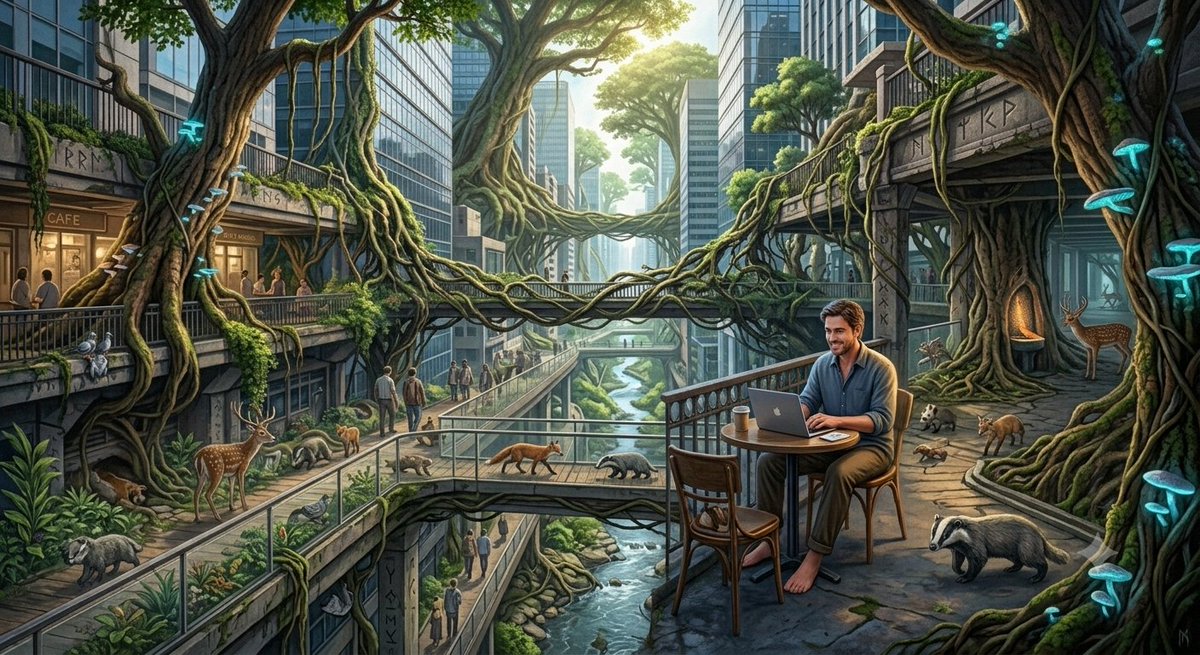
Humanity spends an absurd amount of energy fighting the natural world it built over.
We call urban wildlife “pests”, erase ecosystems, and then build increasingly complex systems to manage the consequences.
Maybe that's the wrong architecture.
Escaping to the forest isn't the solution.
Abandoning technology isn't either.
The challenge is engineering cities as balanced ecosystems — where infrastructure integrates nature instead of erasing it.
I build software, hardware and scalable systems.
My thesis is simple:
If a system requires destroying its environment to operate, it's not advanced.
It's badly designed.
Agentic checkout is the easy part.
The hard part starts before the checkout.
Does the agent know the real inventory?
The real price?
The merchant's rules?
What it can change?
What it can't?
And what happens when the real world doesn't follow the happy path?
Checkout is just where the agent touches the money.
The interesting part is making the whole commerce system operable by an agent.
That's the real shift.
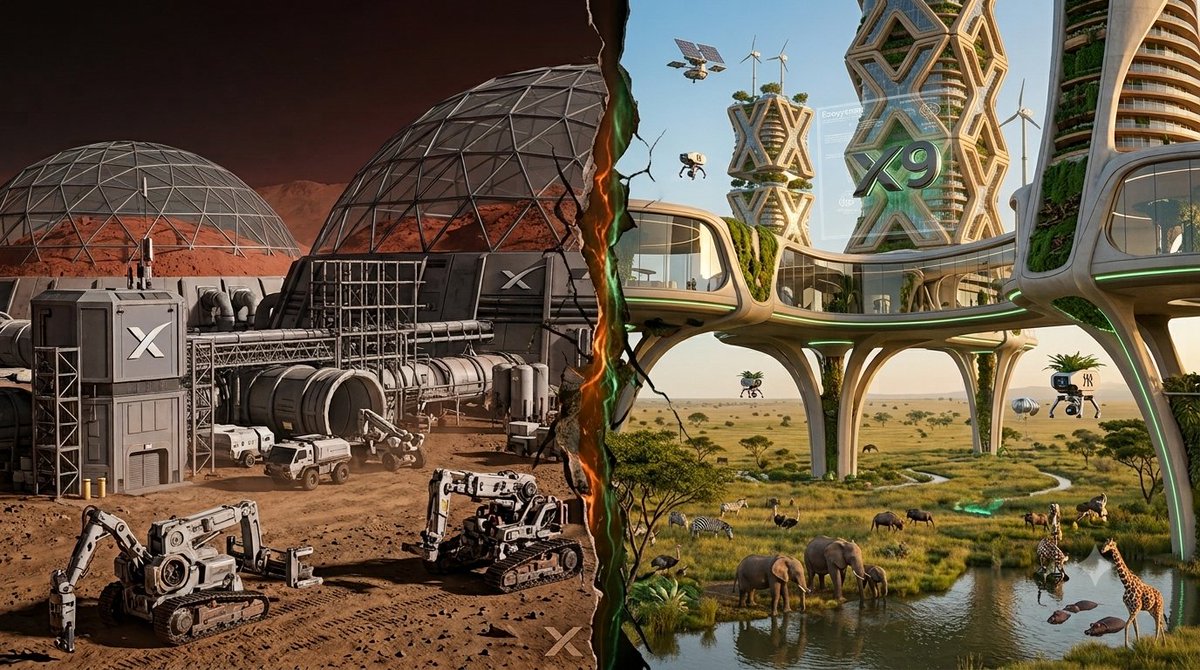
I prefer Earth 🌎
We can fit all of humanity in Brazil and still have space. I’m not buying the overpopulation theory.
Build with nature as a spectacle, integrate with it, and lift the “limitations” agenda.
Earth is not done, so we need to find new spaces to destroy?
Make our original project work first before going for new horizons.
@tobi Generating code has been solved. Owning system design and operational risk hasn't.
Tools change, but the contract between the developer and production remains the exact same.
Merchant:
“Make me a banner for the new collection.”
Boushops:
“Sure.”
2 seconds later:
Done.
This isn't AI making a banner.
The store just did what I asked it to do.
@elonmusk Grok 4.7 double-downed on self-verification.
Self-verification reduces internal logic errors, but models verifying their own work is still an internal loop.
Internal verification improves outputs.
Independent evaluation secures production systems.
@DeItaone You can't really grade your own homework at frontier scale.
Cross-testing models is where the interesting edge cases start showing up.
The next layer of the AI stack isn't just evaluation.
It's independent evaluation.
@PolymarketMoney Automating the training loop is one thing.
Now make everything around it keep up.
Data quality, evaluation, infrastructure, compute - the bottleneck doesn't disappear. It just moves.
Automate research, and the hard engineering moves upstream.
@Alek_Mitch@lord_savages@elonmusk I use AI to express ideas faster - my ideas, wrapped in text you can understand.
It doesn't decide what I believe.
Focus on the argument, not the tool used to write it.
Urban ecology is a systems engineering problem.
@GergelyOrosz Devs build on macOS because of the DX.
Agents don't run on developer laptops.
The age of agents may belong to Linux because headless environments, containers and GPU scheduling don't care about a nice UI.
If inference really drops by 400x, it doesn't just change the monetization model.
It resets the architecture.
You stop treating model calls like expensive DB queries and start treating intelligence as a continuous background layer.
The bigger shift isn't free AI apps.
It's always-on systems that can continuously evaluate state and act on it.
@marclou The real SaaS milestone isn't MRR.
It's becoming infrastructure.
When a product becomes part of the core workflow, cancelling it stops being a subscription decision and becomes an operational problem.
@Robert15629278@elonmusk Exactly.
Biology is just advanced engineering we haven't fully understood yet.
The goal isn't replacing technology with nature.
It's converging them.
@KubaS80394@elonmusk Living in a forest is escaping the problem.
The point is to engineer high-tech infrastructure that doesn't require us to destroy the ecosystems around it.
I build systems. I don't abandon them.
That's exactly why I separate wild nature from engineered nature.
Lions and tigers belong in wild ecosystems. Pigeons, birds, and smaller species already live alongside us — usually under terrible conditions.
The goal isn't to bring the jungle into the city. It's to engineer urban spaces so the species that can coexist with us actually thrive.
Not every animal belongs in the city.
But concrete doesn't have to be the default.