The first global, city-scale 3D map is taking shape, and it’s machine-readable.
City-scale environments can now be reconstructed in high-fidelity, reaching a level of detail that is becoming almost indistinguishable from reality.
This leap is made possible by large-scale mapping using just an Insta360 X5 and Over the Reality technology.
So far, our dataset includes:
- 220,000+ 3D mapped locations
- 97M images
- 1,000TB of spatial data
Growing by more than 10,000+ newly mapped locations every week.
Enabling Visual AI, Robotics, VPS, XR, and Digital twins.
You're right, but you missed the fourth thing: the people getting laid off will start their own companies with the severance and AI tools that make them 10x leaner. The market isn't just downsizing—it's redistributing talent from slow incumbents to fast attackers. The finger-pointing will happen while the next wave builds.
Here is a demo video showing the ribbon control and graph navigator control I've coded for Python Tkinter (that integrate with TTK Bootstrap).
I'll post a link to the Pypi page and SourceForge page in the comments below. (The code is open source.)
Don't let the haters tell you it isn't possible to write attractive modern desktop applications with Python and Tkinter!
#python #tkinter #vibecoding
I've been working on some custom controls (widgets) for Tkinter that integrate with TTK Bootstrap. (TTK Bootstrap is a themeing library for modern Tkinter applications.) Here is a video demonstrating my Kanban Board Control for TKinter.
The code for this control is open source and available on both SourceForge and Pypi. I'll put the link in the comments.
#Pythonm #tkinter #Vibecoding
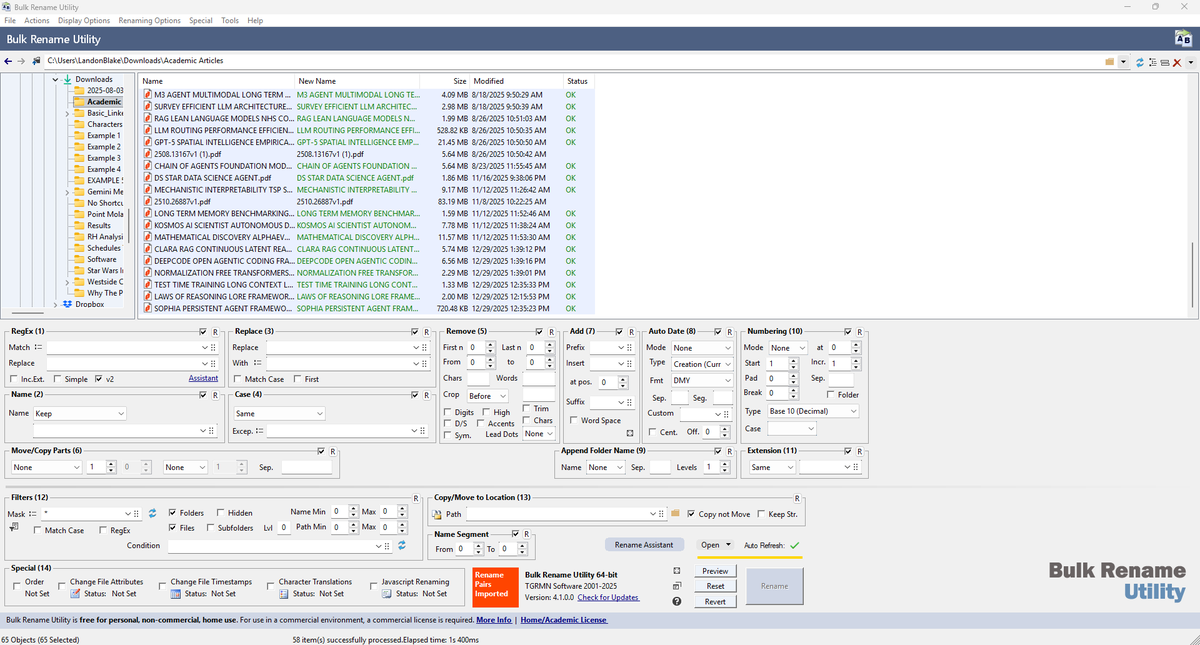
I just did something really cool:
1) Uploaded a folder with a 65 PDF files to Google Drive.
2) Asked the Google Drive chatbot to create a list of new file names based on the contents of the PDF and a file naming standard.
3) Downloaded that list and converted it to a CSV file.
4) Imported the list into the Bulk Rename Utility and renamed the files!!!
Now I'm going to get three paragraph summaries of each PDF to add to my second brain in Obsidian!
LLMs are so freaking awesome!!!!!!!!!!!!!!!!!!!!!!!!!!!!!
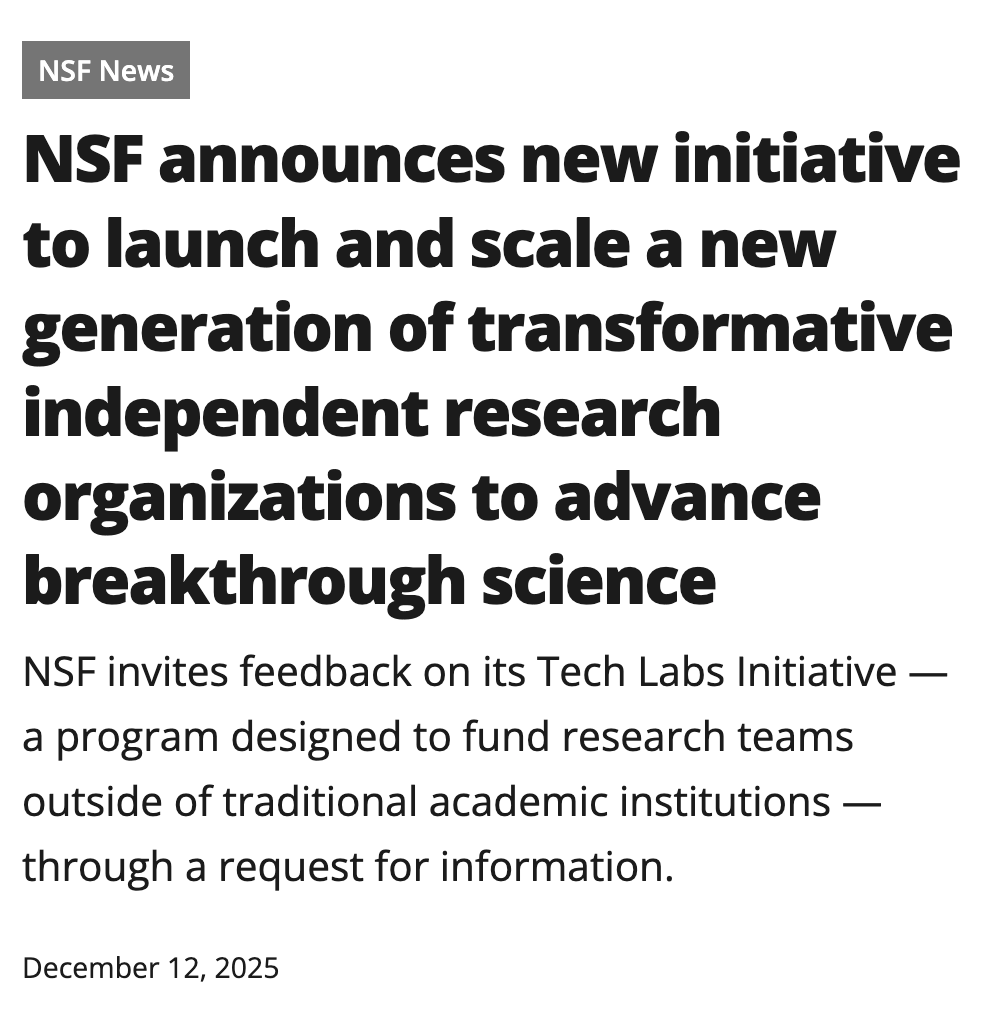
NSF is launching one of the most ambitious experiments in federal science funding in 75 years.
The program is called Tech Labs, and the goal is to invest ~$1 billion to seed new institutions of science and technology for the 21st century.
Instead of funding projects, the NSF will fund teams. I’m in the @WSJ today with a piece on why this matters (gift link): https://t.co/xteQ3NgWVC
Here’s the basic case:
1) Most federal science funding takes the form of small, incremental, project-based grants to individual scientists at universities.
2) The typical NSF grant is ~$250k/year to a professor with a couple of grad students and modest equipment over a few years. This is a perfectly reasonable way to fund some science, but it's not the only way.
3) A healthy portfolio needs more than one instrument. Project-based grants are like bonds: low-risk, steady, safe. But no one trying to maximize long-run returns would put 70% of their portfolio in bonds.
4) Yet that's basically what our civilian science funding portfolio looks like. Around 3/4ths of NSF and NIH grant funding is project-based.
5) Tech Labs is NSF's attempt to diversify that portfolio. The Tech Labs program is aiming for:
- $10-50 million/year awards per team
- 5+ year commitments
- Measuring impact through advancement up the Tech Readiness Level scale rather than papers published
- Up to ~$1 billion for the program
- Supporting research orgs outside traditional university structures
6) Scientific production looks very different than it did when the NSF launched 75 years ago. The lone genius at the chalkboard can only do so much. Frontier science + tech today is increasingly team-based, interdisciplinary, and infrastructure-intensive.
7) The team behind AlphaFold just won the Nobel Prize in Chemistry. It came from DeepMind, an AI lab with sustained institutional funding and full-time research teams. It would be near-impossible to fund this kind of work on a 3-year academic grant.
8) Same pattern at the @arcinstitute (8-year appointments, cross-cutting technical support teams) and @HHMIJanelia (massive infrastructure investments to map the complete fly brain). Ambitious science increasingly needs core institutional support, not a series of project grants stapled together.
9) Similarly, Focused Research Organizations (@Convergent_FROs) have showcased a new model supporting teams with concrete missions and predefined milestones to unlock new funding.
10) There’s a whole ecosystem of philanthropically-supported centers doing amazing research, like the Institute for Protein Design, the Allen Institute, the Flatiron Institute, the Whitehead Institute, the Wyss Institute, the Broad — the list goes on.
11) But philanthropy can’t reshape American science alone. The federal government spends close to $200 billion each year on research and development, an order of magnitude more than even the largest foundations.
12) If we want to change how science gets done at scale, federal funding has to evolve. And the NSF and NIH don’t have dedicated funding mechanisms to support or seed these sorts of organizations.
13) Earlier this year, I started working on a related framework called “X-Labs” that built on all this exciting institutional experimentation that’s been happening within the private and philanthropic sectors. It’s time for the federal government to step into the arena: https://t.co/0iVLobqQeA
14) Traditional university grants are still important for training the next generation of scientists and for certain kinds of curiosity-driven work. But after 75 years of putting nearly everything into one model, we should try something different.
15) And key program details are still being developed! You can reply to the Request for Information with suggestions or feedback on how to design this program here: https://t.co/R6MNo0ZfN1
16) Science is supposed to be about experimentation. Science funding should be too.
Here is a link to the podcast episode on YouTube:
https://t.co/EPQz0Du5Eb
Here is a link to the podcast episode on Buzzsprout:
https://t.co/EPQz0Du5Eb
Here is the podcast home page on the web:
https://t.co/5bTqwMBRZY
A nationwide civil engineering firm once asked me to run a $500,000 line of credit... to a client they wouldn't identify.
Here's what they wanted: 4 months of work, 3 months for them to bill it, then 6 months after THEY got paid (maybe). That's a YEAR of float on half a million dollars — for a mystery client in the renewable energy sector. When I asked who the client was, they said "that's confidential."
Imagine walking into a bank asking for $500k with a co-signer whose identity is a secret. You'd get laughed out of the building. But civil engineers think this is normal payment terms for surveyors.
This is one reason why civil engineers can (and often do) make horrible clients for land surveying companies. You can learn more on Episode of the "Putting Your Business - On The Map Podcast": "Why Civil Engineers Make Horrible Clients". I'll put the link to the podcast episode in the comments section below.
What are the most ridiculous payment terms you've been asked to accept as a professional consultant?
Here is the link to Episode 41 on YouTube:
https://t.co/ICpNUz5m3y
Here is the link to Episode 41 on Buzzsprout:
https://t.co/7Uq5Tt4Mvp
Here is the podcast home page on the web:
https://t.co/5bTqwMBRZY
The "Sibling Profession" Problem
Your worst clients are often the ones who think they almost understand what you do.
I call this the "sibling profession" problem. It happens when potential clients work adjacent to your expertise — close enough that they think they GET IT, but far enough away that they actually don't.
The result? They undervalue your work. They second-guess your methodology. They try to drive down your consulting fees because "it's just math" or "it can't be that complicated."
Here's what makes this so insidious: it's usually not malicious. These are often good people responding to incentives. They've been around your field long enough to be dangerous — they know the vocabulary, they've seen the outputs, but they don't understand the nuance, the judgment calls, the expertise that separates competent work from excellent work.
The fix? Learn to recognize this pattern early. When a person in a related profession says: "I need a price per acre" or "You are overcomplicating things - it is just a survey" that is a warning.
Want the full breakdown? I dive into why this happens and how to protect your business in Episode 41 of the "Putting Your Business - On The Map" Podcast. I'll post the link to the episode below.
Here is a link to the podcast episode on YouTube:
https://t.co/fYwibc7TN0
Here is a link to the podcast episode on Buzzsprout:
https://t.co/vyTYsf6xQD
Here is the podcast home page on the web:
https://t.co/5bTqwMBRZY