Inference Optimizations Behind the MiMo-V2.5 Series API Price Reductions
Read the full technical blog: https://t.co/B5tp4tdnim
The V2.5 model family, including MiMo-V2.5 and MiMo-V2.5-Pro, is built on a Hybrid Sliding Window Attention (Hybrid SWA) architecture, which compresses KVCache storage to roughly 1/7 that of Full Attention. However, architectural advantages rarely translate directly into measurable gains in production serving. To realize these gains, we redesigned KVCache management, tiered caching, and the prefix-cache tree; addressed key challenges in SWA KVCache handling; and optimized scheduling as well as the Prefill/Decode pipeline.
Validated on real production traffic, these optimizations have increased effective KVCache capacity by nearly 5x, with server-side cache hit rates averaging 93%–95% across mainstream harness frameworks. Together with MoE configuration tuning and multimodal inference optimizations, they enable more efficient long-context inference and form part of what makes the recent API price cuts possible.
Windows users, this one’s for you.
Computer use now works on Windows, so Codex can take action on your Windows computer.
And with Windows support for Codex in the ChatGPT mobile app, you can start, review, and steer tasks on the go while work continues on your Windows machine.
An early experience, but we’re working on more ways to keep your work moving, wherever you are.
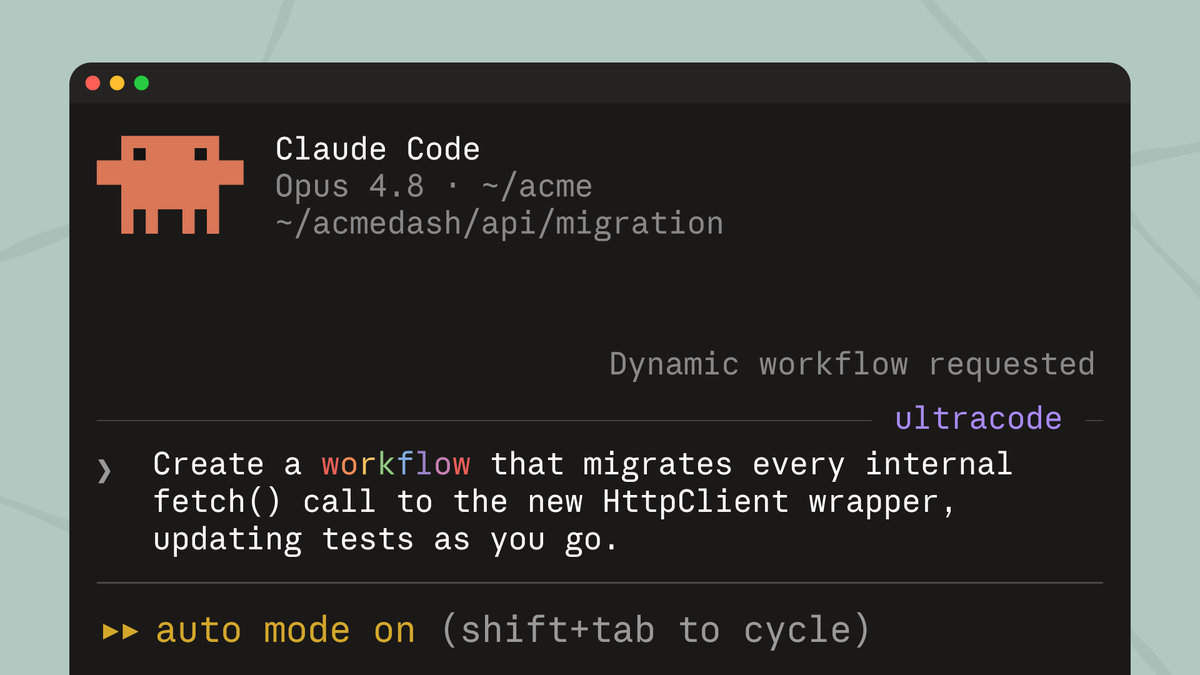
New in Claude Code (research preview): dynamic workflows.
Claude writes an orchestration script on the fly, then spins up a large fleet of coordinated subagents in parallel to take on your most complex tasks.
Use the word "workflow" in a prompt to get started.
Behind the MiMo API Price Reduction:
The deepest price cut, up to 99%, is for Input (Cache Hit). The core reason is our inference framework now supports hierarchical KV cache optimization for SWA. Production inference engine tests show this optimization increases cached token capacity by 5x, equivalent to an 80% reduction in caching costs. Combined with Cache Read Overlap among multiple Full Attention modules in the Hybrid model, actual costs are further reduced.
Prices for Input (Cache Miss) and Output are also reduced by 60%-80%. This mainly benefits from the extreme 1:7 Full:SWA sparsity ratio brought by the model architecture (the prefill compute of the 70-layer MiMo-V2.5-Pro roughly equals a 10-layer GQA model). This kept our original inference costs well below the industry average, naturally leaving a 2x-3x profit margin in pricing. This price adjustment simply reflects our decision to pass these structural cost efficiencies directly to developers.
Operating at these newly reduced API prices, our production inference engine is running at near full capacity, and we can still essentially break even. We previously advised LLM companies not to "blindly cut prices" precisely because very few model architectures and inference optimizations can keep API costs from running at a loss. If more architectures that save compute and KV cache emerge, along with better inference Infra to drive down API costs, this will form an excellent virtuous cycle in the industry.
More crucially, affordable, high-performance model APIs will drive real, sustained, and at-scale inference demand. This upstream demand pulls forward the development of the entire AI infrastructure chain—including chips, servers, optical transceivers, PCBs, liquid cooling, power, energy storage, and data centers—serving as a strategic fulcrum for a systemic revaluation of AI hardware. In the long run, this injects more affordable and accessible compute into both training and inference pipelines, accelerating the parallel evolution of global AGI across multiple regions and technical routes.
For more technical details, we will release a detailed Blog post later.