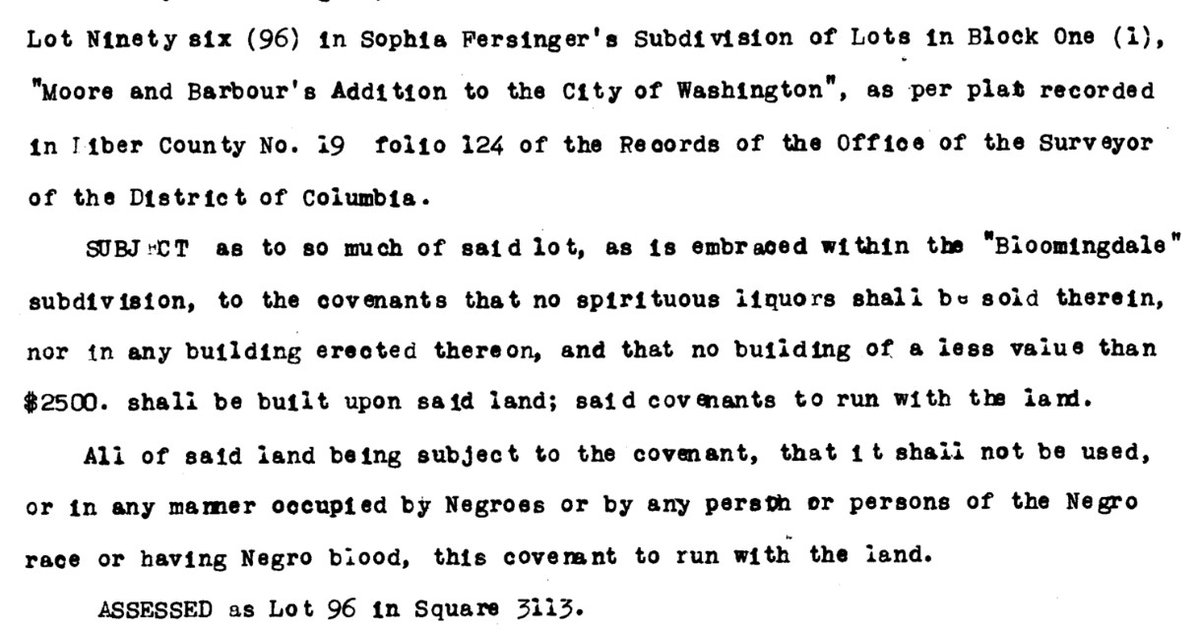
For years we've pressed the city to digitize the land records needed to complete our map of racial covenants in DC. For now, we need your help mapping the racially restrictive covenants that once covered much of the city. Learn how here! https://t.co/1d5QIDLiIH
Join us tonight to learn about Mapping Segregation in WDC and how you can help us complete our map of racial covenants that once covered half the city. Sign up here! https://t.co/BjAcPwiwWv @MapPrejudice
@bloomingdame To be clear, I only spot checked the lots that are fully inside the Addition to LeDroit Park subdivision, figured they'd more likely show up in the Bloomindale subdivision, shown in green.
@bloomingdame Got sucked into this question re the 100 block of Rhode Island Ave NW. It was the border of 3 subdivisions in which covenants were used elsewhere. Only one shows up in the Recorder of Deeds database, for 115 RI Ave (doesn't mean there weren't more).
@CMFrumin In the 1972 case Myers v. Ridley, the District Court ordered deeds w/ racial covenants furnished by the Recorder of Deeds to be stamped with a warning that such covenants were no longer enforceable. Enforcing this would require ID'ing all the deeds that had such covenants.
We're celebrating 20 years of Organizing Community Power! Check out our video recap with some highlights of the last two decades of people power - see anyone you know? # Organize https://t.co/Ft8Sdj1L1x
The racial & economic segregation baked into DC's development has led DC's blackest wards to be the ones most vulnerable to flooding. Thank you @holaculturadc for making use of our work at https://t.co/vPovwBcYYb to provide such deep context for your reporting.
Uncover the untold story of persistent flooding in D.C. neighborhoods. From ruined basements to rising costs, residents like Elizabeth Hall have endured the devastating impact of unpredictable floods.
🔗: https://t.co/CVIZevfD8l
Thanks also to the work of @tanyaboza, @Christy_E_Lopez and @jg_bollard for informing this essay. Also see the testimony of Black Broad Branch descendants from the reparations hearing in May - https://t.co/GgD6HhQ7FC - and read about their work via https://t.co/viwDXmd4qN.
This piece grounds the case for reparations in specific historical harms to Black Washingtonians, esp. the taking of land & other exploitative real estate practices. And it calls for reparative justice by holding accountable those who have benefited. https://t.co/KXNj2nghFH
Per @DCFPI & @iteptweets, DC has .2% of the U.S. population but .5% of the nation’s extreme wealth (net worth over $30 million). 0.4% of DC tax filers (roughly 1,500 households) have net worth over $30 million, holding 46% of all DC's wealth.
4) primarily serves the interests of wealthier, white residents at the expense of Black and other residents of color who are unhoused or have lower incomes.
Nice to see the Council Office of Racial Equity (@dcracialequity) cite this co-written article by Susanna Schaller, @Anarchopology, @ecoylogy, & Sarah Shoenfeld from a recent issue of Urban Studies on private urban governance. https://t.co/fdN5RK223f (1/4)
2) does not offer Black residents and other residents of color equal opportunities to represent their interests, 3) has broad authority to exercise power over communities with little accountability to everyone impacted (3/4)