Something interesting changes today. 🐇
Alchemy makes its new EIP-7702 smart
account implementation the default.
More importantly:
Alchemy now supports ERC-20 gas payments on Robinhood Mainnet.
ETH remains the native gas token, but users can pay transaction costs with a configured ERC-20 while the paymaster handles the ETH underneath.
So maybe we’ve been asking the wrong question about $WALLET.
What if $WALLET was never meant to replace ETH as gas?
What if it belongs to the wallet layer instead?
User pays in $WALLET → account abstraction handles the ETH gas behind the scenes.
And remember: aa33 was already using Alchemy’s EIP-7702 architecture on Robinhood Chain before launching $WALLET.
No evidence yet that $WALLET is enabled for ERC-20 gas payments.
But the infrastructure is now there.
And aa33 was early. Very early. 🐇
$WALLET #RobinhoodChain #EIP7702 #ERC4337
Just a heads up, this isn’t a normal wallet buy.
0x8e3435...1c67 is an ERC 4337 bundler, and the transaction is a Handle Ops call. That means the address is processing one or more UserOperations on behalf of smart wallets.
So the $72k shouldn’t automatically be attributed to this address as the buyer. The actual buyer is the smart account inside the UserOperation.
Still interesting, but it needs to be decoded one layer deeper before calling it a $72k whale buy.
@nguyen_cake Could be. That’s exactly why I’m digging into it. I’m not claiming $WALLET is officially connected to Robinhood. I’m tracing the on chain activity, pre launch transactions and public Robinhood docs. If you’ve found evidence it’s a scam, post it. I genuinely want to see it.
Robinhood docs point beyond gas: programmable wallets, ERC-4337 + gas sponsorship.
aa33 tested Alchemy/EIP-7702 pre-launch.
What if $WALLET belongs to the wallet layer itself? 🐇
#WALLET#RobinhoodChain#ERC4337#EIP7702
That’s a fair distinction.
What I’ve verified so far is real onchain settlement activity through the RobinHoodSettler path. What I have NOT verified yet is two independent external payers completing the flow.
So I wouldn’t claim that receipt exists unless we can point to the actual txs.
If you have the two settlement hashes you’re referring to, send them over. That would be a much stronger piece of evidence than a UI demo.
🚨 I think we’re getting much closer to understanding what the $WALLET deployer "aa33" actually was.
And it does NOT look like a normal trader.
The activity looks much more like a wallet integration / QA account used to test Robinhood Chain before the public got access.
Here’s the timeline:
→ "aa33" receives 0.15 ETH from "F718"
That matters because F718 also funded the privileged address that deployed Robinhood Chain’s core infrastructure.
→ After receiving that gas, "aa33" becomes active on Robinhood Chain before public mainnet
Around 70 successful operations take place during the closed period.
→ The account uses EIP 7702 / smart account infrastructure
This is the same type of programmable wallet architecture Robinhood Chain uses for things like batching, gas sponsorship and wallet execution.
→ "aa33" also has earlier history around Stock Token related testing
→ Then on July 8, after mainnet opens, "aa33" executes a production style transaction through RobinHoodSettler, including Robinhood’s fee routing.
→ Just TWO DAYS later, on July 10, the same account deploys:
Robinhood Wallet ($WALLET)
That changes the question completely.
This no longer looks like:
“Someone found Robinhood Chain and launched a meme.”
It looks more like:
A pre provisioned technical account tested Robinhood wallet and execution infrastructure for weeks, then used that same account to deploy $WALLET.
We still cannot prove whether "aa33" was controlled by Robinhood, Alchemy, a contractor or another integration partner.
But the most logical role for "aa33" now looks increasingly like:
Wallet integration / QA / operations.
And that raises one very obvious question:
Why would an account used around Robinhood Wallet testing deploy a token called “Robinhood Wallet” just two days after testing Robinhood’s live settlement path?
Test token?
Prototype?
Soft launch?
Something intended for later?
We still don’t know.
But “random memecoin” is becoming an increasingly difficult explanation.
$WALLET 🐇
CA: "0x0339f5459FC690aC85F1782e15782A151b4A9E1b"
#WALLET #Robinhood #RobinhoodChain #OnChain #Crypto
Of course I use AI, both for translation, structuring data, and presenting it in a more understandable way.
Sorry if you don’t like that, but I’m just a guy here in Norway who’s gone way too far down the $WALLET rabbit hole 😅
Using AI to organize and explain the research doesn’t change the underlying onchain findings or the data behind them.
@ai_ficial Mine has to be:
“The wallet itself is well-integrated into Robinhood Chain. So, the chain is a first-class citizen.”
That one keeps getting more interesting 👀🐇
The more I look at $WALLET, the more interesting Vlad Tenev’s own comments become.
Vlad has repeatedly made it clear that Robinhood Chain is not meant to be just a boring RWA rail.
He literally said:
“While we’re building Robinhood Chain to be the best chain for RWA … it works great for memes too.”
Then on Sept 1, when someone suggested bringing more memecoins to Robinhood, Vlad responded with 👂. No announcement, no confirmation, but clearly not a rejection either.
At the same time, Vlad has been increasingly bullish on tokenization itself. In September he said Robinhood Chain had surprised them with its growth and that tokenization had become much bigger than they initially anticipated. He has also described Robinhood’s broader mission in one word: ownership.
None of this proves that $WALLET is Robinhood’s token.
But it does matter when evaluating the thesis.
Robinhood is actively building an onchain ecosystem. Vlad openly embraces both tokenization and meme activity on the Chain. Robinhood is comfortable experimenting with products onchain.
And $WALLET appeared inside that ecosystem with one of the strangest provenance trails I’ve seen.
If $WALLET really was a stealth experiment, Vlad’s public comments are certainly not inconsistent with that idea.
Still waiting for the one thing that would change everything:
A direct product level connection between Robinhood and contract
0x0339…9e1b.
Until then, it remains speculation.
But the pieces are getting more interesting. 👀
#WALLET #Robinhood #RobinhoodChain #HOOD #Crypto #Onchain #Tokenization
Fair question, but I don’t think that’s proven yet.
Robinhood Chain can officially block transactions, yes. What I haven’t seen is proof that "aa33" itself is actually on that blocklist.
If you have a failed tx hash or technical evidence showing the chain level filter rejecting "aa33", send it over. That would be very interesting.
There are now three serious theories that fit the evidence:
1️⃣ The lore is broadly correct
$WALLET was deliberately deployed by someone inside, or extremely close to, the Robinhood ecosystem, with a purpose that has simply not been revealed yet.
My subjective weight: ~45%
If this eventually leads to official recognition, utility or integration, I think a $500M to $1.5B+ market cap becomes realistic as a narrative driven scenario.
If $WALLET were ever positioned as a meaningful native asset within the Robinhood ecosystem, even higher valuations would become possible, but that would require substantially more than the evidence we have today.
2️⃣ $WALLET was a Robinhood related test or prototype
"aa33" may have been a dev, QA or operations wallet used around Robinhood Wallet, Stock Tokens or Robinhood Chain infrastructure, and $WALLET began as an internal experiment rather than a planned public product.
My subjective weight: ~35%
If the Robinhood connection becomes clearer but the token itself never gets official utility, I’d see a $100M to $400M market cap as a possible speculation driven scenario.
3️⃣ An external contractor or early ecosystem developer
Someone with privileged early access to Robinhood infrastructure deployed $WALLET independently.
This remains possible because Robinhood Chain is permissionless.
My subjective weight: ~20%
In that scenario, without official Robinhood involvement, I’d put the narrative value range lower at roughly a $70M to $100M market cap.
But after everything uncovered around "aa33", the idea that $WALLET was simply a random Robinhood themed memecoin launched by an unrelated outsider now looks extremely unlikely.
Look at the trail:
→ historical links into wallets used around Robinhood development
→ direct relationship with "f1a726"
→ funding on Robinhood Chain at block 1009, before public mainnet
→ connection to the early "F718" provisioning network
→ activity around an address later used in Robinhood’s Stock Token demo
→ Stock Token and ERC 8056 related testing before $WALLET
→ eventually deploys "Robinhood Wallet ($WALLET)"
→ effectively the entire supply goes into liquidity
→ no obvious creator allocation
Any one of these could be coincidence.
All of them converging on the same deployer is not what a random meme launch normally looks like.
But based on the evidence we now have, the random memecoin explanation is becoming increasingly difficult to defend.
The real question is now which of the three remaining explanations is correct:
Intentional project. Internal experiment. Or someone operating extremely close to Robinhood’s technical environment.
$WALLET 🐇
CA: "0x0339f5459FC690aC85F1782e15782A151b4A9E1b"
#WALLET #Robinhood #RobinhoodChain #OnChain #Crypto #DeFi
🚨 The deeper I dig into the $WALLET deployer "aa33", the harder it is to explain it as a random retail wallet.
A few technical facts:
→ "aa33" was funded on Robinhood Chain at block 1009, weeks before public mainnet
→ funding came from "F718", an address tied to early provisioning activity
→ "aa33" had already interacted with an address later used in Robinhood’s stock-token demo
→ it deployed a Test Stock Token / ERC-8056-related contract on Base before $WALLET existed
→ "aa33" is directly connected to "f1a726", which has historic funding links to wallets used in publicly visible Robinhood development work
→ the $WALLET launch itself used effectively the full supply for liquidity, with no obvious creator allocation
So the interesting question is no longer:
“Did some random person launch a Robinhood-themed memecoin?”
It’s:
Why did a wallet with years of Robinhood-adjacent dev, stock-token and pre-mainnet history end up deploying $WALLET?
This still does NOT prove Robinhood officially created $WALLET.
But technically, the deployer history is becoming increasingly difficult to dismiss as coincidence.
$WALLET
CA: "0x0339f5459FC690aC85F1782e15782A151b4A9E1b"
#WALLET #Robinhood #RobinhoodChain #OnChain #Crypto
🚨 I think the most interesting $WALLET clue is being overlooked.
Forget the obvious “Robinhood employee funded a connected wallet” angle for a second.
The deeper clue is wallet provenance — years before $WALLET existed.
In Nov 2022, a wallet address — "0x1fB4…4f0A" — appeared publicly inside development work posted by "joshuajiangdev".
That same address later funded "f1a726".
Then "f1a726" developed a repeated, direct multichain relationship with "aa33":
"0x542718…aa33"
The wallet that eventually deployed $WALLET.
Now add the strange part:
→ aa33 later acquired the onchain name "jj.staketr.hi"
→ aa33 interacted with Robinhood-related stock-token infrastructure
→ aa33 was active on Robinhood Chain before public mainnet
→ aa33 was funded there through the early F718 network
→ aa33 eventually launched $WALLET with effectively the full supply entering liquidity, no creator allocation and restrictive LP custody
So this isn’t just:
“a Robinhood employee once sent funds somewhere.”
The trail appears to go back years, through wallets connected to Robinhood development activity, before Robinhood Chain — and long before $WALLET — even existed.
That does NOT prove Robinhood created $WALLET.
But if this is all coincidence, it is becoming a very specific coincidence.
The question I’m now asking is:
Who actually controlled aa33 — and why does its history keep converging on Robinhood?
$WALLET 🐇
CA: 0x0339f5459FC690aC85F1782e15782A151b4A9E1b
#WALLET #Robinhood #RobinhoodChain #OnChain #Crypto #DeFi
@Hank69Moody I’d really like to hear your take on this.
Do you see the crash as a whale driven liquidity cascade, or have you found any evidence linking the biggest sellers back to aa33, F718 or the wider deployer cluster?
Also curious whether you have traced where the largest sellers originally acquired their $WALLET. That feels like the most important remaining piece of the puzzle.
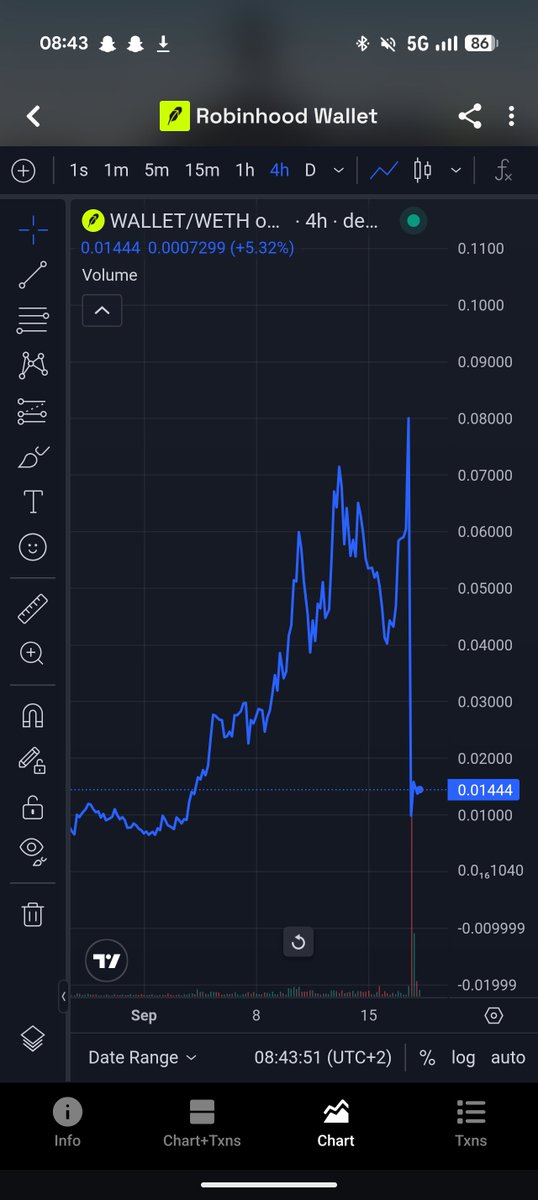
$WALLET after the crash
799 wallets reportedly sold roughly 238.6M $WALLET in just 75 minutes, nearly 24% of the total supply.
So far, I haven’t seen evidence linking the major sellers to aa33, F718 or the known deployer cluster. That looks more like mass panic and liquidation than a classic insider rug.
What I find even more interesting is what survived.
Despite crashing from roughly $0.09 to $0.0032, the main Uniswap pool still holds around $1.6M in liquidity, including roughly 247 WETH, with about $21M in 24h volume and 9.4K holders.
That doesn’t prove the Robinhood lore.
But if this was a classic liquidity rug, I would expect the liquidity to disappear with the price. It didn’t.
The market got absolutely destroyed, yet the pool, liquidity and trading activity survived.
To me, that means there is still a case worth investigating.
The key question now is:
Who were the biggest sellers, and where did their $WALLET originally come from?
Follow the money. 👀
#WALLET #Robinhood #RobinhoodChain #RobinhoodWallet #Onchain #DeFi #Crypto #RWA
I dug deeper into the $WALLET crash, and the data looks very different from a classic rug.
During the 75 minute collapse, 799 wallets reportedly sold around 238.6M WALLET, almost 24% of the supply.
The top 100 sellers accounted for roughly 190M, and 16 of the top 30 sellers were contracts, suggesting bots, smart accounts, vaults and professional trading infrastructure were heavily involved.
More importantly, several major sellers bought back after the crash.
One wallet sold around 20.7M WALLET and later bought back about 4.2M.
Another sold 4.88M and bought back 3.47M.
A third sold 7M and bought back 1M shortly after.
So far, I have found no documented connection between the major crash sellers and aa33, F718 or the known deployer cluster.
The liquidity story is also important.
Despite the move from roughly $0.09 to $0.0032, the pools continued functioning, significant liquidity remained, and trading activity stayed extremely high.
That does not look like the simple pattern of:
Dev dumps
Liquidity disappears
Token dies
It looks much more like a massive whale and panic liquidity cascade through concentrated Uniswap liquidity.
None of this proves the Robinhood thesis.
But the crash itself has not exposed $WALLET as a simple rug either.
The biggest unanswered question now is still:
Where did the largest sellers originally acquire their WALLET?
That is the trail worth following. 👀
#WALLET #Robinhood #RobinhoodChain #RobinhoodWallet #Onchain #DeFi #Crypto
WALLET: where the thesis stands today 👀
Price is back around $0.058 after bouncing hard from ~$0.040. Technically, the structure is recovering, but what makes $WALLET interesting to me has never been the chart alone. It’s the lore behind the deployer.
The strongest part of the thesis is aa33, the wallet that deployed $WALLET.
Community research, including work originally uncovered by @Hank69Moody, has built a surprisingly deep onchain trail.
aa33 funded the wallet later used in Robinhood’s public OpenAI Stock Token demo before that demo wallet became public.
aa33 was active on Robinhood Chain before public mainnet, receiving funding at block 1009 from F718, a wallet connected onchain to Robinhood Chain’s early infrastructure and launch cohort.
aa33 tested ERC8056 stock token technology before mainnet.
Just two days before launching $WALLET, aa33 used production Robinhood and https://t.co/FwMe3cYKk4 execution infrastructure.
Then, on July 10, aa33 launched Robinhood Wallet ($WALLET) through NOXA.
The launch itself is unusual. Essentially the full 1B supply went into liquidity, with zero initial creator token allocation.
None of this proves that $WALLET is an official Robinhood token. That distinction matters.
Robinhood Chain is permissionless. Anyone can deploy a token. Robinhood still documents ETH as the native gas token, and Robinhood has never publicly connected the exact $WALLET contract to the company.
That leaves me with three possibilities:
1️⃣ $WALLET is an unofficial project created by someone very close to the Robinhood ecosystem.
2️⃣ $WALLET was a live production experiment or test, potentially testing liquidity, swaps, Wallet infrastructure and user behaviour before something else launches.
3️⃣ The full lore is right. This was a deliberate stealth and fair launch before eventual utility or official recognition.
Number 3 is obviously the explosive scenario, but I think 1 and 2 have to be taken seriously.
And that brings us to HOOD Summit on September 29.
Robinhood says Vlad Tenev will unveil its newest products and updates there.
If $WALLET really is part of a larger Robinhood strategy, one question still bothers me:
Why stealth launch it in July instead of officially launching it at Summit?
Maybe there is a structural reason. Maybe fair distribution was intentional. Maybe $WALLET was simply a test. Or maybe the community is connecting dots that were never intended to connect.
What if $WALLET was the test, not the product?
That’s what makes this fascinating.
I’ve been in since around $3M MC and remain bullish on $WALLET, but I think challenging the thesis is just as important as building it.
Between now and September 29, I’m watching for one thing above everything else:
An official product level connection between Robinhood and the exact $WALLET contract.
That would change the thesis completely.
Until then, we have strong provenance, fascinating lore and real onchain connections, but still no official confirmation.
$WALLET 👀
#WALLET #Robinhood #RobinhoodChain #RobinhoodWallet #HOOD #Crypto #DeFi #Onchain #RWA #Tokenization #StockTokens #Arbitrum
That actually fits the Robinhood philosophy pretty well — a fair launch where the people willing to dig deep get the opportunity early.
I’ve been in since around $3M MC, I’m very bullish on $WALLET and I believe in the lore. But I’m genuinely curious if there could also be a technical or structural reason for launching it this way?
I think it’s important to challenge the thesis too, especially with HOOD Summit coming up on Sept 29. The stronger the thesis survives the skeptical questions, the stronger the case becomes.
Serious question for the $WALLET thesis:
If this really is connected to Robinhood, why launch it quietly through NOXA months before HOOD Summit?
What does Robinhood gain from a stealth/fair launch instead of officially launching it on stage?
Test? Distribution? Regulatory reasons? Something else?
Genuinely curious. #WALLET #RobinhoodChain
$wallet