A mathematician noticed that the scientists at Bell Labs who shut their office door to focus got more done that week, and the ones who left it open and got interrupted all day won Nobel Prizes. He spent 30 years figuring out why the interruptions were the reason.
His name was Richard Hamming, and he had earned the right to notice things like this.
He won the Turing Award. He invented the codes that let every computer on earth catch and fix its own errors.
And for 30 years he ate lunch in the same Bell Labs cafeteria, watching which of his brilliant colleagues became legends and which ones quietly disappeared.
Near the end of his life he put everything he saw into one book. It's called The Art of Doing Science and Engineering.
The open door thing is the part everyone quotes, but almost nobody sits with what it actually means.
The closed-door scientists were not lazy. They were disciplined. They protected their time. And over a single afternoon, they won. No interruptions, more output. But stretch that out over 30 years and something strange happened. The open-door people pulled miles ahead.
Every idea drifting down the hallway walked through their open door. Every problem someone else was stuck on landed on their desk.
Ten years in, they were working on questions the closed-door people didn't even know existed yet. The interruptions weren't stealing their focus. They were feeding it.
That's the whole book in one image. The thing that looks like a cost is often the investment.
He does the same move again and again. When Bell Labs refused to give him the team of programmers he asked for, he didn't sulk and he didn't quit.
He sat with the rejection for weeks. Then he turned it inside out and asked why the machines couldn't just write the programs themselves. That single flipped question pushed him straight to the frontier of computer science. The wall became the door.
Then there's the part that hurts to read.
Hamming said most scientists spend their whole careers dodging the biggest problem in their field. Not because they can't see it. They see it fine.
They avoid it because the odds of failing are high, and failing on a big problem is embarrassing. So they pick a safe problem sitting right next to it, solve it cleanly, publish, and move on.
And because they never once swing at the hard one, they never hit it. If you do not work on important problems, you will not do important work. He said it flatly, like it was arithmetic, because it is.
The last idea is the one I keep coming back to. He said knowledge compounds like money left in a bank. Someone who works 10% harder than you does not finish 10% ahead over a lifetime. They finish twice as far ahead, because the gap doesn't add up year by year. It multiplies. And it multiplies silently for a long time before anyone can see the distance.
He closed on a line I've never been able to shake. Luck favors the prepared mind. He didn't mean it as a poster. He meant it as an instruction. You don't wait around hoping luck finds you.
You build the exact conditions where it can land, then you stand there long enough for it to happen. Open doors. Hard problems. Questions turned inside out. Hours stacked on hours.
Hamming died in 1998. He gave his final lecture a few weeks before, at 82. The book is still in print. The lectures are free online.
The manual for a career that actually matters has been sitting in the open for years.
Most of the people who need it will never open it.
STEVE JOBS GOT FIRED FROM APPLE.
Then he walked straight into MIT and dropped the most raw, unfiltered 60-minute business masterclass ever recorded.
Zero PR bullshit. Zero image to protect.
Just pure, brutal honesty from the man who built Apple once and was about to rebuild it even bigger.
Stop scrolling.
Watch this tonight instead of Netflix.
Bookmark it. Come back to it.
Una profesora de stanford lleva 20 años estudiando por qué unos tienen suerte y la mayoría no.
Su conclusión: la suerte es como el viento pero nadie sabe ponerle vela.
Si quisiera más suerte, haría estas 5 cosas:
1. Tomar micro riesgos fuera de mi zona de confort.
Saludar a desconocidos, escribir a alguien que admiro o levantar la mano. Cada pequeño riesgo me pone en el camino de la suerte.
2. Decir que sí a lo que normalmente rechazaría.
Las mejores oportunidades casi siempre llegan disfrazadas de incomodidad.
3. Dar las gracias de verdad y mandar notas de agradecimiento.
En un mundo donde casi nadie lo hace, quien agradece se vuelve memorable.
4. No matar las ideas “locas” demasiado pronto.
Muchas cosas grandes empezaron como una locura que todo el mundo descartó.
5. Ser constante y tener la vela siempre lista.
La suerte no es un rayo que cae una vez. Es viento que sopla todos los días. Mi trabajo es estar preparado cuando pase.
La suerte se cultiva.
Arriésgate un poco más, agradece mucho más, no descartes lo absurdo y sé constante.
Cuál de estas 5 harías primero?
Tienes alguna que recomendarias?
I am having a drink this evening with a friend in a Chiswick pub. Two policemen have just come into the pub and asked me to step outside. I have stepped outside and they have threatened me because I tweeted about a councillor banning seating outside pubs in Chiswick. They admit on video (watch it!) that I did not break the law at all. They came to threaten me. To warn me off tweeting about councillors and the council. This is modern Britain. This is the police state. Please, please, please watch this video. It does involve me using very bad language, but this has got to be seen. Police coming out to threaten someone who hasn’t committed a crime. I’m fuming.
A lawyer in Manhattan gets a 500-page contract. Every clause needs to be searchable. By hand: one week.
An accountant in Chicago gets 200 scanned invoices. Every number needs to land in a spreadsheet. By hand: four days.
A researcher at Stanford has 50 academic papers. Tables, formulas, charts locked inside PDFs. By hand: two weeks.
Every one of them is losing days of their life to copy-paste.
Now meet MinerU.
A free and open source tool that reads any PDF, Word doc, PowerPoint, Excel sheet, or scanned image. It pulls out the text in reading order. Tables become clean HTML. Equations become LaTeX. Handwriting handled. 109 languages.
You give it a 200-page PDF. You get clean Markdown back in 90 seconds.
What makes it different from every other PDF tool:
- Multi-column layouts. It reads top to bottom within each column. Not left to right across the page. Like a human reads.
- Scanned documents. OCR built in. Point it at a photo of a printed page from 1995. Get clean text back.
- Math formulas. LaTeX-quality recognition. Every equation renders correctly.
- Tables. Merged cells, multi-row headers, tables that span three pages. All preserved.
- Ten-thousand-page documents. Sliding window processing. No manual splitting.
- Batch mode. Point it at a folder of 500 documents. Walk away.
Three ways to use it:
- CLI. One command per document.
- Python SDK. Five lines of code.
- Web app at https://t.co/AIC2NNey41. Upload, click, download. No install.
Plugs into Claude Desktop, Cursor, Windsurf, LangChain, LlamaIndex, RAGFlow, Dify, and FastGPT. Feed extracted documents straight to your AI agent.
The story:
The OpenDataLab team at Shanghai AI Laboratory needed to extract clean text from millions of scientific documents to train a language model. Existing tools failed. They built their own. Then they open sourced it.
68,551 stars. MinerU Open Source License, built on Apache 2.0. Free for personal and commercial use. Three technical reports on arXiv.
Adobe Acrobat Pro charges $239.88 a year. It still loses your tables.
ABBYY FineReader Corporate charges $165 a year. It still cannot do equations.
Mistral OCR charges $2 per 1,000 pages. Your bill never stops.
MinerU costs $0. Runs on your laptop. Your documents never leave your machine.
Here is the wild part.
The lawyer got her contract back in 4 minutes. Every clause searchable.
The accountant fed 200 invoices in. Every number landed in a spreadsheet in 12 minutes.
The researcher fed his 50 papers in. He wrote his literature review on a Sunday afternoon.
The document your company has been processing by hand for years takes MinerU minutes.
Your documents become text. Your text becomes data. Your data becomes answers.
The week you used to lose to paperwork is back in your hands.
The engineer who built Claude Code just dropped a 28-minute video on how to write prompts that actually work
I've seen $300 courses that don't cover what he shows in the first 10 minutes
CLAUDE.md files, memory shortcuts, parallel sessions, prompting patterns
all in one video and completely free works whether you're a developer, a beginner, or someone who's been using Claude for months.
The Dead Internet Theory was a conspiracy. The idea that the internet is no longer human. That bots and AI have quietly replaced real people. It started on anonymous message boards in 2019. Most people dismissed it.
Stanford, Imperial College London, and the Internet Archive just measured it.
They used the Wayback Machine to scan every new website published between 2022 and 2025. Thirty-three months of the internet, captured and classified. They applied one of the most advanced AI text detectors in the world to every page.
35.3% of all newly published websites were AI-generated or AI-assisted.
17.6% were completely AI-generated. No human involvement at all.
In late 2022, before ChatGPT launched, that number was zero.
In three years, more than a third of the new internet became synthetic. Not over decades. Not over a generation. Three years.
Then they measured what that is doing to the internet itself.
Semantic diversity is falling. The range of ideas, perspectives, and ways of saying things is narrowing. As AI content increases, the internet sounds more and more like one voice. Because it is one voice. The same models producing the same patterns across millions of pages.
Positive sentiment is rising. Everything sounds upbeat. Polished. Confident. Helpful. The internet is getting friendlier while getting emptier. The tone improves as the substance disappears.
The lead researcher, Jonáš Doležal at Imperial College London, said this to 404 Media: "I find the sheer speed of the AI takeover of the web quite staggering. After decades of humans shaping it, a significant portion of the internet has become defined by AI in just three years."
Separately, Cloudflare reported that nearly a third of all internet traffic now comes from bots. Imperva reported that automated traffic surpassed human traffic for the first time in 2024.
If you read my previous threads on Model Collapse and Retrieval Collapse, this is the final chapter. Model Collapse showed that AI trained on AI gets dumber. Retrieval Collapse showed that search engines indexing AI content get emptier. This paper shows the source of both problems. The internet itself is being replaced.
The researchers are now working with the Internet Archive to build a live monitoring tool. A real-time tracker of how much of the internet is human and how much is not.
The fact that we need a tool to measure how much of the internet is still real is the finding.
The US government, citing national security authorities, has issued an export control directive to suspend all access to Fable 5 and Mythos 5 by any foreign national, whether inside or outside the United States, including foreign national Anthropic employees.
The net effect of this order is that we must abruptly disable Fable 5 and Mythos 5 for all our customers to ensure compliance.
Access to all other Claude models is not affected.
We apologize for this disruption to our customers. We believe this is a misunderstanding and are working to restore access as soon as possible.
Read our full statement: https://t.co/bwn0sximKZ
A student today at my elite university admitted to me today that she took a class so she could work on reading for more than 20 minutes at a time. She can't read. She mainly skims and summarizes, she says and still gets A's.
This student is, by professional standards, illiterate. Gonna have high GPA when she graduates.
This conversation was had after 6 of 22 students dropped my course because the maximum reading per week in one week was over 100 pages.
What people aren't grasping is that this is literally *dangerous*. These people are going to be come doctors, engineers, etc. They are - by any metric - vastly less capable than prior generations. These effects are cumulative over a lifetime.
This grade inflation is part of the problem, but not even close to the entirety. And the problem obviously starts in K-12.
Students don't know history because, you can't actually become historically literate on the advice of 'never assign more than 30 pages a week'. You can't develop any of the skills that came with literacy. This is, quite honestly, a civilizational catastrophe.
A student today at my elite university admitted to me today that she took a class so she could work on reading for more than 20 minutes at a time. She can't read. She mainly skims and summarizes, she says and still gets A's.
This student is, by professional standards, illiterate. Gonna have high GPA when she graduates.
This conversation was had after 6 of 22 students dropped my course because the maximum reading per week in one week was over 100 pages.
What people aren't grasping is that this is literally *dangerous*. These people are going to be come doctors, engineers, etc. They are - by any metric - vastly less capable than prior generations. These effects are cumulative over a lifetime.
This grade inflation is part of the problem, but not even close to the entirety. And the problem obviously starts in K-12.
Students don't know history because, you can't actually become historically literate on the advice of 'never assign more than 30 pages a week'. You can't develop any of the skills that came with literacy. This is, quite honestly, a civilizational catastrophe.
El gobierno de Noruega le paga más de 500 millones de pesos -al año- a indígenas Lafkenches para que paralicen y reclamen terrenos para frenar la producción de salmón. Lo comprobó reportaje de TVN.
Noruega lo reconoció y dice que es forma de luchar con la competencia
POR QUÉ FUI COMUNISTA ??
A los 16 años fui miembro de las JJCC de Chile. Por qué era comunista ???. Porque me decian que el comunismo combatia la pobreza, combatia la miseria, luchaba por la justicia social, daba a todos segun sus necesidades y exigia apenas segun sus capacidades, no importaba nacer pobre pues el comunismo permitia el desarrollo integral de todos, éramos todos hermanos, el comunismo daria a todos la chance de comer bien y abundante, todos tendrian sus necesidades basicas garantizadas por el Estado, no habrian ricos ni pobres, todos serian clase media feliz, los sueldos y salarios serian excelentes para todos, no habria filas en los hospitales ni en los colegios, etc.
CUANDO DESCUBRI QUE ERA TODO MENTIRA, me senti engañado, LOS MANDÉ A LA MIERDA Y LES DI MI DESPRECIO ETERNO ...
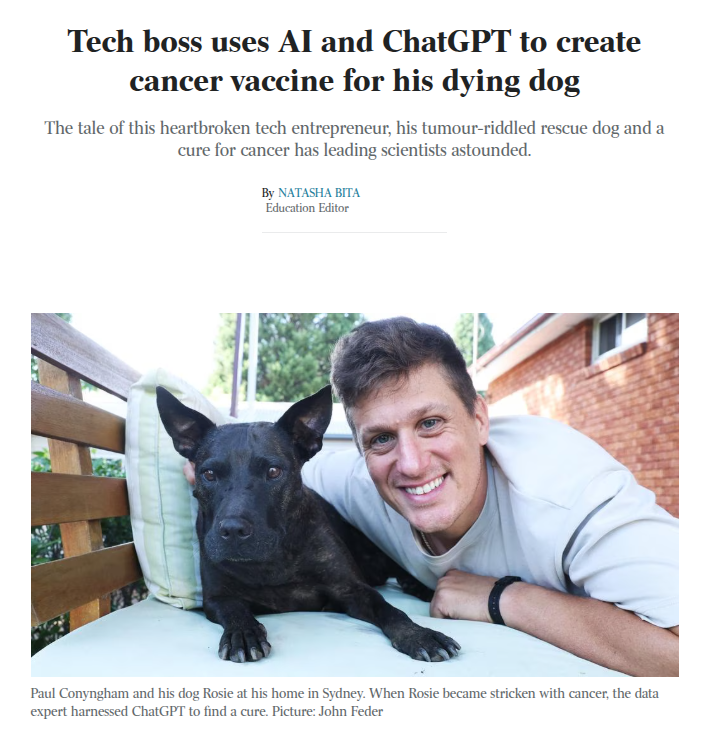
Truly wild story 🤯. A new era of "citizen science" is beginning.
An engineer with no medical training used ChatGPT and Google’s Alphafold (AI protein sequencer) to build a working cancer vaccine from scratch.
He turned raw genetic data into a custom mRNA vaccine that shrank his dying dog's tumor by 50%.
Paul Conyngham spent $3000 to get the DNA sequences of his dog's healthy blood and the cancerous tumor.
He was staring at gigabytes of raw genetic code without having any clue how to read biological data.
This is exactly where ChatGPT became the crucial missing link in his process.
He used ChatGPT as a high-level biological consultant to figure out how to compare the two DNA samples and spot the exact mutations causing the cancer.
ChatGPT gave him the step-by-step instructions to run the data pipelines and pointed him toward an AI tool called AlphaFold to map the physical shape of the damaged proteins.
The chatbot basically translated complex oncology concepts so he could write a half-page chemical recipe for an mRNA vaccine.
This mRNA is just a genetic instruction manual that tells the immune system how to recognize and attack those specific mutated cancer cells.
University researchers were blown away by his formula and manufactured the physical vaccine for him.
A veterinary expert then injected the dog, and within weeks the massive tumor had halved in size.
Cuando trabajás con un solo agente, todo pasa por el mismo context window.
Eso genera varios problemas:
1) el contexto se llena rápido (archivos, logs o diffs consumen muchos tokens)
2) las tareas se mezclan (analizar, implementar y revisar al mismo tiempo)
3) el razonamiento empeora (más ruido en el contexto)
Una forma de resolverlo es usar Subagentes.
El agente principal puede invocar a otro agente para resolver una tarea específica.
Cada subagente trabaja con su propio contexto, usa solo la información que necesita y devuelve un resultado o resumen.
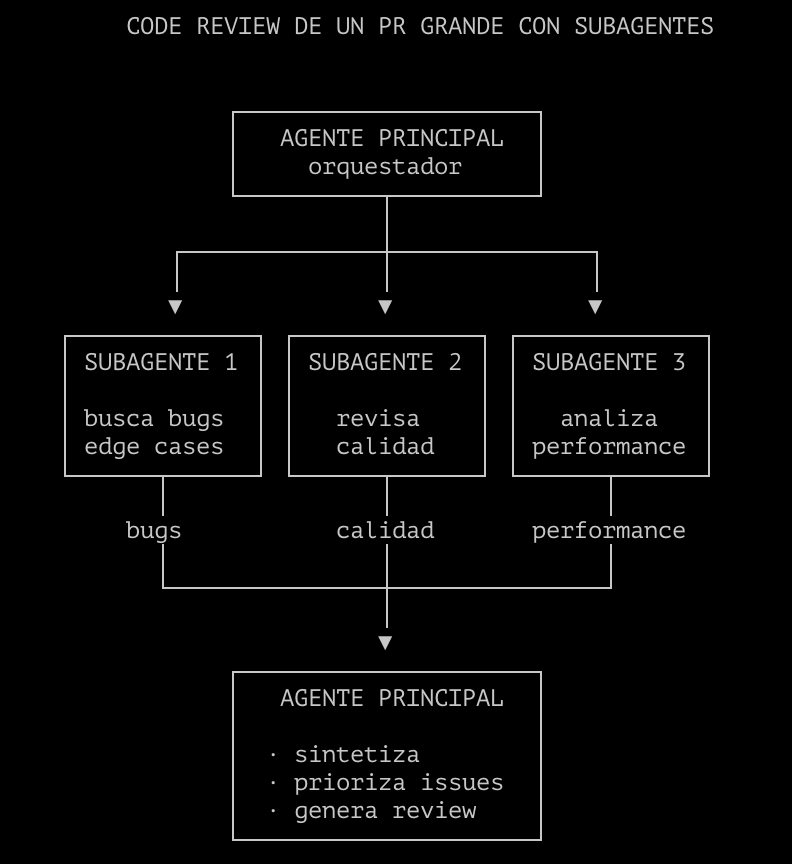
Así, el agente principal pasa a actuar como orquestador: divide la tarea, delega partes del trabajo y después junta los resultados para generar la respuesta final.
Ejemplo: code review de un PR grande.
Con un solo agente:
tiene que buscar bugs, revisar calidad y analizar performance dentro del mismo contexto.
Con subagentes:
Subagente 1 → busca bugs y edge cases
Subagente 2 → revisa calidad del código
Subagente 3 → analiza performance
Cada uno trabaja con su propio contexto y devuelve sus conclusiones. Después, el agente principal junta todo y arma el review final.
Tradeoff: más tokens y más complejidad.
Pero en tareas grandes suele funcionar mejor, porque cada agente se enfoca en una sola cosa y el contexto se mantiene limpio.
🦔 Meta contractors in Kenya told Swedish newspapers they're being asked to review intimate footage from Ray-Ban AI glasses, including people undressing, using the bathroom, watching porn, and filming sex. One contractor said users often don't realize they're still recording when they set the glasses down. Meta sold 7 million pairs in 2025, up from 2 million in 2023-2024 combined.
Users can't use the AI features without agreeing to share data with Meta's servers, and the terms of service bury the fact that humans may manually review your footage. One annotator said "if they knew about the extent of the data collection, no one would dare to use the glasses."
My Take
This is the Google Home story again but worse. At least with cameras in your house, you know where they are. These are glasses you wear on your face that keep recording when you take them off and set them on your nightstand. And the footage goes to contractors overseas who are paid to watch and label it for AI training. One worker described seeing a man leave the room, then his wife come in and change clothes. People forget the camera is still on.
Meta buries all of this in terms of service nobody reads. The product is marketed as a cool way to capture your life and interact with AI. The reality is strangers in Kenya watching you undress so they can annotate the footage to make Zuckerberg's AI better. Seven million people bought these last year. I'd bet almost none of them understood what they were actually agreeing to.
Hedgie🤗
I asked Claude Code to summarize my talk at the Sonar Summit.
Here are the 18 Claude Code tips I shared (and the complete talk below):
1. Always reference files directly using `@filename.py` or `@src/classes/` to constrain the agent.
2. CLAUDEmd → Before writing any code, describe your approach and wait for approval. Ask clarifying questions if requirements are ambiguous.
3. CLAUDEmd → If a task requires changes to more than 3 files, stop and break it into smaller tasks first.
4. Consider creating a `/decompose` command that takes a plan and outputs a list of small tasks to implement one at a time.
5. CLAUDEmd → Describe your tech stack, folder structure, coding conventions, and any anti-patterns you'd like to avoid.
6. Use `/memory` to save any personal preferences that should persist across projects.
7. Create a `.claudeignore` file containing any files the agent shouldn't read or modify.
8. CLAUDEmd → When there's a bug, start by writing a test that reproduces it, then fix it until the test passes.
9. CLAUDEmd → After writing code, list what could break and suggest tests to cover it.
10. Create a `/review-xyz` command that checks for correctness, edge cases, and consistency with codebase patterns.
11. Create a `/test` command that invokes a test sub-agent that runs your test suite.
12. CLAUDEmd → When I say something is wrong, ask clarifying questions before rewriting.
13. Use the `/rewind` command to rollback changes, then give more specific feedback and try again.
14. Use Git worktrees to run parallel agent sessions on different tasks.
15. Use `claude --dangerously-skip-permissions` on a disposable environment to iterate faster while still being able to recover when things go wrong.
16. CLAUDEmd → Every time I correct you, add a new rule to the CLAUDE .md file so it never happens again.
17. Convert any successful, repeatable prompt into a workflow by saving it as a slash command or a skill.
18. Create sub-agents for any repetitive tasks that require a large context or specialized analysis. Reuse these agents without polluting your main context.