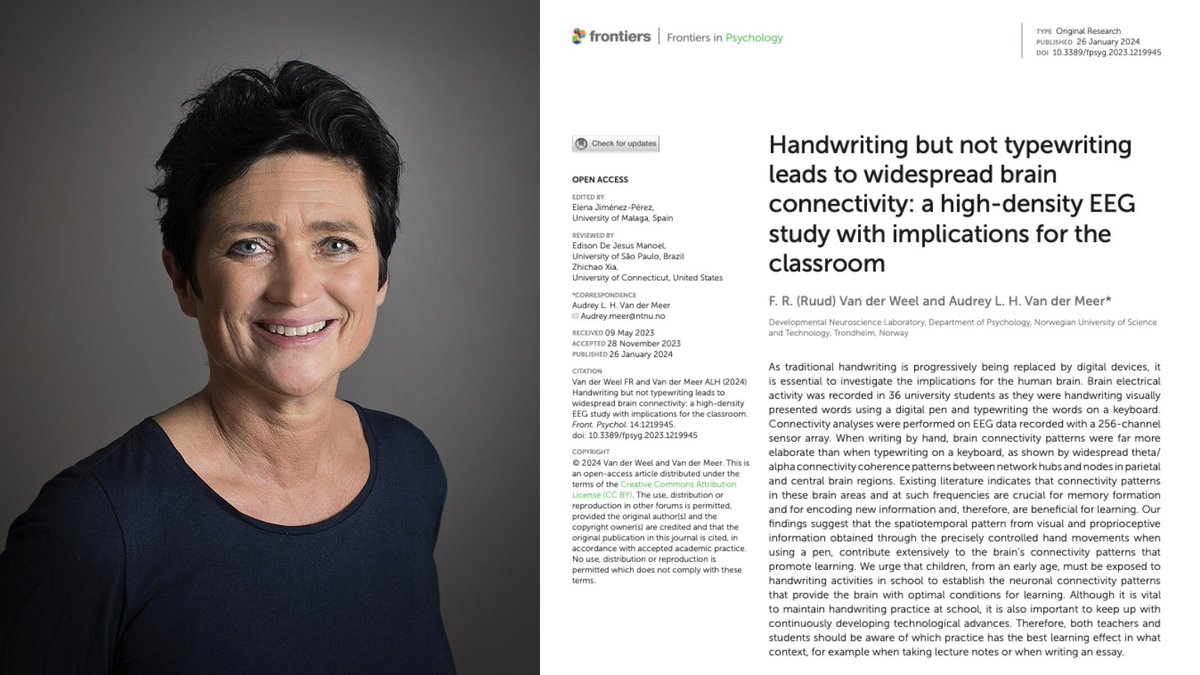
A Norwegian neuroscientist spent 20 years proving that the act of writing by hand changes the human brain in ways typing physically cannot, and almost nobody outside her field has read the paper.
Her name is Audrey van der Meer.
She runs a brain research lab in Trondheim, and the paper that closed the argument was published in 2024 in a journal called Frontiers in Psychology. The finding is brutal enough that it should have changed every classroom on Earth.
The experiment was simple. She recruited 36 university students and put each one in a cap with 256 sensors pressed against their scalp to record brain activity. Words flashed on a screen one at a time.
Sometimes the students wrote the word by hand on a touchscreen using a digital pen, and sometimes they typed the same word on a keyboard. Every neural response was recorded for the full five seconds the word stayed on screen.
Then her team looked at the part of the data most researchers had ignored for years, which is how different parts of the brain were communicating with each other during the task.
When the students wrote by hand, the brain lit up everywhere at once.
The regions responsible for memory, sensory integration, and the encoding of new information were all firing together in a coordinated pattern that spread across the entire cortex. The whole network was awake and connected.
When the same students typed the same word, that pattern collapsed almost completely.
Most of the brain went quiet, and the connections between regions that had been alive seconds earlier were nowhere to be found on the EEG.
Same word, same brain, same person, and two completely different neurological events.
The reason turned out to be something nobody had really paid attention to before her work. Writing by hand is not one motion but a sequence of thousands of tiny micro-movements coordinated with your eyes in real time, where each letter is a different shape that requires the brain to solve a slightly different spatial problem.
Your fingers, wrist, vision, and the parts of your brain that track position in space are all working together to produce one letter, then the next, then the next.
Typing throws all of that away. Every key on a keyboard requires the exact same finger motion regardless of which letter you are pressing, which means the brain has almost nothing to integrate and almost no problem to solve.
Van der Meer said it plainly in her interviews.
Pressing the same key with the same finger over and over does not stimulate the brain in any meaningful way, and she pointed out something that should scare every parent who handed their kid an iPad.
Children who learn to read and write on tablets often cannot tell letters like b and d apart, because they have never physically felt with their bodies what it takes to actually produce those letters on a page.
A decade before her, two researchers at Princeton ran the same fight using a completely different method and ended up at the same answer. Pam Mueller and Daniel Oppenheimer tested 327 students across three experiments, where half took notes on laptops with the internet disabled and half took notes by hand, before testing everyone on what they actually understood from the lectures they had watched.
The handwriting group won by a wide margin on every question that required real understanding rather than surface recall.
The reason was hiding in the transcripts of what the two groups had actually written down.
The laptop students typed almost word for word, capturing more total content but processing almost none of it as they went, while the handwriting students physically could not write fast enough to transcribe a lecture in real time, which forced them to listen carefully, decide what actually mattered, and put it in their own words on the page.
That single act of choosing what to keep was the learning itself, and the keyboard had quietly skipped the choosing and skipped the learning along with it.
Two studies. Two countries. Same answer.
Handwriting makes the brain work. Typing lets it coast.
Every note you have ever typed instead of written went into your brain through a thinner pipe. Every meeting, every book highlight, every idea you captured on your phone instead of on paper was processed at half depth.
You did not forget those things because your memory is bad. You forgot them because typing never woke the part of the brain that would have made them stick.
The fix is the thing your grandmother already knew.
Pick up a pen. Write the thing down. The slower road is the faster one.
BREAKING: LANDMARK PEER-REVIEWED STUDY FINDS VACCINATION IS A MAJOR RISK FACTOR FOR AUTISM
We found 79% of studies evaluating vaccines or their components (107 of 136) reported evidence consistent with a vaccine–autism link.
After DECADES of censorship and denial, our 50-page analysis of more than 300 studies provides one of the most comprehensive syntheses to date on the possible causes of autism.
The paper is now officially PEER-REVIEWED and PUBLISHED in the Journal of Independent Medicine.
Autism’s rise is multifactorial—but routine childhood vaccination emerged as a MAJOR modifiable risk factor within the broader causal framework.
We found potential determinants of new-onset autism before age 9 to include:
👵 Older parents (>35 years mother, >40 years father)
👶 Premature delivery (<37 weeks)
🧬 Common genetic variants
🧩 Siblings with autism
🔥 Maternal immune activation
💊 In utero drug exposure
☣️ Environmental toxicants
🦠 Gut–brain axis alterations
💉 Combination routine childhood vaccination
Of 136 studies evaluating vaccines or their components:
➡️ 107 (79%) found evidence consistent with a vaccine–autism link
➡️ 29 reported “no association,” yet lacked unvaccinated controls and were riddled with major flaws
➡️ 12 studies comparing fully vaccinated vs. completely unvaccinated children found every time that the unvaccinated had superior overall health outcomes and substantially lower autism risk
Biologic mechanisms converged on shared pathways—including immune dysregulation, mitochondrial dysfunction, and neuroinflammation—triggered by clustered and early-timed vaccination during critical windows of brain development.
By evaluating all known risk factors side by side, this analysis uniquely clarifies the relative contribution of vaccination compared to genetic and environmental domains. No prior review has attempted this integrative scope without excluding positive vaccine-association studies or unvaccinated controls—an essential step in determining whether vaccines truly play a role in autism risk, and if so, how significant that role may be within the broader causal landscape.
This publication represents a major breakthrough through the longstanding censorship imposed by the Bio-Pharmaceutical Complex on the issue of vaccination and autism. It also marks Dr. Andrew Wakefield’s first major return to the peer-reviewed scientific literature in years—after enduring decades of attacks from the vaccine cartel.
CONCLUSION:
The totality of evidence supports a multifactorial model of ASD in which genetic predisposition, neuroimmune biology, environmental toxicants, perinatal stressors, and iatrogenic exposures converge to produce the phenotype of a post-encephalitic state.
Combination and early-timed routine childhood vaccination represents a significant modifiable risk factor for ASD within a broader multifactorial framework, supported by convergent mechanistic, clinical, and epidemiologic findings, and characterized by intensified use, the clustering of multiple doses during critical neurodevelopmental windows, and the lack of research on the cumulative safety of the full pediatric schedule.
@McCulloughFund@P_McCulloughMD@DrAndyWakefield@Honest_Medicine@CPriceRogers@KirstinCosgrove@NathanMeadPhD@BreCraven_PA@MilaLRad
Everyone's fighting about Achilles again.
Whatever side you're on, most of the takes are flattening him into a meme. Let me remind you who he actually was.
Achilles was raised by Chiron, the wisest of the centaurs, who taught him medicine, music, and philosophy alongside war. He could heal wounds and play the lyre. He was never just a killer.
His mother, the sea goddess Thetis, knew the prophecy. He could live a long, peaceful life at home in obscurity, or die young at Troy and be remembered forever.
He chose Troy. Knowing.
When his best friend Patroclus was killed wearing his armor, Achilles' grief broke him. He tore his face. He poured ashes on his head. He refused to eat. Homer gives him the most devastating mourning scene in Western literature, and then Thetis appears and confirms it: if you go back to kill Hector, you will die soon after.
He went back anyway.
But here's the scene people forget, the one classicists call the moral heart of the Iliad.
After killing Hector and dragging his body around the walls of Troy, Achilles is visited at midnight, alone in his tent, by Hector's elderly father, King Priam. Priam, the father of the man Achilles killed, kneels and kisses "the terrible, man-slaying hands that had killed so many of his sons."
And Achilles weeps. They weep together. He lifts the old king up, feeds him, gives him a bed for the night, and returns Hector's body for burial with full honors. He even pauses the war so the Trojans can mourn.
That's how the Iliad ends. Not a duel. Not a sack. An act of mercy between two grieving men.
This is why, six centuries later, Alexander the Great sailed to Troy, anointed himself with oil, ran a footrace around Achilles' tomb, and slept every night with a dagger and a copy of the Iliad under his pillow.
This is why the Greek word for hero, hērōs, was practically synonymous with his name.
He chose to die for his friend. He wept with his enemy's father. He's been a hero for 2,700 years for a reason.
Heads need to roll…
🚨 CONFIRMED: Robert Malone to Chanel Rion — YES, the U.S. Government dropped Radioactive Ticks on American’s
• Three really viralant tick-born diseases mysteriously showed in Lyme Connecticut in the late 60’s, right across from Plum Island — a US Government’s anti-animal/crop headquarters for the for the Biological Weapons Program
—— Lyme arthritis
—— Rickettsia
—— Babesia
Clip
https://t.co/haTJ02T9IL
Here is @RWMaloneMD analysis.
https://t.co/zZbnLlDEGw
Reporting by @ChanelRion
Dear conspiracy theorists.. sadly, you were right again…
🚨 Dr. Robert Malone: Declassified Docs Expose U.S. Military Releasing 282,800 Radioactive Ticks, Sparking Lyme Disease Epidemic and 40-Year Cover-Up
- The U.S. military released 282,800 radioactive lone star ticks (labeled with Carbon-14) across Virginia sites along bird migration routes from 1966–1969; before the experiments, these ticks were not found north of the Mason-Dixon Line, but they soon established populations on Long Island for the first time.
- CIA operatives under Operation Mongoose (1962) dropped infected ticks on Cuban sugarcane workers via nighttime C-123 flights; one operative’s infant son suffered a life-threatening 105°F fever requiring emergency tracheotomy after family contamination.
- Plum Island Animal Disease Center (under Army Chemical Corps) conducted open-air tick experiments with containment failures: test animals mingled with wild deer and birds, and deer from nearby Lyme, Connecticut, swam to the island while birds fed on insects—Lyme, CT, is only 13 miles away and became the namesake epicenter in 1975.
- Willy Burgdorfer (who identified the Lyme bacterium in 1982) discovered a second pathogen called the “Swiss Agent” (Rickettsia helvetica) in patient samples but deliberately omitted it from his published research; materials found in his garage after his 2014 death proved 40+ years of suppression of co-infection data that could explain chronic Lyme treatment failures.
- Under Project 112 (1962–1974), the Pentagon ran 134 bioweapons tests (plus hundreds more classified), investing $3–4 billion and building capacity to produce 100 million infected mosquitoes and 50 million fleas per month; the program was “categorically denied” by the military for nearly 50 years until 2000.
- Operation Big Itch (1954) successfully dropped 670,000 tropical rat fleas from cluster bombs to prove the weapons could incapacitate an entire battalion-sized target area for up to a full day.
- Multiple tick-borne diseases (Lyme arthritis, babesiosis, Rocky Mountain spotted fever) erupted simultaneously around Long Island Sound right after the tick releases (1968–1972), clustering statistically around Plum Island—an anomaly the article attributes to possible lab enhancement or accidental release (45% probability per the analysis).
- Burgdorfer, recruited in 1951 for tick weaponization and linked to Nazi scientists brought via Operation Paperclip, left a cryptic note before dying: “I wondered why somebody didn’t do something,” and in 2013 video testimony insinuated an accidental release while admitting he “didn’t tell you everything.”
These claims are based on a review of 41 primary declassified sources, testimony, and suppressed research presented in the article.
https://t.co/zZbnLlEcw4
🚨🚨🚨⚠️
دراسة فحصت كل السماعات واكتشفت ان بعضها تسبب خلل بالهرمونات وتؤثر على الخصوبة !!!!!! ⚠️
دراسة تمت بتمويل من الاتحاد الأوروبي LIFE اختبروا فيها 81 سماعة، لقوا ان البلاستيك والمواد المستخدمه فيها أعلى من النسب الصحية المفترضة وقد تتسبب في اضطراب الهرمونات، مشاكل الخصوبة، تأثير على الجنين والأطفال، أضرار عصبية.
السماعات بالصورة بالأسفل مقسمة كالتالي:
🟢5 يُنصح بها.
🟡4 تتجاوز الحدود المقترحة لكن لا بأس بها
🟠3 آمنة على الجلد لكن العلبة أو بعض المحتويات الداخلية ضارة
🟠2 الأجزاء الملامسة للجلد تحوي أجزاء ضارة
🔴1 كل أجزائها ضارة - تجنبها كلياً
بناء عليه بعض الشركات بدأت تستدعي سماعاتها في أوروبا مثل: HyperX Cloud III و Razer Kraken V3 وربما سماعات أخرى.
بحسب الدراسة فإن الخطر يعتبر مزمن، يعني لايوجد اعراض فورية راح تطلع على أحد.
⚠️نصيحتي: ابتعد ابتعد ابتعد عن السماعات الرخيصة مهما صار. فآثارها على الاذن او الجسم دائما ليست جيدة
مصدر الدراسة: Arnika لمن يريد الاستزادة.
🚨 🚨🚨
Florida just dropped a bombshell: 28 out of 46 popular candy brands tested had elevated arsenic levels like Tootsie Rolls, hitting 570 ppb.
That’s way above what’s considered safe for kids. Snickers and other big names made the list too.
This isn’t “trace amounts” we can ignore. This is chronic, low-dose poisoning that adds up over years—especially when kids are eating this stuff daily from a young age.
Here’s what long-term arsenic exposure actually does (backed by decades of research from CDC, WHO, and peer-reviewed studies):
• Neurodevelopmental damage in children: lower IQ, impaired memory, reduced attention, poorer executive function. These effects can last into adulthood and rob kids of potential.
• Skin lesions (hyperpigmentation, keratosis) that show up after 5–10 years and are precursors to skin cancer.
• Dramatically higher risk of lung, bladder, and skin cancers—latency can be 20+ years, so childhood exposure shows up in adulthood.
• Increased cardiovascular disease, hypertension, heart attacks, and type 2 diabetes.
• Chronic respiratory issues and peripheral neuropathy.
There is no established “safe” threshold for inorganic arsenic when it comes to cancer or neurodevelopment. Every extra microgram adds risk.
Kids are especially vulnerable: higher intake per body weight, developing brains and organs, hand-to-mouth behavior. The cumulative dose over 10–20 years matters far more than any single piece of candy.
We wouldn’t let our kids drink water with these arsenic levels—so why is it okay in the treats we hand them every day?
The candy industry calls this “alarmist.” I call it protecting our children’s future.
Cut the toxic candies. Switch to real fruit, dark chocolate (check brands carefully), homemade treats, or cleaner alternatives. Read labels. #MAHA.
What candy are you throwing out today? 👇
#ArsenicInCandy
Called to a young Man in V‑tach
Patient: “I don’t want to die.”
Paramedic (me): “Put the pads on him.”
Partner: “Okay.”
Paramedic (me): “Are you hurting anywhere?”
Patient (frantic): “My chest feels so f***ing weird.”
Paramedic (me): “You’re in a heart rhythm called V‑tach. Your blood pressure is low. I’m going to treat you with electricity, it’ll hurt, but it’ll be fast. Hopefully this will get your heart back into a normal rhythm and make you feel better almost immediately.”
Patient: “Okay.”
Monitor sync… joules set. Charge. Everyone clear. Shock/cardiovert.
The patient takes a hard breath, looks like he’s been hit by an invisible mule, then shouts, “OH MY GOD!”
Now back in a normal sinus rhythm.
Patient: “Oh my God, what happened?!”
Paramedic (me): “You were in a dangerous heart rhythm. Now you’re back in what we call a sinus rhythm. I know that hurt, but how do you feel now?”
Patient: “Much better. My chest is still sore, but better.”
Paramedic (me): “Do you have any heart history or known problems?”
Patient: “No.”
Paramedic (me): “Take any new medications? Drink alcohol? Smoke or use tobacco?”
Patient: “No, I work out a lot.”
Paramedic (me): “Did you take the COVID vaccines?”
Patient: “Yes. I wanted to travel to see my family, so I had to.”
___________
The fact is I have had to cardiovert more people post‑mRNA COVID shots than I have in my entire career, a very long time.
The only thing baffling these days is that this dangerous substance is still on the market. The FDA at this point has said it kills children. I have seen first hand how it does.
Praying for sanity and truth revival in a rapidly dying world.
Note: The “market” for ventricular tachycardia ablation is suddenly booming, projected growth through 2034, billions in profit ahead. That’s how the industry slyly tells you there’s an epidemic of hearts misfiring in people who shouldn’t be.
While advertising agencies call it “market expansion,” paramedics like me call it “a surge in cardiac arrests.”
God bless